1803
6 January 1803
ThursdaySouth Carolina
I wrote three large letters to the north,1 and put myself in order for travelling. From Saturday until Wednesday the time was spent in conference, and in public exercises; we had preaching every noon and evening; seven elders and four deacons were ordained. Of preachers, two were admitted, one had located, none were dead, and none were expelled. We had great peace and union in our labours, two days of which were directed to the explanation and recommendation of discipline, as it respects the order of the Church. We have added, in this conference, three thousand three hundred and seventy-one to our number.2
ASB_VOL2.PDF, p. 347
7 January 1803
FridaySouth CarolinaA cold day. We came to Mr. Evans’s,1 on Congaree, thirty miles.
ASB_VOL2.PDF, p. 347
Notes (1)
- Evans lived near Gadsden in Richland County. ↩
8 January 1803
SaturdaySouth CarolinaWe crossed Congaree at Howell’s ferry—almost abandoned. The flat was so small, that our horses, had they not been quiet, might have endangered us. It was well we chose this ferry, for we should have had a more roundabout road, and more swamp. We reached John Whetstones’s1 at the end of thirty-three miles, in good time, and were most kindly and comfortably entertained. At the meeting house on the Sabbath day Nicholas Snethen spoke on 1 Thessalonians 5:9, 10; my subject was 2 Corinthians 13:9. Isaac Smith exhorted, George Dougherty prayed, and so we concluded. The cold weather prevented many, yet the house was full, and on the sunny side, without, there were numbers.
ASB_VOL2.PDF, p. 347
Notes (1)
- Whetstone lived near St. Matthews. ↩
10 January 1803
MondaySouth CarolinaWe rode twelve miles to Dantzler’s.1 I have been greatly supported under long rides (by my computation making six thousand miles), and cold, and wet, and sufferings, and privations. My soul is devoted to God. As there are many who preach upon the first principles of the oracles of the Gospel of Christ, I feel it my duty to speak chiefly upon perfection—and above all, to strive to attain unto that which I preach. On Tuesday I spoke at the white meeting house on 2 Corinthians 7:1. We lodged at Mr. Winningham’s. Next day Nicholas Snethen preached at Cattle Creek.2 We lodged at Mr. Simpson’s. On Thursday, at the Indian Fields, I spoke on 1 John 4:16, 17. We lodged at Moore’s: glory to God for a natural and spiritual birth in this family since my last visit! On Friday, at the Cypress I only exhorted. Sister Hare is dying of a cancer; but she appears to rejoice exceedingly in God, day and night.3 On Saturday we rode into Charleston. On the Sabbath day I preached on Romans 5:20. I was blest in the administration of the word and ordinances. I live in the victory of the grace of God in purity of mind and uprightness of intention. Tuesday and Wednesday, 18, 19, were days made glorious by the visits of the poor Africans who came to visit me: we frequently prayed together.
ASB_VOL2.PDF, p. 348
20 January 1803
ThursdaySouth CarolinaWe came to Haddrell’s Point; dined at Mr. Pritchard’s, rode up to Wappataw, and lodged at Mr. Jones’s, where we were well entertained. Next day, it being very stormy and cold, we were compelled to stop at Santee lower ferry.1
ASB_VOL2.PDF, p. 348
Notes (1)
- Asbury left Charleston by a familiar route, crossing to Haddrell’s Point (Mount Pleasant). He followed the coast road or the old Kingshighway along present Highway 17 and crossed the Santee at the lower or Myzack’s Ferry. Jones lived on that road between Wappetaw and Awendaw. ↩
22 January 1803
SaturdaySouth CarolinaWe came to Georgetown—still cold. At the ferry we could scarcely get firewood to keep us warm: we had bad bedding; and I suffered in my body, but my mind was at peace.
ASB_VOL2.PDF, p. 348
23 January 1803
SundaySouth CarolinaI preached at Georgetown from 1 Timothy 4:10. Nicholas Snethen preached in the afternoon, and James Mellard in the evening. I visited Miss Dick—Ah! how changed every way!—had I not expected to see her, I might not have known her: I administered the sacrament in her room.
ASB_VOL2.PDF, p. 348
24 January 1803
MondaySouth CarolinaAt Black River chapel I spoke on Matthew 6:31-33. We crossed the river at Evans’s ferry,1 and lodged at the widow M’Cantry’s. Next day I preached at Jenkins’s chapel,2 and after meeting rode up to Port’s ferry. We lodged at Thomas Humphries’s.3
ASB_VOL2.PDF, p. 348
Notes (3)
- Evans Ferry crossed Black River near Black Mingo. ↩
- Jenkins’ chapel was located near Johnsonville. ↩
- The Rev. Thomas Humphries had formerly preached on circuits in Virginia, North Carolina, Georgia, and South Carolina. After fifteen years of itinerant service he located and settled on Jeffers Creek near Port’s Ferry on the Pee Dee River in Darlington County, where he continued his work as a local preacher, until his death in 1820. “He lived palatially, was rich as a rice planter, quite popular among the aristocratic, with no discount on his ministry therefor.” (Betts, op. cit., 72.) ↩
26 January 1803
WednesdaySouth CarolinaI preached at the Bare Ponds1 upon Hebrews 8:10,
11. We dined at Mr. Shackleford’s, and thence went on to Gaspero Sweet’s.
ASB_VOL2.PDF, p. 348
Notes (1)
- The Bare Ponds meeting house, formerly called Sweets, was fifteen miles south of Marion. ↩
27 January 1803
ThursdayNorth CarolinaNicholas Snethen preached at Rowell’s meeting house:1 I added a few words on St. Paul’s triumphant words in 2 Timothy 4:7. We lodged at the widow Davis’s, a daughter of Mr. Dunham, at whose house I had lodged some years back. I have lived to serve three generations in South Carolina.
ASB_VOL2.PDF, p. 349
Notes (1)
- Rowell’s meeting house was near Centenary. ↩
28 January 1803
FridayNorth CarolinaAt Wood’s meeting house1 Nicholas Snethen preached: I only glossed a little upon 2 Corinthians 4:3. We lodged at old Mr. Wood’s, Marion district.
ASB_VOL2.PDF, p. 349
Notes (1)
- Woods’ meeting house was near Sellers. ↩
29 January 1803
SaturdayNorth CarolinaWe rode to George Shank’s, Marlborough district, upon Great Pee Dee. I have ridden two hundred and sixty miles towards the seventh thousand. My mind hath been very calm: but we have had it so severely cold and the meeting houses are so open between this and Charleston, that I fear the congregations have profited little by the word.
ASB_VOL2.PDF, p. 349
30 January 1803
SundayNorth CarolinaAt Harris’s chapel,1 at the head of Catfish, I preached upon Ephesians 2:8. We lodged with Captain Nevell: he and his wife appear to be seeking the Lord.
ASB_VOL2.PDF, p. 349
Notes (1)
- Harris’ chapel was near Brownsville in Marlboro County. After preaching at Gibson’s chapel, Asbury proceeded into Robeson County, North Carolina. ↩
31 January 1803
MondayNorth CarolinaWe rode a muddy path to Gibson’s chapel—pole chapel— open as a sieve, and the weather very cold. Nicholas Snethen preached upon Philippians 4:8. I only added a few pointed, scattering shot in exhortation.
NORTH CAROLINA
I came off with a very slim breakfast, and then after meeting had to ride on to (north) Britain Drake’s, Robeson county, North Carolina. Here is a settlement of Scotch, originally: it began in the year 1771; since which time the descendants of these emigrants are chiefly in Cumberland, Richmond, and some in Anson, Robeson, and Bladen counties; and some are over the line south: there is a work of God amongst them, and some living young ministers have been raised up. Perhaps the rebellion of “forty-five” made those people averse to all opposition to the powers that be—and they were tories during the American revolution only because they remembered their former failures and sufferings and those of their fathers. The open dwellings, only calculated for warm weather, occasion the people of South Carolina to suffer more, in cold spells, than those of the east or north: let those who doubt this make the trial for one winter. I have felt great lowness of spirits, but a holy resignation in the midst of cold, hunger, thirst, labour, and temptations.
ASB_VOL2.PDF, p. 349
1 February 1803
TuesdayNorth CarolinaI preached upon the glorious subject of Christian perfection: my text I found in Hebrews 6:1. Next day (Wednesday), we had a rainy ride of fifteen miles to Lumberton, which I had not visited for some years. I was present at its foundation and nomination: there are now, I suppose, about twenty families, and a hundred buildings; an academy, which serves also as a church; a very good prison, and a court house, it being the county town of Robeson. Its property is much owing to the navigation of Drowning Creek, down which lumber and other articles are conveyed to Georgetown, and thence frequently the merchandise is sent to Charleston. Nicholas Snethen preached; I only exhorted: Presbyterian ministers, Brown and M’Nare, attended; I had a Christian interview with them, and I learned with pleasure that their labours had been owned and blessed among the Scotch Presbyterians. We lodged at Robert Haille’s. We have a small society in this town. Drowning Creek (so called from the drowning of some Indians) is the northeast branch of Pee Dee River; it rises in Cumberland county, North Carolina, is fed by Ten Miles and Great Swamp, passes through Robeson county, flowing about one hundred miles before it mingles with the waters of Pee Dee; at Ford’s bridge Little Pee Dee unites with Great Pee Dee, twelve miles below Britain’s ferry: the north-west branch of the first-mentioned river flows about the same distance as Drowning Creek, but its navigation is not so good.
ASB_VOL2.PDF, p. 350
3 February 1803
ThursdayNorth CarolinaI preached at Riggins’s chapel in a powerful gale of wind; my subject was Acts 11:23. Daniel Brown gave an energetic exhortation. I ordained William Glover to the office of deacon. After dining at Joseph Riggins’s, we went on to Frederick Miller’s at Mine Creek. I was very unwell to-day; I could not eat, yet I was compelled to labour under great mental dejection.
ASB_VOL2.PDF, p. 350
4 February 1803
FridayNorth CarolinaA change for colder weather. We had to ride ten miles to Gray’s Creek.
It was my day to preach on Saturday, and unwell as I was, I stood up and spoke on 1 Peter 3:15, to a large congregation of Methodists, Baptists, and people of the world: it was a very cold day. I visited John Newberry, an afflicted man; and his wife, a godly woman.
ASB_VOL2.PDF, p. 350
6 February 1803
SundayNorth CarolinaWe rode twelve miles to Fayetteville. It was not known whether we were to preach at our own meeting house or in the State house; so we ventured into the Presbyterian meeting house: it was only free for me, as I had been told by Mr. Flinn, the minister, who had received his authority from the magisterial eldership; but it was not my day, so James Jenkins and Nicholas Snethen went into the pulpit, and the latter spoke on 2 Corinthians 7:10. I came off without saying anything—well for me, for I had nearly lost my breath in walking to the house. We were kindly and comfortably entertained at Mr. John Lumsden’s. The rain came on, but we rode on seven miles, and were compelled to ferry ourselves over Cape Fear River, after being detained nearly half an hour in the rain.
ASB_VOL2.PDF, p. 350
7 February 1803
MondayNorth CarolinaWe had about twenty-two miles to make to reach Purdy’s chapel. I preached upon Titus 2:11, 14. We lodged at Samuel Richardson’s. I have had a day and night of temptations.
ASB_VOL2.PDF, p. 351
8 February 1803
TuesdayNorth CarolinaWe came down the north side of the river to Elizabethtown: Nicholas Snethen preached in the court house; I was silent. After meeting we rode on fifteen miles to the widow Clarrida’s. Leaving the Brown, next day we came to the White Marsh: I preached at Clark’s on 1 Peter 5:10; and afterward rode to the Lake of Wacamaw, and lodged at William Wilkinson’s.
I sometimes smile at the simplicity of our friends—they would love us to death, in company and in labours too: they cannot do too much, it would seem, to express their kindness; and in return, we are to be such immortal men as never to be weary, and never to complain. I feel for this circuit, having ridden through it: they have need of three preachers at least. At the Lake chapel Nicholas Snethen preached: we concluded with prayer. On Friday we had a long ride to Livingston Creek, crossing several swamps whose waters supply the Lake. My subject at Union chapel was 1 Peter 5:8: the day was cold; but we had a full house, and a feeling season. We lodged at Mr. Browning’s. Next day we rode twelve miles to the ferry, crossing in a storm, and landing where we could on the deep bank, out of which my mare struggled with difficulty: at the town (Wilmington), another ferry, and another storm in crossing made our journey for the day unpleasant enough: we arrived, however, at our own house in proper time. We found the church ceiled, and the dwelling improved. I met the people of colour, leaders and stewards; we have eight hundred and seventy-eight Africans, and a few whites in fellowship. Nicholas Snethen preached on Saturday night; I spoke on Sunday morning upon 1 Peter 5:7; Nicholas Snethen held forth at eleven o’clock; I preached again at half-past three o’clock on 2 Corinthians 13:9; and Nicholas Snethen gave another discourse at night: thus ended the public labours of this day. The Africans hire their time of their masters, labour and grow wealthy; they have built houses on the church lots. I hope to be able to establish a school for their children.
ASB_VOL2.PDF, p. 351
14 February 1803
MondayNorth CarolinaWas so cold we could hardly stand it. At Walter Nicol’s I preached a little upon Luke 8:21. We then rode on to the widow Campbell’s, where we held an evening meeting. Next day we must needs ride home with the widow Spicer, living upon the Stump Sound; through hail and wind we went, and little Jane had a shoe on which clogged and made some difficulty. We have been highly favoured hitherto in attending our appointments and having congregations.
ASB_VOL2.PDF, p. 352
16 February 1803
WednesdayNorth CarolinaHard necessity compelled us to rest with the widow and the fatherless: we had a mere storm of wind, and hail, and snow.
ASB_VOL2.PDF, p. 352
17 February 1803
ThursdayNorth CarolinaWe took a south-west course, through ice, and snow, and frost, and the wind in our faces; and arrived at Lot Ballard’s half-past three o’clock; our appointment at the chapel was for twelve o’clock. I conclude I shall have no more appointments between Wilmington and Newbern; there is a description of people we must not preach to; the people of Onslow seem to resemble the ancient Jews—they please not God, and are contrary to all men.
ASB_VOL2.PDF, p. 352
18 February 1803
FridayNorth CarolinaFinding it was but forty-two miles to Newbern, we concluded to push for it. I rose early, ordained J. Wilden to the office of deacon, and started. I had had thoughts of calling at a certain house, but being fearful we had not the time to spare, we stopped and fed on the ground: soon after we met the master of the house, and dropped a hint of our intention of being his guests had time permitted; he did not say “Will you,” or “Do call at my house”—farewell! farewell! O unhappy people of Jones, and Trent, and Onslow!1 With a little cake and cheese, and some corn for our horses, we came in fine spirits to Newbern, about six o’clock. On Saturday I rested; and Nicholas Snethen preached upon, “He that hath ears to hear, let him hear.”
ASB_VOL2.PDF, p. 353
Notes (1)
- These were the counties through which Asbury had traveled. ↩
20 February 1803
SundayNorth CarolinaI preached at seven o’clock upon 2 Peter 3:14; Nicholas Snethen spoke at eleven o’clock; I held forth at three o’clock on 2 Corinthians 6:2; we were exceedingly crowded. I am grieved for this society; there are more heads than agree well together; want of harmony and want of discipline are too evident: I felt as if I wanted to see them no more until affairs wore a more pleasing aspect.
We set out on Monday under some apprehensions that the late rains had swelled the rivers; but we found no difficulties, either at Neuse or Tar rivers. Nicholas Snethen preached at Washington, Beaufort county, on 1 Thessalonians 5:19, 20; the chapel was crowded. On Tuesday, at eleven o’clock, I spoke on Luke 8:11-15. The want of sleep and other things made me unwell and unpleasant in my feelings. Nicholas Snethen spoke at four o’clock in the evening on Luke 13:5.
ASB_VOL2.PDF, p. 353
23 February 1803
WednesdayNorth CarolinaWe rode twenty-two miles, to Williamston, Martin county; I had not been at this place since January, 1792: I find here now about twenty families, and about forty buildings. My subject at the court house was Titus; although greatly outdone by fatigue and heat, I had some openings of mind. I was somewhat surprised to see so many called together by twenty-four hours’ notice; and I admired the patience of the people, many of whom were obliged to stand in the lobby of the court house—a house and a half. We want a house of our own. John Watts, a local preacher, still keeps his ground as a minister and a Christian, although the Baptists are very numerous here. On Wednesday we rode through a very warm, weather-breeding day, twenty-two miles, to Tarboro, and came in about half-past two o’clock. Many came to the new church, and were attentive to hear, whilst Nicholas Snethen preached upon 2 Corinthians 5:18-20. I had strength to sit still to-day. We dined at Mr. Ryley’s, and were kindly invited to lodge at the widow Tool’s, the first which was opened to me in Tarboro. There are in this place about thirty-three families: the people have more trade than religion, more wealth than grace. We have about thirty Africans in fellowship; but no whites. I may notice the bridge; it is 540 feet long, and about thirty feet above the water.
ASB_VOL2.PDF, p. 353
25 February 1803
FridayNorth CarolinaIt rained and hailed; and through the night snowed heavily, and continued to fall on us after we set out until we came to Prospect Hill: we fed, and went on to Henry Bradford’s, twenty-five miles. The snow in places was from eight to twelve inches deep; and as my horse was newly shod, he clogged, and kept me in continual fear. On Saturday I preached at our host’s from 2 Peter 1, 4.
ASB_VOL2.PDF, p. 354
27 February 1803
SundayNorth CarolinaWe came to Halifax. The rich had the Gospel preached to them by Nicholas Snethen, from 2 Corinthians 16-77; I had to speak a little, and then baptized the children. The respectable sisterhood were very attentive; in short, a more decent, well-bred congregation, need not be. We dined at D. Fisher’s, who treated us in a most serious and friendly manner. By guess, I should say there were forty families in Halifax. We were impressed, as if by magic, that the river would rise rapidly; so we crossed at four o’clock, and rode twenty miles, to Seth Peeble’s, whom we called from his downy bed to take in poor benighted travellers.
ASB_VOL2.PDF, p. 354
5 March 1803
SaturdayNorth CarolinaEnded our most amicable conference,1 which began on Tuesday. We had preaching each day by Alexander McCaine, Hope Hull, Jesse Lee, Nicholas Snethen, and myself on the last day. We ordained the travelling and local deacons upon Friday, and the elders upon Saturday.
ASB_VOL2.PDF, p. 354
Notes (1)
- The Minutes of 1802 show that this session of the Virginia Conference was to be held at Dromgoole’s on March 1, 1803. The Journal of the conference simply states that it was held at Olive Branch Meeting House. This was the old Wolsey’s Barn, later called Dromgoole’s, and is presently located at Gasburg in Brunswick County, Virginia. However, the church was moved several miles from its original location to Gasburg. (Bennett, op. cit., 407.) However, if the conference was held in Virginia, Asbury crossed the state line for the sessions and immediately re-entered North Carolina. The night of February 27 was spent with Seth Peebles in Northampton County, North Carolina, and the day after the conference closed, Asbury was entertained by Sterling Boyakin, who also lived in Northampton County. (Heads of Families, 72, 73.) ↩
6 March 1803
SundayNorth CarolinaNicholas Snethen preached upon 2 Corinthians 4:17, 18; and I followed with an exhortation; and Brother Whatcoat after me. Our stand was in the woods; our congregation consisted of about two thousand souls. I was exceedingly pleased with our conference love feast—with its order, solemnity, and life; the testimonies borne appeared to be all given under the immediate impulse of the Spirit of God, both in ministers and members.
Bishop Whatcoat being ill, the burden of the conference labours fell upon me.
ASB_VOL2.PDF, p. 354
7 March 1803
MondayVirginiaAt Concord meeting house I spoke on 2 Corinthians 7:1. We lodged at Sterling Boykin’s. I find the way of holiness very narrow to walk in or to preach; and although I do not consider sanctification— Christian perfection, commonplace subjects, yet I make them the burden, and labour to make them the savour of every sermon. I feel, I fear for my dear lowland brethren—so much of this world’s wealth; so much fulness of bread, and idleness, and strong drink. Lord, help!
ASB_VOL2.PDF, p. 355
8 March 1803
TuesdayVirginiaWe rode in the evening to Edward Saurey’s. The excessive rains in the morning prevented our attending our appointments, to the sad disappointment of our friends in Murfreesborough—brethren we have not, for we have no society there. Next day we had a race of a ride to Winton, twenty-five miles: Brother Snethen preached in the court house at twelve o’clock. We dined at Mr. Bell’s, and were generously entertained. Gates court house, twenty miles farther, brought us up for the night.
ASB_VOL2.PDF, p. 355
10 March 1803
ThursdayVirginiaAt the court house Nicholas Snethen insisted upon the one thing needful. I ordained B. Harrell1 to the deacon’s office: he is a man of good repute, without slaves.
VIRGINIA
As we had two appointments for Friday, I preached at Deacon Haslet’s, to many people, on 1 Peter 5:10. We had a consoling, gracious season. Brother Snethen preached at Suffolk.2 I was surprised to hear that some who had separated from us should have reported that the new meeting house would belong to the bishops, and that they might sell them: these reports were offered by some, not of the connexion, as reasons which prevented their subscribing; and our brethren have therefore determined to build without the aid of others: what our enemies accuse us of intending to do they have already done in some cases, and attempted in others—Isle of Wight, Mooring’s chapel, Wells’s chapel, and Major Ben, in building this house within a small distance of the Methodist house, furnish sufficient proofs of their principles and their spirit.
ASB_VOL2.PDF, p. 355
Notes (2)
- The Harrell family was prominent in Gates County, North Carolina. Harrell’s Methodist Church was located a few miles north of Gatesville. (Harrell.) ↩
- The O’Kellyites were strong in this section. They became the Christian Church after dropping the name Republican Methodists, and this section of Virginia and the adjoining section of North Carolina became their stronghold. Elon College in North Carolina was the college of this denomination, and the church in Suffolk is to this day a very strong church. The Christians later joined the Congregationalists to form the Congregational Christian Church, now United Church of Christ. ↩
12 March 1803
SaturdayVirginiaI preached at M’Kee’s upon Ephesians 5:25, 26. We rode to Portsmouth, and I crossed over to Norfolk, where I had an interview with the official members, and ordained George Lee Green to the office of deacon.
ASB_VOL2.PDF, p. 355
13 March 1803
SundayVirginiaI preached in the new house (the best in Virginia belonging to our society): the pulpit is high with a witness—like that awkward thing in Baltimore, calculated for the gallery, and too high for that. My subject was Titus 2:13, 14. At Portsmouth, in the afternoon, I spoke on 2 Corinthians 6:2. Nicholas Snethen preached at Denby’s. We had a good passage over the river at Sleepy Hole ferry,1 and came to Benjamin Powell’s; the parents had gone to rest, but some of the children were yet up, and took us in. I felt solemn whilst I looked upon this young race, who make the third generation whom I have served. I ordained their father to the office of deacon, and have preached to their grandfathers, Pinner and Powell, who, with the Collinses, were the three first families that opened their houses to the Methodist preachers in this part of the state.
ASB_VOL2.PDF, p. 356
Notes (1)
- This was on the Nansemond River, three miles east of Driver. Benedict Arnold crossed there on his return from the Richmond raid in January, 1781. ↩
15 March 1803
TuesdayVirginiaAt Powell’s chapel I preached on Romans 12:2. In the afternoon Nicholas Snethen held forth at Murphy’s chapel on 1 Corinthians 12:27: I concluded the meeting by exhortation. There is a revival of religion in this settlement. Next day, Nicholas Snethen spoke on 1 Corinthians 3:11-15. I feel myself failing and unwell.
ASB_VOL2.PDF, p. 356
17 March 1803
ThursdayVirginiaWe rode twenty-five miles to Ellis’s chapel. There has been a great mortality in this neighbourhood within the last twenty-six years: only a few of my first female friends are now living. We lodged with the widow of Stephen Andrews.
ASB_VOL2.PDF, p. 356
18 March 1803
FridayVirginiaWe rode to Petersburg, encountering a long, intricate, muddy path; and no food had we, for man or beast, until we came to our friend Joseph Harding’s: by erring in our route we made our day’s ride thirty-five miles. If my information be correct, the conference congregation meeting continued in the woods until nine or ten o’clock on Sunday evening; it held each day from Saturday until the Monday; and it is believed as many as thirty-five souls professed to find mercy and faith in Christ. By letter from John Pitts, in Fredericksburg, I learn that since he was stationed there, in October last, thirty-five joined the society, which now consists of seventy-three members—Glory, glory be to God!
On Saturday Nicholas Snethen preached in Petersburg on 1 John 2:15-17. On the Sabbath my subject was 2 Corinthians 13:2. We feel the effects of intense labour in the lowlands; our habits were very feverish, and I suffer from a deep cold and oppression on my breast. We contemplate placing a proper stationed preacher in Petersburg; and the building a new brick church sixty or seventy by forty feet, and two stories high: but this, like many other of our great and good designs, may fall through. Nicholas Snethen preached at four o’clock on 2 Peter 3:8-10.
ASB_VOL2.PDF, p. 356
21 March 1803
MondayVirginiaWe travelled, very unwell, to Mr. Walthall’s, near Chesterfield court house: we rested in part, and then divided our ride to Richmond into a journey of two days: we arrived on Tuesday, and I preached at twelve o’clock to many serious people on Titus 2:10-13. Nicholas Snethen preached at seven o’clock. Next day we came along to Caroline, thirty-five miles. In the morning it rained, and the day was wintry and dreary: we saw the wagons sinking and set fast, for in many places the route was dreadful: we worried through, feeding our horses once, and ourselves not at all. Next day I preached once more at Dickenson’s chapel; my subject was Hebrews 3:12-14.
I feel my infirmities, and the labour of my journeys; but my soul is cast upon the Lord in unceasing prayer that God may guide the Church, and give the spirit of wisdom, and love and zeal to our conferences: we only, as we think, want more useful labourers in the vineyard, and thousands will be brought home to God in the cities, circuits, and towns this year. I lodged at the widow Collins’s.
ASB_VOL2.PDF, p. 357
25 March 1803
FridayVirginiaWe rode to Fredericksburg and dined, and then pushed on to Stafford court house, making forty miles this day. Next day we gained Alexandria, eating nothing between seven o’clock in the morning and seven at night.
ASB_VOL2.PDF, p. 357
27 March 1803
SundayVirginiaI preached upon John 1:6, 7. John Chalmers spoke in the afternoon, and Nicholas Snethen at night; sermon, love feast, and sacrament held us five hours. God is gracious; the people are lively, and several were admitted into fellowship. On Monday, it blew clear and strong, and cold enough: I hardly stemmed the blast, chilly and trembling as I was.
MARYLAND
I preached at Georgetown on Hebrews 4:15, 16; it was a quickening time. Brothers Chalmers and Snethen exhorted.
ASB_VOL2.PDF, p. 357
29 March 1803
TuesdayMarylandWe reached Baltimore, forty-five miles, stopping an hour on our way at the widow Shadrach Turner’s. We have travelled about three hundred miles towards eight thousand miles.
ASB_VOL2.PDF, p. 358
12 April 1803
MarylandThe last Tuesday, Wednesday, and Thursday, in March, were occupied in reading and answering letters,1 and in making preparations for the conference:2 its sitting commenced on Friday, the first instant, continuing and ending in great peace: there were sixty-four preachers appointed to their several stations; most of whom were present at the session. Except four hours a day for the transaction of our own business, our time was given to the duties of prayer and the pulpit—we were between the mount and the multitude, and the conference and the congregations large, lively, and serious, to whom we dispensed the word of life at eleven o’clock, at three o’clock, and at night, and we hope and trust much good was done in the name of the Lord Jesus. My subjects were—on the first Sabbath, Colossians 4:2, 3; on the second, Titus 3:9; at Fell’s Point, Luke 24:46. The reasons why I did not speak oftener were, First, Because there were many zealous, acceptable preachers present; Secondly, Because I wished to be a man of one business, and to have my mind free; and, Thirdly, Because I had neither bodily nor mental strength to preside in the conference, and to take so great a part in my particular duties as its head; to receive the continual applications of so many preachers on so many subjects presented to me at this time; and to fill my place regularly in the pulpit. I paid no visits but to the sick. It is sufficiently proved that upon our present plan, unless the preachers exert themselves, every conference in the union, except that of Baltimore, will be insolvent in its finances: in the late and last year’s conferences they have had a surplus here—they have supported wives, widows and children; and in the present instance have supplied the contingencies of those preachers who have gone to distant parts; besides giving one hundred dollars to the Philadelphia, and as much, each, to the conferences of New York and Boston. I can say, hitherto the Lord hath helped us through deeps, deserts, dangers, and distresses: I have told but a small part of our labours and sufferings—let the great day of eternity reveal the rest! Glory be to the Father, and to the Son, and to the Holy Ghost, forever! Amen! Yesterday I preached at Gatch’s chapel, on 1 Peter 5:10. We then came on to Perry Hall. To-day we have had a meeting here. Brother Whatcoat preached upon Colossians 2:6. My mind is solemnly stayed upon God. On Wednesday, we parted with the elders at Perry Hall: I had preached on 2 Corinthians 12:9, 10. We rode on to Deer Creek, and halted for the night with Harry Watters.
My mind is in a great calm after the tumult of a Baltimore conference, and the continual concourse of visitors and people to which my duty subjected me: I have felt deeply engaged, and much self-possession; indeed, age, grace, and the weight and responsibility of one of the greatest charges upon earth, ought to make me serious. In addition to this charge of the superintendent, to preach, to feel, and to live perfect love! The promise of the year is great—in the fruits of the earth, and in the Church of God: the trees are full of blossoms, and want but rains and sun; and so with us, we want spiritually gracious seasons: Lord, hear, and help, and enlarge, invigorate, sanctify, and bless thine inheritance.
ASB_VOL2.PDF, p. 358
Notes (2)
- See John J. Jacob’s letter to Asbury, March 21, 1803. ↩
- The conference met in Light Street Church with fifty preachers present. There were preaching services daily in Otterbein’s church. James Quinn was the sole person to receive elder’s orders. Christian Newcomer of the United Brethren had come to propose a “plan of operation by which the English and the German brethren could be more united” but to his own regret accepted somebody’s advice to defer it until the meeting of the next General Conference. (Armstrong, op. cit., 133-35; Hough, op. cit., 70; Wright, op. cit., 76-78.) ↩
14 April 1803
ThursdayMarylandWe rode to Dublin,1 upon Deer Creek; and next day I preached upon Hebrews 3:12-14, in a neat chapel, and many attended. After sermon we dined with our brother Evitt,2 with whom we had lodged, and then rode over the hills of Deer Creek, through a great storm, twelve miles, down to the widow Stump’s,3 at Mount Friendship: J.W. Dallam and three ladies were in company, and I feared for them.
ASB_VOL2.PDF, p. 359
Notes (3)
- It is probable that as early as 1772 Asbury preached in the neighborhood of Dublin, which is three and one-half miles northwest of Darlington in Harford County. The foundations of a church were laid at Greenstone near Bald Frair Road, but the site was abandoned for another in Dublin. This lot was conveyed by Charles Beaver to five trustees in 1800, and it is believed that the church was erected soon thereafter. (Harford County Directory, 366.) ↩
- This may have been William Evit, who in 1790 lived in Harford County as head of a large household. The marriage of “William Evatt” to Elizabeth Wiley in 1794 appears in the records of Harford County. ↩
- This was Elizabeth Dallam Stump, widow of Herman Stump. ↩
16 April 1803
SaturdayMarylandThrough storms of snow, we pushed on to the ferry, but the water was so low, and the wind so high, we could not cross; we therefore returned to the widow Stump’s and rested, and whilst it snowed without, we performed Divine worship within doors in the family. On Monday we succeeded better at the ferry, and got over early enough to reach Back Creek, Cecil county, a distance of twenty-eight miles, by ten o’clock, having arrived in time to dismiss the congregation with prayer. We dined at John Carnan’s; and after commending his afflicted wife in prayer to God, we rode home with Richard Bassett to Bohemia ferry.
ASB_VOL2.PDF, p. 359
19 April 1803
TuesdayMarylandI spoke at the Manor chapel, on 1 Corinthians 14:15; we had preaching, singing, exhorting, shouting, leaping, and praising God. After meeting, we crossed Bohemia and Sassafras rivers, and housed with Robert Moody.1 My mind is kept in peace; I only seek to please God, and to serve my fellow men as faithfully and impartially as I can—I cannot accommodate myself to the caprices of every man: what a strange creature should I be were I to suffer myself to exist in such a continual state of transformation as some people’s whims might require!
ASB_VOL2.PDF, p. 359
Notes (1)
- Robert Moody (?-1815) lived near Galena, Kent County, Maryland. He was formerly of Fells Point, where in 1799 he married Lucretia Butler. He was survived by his wife and daughter. (Kent County Wills; Hallman, op. cit., 117.) ↩
20 April 1803
WednesdayMarylandMy subject at the new chapel, George Town, Cross Roads, was 1 Timothy 4:2. We had a living season. Our brethren from Chester Town came to meet us, and to convey us forward with more ease. Save me from parade! the greatest good-will, and the kindest intentions, will never make it acceptable in my eyes; I choose rather to go on in my own way, though I suffer for it.
The new chapel in Chester Town is elegantly planned: Brother Whatcoat first preached in it. We dined at Solomon Brady’s.1 Blessed be God, there are some still left of this family to show us kindness, and renew the remembrance of kindness shown twenty-five years ago. We came on to Doctor Allen’s: he has been strangely kept alive for about seventy years, in many infirmities.
ASB_VOL2.PDF, p. 360
Notes (1)
- Solomon Brady lived in Chestertown. ↩
23 April 1803
SaturdayMarylandI preached at Easton, on 2 Thessalonians 3:1. It was a gracious season for preachers and people. I spoke at eleven o’clock; and I advised the brethren to have preaching at three o’clock, and at night. My subjects for the past week have been generally prayer, and preaching the word. On the Sabbath day we had a love feast: our exercises were closed by my reading the extraordinary accounts I had received of the work of God in the south and west of our continent. Preaching began on Hebrews 6:1, at eleven o’clock, and a more solemn assembly I think I never saw. Brother Whatcoat spoke in the afternoon, and James Moore1 exhorted clothed with power, and full of love; never was preacher more respected in Talbot than our brother Moore. Doctor Allen’s was our lodging place for three nights. It seems as if the whole Peninsula must be methodised: twenty-five years of faithful labours, and the consistent lives of our brethren, generally have worn down prejudice; so that many who will not live will, nevertheless, when they are sick, send for the preachers, that they may die Christians.
ASB_VOL2.PDF, p. 360
Notes (1)
- James Moore, a traveling preacher (1794-1818), was born in Tyrone, Ireland, in 1760. He was stationed on Queen Anne’s Circuit with Thomas Scott in 1803. ↩
25 April 1803
MondayMarylandWe set out for Dover Ferry, and missing our way, rode an additional twelve miles; arriving, we found it impassable, such was the violence of the weather: we took shelter with Mrs. Dickenson.1 On Tuesday the storm increased; and on Wednesday I rode to Cambridge and crossed Choptank. I preached at Cambridge on 2 Corinthians 6:2, and returned to the former residence of Henry Ennalls, deceased.
ASB_VOL2.PDF, p. 360
Notes (1)
- Mrs. Dickenson lived near Dover Ferry, Talbot County. Among the heads of families in Talbot County, 1790, the census gives John, Samuel, and Susan Dickenson. Richard Whatcoat refers to one H.Y. Dickenson and his daughter, who lived near Judge Thomas White. (Sweet, op. cit., IV, 84, 85.) ↩
28 April 1803
ThursdayMarylandI preached at Foster’s chapel1 on 1 Peter 1:4, and came along to Major Mitchell’s, in Caroline:2 the wind was east, the evening cold, and I unwell. At Denton, I took to bed awhile; we continued on, however, and reached Choptank.
DELAWARE
On Saturday I rode, under great bodily affliction, to Duck Creek town. I was under the necessity of submitting to bleeding, tooth-drawing, and the operation of cathartics. I sat in our conference, held in the Friends’ meeting house,3 four days. We had nearly one hundred preachers, travelling and local, present for the transaction of business. Twelve elders and twelve deacons were ordained. On Friday I rode over on a visit to the daughters of Thomas White, Sarah and Anna. I found the children of my once dear friend4 at Mr. Cook’s.
ASB_VOL2.PDF, p. 360
Notes (4)
- See note under May 24, 1801. ↩
- This may have been John Mitchell, who was a captain in the Caroline Militia in the Revolutionary War. ↩
- The Friends’ Meeting House, erected of stone about 1705, stood in Salisbury, Delaware, then a small settlement near the present Smyrna. Of the edifice of this pioneer religious body in Duck Creek Hundred, not a vestige remains save the cemetery. Boehm explains that the Friends’ Meeting House was used “so that we could have our own to preach in.” Sermons by Bishop Whatcoat and “Black Harry” Hosier were, long remembered. (Scharf: History of Delaware, II, 1096, 1099; Boehm, op. cit., 88-92.) ↩
- The two women were children during the enforced sojourn of Asbury in the home of their parents, Judge Thomas White. (See notes under November 30, 1780, and June 13, 1795.) ↩
7 May 1803
SaturdayNew JerseyI went, very unwell, to Wilmington. Next day (Sunday), we had frost and snow. I was very unwell, and kept my room. On Monday I attended to the altering of the minutes, with Thomas Jones my secretary. PENNSYLVANIA
ASB_VOL2.PDF, p. 361
10 May 1803
TuesdayNew JerseyWe came into the city of Philadelphia: the rain brought on my intermitting fever; yet, unwell as I was, conditional appointments had been made by my friends; but instead of the pulpit, I took to my room. My journey from Baltimore to the city has brought me over about three hundred and fifty miles. Wednesday, Thursday, Friday, and Saturday, I remained in Philadelphia, most of the time confined to my room. The spirit of contention and Church divisions adds distress of mind to my bodily afflictions of colds and intermittents. I crept out upon the Sabbath day, and preached at St. George’s, on 2 Peter 1:5-9; my voice was weak, and some could not hear; but it was a searching sermon and in season. NEW JERSEY
We set out on Monday, and reached Burlington by twelve o’clock: I crossed over and preached in our new house in the solitary town of Bristol.1 James Sterling2 and Thomas Ware accompanied me.
ASB_VOL2.PDF, p. 361
Notes (2)
- Bristol was located in Buck’s County, Pennsylvania, about thirteen miles up the Delaware River from Philadelphia. The town was incorporated in 1720. There was a small class in Bristol, and Henry Boehm had preached to them in the old Episcopal Church. The Methodists began building a brick edifice, and when the walls were standing but the roof not yet on, Henry Boehm raised a subscription to finish it. It was dedicated on March 12, 1803. ↩
- James Sterling was from Burlington, New Jersey. ↩
17 May 1803
TuesdayNew JerseyWe rode to Joseph Hutchinson’s, and next day came to Elizabethtown and lodged at Mr. Crowell’s.
NEW YORK
On Thursday we reached New York. My weakness continued. Many subjects and persons engaged my thoughts and my attention: but the best of all is God is with me in all my troubles, sharp and strong. On Friday and Saturday I did a little in writing, talking, planning, and thinking. I can hear, see, or feel, no more of religion here than there was last year. I signed a memorial for the obtaining in the court a legal claim to f300 left by Miss DePeyster,1 for the bishops and clergy of the Methodist Church, to be appropriated in the best manner for the good of the society.
ASB_VOL2.PDF, p. 361
Notes (1)
- This was the daughter of Frederick DePeyster, a New York merchant. He had given sixteen shillings to the fund for building Wesley Chapel on John Street in 1769. (Seaman, op. cit., 442.) The amount provided in the will of his daughter has been maintained in the New York Conference and is available for application to necessitous cases among the clergy. ↩
22 May 1803
SundayNew YorkI preached at the old church, John street, from James 3:17. I. “The wisdom that cometh from above” is revealed and inspired; it is “pure”—negatively: it is not mixed by its Divine Author with that wisdom which is “earthly, sensual, and devilish”; it is not mixed with the policy, or pleasures, or profits of this world; or of sin, which is of hell. The apostle hath written “pure religion,” and this it cannot be when mingled with such qualifies, all of which spring from men or devils.
II. “The wisdom that cometh from above is pure,”—positively; it is pure in conviction, repentance, faith, regeneration, and sanctification: it is the operative principles of grace in the soul, as internally, and externally manifested. It is “peaceable” in relation to God, and all mankind, to the Church, and the world, and the tranquil state of the soul. It is “gentle,” soft, amiable in all its administrations, never stormy, or sour, or haughty, or overbearing. “Easy to be entreated,” to do and suffer anything that is right and reasonable, for the glory of God, and for the good of our own, and the souls of others. “Impartiality,” this is the Christian dress: not bound and pinched by countries, names, forms, and opinions; neither does it envy the rich on account of their riches, nor neglect the poor on account of their poverty. “Without hypocrisy,” sincerity is the incontestable evidence of God and man of our possession of the heavenly treasure of “that wisdom that cometh from above”; and people may go upon fancies, and be ready to die with raptures, but if they are turbulent, ungovernable, self-willed, and false towards their fellow men, or towards their God, their religion is vain; whatever it may once have been, it is not the gold of the sanctuary now, but a counterfeit, alloyed by a mixture of the wisdom of this world. After Brother Whatcoat had preached in the afternoon, I gave them an exhortation.
ASB_VOL2.PDF, p. 362
23 May 1803
MondayConnecticutA bread factory caught fire1 and occasioned a great alarm and bustle; plenty of water, and the great activity of the citizens prevented the flames from spreading.
I rode twenty-two miles to the widow Sherwood’s, and preached at four o’clock on Hebrews 4:9-11. Next day we called at Nicholas Underhill’s2 and dined, and exhorted and prayed with the family. At the White Plains I preached on 1 John 2:15. It was the time of the court’s sitting, which, together with a want of information respecting the appointment made for me, caused but a thin congregation. We lodged at Moses Fowler’s,3 and the next day reached Bedford, where brother Whatcoat preached.
CONNECTICUT
On the morrow we reached Reading, passing through Ridgefield, and I preached in Aaron Hunt’s house upon Colossians 3:12, 13; the text itself is a sermon.
ASB_VOL2.PDF, p. 363
Notes (3)
- At 2 A.M. on the morning of May 23 a fire broke out in a large bakehouse on Philipot Street on the estate of J. Pannell. It spread to an adjoining warehouse of W.J. Nicoll, but the blaze was confined to the two buildings. (New York Morning Chronicle, May 24, 1803.) ↩
- Underhill was a prominent Methodist leader whom Asbury occasionally visited. (See Journal entry for September 14, 1797, when Mrs. Underhill was seriously ill.) ↩
- Moses Fowler was a leader in the church at North Castle, the present Armonk. Asbury first visited North Castle on June 13, 1787, although he did not then mention Fowler. ↩
27 May 1803
FridayConnecticutFinding the road, by information, to be rocky and hilly, we were persuaded to come back to the post road; we therefore directed our course down through Greenfield and Bridgeport to Stratford, and arriving at Elkanan Wheeler’s, we were willing to rest: thirty miles of our journey we made without feeding man or beast. My health is better; but the labour of riding, and the inconvenience occasioned by the dust raised by the chaise in advance of us, made me feel a little like Jonah. My soul is often led out after God: my treasure and pleasure in Christ and the service of his Church. The Baptists of Connecticut have sent their petition from the Assembly to the legislature of Connecticut, to the bishops of the Methodist Church, that they may have their aid in obtaining toleration: what can we do, and how is it our business? We are neither popes nor politicians: let our brethren assert their own liberties. Besides, who may now be trusted with power? The Baptists are avowed enemies to episcopacy, be the form of Church government as mild as it may; now it seems, popes, as they would otherwise term us, may be useful to them, nor are they too proud to ask for help; but our people will not be pushed into their measures; their bishops have no coercive power of this sort: if the Baptists know not what to do we cannot tell them.
ASB_VOL2.PDF, p. 363
29 May 1803
SundayConnecticutWe came to Middletown: as it was the hour of devotion, we stepped into the Separate meeting house, and heard a certain Mr. Greaves preach. At five o’clock, brother Whatcoat, after some demurring, was permitted to preach: when he was done, the old woman controverted his doctrine of sanctification. I told you so. The work of God revives at New Haven; and Satan’s emissaries rage, and those who are too good to be better, oppose.
ASB_VOL2.PDF, p. 363
30 May 1803
MondayMassachusettsWe crossed Connecticut River at Rocky Hill, and came on to Kelsom,1 twenty-five miles; I preached at four o’clock on 1 Peter 5:6- 9, and ordained Daniel Burrows a deacon.
ASB_VOL2.PDF, p. 364
Notes (1)
- This place was doubtless Hebron, which is twenty-five miles from Rocky Hill on the way to Windham. There has never been a Kelsom in Connecticut. ↩
31 May 1803
TuesdayMassachusettsWe came to Windham, twenty miles, and had some rain. Brother Whatcoat preached. After refreshing ourselves with Mr. Harris and his kind family at Brooklin, we came on through Pomfret, and thence to Thompson, where I preached at four o’clock upon Galatians 5:22-26; and thus ended the labours of Wednesday.
MASSACHUSETTS
ASB_VOL2.PDF, p. 364
2 June 1803
ThursdayMassachusettsAt Milford in Massachusetts, brother Whatcoat preached at five o’clock; and on Friday I made at Needham an improvement on 1 Peter 5:10. On each of the last two days we have travelled thirty miles. I have read some letters giving an account of the work of God at the south1: some in our eastern congregations wonder, if they do not believe. since we left Baltimore we have made seven hundred and twelve miles.
ASB_VOL2.PDF, p. 364
Notes (1)
- One of these letters was from Stith Mead in Georgia dated April 21, 1803. It is printed in Moore: Pioneers of Methodism in North Carolina and Virginia, 222-25. (See Asbury’s letter to Charles Atmore in England, June 3, 1803.) ↩
4 June 1803
SaturdayMassachusettsWe have had a gracious rain. My mind is in peace; but such perpetual motion wearies the flesh, and flags the spirits. Poor New England! she is the valley of dry bones still!1 Come, O breath of the Lord, and breathe upon these slain that they may live!
ASB_VOL2.PDF, p. 364
Notes (1)
- Methodism did not flourish in New England as it did elsewhere. In 1803 the New England Conference reported 22 circuits with 2,941 Methodists, of which 14 were colored. It was by far the smallest of all the conferences. The total membership of the 7 conferences then existing was 104,070 with 22,443 being persons of color. ↩
5 June 1803
SundayMassachusettsBrother Whatcoat at Waltham spoke upon Hebrews 8:10-12. I dropped a few hints upon Hebrews 2:1-3. We receive good news from the south. We rest, we write, we read, and lay plans for the Boston Conference.
ASB_VOL2.PDF, p. 364
8 June 1803
WednesdayMassachusettsWe came through the dust to Boston; and as eighteen members were present, we opened the conference in our chapel.1 We sat six hours a day for despatch of business; there was preaching at eleven and five o’clock, and in the evening: it was all new, but nothing special appeared.
ASB_VOL2.PDF, p. 364
Notes (1)
- The chapel was located in Methodist Alley, a narrow street which ran from North (now Hanover) to Ship Street. In 1829 the name was changed; the chapel was located at what is now 16 Hanover Avenue. The first Methodist class in Boston was formed July 13, 1792, at the present 29 Sheafe Street in the home of Samuel Burrill, a shipsmith. It later moved to the home of James Connor and in September, 1793, to the home of James Ruddock on the corner of White-Bread Alley and Ship Street, now Harris and North Streets. There Asbury preached on July 22, 1794. On August 28, 1795, Jesse Lee laid the cornerstone of the chapel in Ingraham’s yard, afterwards Methodist Alley. There were seventy members of the society. The lot cost 22 cents per foot, and the total cost of the chapel was around $1,200, of which $659.07 was raised in the southern states by Jesse Lee and John Hill. (Memorial History of Boston, III, 438; Seybolt: Town Officials of Colonial Boston; Treasurer’s Book, Class Papers,, and Steward’s Book of the chapel, in the possession of the New England Conference Methodist Historical Society.) ↩
11 June 1803
SaturdayNew HampshireWe ordained Joshua Soule and Nathan Emory elders, and Edward Whittle deacon: as our work was done, and we were feeble, we came away to Waltham. It is no time to journalize; but I may remark that we had great peace in our conference, and that we have an increase of five hundred members. I lodged at Mrs. Woodard’s, and was kindly and comfortably entertained. The great wants of Boston are good religion and good water. How can this city and Massachusetts be in any other than a melancholy state! worse, perhaps, for true piety, than any other parts of the Union: what! reading priests, and alive? O no! dead, dead, dead, by nature—by formality—by sin!
ASB_VOL2.PDF, p. 365
12 June 1803
SundayNew HampshirePreached at Waltham chapel on 1 Peter 4:18. On Monday I rested, and made ready for the tour to Ashgrove. Long-wanted rain overtook us on our road to Harvard, and we came in dripping to Caleb Sawyer’s: here I was pleased with the decency, piety, and simplicity of manners of both parents and children. At a small school house, two miles distant, brother Whatcoat preached. On Wednesday we came on to Leominster, twelve miles, and dined at Silas Willard’s: at four o’clock I preached on 1 Corinthians 1:30. It is in this town we crossed the Nashua River, which empties into the Merrimack.
I will not mention names, but I could tell of a congregation that sold their priest to another congregation in Boston for the sum of one thousand dollars, and hired out the money at the unlawful interest of twenty-five or thirty per cent. Lord, have mercy upon the priest and people that can think of buying the kingdom of heaven with money! How would it tell to the south, that priests were among the notions of Yankee traffic? NEW HAMPSHIRE
ASB_VOL2.PDF, p. 365
16 June 1803
ThursdayNew HampshireWe came to Ebeneezer Coleburn’s,1 New Hampshire; and I preached upon Titus 2:11, 12. We had an open time, a baptism, and sacrament. Next day we laboured through extreme heat, and over high hills, to Marlboro and were glad to rest ourselves at Ebenezer Herrick’s, opposite the west side of the great mountain called Monadnock. This portion of the State of New Hampshire is full of hemlock swamps; and I question if any part of the Alleghany, south, is more broken: the roads, however, are greatly improved, and there is a turnpike extending from Boston to Keene. The soil, though barren, exhibits, in its abundant productions of grass, oats, barley, rye, and potatoes, what the arm of labour, and habits of economy and industry will do: out-doors there is a well-kept stock of cattle, sheep, and hogs; and in-doors you see plenty of cheese, butter, milk, and fish from the mill ponds, which are wonderfully frequent, producing the finest trout and pike: the people are pictures of health, and appear to be of the old English stamina.
ASB_VOL2.PDF, p. 365
Notes (1)
- Ebeneezer Coleburn was the son of Daniel Coleburn, a Revolutionary soldier. The family lived in Chesterfield, New Hampshire. The Coleburns were numerous in New England, but the only family of Daniel lived in New Hampshire. (Descendants of Edward Coleburn, 1635-1913, 60.) ↩
18 June 1803
SaturdayVermontWe journeyed through the vale and pleasant town of Keene, and climbed along, height after height, towards Walpole; seven miles off, upon the south-west, we turned and came to Westmoreland, and held our quarterly meeting for Chesterfield circuit at Jonathan Winchester’s, brother to the famous Universalist of that name. I opened the meeting in a new barn, upon Titus 2:13, 14. On the Sabbath we were crowded from seven o’clock in the morning until three in the afternoon; the wind from the south-east blew in at the door, and it rained withal. Brother Richard Whatcoat and elder Daniel Ostrander preached before, and the young men exhorted after love feast and the sacrament.
ASB_VOL2.PDF, p. 366
20 June 1803
MondayVermontWe came over the mighty hills to Chesterfield: here we called upon John Bishop, and at four o’clock a few were got together, to whom I gave a lecture upon Hebrews 12:1-3.
VERMONT
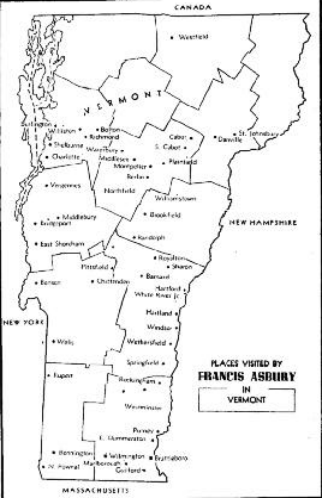
Next day we crossed the Connecticut River at Barrett’s1 ferry, and came into the city of Brattleboro, stopping at Joseph Jacob’s.2 We are now in Vermont. The stupendous steeps on each side of the river resemble those at Harper’s Ferry, and the precipitous heights of the North River. We have ridden eight hundred and fifty miles since we left Baltimore. My mind enjoys a great calm; and I have faith to believe that as God is working gloriously in other parts of the continent, he will make a display of his power even here, and bid the dry bones live: I hope to hear of it at the Ashgrove conference.
ASB_VOL2.PDF, p. 366
22 June 1803
WednesdayVermontWe had a meeting at a school house near to Joseph Jacob’s, in Guilford;1 brother Whatcoat preached upon the perfect law of liberty, and we had a gracious season. As we could not consent to wait three days for Whittingham quarterly meeting, we, on Thursday, took the track to Bennington, the mountain notwithstanding: we had been advised to go round nearly one hundred miles. We passed through Brattleboro, Marlboro, Wilmington, and the skirts of several other small towns. Our dinner we took with Daniel Mixer2 and continued on to William Perry’s,3 thirty-five miles. Our journey to-day was quite in the old style— Braddock’s road, over the Alleghany mountain.
NEW YORK
On Friday evening we reached Ashgrove, twenty-eight miles, by four o’clock—weary men, and tired horses. I have good health, severe temptations, but no murmuring or ill temper. I am once more in Cambridge, New York.
ASB_VOL2.PDF, p. 366
Notes (3)
- This school house was probably a little over two miles south of the town of Guilford in Windham County, and a part of the foundation still remains. It seems to have been the property of Jacobs. In June, 1813, he filed an indenture conveying the use of the school house so long as the proprietors permitted public worship at any day or hour when it was not used for school purposes. (Land Records, Town of Guilford, Vermont, VII, 345.) ↩
- Daniel Mixer lived in Brattleboro. ↩
- William Perry probably lived in Bennington or Shaftesbury, although the census listed William Perrys also in Putney and Westminster. ↩
25 June 1803
SaturdayNew YorkI spent in reading, writing, meditation and prayer.
ASB_VOL2.PDF, p. 367
26 June 1803
SundayNew YorkAt our church at Ashgrove, I spoke upon Colossians 4:2, 3: we had a quickening time. When I came across the mountain I found the season was exceeding dry, and was led out in prayer that the Lord would graciously give us the fruits of the earth, and be merciful to man and beast: our exercises of faith and prayer I believe were not unavailing. On Saturday and Sunday we had rain; and now the same blessings of a spiritual nature are wanting, for which we wrestle with our God; and I believe souls will be converted at this conference. Luther Bishop, a young boy,1 preached on the Sabbath day—and so we will continue every evening until next Monday or Tuesday week, stroke after stroke with the rod of the Lord, like Moses, until the waters of repentance flow from hearts of rock. On Monday brother Whatcoat preached: my subject on Tuesday was Romans 2:7: we rested at John Baker’s.2 On Wednesday the elders did not appear, and I was obliged to hold forth again—my text Psalm 102:13-17. By deaths and removals,3 this Ashgrove society is diminished, but there will be a revival at this conference. This is a very eligible place for Albany, New York, Genessee, Pittsfield, and Vermont districts, but the conference ought to be divided between the two old societies of New York and Ashgrove. On Thursday I had to preach again.
ASB_VOL2.PDF, p. 367
Notes (3)
- Luther Bishop was received on trial at this conference and appointed to a difficult assignment in Canada. It does not seem likely that he was a “young boy” to have received this assignment. He remained under Canadian appointment until 1808, when he came into western and central New York. Orders came in due process until he located in 1814. ↩
- John Baker came from Ireland and settled in Ashgrove in 1786, becoming a strong leader in the Methodist society. (Parks: Troy Conference Miscellany, 25-28.) ↩
- Among the deaths had been that of Thomas Ashton in 1801, from whose name Ashgrove was derived. ↩
1 July 1803
FridayNew YorkWe opened our conference at John Baker’s in the Holloway, prettily environed with hills, a carpet of green spread beneath, and here and there around us fields clothed with the promise of an abundant harvest. We finished our business on Tuesday, public and private: there were nearly seventy preachers and fifty members. On the Sabbath day, perhaps, we had two thousand hearers: the house was filled with women, and the men stood without: I stood in the door, and spoke to them from 1 Timothy 4:11, 12; but I had been overcome by twelve hours a day constant attention to business in the conference, and spoke with pain.
ASB_VOL2.PDF, p. 368
6 July 1803
WednesdayNew YorkWe came to Pittstown,1 dined with Mr. Follitt, and came on to the Half Moon,2 thirty miles, and lodged at John Barber’s:3 these two villages increase. On Thursday we came through Albany, and stopped to dine at Dole’s tavern, three miles beyond: here brother Whatcoat discovered that he had left my coat and my cloak behind: I bore the loss with some patience. Finding we had two hundred miles to reach Trenton, and only six days to accomplish the distance in, we continued on to Blasdale’s at Coeyman’s Landing: reflecting on this, and the journey of fourteen hundred miles still to Kentucky, and brother Whatcoat’s indisposition withal, I felt somewhat moved. On Friday we came to John Crawford’s,4 near the Catskill mountains, making thirty-five miles without food for man or beast. On Saturday we reached Cole’s, at Hurly Town,5 on Esopus Creek. The drought, and heat, and dust, in nine hundred and ninety miles from Baltimore to this place, made us suffer; but my mind was supported, and my health preserved. At Hurly we called a few attentive people together, to whom I dispensed the word of life on Hebrews 11:25.
ASB_VOL2.PDF, p. 368
Notes (5)
- This was a village near Schaghticoke where present Route 40 crosses the Hoosic River. ↩
- Half Moon was an inn north of Troy along the present Route 40. ↩
- John Barber was a leader in the church at Troy. ↩
- John Crawford lived near Palenville. ↩
- This town was west of Kingston on the southward road at the crossing of Esopus Creek. Asbury had visited there on July 12, 1799. ↩
11 July 1803
MondayPennsylvaniaWe rose at four o’clock, and came off at six, and at twelve stopped at Mr. Ostrander’s1: in this happy family we found the son of peace. We came on to New Windsor (through Newburg), to John Ellison’s, making forty miles. Were I to listen to the murmurs of people, I might bring myself into dreadful business: feeling my unworthiness, I the more readily forgive their complaints: indeed their censure is far more safe for me than their praise. I have travelled about two hundred miles through the State of New York. By a fair and accurate computation I judge that we have added, exclusive of the dead, the removed, and the expelled, and withdrawn, 17,300. Our total for the year 1803 is 104,070 members: in 1771 there were about 300 Methodists in New York, 250 in Philadelphia, and a few in Jersey; I then longed for 100,000; now I want 200,000—nay, thousands upon thousands.
ASB_VOL2.PDF, p. 369
Notes (1)
- David Ostrander lived at Plattekill. He was of Dutch ancestry and had served as a major in the Ulster County Militia during the Revolution. He was a leader in the Plattekill Methodist class, and his son, Daniel, entered the Methodist ministry in 1793, becoming an outstanding member of the New York Conference. (Seaman, op. cit., 158-59.) ↩
12 July 1803
TuesdayPennsylvaniaWe rested: but we shall pay for it before we reach Trenton. On Wednesday, we started for Warwick, but the tire of the carriage-wheel giving way, we only reached Nicholas Simonson’s.
NEW JERSEY
Next day we dined at Sussex court house, and reached Mizner’s,1 on the mountain; next day we came to Asbury Town,2 between Sussex and Hunterdon counties.
ASB_VOL2.PDF, p. 369
Notes (2)
- Adam Mizner was a descendant of the pioneer family which settled in the original Hardwick Township, from which the present Frelinghuysen Township in Warren County was separated in 1848. Mizner lived near the hamlet on the Allamuchy Mountain now known as Warren, but which for many years was called Wiretown. He and his family were among the early Methodists of Tranquility-Allamuchy churches. (Honeyman: History of Northwestern New Jersey, II, 787; Snell, op. cit., 684, 738.) ↩
- This is the first time Asbury uses the new name of the town which was renamed in 1796 by its chief benefactor, Colonel William McCullough, in recognition of American Methodism’s pioneer bishop. The date marks it as the first community in America to be named for Asbury. (Snell, op. cit., 480.) ↩
16 July 1803
SaturdayPennsylvaniaWe were driven into Jonathan Bunn’s,1 by a blessed rain. On the Sabbath day, at Trenton, my subject was 2 Corinthians 11:17. PENNSYLVANIA
ASB_VOL2.PDF, p. 369
Notes (1)
- Jonathan Bunn lived in Hopewell Township in Hunterdon County, New Jersey. ↩
18 July 1803
MondayPennsylvaniaWe went forward to Bristol: brother Whatcoat preached; I had spoken at Burlington1 on Titus 2:14. I must here, in Philadelphia, labour with the pen, and answer letters, and refit for the western conference.
ASB_VOL2.PDF, p. 369
Notes (1)
- Burlington, New Jersey. ↩
22 July 1803
FridayPennsylvaniaWe left the city. During my three days’ stay, I preached once at the Academy. On the Great Valley road1 we stopped at brother Geiger’s,2 and housed for the night with an exceedingly kind German family by the name of Kenagee.3 On Saturday we found heat, and dust and turnpike gates (twelve in seventy-five miles), as usual.
ASB_VOL2.PDF, p. 369
Notes (3)
- This was the road to Lancaster and the West through Chester County. ↩
- Geiger was a member of the Radnor Church. He entertained William Colbert in October, 1797. ↩
- There was a family by the name Kaneagy which settled at Kinzer in Lancaster County. Dr. Samuel Kaneagy received his M.D. in 1844, and it is possible that he may have been a child in the home when Asbury visited them. ↩
24 July 1803
SundayPennsylvaniaSabbath, 24, we spent at Soudersburg. I spoke on Psalm 51:9-12. Here Bishop Whatcoat concluded he must stop, or go on with me and die by inches.1
ASB_VOL2.PDF, p. 370
Notes (1)
- See letter to Ezekiel Cooper, July 24, 1803. ↩
25 July 1803
MondayPennsylvaniaI passed through Lancaster, called upon John Shainer, upon Little Conastoga, dined at Columbia and preached at three o’clock and then crossed the ferry and reached Henry Strickler’s1 to lodge for the night. We stole a march upon our friends at York, and met them at the court house as they were coming to meet us: we stopped awhile at brother John Lay’s,2 and then came on to brother Pentz’s.3 On Tuesday I had a little leisure to write a few letters; and on Wednesday morning I preached at the chapel; and in the evening went to James Worley’s. On Thursday I preached once more at the widow Hollopeter’s upon Conewago: since I was here the old man has gone to rest. My mind is under a great calm. I hope this will be a great year of Gospel grace.
ASB_VOL2.PDF, p. 370
Notes (3)
- Henry Strickler lived in Hellam Township near Wrightsville. (Prowell, op. cit., I, 985.) ↩
- John Lay was a member of the first board of trustees of the First Methodist Episcopal Church in York, which was incorporated in 1820. (Ibid., 711.) ↩
- Hollow Pentz lived a short distance from York. (Boehm, op. cit., 100.) ↩
29 July 1803
FridayPennsylvaniaWe had a sultry ride to Carlisle. Henry Boehm preached in the evening.1 Next day, at eleven o’clock, I gave them a sermon from Colossians 3:12-14: in the evening Wilson Lee2 spoke. On the Sabbath we had prayer meeting at five o’clock; James Smith3 preached at eight o’clock; I spoke on 2 Corinthians 6:2; and Wilson Lee in the afternoon: we had excessive heat, but the people were very attentive. I have read the half of the “Portrait of St. Paul”: O inimitable Fletcher—in preaching, writing, in living, and in dying!
ASB_VOL2.PDF, p. 370
Notes (3)
- Henry Boehm traveled only fourteen days with Asbury this trip. When they reached Berlin in Somerset County on August 5, Asbury sent him back to preach to the Germans. Later, from 1808 to 1813, Boehm was Asbury’s constant traveling companion. (Boehm, op. cit., 100-101.) ↩
- Wilson Lee was admitted in full connection in 1786 and became the presiding elder of the Baltimore District. He was an outstanding early preacher and a great friend of Asbury. (Boehm, op. cit., 103-4.) ↩
- James Smith was admitted on trial in 1793. (See Minutes.) ↩
1 August 1803
MondayPennsylvaniaI came ten miles to a Mr. David Snyder’s, near a village called Newville and dined about eleven o’clock: the people gathered together, and I must needs preach to them. We proceeded on to Shippensburgh in haste, and here I again stood up in my Master’s name: we had a crowded house, and a sick preacher. There is a meeting house here on shares with the Presbyterians and Seceders; the Methodists have one of their own.
On Tuesday morning, at four o’clock, we set out to scale the mountains. We passed a little town called Strasburg,1 and another called Emmitsburg: here we stopped, and I laid myself down upon the floor to rest; intense heat, rugged mountains, and a wasting dysentery almost overcame me. I feel, and have felt thirty-two years, for Pennsylvania—the most wealthy, and the most careless about God, and the things of God: but I hope God will shake the State and the Churches. There are now upwards of twenty German preachers somehow connected with Mr. Philip Otterbein and Martin Boehm; but they want authority, and the Church wants discipline.2
ASB_VOL2.PDF, p. 370
3 August 1803
WednesdayPennsylvaniaWe came to David Field’s and fed. After prayer, Wilson Lee bade us farewell, and went away to the Fort Littleton quarterly meeting: a rumour had spread that I also was to be there; strange, that they should expect that I would stay one hundred miles in the rear of my appointments for such a purpose; what must I not do to please all the preachers and all the people!
Hard and slowly did we toil up, through intense heat, eight miles of the Sideling Hill;1 we stopped at a house of entertainment, kept by Mr. Edward Head; the night was very sultry, and my lodging-room very small.
ASB_VOL2.PDF, p. 371
Notes (1)
- Sideling Hill was so named because it was so steep that, when the road over it was being built, as many men as could be spared from the work were required to pull on the sidestays, or long ropes, attached to the upper side of the wagons to prevent them from turning over on their sides. ↩
4 August 1803
ThursdayPennsylvaniaWe started for Berlin: passing through Bedford and Somerset counties, and crossing the Juniata, we came into pleasant Berlin about sun-set, making a ride of forty miles. We lodged with Squire Johnston; and necessity was laid upon us to speak both in English and German—with the assistance of my travelling companion, Henry Boehm.
ASB_VOL2.PDF, p. 371
5 August 1803
FridayPennsylvaniaForty-two miles over hills and rocks, brought us down upon Connellstown, on the Youghiogeny River, where we lodged with Anthony Banning. I called at the twenty-mile house, and found a daughter of Michael King, a local preacher amongst us whilst living, and now, I trust, a glorified spirit. I think it will be better for me never to ride eighty-two miles in two days again: a wearied mare, just off a journey of thirteen hundred miles, and an old, afflicted man; but God and grace is sufficient. On Saturday and Sabbath I rested in Connellstown, and preached; my subject was Matthew 5:13. There has been death in the pot here, nor do we know that it is yet, or when it will be, out. On our way to Jacob Murphy’s, we noticed Colonel Meason’s superb stone mansion on Mount Braddock.1
ASB_VOL2.PDF, p. 371
Notes (1)
- Mount Braddock, just north of Uniontown and the westernmost ridge of the Allegheny Mountains, was the location of the plantation of Christopher Gist, the first white settlement west of the mountains, settled in 1753, and which was an important cause of the French and Indian War. The stone mansion was built in 1802 by Adam Wilson, an English craftsman-architect, for Isaac Meason and is one of the finest examples of post-colonial architecture still standing in western Pennsylvania. Isaac Meason was one of the earliest ironmasters of western Pennsylvania, having established Union Furnace on Dunbar Creek in Fayette County as early as 1792. Jacob Murphy, Meason’s son-in-law, and his mother, the widow Ann Murphy, were charter members of the original Methodist society in Uniontown. Mrs. Murphy’s home was a favorite stopping place of Asbury and other preachers. (Mulkearn and Pugh, op. cit., 219.) ↩
9 August 1803
TuesdayPennsylvaniaAt Murphy’s barn I spoke on 1 Corinthians 7:29-31. Although much afflicted in my bowels, I felt wholly given up to do or suffer the will of God—to be sick or well, and to live or die at any time and in any place—the fields, the woods, the house, or the wilderness: glory be to God for such resignation! I have little to leave, except a journey of five thousand miles a year, the care of more than a hundred thousand souls, and the arrangement of about four hundred preachers yearly, to which I may add the murmurs and discontent of ministers and people: who wants this legacy? Those who do are welcome to it for me!
ASB_VOL2.PDF, p. 371
11 August 1803
ThursdayPennsylvaniaI dined with the aforesaid Colonel Meason, one of the great men of the west. Next day I came to Union Town, and returned to Jacob Murphy’s. On Saturday I came to the quarterly meeting; I preached, and we had an open time: at the night meeting it was a shouting time; and our meetings, I believe, were warning times to Union Town. I believe God will yet work in the Redstone settlement; has already begun amongst the Presbyterians.
ASB_VOL2.PDF, p. 372
16 August 1803
TuesdayPennsylvaniaI rode, twenty miles, to Harry Stephens’s, upon Monongahela; weak and afflicted. Next day I attended an appointment made for me at Maple Town; my subject was 2 Timothy 4:7, 8: many heard and felt. I stayed with Mr. Jackson, on Muddy Creek, for the night.
ASB_VOL2.PDF, p. 372
18 August 1803
ThursdayPennsylvaniaI preached at Sheppard’s meeting house upon Romans 8:9. I was uncommonly led out upon both my last subjects, and I suppose I had one thousand hearers in the two congregations. After dining we rode down the heights of Tenmile, to a town called Frederick; thence to the Quaker settlement, and stopped at Alexander Frew’s. Were the grounds not so uneven, and so destitute of springs and streams, I should give the Redstone settlement the preference to almost any in America: the soil is good, the timber lofty, and there is plenty of iron, coal, and limestone; and would the settlers generally do as their Quaker neighbours (the only people here who manure their lands), the soil would never be exhausted. The great promise of fruit has failed. It is mercifully wise in Providence to check our plenty; particularly here: many drunkards will now be kept sober in this distilling country, and I hope some will be converted to God.
ASB_VOL2.PDF, p. 372
19 August 1803
FridayPennsylvaniaOur camp meeting begins today:1 the ground chosen was William Jackson’s, near the old fort upon the Monongahela; it was upon a beautiful eminence, the great stand was erected, and a second one to the left, concealed by the trees. On Saturday I preached to about one thousand hearers; my text was Isaiah 55:12. The Sabbath was wet in the morning, but, clearing away, both stands were occupied, and there might be in the two congregations nearly four thousand people: there was a visible impression made upon many, and we hope fifty souls were converted to God. On Tuesday we came away, whilst others were coming to the ground. Thornton Fleming and James Quinn went back and preached. We came to Samuel Hammond’s.
ASB_VOL2.PDF, p. 372
Notes (1)
- This was the first camp meeting which Asbury officially promoted. See his letters to George Roberts in Philadelphia written during this meeting and also his letter of December 2, 1802, to Thornton Fleming. ↩
24 August 1803
WednesdayPennsylvaniaAt the Forks meeting house I preached on 1 Thessalonians 3:1. Whilst we were at dinner at Benjamin Fell’s,1 William Page came in with the agreeable intelligence of a revival at Connellstown. On Thursday we crossed Monongahela, at Elizabethtown, and came to William Jones’s, and preached to an unexpected congregation: I was unwell, but spoke on Acts 2:21. A woman, noted for being a mocker, fell down, and cried for mercy, confessing her sins before all the people. Brother Page exhorted, but the people would not disperse until he had given them a sermon under the sugar maple trees: many trembled and wept, if they did not pray. This has been a neglected spot. On Friday we rested.2
ASB_VOL2.PDF, p. 373
Notes (2)
- Benjamin Fell (1739-1811) was a Quaker from Bucks County, Pennsylvania, who moved to western Pennsylvania with his numerous family in 1786. He settled in the “forks of the Yough” where he was neighbor to Edward Teal, whose home was one of the original preaching points of the original Redstone Circuit. The Fells soon became Methodists and donated the land on which the first church of the society was built in 1792. This was the seventh Methodist church in this region. The present stone church, located on the original site and known as “Fells Church,” was erected in 1835. (Smeltzer, op. cit., 69.) ↩
- See letter to Daniel Hitt, August 26, 1803. ↩
27 August 1803
SaturdayPennsylvaniaWe had a dry, sultry ride to Pittsburgh. In the evening William Page preached. In the court house I spoke, on the Sabbath day, to about four hundred people; my subject was 1 Chronicles 7:14. I would have preached again, but the Episcopalians occupied the house. I come but once in twelve years,1 but they could not consent to give way for me. It is time we had a house of our own.2 I think I have seen a lot which will answer to build upon.
ASB_VOL2.PDF, p. 373
Notes (2)
- This was Asbury’s second visit to Pittsburgh, the first having been in 1789. The statement “twelve years” must have been an error in copying the original Journal as it should be fourteen years. ↩
- The Methodist preaching place in Pittsburgh from the time the society started under the leadership of John Wrenshall in 1796 until 1803 was in a large room in abandoned Fort Pitt, which was owned by Peter Shires, a Methodist. Shires sold the fort in 1802, and the society met in Wrenshall’s and Thomas Cooper’s homes until the first chapel was erected in 1810. (Smeltzer, op. cit., 98 ff.) ↩
29 August 1803
MondayPennsylvaniaI came down, and crossed at the old fort, the point of confluence of the rivers Monongahela and Alleghany, whence these united waters flow under the appropriate name of Ohio, beautiful. I crossed Sawmill and the Chartiers,1 and passed the lands of General Neville.2 At John Wrenshall’s I found an agreeable hostess, and lovely children.3 Riding up the road I met an aged Presbyterian, who told me that religion was at a great height in Mr. Wood’s congregation—that yesterday under preaching several fell down; he asked my opinion of the work: I replied, that in my judgment, any person who could not give an account of the convincing and converting power of God, might be mistaken; falling down would not do: we agreed in sentiment. I stopped at John Fawcett’s, where, although very sick, I preached to a large congregation, at seven o’clock on Tuesday; my subject was Matthew 7:7, 8. I baptized several children. On the same day I rode, weak, faint, and alone, to Washington; it was the time of the court sessions: we had about four hundred people to hear, to whom I spoke on Titus 2:11, 12. I lodged at John Crouch’s: God is in this house.
ASB_VOL2.PDF, p. 373
Notes (3)
- Sawmill Run and Chartiers Creek flow into the Ohio from the south near the junction of the Monongahela and Allegheny Rivers at the “Point.” ↩
- General John Neville was a prominent early citizen of western Pennsylvania, commandant at Fort Pitt from 1775 to 1777, an officer who fought in a number of battles of the Revolution in the East, a representative at the Pennsylvania constitutional convention in 1787, and the collector of the excise taxes in western Pennsylvania which precipitated the whiskey insurrection. His mansion at Bower Hill, south of Pittsburgh, the site of which was the occasion of Asbury’s observation, was attacked and burned by the whiskey rebels on July 17, 1794. (Mulkearn and Pugh, op. cit., 90-92.) ↩
- Smeltzer says this sentence is misplaced and belongs in the paragraph when Asbury was in Pittsburgh. John Wrenshall (1761-1821) was an English Methodist local preacher who emigrated to America in 1794 and established himself as a merchant in Pittsburgh in 1796. He was the founder of Methodism in Pittsburgh, and it was his concern and leadership which enabled the Methodist society there to survive in its early years. (Smeltzer, op. cit., 94-103.) ↩
31 August 1803
WednesdayPennsylvaniaWe rode seventeen miles to Philip Doddridge’s, near a new-made town called Middletown; here I preached next day in a new stone house, the first of the kind I have met with in my tour. Although faint, from heat and a dysentery, I was long and fervent, and the people were attentive.
ASB_VOL2.PDF, p. 373
2 September 1803
FridayWest VirginiaWe found a spot and made a pulpit between two sugar maple trees. I was in great pain, so that I did not attend quarterly meeting, which began on Saturday, continued until midnight, re-commenced on the Sabbath with love feast and sacrament, and at eleven o’clock I preached on Ephesians 6:18-20.
I. “The ministry of the Gospel,” in redemption and salvation; in what Christ hath done for us, and in what is wrought in us by his Spirit. II. The duty, nature, and exercise of prayer—for saints, for the ministry, and for the success of the Gospel.
III. That the apostle might be bold as a prisoner and a martyr. Many things were said of the mysteries of God—creation, the winds, and our own existence in embryo; we have demonstration of these mysteries, and such we also have of redemption, conviction, conversion, sanctification, and the adorable Trinity; and frequent and obvious demonstrations of the power of God and his word instantaneously manifested: we do not know how these things are, but we know that they do exist.
My indisposition was such, that I felt the people still engaged in worship, much ashamed of the meanness of my performance, however well my hearers may have thought of it: the Lord knew my good intentions, but I saw that the excellency of such sublime and interesting subjects was beyond my reach of thought or expression. The Lord blessed our gathering together, and souls were converted.
WEST VIRGINIA
ASB_VOL2.PDF, p. 374
5 September 1803
MondayWest VirginiaWe rode ten miles to John Beck’s, near West Liberty. I preached on Acts 3:26; one soul who had been convicted at our quarterly meeting, professed to find peace with God, and shouted glory! with a loud voice. On Tuesday I preached near this place to a crowd, at John Spahr’s. I came with Reason Pumphrey1 down the great hill, to the Ohio.
Wednesday brought us to Charlestown,2 the capital of Brook County, situated at the mouth of Buffalo, eighty miles from Pittsburgh. We found the Ohio so low, that the boat of Colonel Lewis,3 who is going to explore the Mississippi, would not float over the flats.
OHIO
ASB_VOL2.PDF, p. 374
Notes (3)
- Reason Pumphrey (1735-1812) was probably the first Methodist west of the mountains. He was a Strawbridge convert in Maryland and was accompanied westward in 1772 by Eli Shickle, one of Strawbridge’s local preachers. Shickle preached in the camps en route across the mountains and then in Pumphrey’s and neighboring log-cabin homes when Pumphrey established his original land claim within the boundaries of the present city of Washington, Pennsylvania, in 1772. In 1786 Pumphrey moved to Beech Bottom on the Ohio River, just below the present city of Wellsburg, West Virginia, where his home became a preaching point on the original Redstone Circuit, and the society raised there became the original Kadesh Chapel congregation when this seventh western Pennsylvania chapel was built in 1788. Pumphrey’s location on the Ohio River was doubtless the occasion for early extension of the original Redstone Circuit to the extreme limits of western settlement until the defeat of the Indians of the Northwest Territory. (Smeltzer, op. cit., 38-41.) ↩
- Charlestown is the present Wellsburg, West Virginia, county seat of Brooke County in the northwestern West Virginia panhandle. The town was established in 1791. ↩
- Colonel Meriweather Lewis and Colonel William Clark started for the West in 1803. (Gwaltmey: Twelve Virginia Counties, 325. For the date see Bakeless: Lewis and Clark, 102; Wheeler: The Trail of Lewis and Clark, I, 58-61; American Explorers, Vol. I.) ↩
8 September 1803
ThursdayOhioI reached Steubenville, and preached on Luke 19:10. As the court house could not contain the people, we went to a presbyterian tent; for which, as the “Jews and Samaritans have no dealings” in this country, we must ask pardon. I was invited to dine with Mr. Bazaleel Wells, one of the proprietors of this town, and the rich occupant of a large mansion, which, if rough-cast, would be grand. The rivers and streams were never lower than now. My mind is greatly engaged with God in public and in private; but I feel the power of Satan in these little, wicked, western trading towns.
ASB_VOL2.PDF, p. 375
9 September 1803
FridayOhioAt Charlestown I preached in Brook court house, on Joshua 24:19. We came to Nicholas Pumphrey’s to lodge in the evening. On Saturday we crossed at Pumphrey’s ferry, and attended West Wheeling quarterly meeting at Hopewell chapel.1 I ordained brother Wrenshall2 to the office of deacon, and then came to the stand, and preached on the Sabbath day on 1 Peter 5:10. We had love feast and sacrament. There was a cry raised very soon, and it was with difficulty I could keep the thread of my discourse whilst they were singing and shouting upon the top of the hill. At candle light the cry began again, and continued until the break of day on Monday morning: it is judged there were twenty souls converted to God. I came away, keeping up Indian Short Creek to Isaac Meek’s, ten miles; on this stream are some of as fine lands as any in America.
ASB_VOL2.PDF, p. 375
Notes (2)
- Methodism was planted in the former Indian lands of the Northwest Territory across the Allegheny and Ohio rivers between 1799 and 1803. The West Wheeling Circuit was formed in 1802. This is the record of Asbury’s first tour across Ohio, though he had taken his “peek into Indian lands” in 1786. ↩
- John Wrenshall had been administering the sacraments to the Pittsburgh Society without ordination. Under Asbury’s urging he made the eighty-mile journey to the West Wheeling Quarterly Meeting for ordination. This was the first Methodist ordination in the state of Ohio. (John Wrenshall: Manuscript Journal.) ↩
13 September 1803
TuesdayOhioWe came to Morrison’s tavern, twenty miles, our route lying along upon the branches of Short Creek, Wheeling, and Stillwater—the land still fertile. Next day we reached Will’s Creek, after tiding thirty-seven miles; we were richly entertained at Mr. Beatty’s. On Thursday morning it rained about two hours; I was damped, and felt a touch of inflammation in my throat. We stopped at Zanesville,1 and found good entertainment at Mrs. Morrison’s.
ASB_VOL2.PDF, p. 375
Notes (1)
- This town was named for Ebenezer Zane. The Zane home was in Wheeling, then in Virginia, and the first Methodist society in Wheeling was established at Zane’s while Thomas Scott rode the original Ohio Circuit in 1793. (Thomas Scott, Manuscript Journal.) ↩
16 September 1803
FridayOhioWe reached John Murphy’s, at New Lancaster. Since Tuesday morning we have ridden one hundred and twenty miles, over successive and excessively steep hills. My mind has been calm. Daniel and Benjamin Hitt have been my companions. The levels, and on the watercourses the lands, in this state are exceedingly rich,1 with all the appearances which alluvial soils present. I frequently see the tumuli or barrows,2 such as are seen in the west of Georgia—most probably graves of the aborigines. Jonathan’s and Brush Creeks are branches of the Hockhocking: there is fine land on these streams. We are, I judge, six hundred miles from Philadelphia.
On Saturday, I preached at John Murphy’s, on 2 Peter 1:2. We held a sacramental and social meeting. At eleven o’clock Daniel Hitt preached, and I spoke after him; we had the attention of the people, and we saw some tears, but there was nothing special done. On Monday I preached at Edward Teal’s3 once more: this brother I knew in Maryland thirty years ago; he is now settled in Fairfield, near Rush Creek, and has twelve hundred acres of land under his feet, equal to any in the United States: what will not a little enterprise do for a man in this highly-favoured country!
ASB_VOL2.PDF, p. 375
Notes (3)
- The early settlement of Ohio was spectacular. No settlement was possible, and land titles could not be granted until 1796. The territory was admitted to the Union on March 1, 1803, with a population of about 100,000. ↩
- These were prehistoric Indian mounds, which are numerous in Ohio. ↩
- Edward Teal (1737-1822) was converted under Asbury near Baltimore, where he had been a class leader. He moved west to the “forks of the Yough” in western Pennsylvania where Fell’s Church is now located and where he opened his home as one of the first preaching places on the original Redstone Circuit. Between 1800 and 1803 he moved on west to the Hockhocking Valley in Ohio, and his leadership there was instrumental in the creating of the Hockhocking Circuit in 1803. His son-in-law, James Quinn, was one of the founding circuit riders and the leading early presiding elder Of Ohio Methodism. (Wright: Life and Labors of James Quinn, 36-37; Smeltzer, op. cit., 86.) ↩
20 September 1803
TuesdayOhioWas a day of settled rain; we sought a shelter at Edward Teal’s. Next day, having two appointments, we set out and got bewildered in the woods and lost our way upon Mount Pleasant: we judged it best to take the path to New Lancaster and try to secure our second appointment, at Broad Cole’s. After riding about twenty miles, and again missing our way, we came in at three o’clock, and I preached upon Luke 11:13. I took lodging at Mr. Daniel Van Meeter’s. Mr. Van Meeter told me, that a boy had cultivated about twelve acres, which would yield him about seven hundred bushels of Indian corn: now what do these people want with slaves? They have wisely prohibited their introduction into the state.1 The Muddy Prairie is five miles in length, and a mile wide, more or less; it was, doubtless, once a lake: it is very fertile, but must be drained before it can be well cultivated. New Lancaster has nearly one hundred houses of all kinds, ill situated for health on a low, rich level, through which creeps the still Hockhocking.
ASB_VOL2.PDF, p. 376
Notes (1)
- A reference to the strong antislavery position of the original Ohio constitution. Perhaps the hand of Edward Tiffin, Thomas Scott, and other Methodist leaders in the new state who helped write the constitution may be seen in this. ↩
22 September 1803
ThursdayOhioWe came thirty miles to White Brown’s, on Deer Creek, Ross county. Our route brought us over the Picaway Plains, seven miles long, three miles wide, and fertile; little hills covered with lofty trees here and there, rise from the level and give a beautifully picturesque appearance to the plains. At Thomas’s we crossed the Scioto, now dwindled to a small body of water. On Friday I preached at Brown’s; my text was 2 Timothy 4:7, 8; it was an open season, with about three hundred hearers.
ASB_VOL2.PDF, p. 376
24 September 1803
SaturdayOhioI rode to Chillicothe,1 fifteen miles, through lands generally rich. We passed some of those mounds and intrenchments which still astonish all who visit this country, and give rise to many conjectures respecting their origin: “Shadows, clouds, and darkness rest” and will rest “upon them.” In the state house, which also answers for a court house, I preached to about five hundred hearers, and would have had more had not the rain prevented. Chilicothe stands upon the point of confluence of the Scioto River and Paint Creek. On Monday we came away from Governor Edward Tiffin’s2 across the fat lands of the Paint: at the end of thirty miles we stopped at Brancker’s, and had the common fare of travellers, with other travellers.
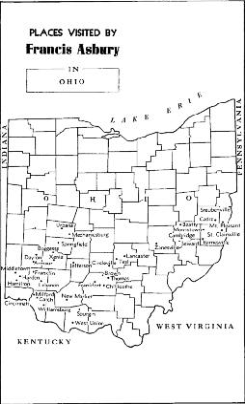
ASB_VOL2.PDF, p. 377
Notes (2)
- Chillicothe was the first capital of Ohio. ↩
- Dr. Edward Tiffin (1776-1829), the first governor of Ohio, was a devoted Methodist local preacher. He was converted under the preaching of Thomas Scott and was ordained a deacon by Asbury. He moved to Chillicothe in 1796, where he practiced medicine. He was president of the Ohio constitutional convention in 1802 and was the first governor of the state in 1803. His friend Thomas Scott located from the Methodist ministry in 1796, studied law, and in 1800 moved to Chillicothe, where he was associated with Edward Tiffin in both early Ohio politics and Methodism. In 1810 Thomas Scott became chief justice of the Ohio Supreme Court. (Payton, op. cit., 97-99; Scott Journal.) ↩
27 September 1803
TuesdayOhioWe stopped at Ohio Brush Creek, fifteen miles; dined in haste with George Spurgin, and bent our course to George Rogers’s, at Darlington’s ferry—this was a stretching ride.
KENTUCKY
ASB_VOL2.PDF, p. 377
28 September 1803
WednesdayKentuckyWe crossed the Ohio into the state of Kentucky, Fleming county, stopping at Salathiel Fitch’s. It is wonderful to contemplate the effects of American enterprise exhibited in the State of Ohio: it is but four years since Zane opened the road1 for the general government through the wilderness so lately called, and now there are the towns of Marietta at the mouth of the Muskingum, of about one thousand houses; Cincinnati, containing as many; Hamilton, of five hundred houses: and many others whose names are scarcely fixed.
ASB_VOL2.PDF, p. 378
Notes (1)
- In 1796 the Federal Government granted Ebenezer Zane the tract of land on the Muskingum River on which the city of Zanesville stands on condition that he open a road across southern Ohio from Wheeling to Maysville, Kentucky. ↩
29 September 1803
ThursdayKentuckyWe came through Bourbon county. I crossed Licking River by the Salt Works,1 and rode thirty-three miles to Benjamin Coleman’s, at Mount Gerizim,2 to attend the Kentucky Conference; this was a heavy ride, without food for man or beast until we reached home. On Friday we rested.
ASB_VOL2.PDF, p. 378
Notes (2)
- The Salt Works later became Blue Lick Springs. Daniel Boone made salt there, and he was captured by the Indians near this place in 1788. On August 19, 1782, the famous battle between Kentucky pioneers and Indians was fought near the springs. ↩
- Mount Gerizim, or Broadwell, was in Harrison County, Kentucky, three miles from Cynthiana on the road to Ruddell’s Mills. The historic church was built of blue ash logs on ground provided by Richard Timberlake, a Presbyterian, and Samuel Broadwell, a Methodist. It was burned in 1825, and a brick church was erected. (Redford: Methodism in Kentucky, I, 398.) ↩
1 October 1803
SaturdayKentuckyBarnabas M’Henry preached upon the Divine institution of the Sabbath. On Sunday I had to preach from a stand in the woods to about two thousand people; my subject was 1 Thessalonians 3:1. It was an open time.
ASB_VOL2.PDF, p. 378
3 October 1803
MondayKentuckyWe entered fully upon our conference work; but I had to preach nevertheless. We had preaching every day; and the people continued singing and prayer, night and day, with little intermission. On Wednesday the meeting closed. We hope there were twenty souls converted to God, besides five who are reported to have been converted at a family meeting. Our conference ended on Thursday the sixth. I had taken cold, but rode twelve miles to Smith’s, and was driven by illness early to bed. Next day I rose unwell, and continued my route through Paris, standing upon the fork between Stono and another stream, useful for mills, but apt to be nearly dry in autumn. Paris is the capital of Bourbon county—a growing place of about four hundred houses, some of brick, and a stone meeting house belonging to the Presbyterians. The day was excessively warm, but I made twenty miles to Doctor Hinde’s,1 Clarke county; brothers M’Kendree, Garratt, Douthet, and Granade were with me.
ASB_VOL2.PDF, p. 378
Notes (1)
- Dr. Thomas Hinde was a well-known physician, educated at Oxford. He was the grandfather of Bishop H.H. Kavanagh. (Ibid., I, 371.) ↩
8 October 1803
SaturdayKentuckyI felt my mind devoutly fixed on God. I accomplished two things in conference: viz. 1. Forming the Ohio circuits into a district; 2. Sending two missionaries to Natchez, and one to the Illinois—as the minutes of the present year will show.
ASB_VOL2.PDF, p. 378
9 October 1803
SundayTennesseeAt Hinde’s chapel, Clarke county, I preached, and thereby paid a debt which I had contracted last year, by sending Nicholas Snethen to preach in my place, by which, it may be, some people were disappointed: my text was 2 Peter 1:4-8. On Monday we took the path for Madison, crossing the Kentucky River at Combe’s ferry:1 we put in at Christopher Irwine’s. On Tuesday we stopped at Wood’s—in the woods: his house being unfinished, there were masons, and carpenters, and gentlemen, and riflemen, and whisky topers, besides the gnats and bats, which, ever and anon, flew in and out: we quitted our purgatory upon paying two and a half dollars for three of us.
ASB_VOL2.PDF, p. 379
Notes (1)
- Combe’s Ferry was at Boonesborough. It was the first ferry licensed in Kentucky, being authorized by the Virginia legislature in 1779. ↩
12 October 1803
WednesdayTennesseeIt rained to-day. We encountered the rocks and hills, on the route to Rock Castle River, and stopped, dripping and willing, at Senior Farris’s1: here we had fire, food, prayer, a room, and a bed. On Thursday we started and reached Richard Ballinger’s:2 our host gave us entertainment gratis, and we had prayer at night and in the morning. I think seriously of forming a wilderness circuit: it is high time to begin. TENNESSEE
ASB_VOL2.PDF, p. 379
14 October 1803
FridayTennesseeWe came to Hunt’s, at Claibornes court house (Taxewell); and next day reached Martin Stubblefield’s.1 What a road have we passed! certainly the worst on the whole continent, even in the best weather; yet, bad as it was, there were four or five hundred crossing the rude hills whilst we were: I was powerfully struck with the consideration, that there were at least as many thousand emigrants annually from east to west: we must take care to send preachers after these people. We have made one thousand and eighty miles from Philadelphia; and now, what a detail of sufferings might I give, fatiguing to me to write, and perhaps to my friends to read! A man who is well mounted will scorn to complain of the roads, when he sees men, women, and children, almost naked, paddling bare-foot and bare-legged along, or labouring up the rocky hills, whilst those who are best off have only a horse for two or three children to ride at once. If these adventurers have little or nothing to eat, it is no extraordinary circumstance; and not uncommon, to encamp in the wet woods after night—in the mountains it does not rain, but pours. I too have my sufferings, perhaps peculiar to myself: pain, and temptation; the one of the body, and the other of the spirit; no room to retire to—that in which you sit common to all, crowded with women and children, the fire occupied by cooking, much and long-loved solitude not to be found, unless you choose to run out into the rain, in the woods: six months in the year I have had, for thirty-two years, occasionally, to submit to what will never be agreeable to me; but the people, it must be confessed, are amongst the kindest souls in the world. But kindness will not make a crowded log cabin, twelve feet by ten, agreeable: without are cold and rain; and within, six adults, and as many children, one of which is all motion; the dogs, too, must sometimes be admitted. On Saturday, at Felix Ernest’s, I found that amongst my other trials, I had taken the itch; and, considering the filthy houses and filthy beds I have met with, in coming from Kentucky Conference, it is perhaps strange that I have not caught it twenty times: I do not see that there is any security against it, but by sleeping in a brimstone shirt:—poor bishop! But we must bear it for the elect’s sake. I wrote some letters to our local brethren, and read the book of Daniel while in this house.
ASB_VOL2.PDF, p. 379
Notes (1)
- The Stubblefield brothers, Thomas, Joseph, and Martin, lived at County Line, between Bean Station and Morristown, where there was a church. Martin Stubblefield was later killed by his runaway team in Cincinnati, where he was buried. This has been a prominent Methodist family in the section. (Price, op. cit., II, 76, 77.) ↩
23 October 1803
SundayTennesseeMy soul is tranquil, the air is pure, and the house of God is near; and Jehovah is nearer. At Ebenezer,1 I preached on James 1:22: “But be ye doers of the word, and not hearers only, deceiving your own selves.” By introduction, I collected the words of our Lord, and those of the apostle Paul upon the same subject, and brought them to one point. In opening the subject, I observed, 1. What we are taught in the preaching of the Gospel: First, Christian experience; Secondly, Christian tempers; Thirdly, Christian perfection; Fourthly, Christian duties. 2. General head: How people should hear the word—constantly, seriously; in faith, in prayer; as believing it promises all that is good, and threatens the most dreadful evil. 3. To be doers of the word is to seek for the immediate experience and practice of the word.
On Monday, we came off in earnest; refreshed at Isaiah Harrison’s,2 and continued on to the Paint mountain, passing the gap newly made, which makes the road down to Paint Creek much better: I lodged with Mr. Neilson, who treated me like a minister, a Christian, and a gentleman. NORTH CAROLINA
ASB_VOL2.PDF, p. 380
25 October 1803
TuesdayTennesseeWe reached Buncombe. The road is mended by changing the direction and bridging the Ivy.
ASB_VOL2.PDF, p. 380
26 October 1803
WednesdaySouth CarolinaWe called a meeting at Killian’s and a gracious season it was: my subject was 1 Corinthians 15:38. Sister Killian and sister Smith, sisters in the flesh, and kindred spirits in holiness and humble obedience, are both gone to their reward in glory. On Thursday we came away in haste, crossed Swannanoa at Thomas Foster’s, the French Broad at the High Shoals, and afterward again at Beard’s bridge, and put up for the night at Andrew Mitchell’s: we passed two large encamping places of the Methodists and Presbyterians; it made the country look like the Holy Land.
ASB_VOL2.PDF, p. 381
28 October 1803
FridaySouth CarolinaWe came up Little River, a sister stream of French Broad: it offered some beautiful flats of land. We found a new road, lately cut, which brought us in at the head of Little River, at the old fording-place, and within hearing of the falls, a few miles off of the head of Matthews Creek, a branch of the Saluda: the waters foaming down the rocks with a descent of half a mile, make themselves heard at a great distance. SOUTH CAROLINA
I walked down the mountain, after riding sixteen or eighteen miles before breakfast, and came in about twelve o’clock to father John Douthet’s;1 once more I have escaped from filth, fleas, rattlesnake’s, hills, mountains, rocks, and rivers: farewell, western world, for a while! We are twelve hundred and seventy miles from Philadelphia.
ASB_VOL2.PDF, p. 381
Notes (1)
- Asbury followed his former route from western North Carolina by way of Table Rock Mountain to John Douthet’s. ↩
31 October 1803
MondaySouth CarolinaI rode to Chastaine’s,1 twenty miles, crossing three branches of the Saluda.
ASB_VOL2.PDF, p. 381
Notes (1)
- Chastaine lived near Traveler’s Rest. ↩
1 November 1803
TuesdaySouth CarolinaEditorial note: The supplied edition cites “2 Peter 5:6-9” (ASB_VOL2.PDF, PDF page 381), but this is not a valid reference in the library’s KJV numbering. The source’s own footnote discusses the difficulty: There are only three chapters in this book. The passage may have been 1 Peter 5:6-9. These suggestions remain conjectural. The 1821 printed journal also reads “2 Peter v. 6–9”; that older witness does not remove the citation difficulty. Francis Asbury, Journal (1821), PDF page 123.
At the meeting house, I spoke on 2 Peter 5:6-9:1 after meeting we rode away fifteen miles to Wood’s2; and next day preached at his house, to a lifeless congregation, and came off without dining to John Foster’s, twelve miles. In this route I crossed the three branches of Tyger River, and passed through Greenville and Spartanburg counties. My mind hath been in great peace under all my trials, and labours, and troubles. I find that the camp meetings in this State, and in Georgia, have been conducted in great order, and with great success.
ASB_VOL2.PDF, p. 381
Notes (2)
- There are only three chapters in this book. The passage may have been 1 Peter 5:6-9. ↩
- Wood lived near Greer. ↩
3 November 1803
ThursdaySouth CarolinaAt Foster’s meeting house,1 I spoke on Matthew 5:12. I had some opening. In the evening, Moses Matthews and G. Dougharty2 had a lively prayer meeting. I find we have lost Phoebe Wells, Mary Hughs, Eleanor Parker (formerly Owens), and William Hazlewood, members of our society in Charleston: they died of the prevailing fever.
ASB_VOL2.PDF, p. 381
4 November 1803
FridaySouth CarolinaWe re-crossed the branches of Tyger and Enoree rivers, and came along a crippling path to Thomas Terry’s, near the Fork Shoals of Reedy River. We have a new frame house, built for worship, on Mount Terry: this has been erected in pursuance of my last year’s advice, and by one man. To-morrow we shall open our new house.1
ASB_VOL2.PDF, p. 382
Notes (1)
- This new meeting house erected by Thomas Terry at Fork Shoals was in Greenville County. ↩
5 November 1803
SaturdaySouth CarolinaI spoke on 2 Peter 2:1, 2. It was a rainy day, but we had a congregation. On the Sabbath day, I preached on Isaiah 46:7. I laboured hard—I fear to little purpose: may the seed, sown in great weakness, be raised by the power of God! On Monday I rode to the Golden Grove,1 and preached upon Galatians 5:22-25: it was a cold day, and there were but few people: it is the cotton, corn, and potato harvest. I rode that evening to B. Stanton’s, upon Saluda. On Tuesday, at Salem, I preached to a few hearers upon Ephesians 6:13-19. We made James Tarrant’s that evening. Wednesday brought us to David Dunlap’s, and Thursday, to Claiborne Brown’s.2 We met people coming from the militia muster, drunk, and staggering along the lanes and paths; these unhappy souls have had their camp meeting and shout forth the praises of the god of strong drink: glory be to God, we have our camp meetings too; of longer continuance, and more and louder shouting of glory, and honour, and praises to the God of the armies of the earth. Go on, ye servants of the Lord; and Thou, mighty Saviour, extend the victories of Gospel grace! In Laurens county, I passed the Quaker settlement upon Rabun’s Creek.
ASB_VOL2.PDF, p. 382
11 November 1803
FridaySouth CarolinaI rode in haste to Bethel Academy, thirty-five miles. On Saturday I rested. On the Sabbath I preached at Bethel once more: my text was Mark 13:34, to the end of the chapter: after sermon, I rode eight miles to brother Lowe’s,1 amongst the Dutch people, and enforced Hebrews 4:4-16. At Mr. Rolles’s,2 twenty-five miles distant, I had on Monday a gracious season whilst expounding Matthew 7:7-11. We crossed Contee’s ferry on Tuesday, and I entered Columbia like an Indian chief; it rained, and I had cast a blanket round me. John Harper3 came to meet us and welcome us to his house, where, although the weather was stormy, we held a family meeting, and the rooms were filled with respectable hearers: my choice of a text was singular; it was our Lord’s most affectionate words to his broken-hearted disciples when giving notice of his departure from them—John 14:18.
ASB_VOL2.PDF, p. 382
Notes (3)
- Lowe’s was eight miles southeast of Mount Bethel. ↩
- Rolles was probably Rawls, a prominent family in Lexington and Richland counties. ↩
- The Rev. John Harper was licensed to preach by John Wesley in England. In 1795 he came to America and was stationed in Boston, and in 1799 he was sent to Charleston for three years; locating in 1803, he settled in Columbia and became an outstanding local preacher. He was the founder of Washington Street Church in Columbia and one of the founders of the Mount Bethel Academy. (Betts, op. cit., 169.) ↩
16 November 1803
WednesdaySouth CarolinaWednesday, 16, was unfavourable; but we took the path manfully for Charleston. After crossing the ferry at Granby the rain came up, and accompanied us to the widow Geiger’s; with her we dined, and took it again to John Whetstone’s.1
ASB_VOL2.PDF, p. 383
Notes (1)
- John Whetstone lived seven miles southeast of St. Matthews. Asbury was following the state road which corresponded generally to present Highway 176 toward Charleston. ↩
17 November 1803
ThursdaySouth CarolinaThursday, 17, was a clear, warm day. We dined with the widow Welch and, pursuing our journey, lodged at the widow Hart’s;1 thus we have been cast upon the distinguishing kindness of sisters to her of Sarepta.
ASB_VOL2.PDF, p. 383
Notes (1)
- Mrs. Hart lived near Holly Hill. ↩
18 November 1803
FridaySouth CarolinaWe came to Mr. M’Quinn’s,1 and next day reached Charleston, after riding thirty miles without rest or food for man or beast. I took possession of the new house built for the preachers, near the new chapel.2
ASB_VOL2.PDF, p. 383
Notes (2)
- McQuinn was probably O’Quinn, a well-known name in Dorchester and Colleton counties. ↩
- This new house was the parsonage of Bethel Church, which Asbury was among the first to occupy. The building had been erected but had no furniture. However, Asbury insisted on staying there, and some friends furnished two rooms and the kitchen. (Chreitzburg, op. cit., 82.) ↩
20 November 1803
SundaySouth CarolinaI went once more to Cumberland street house, and had gracious feelings whilst expounding 1 Peter 5:10. My stay being short, I attended in the afternoon, and spoke upon David’s repentance, as recorded in Psalm 51:9-11: this also was a seasonable time, and all were attentive. Brother Kendrick spoke in the new church in the afternoon, and brother Dougharty in the old church at night, whilst the new church was occupied by brother Darley1: all this labour was, we hope, not in vain; some appeared to be in distress; who knows what God will yet do for wicked Charleston? I continued a week in Charleston, lodging in our own house at Bethel, receiving my visitors, ministers and people, white, black, and yellow; it was a paradise to me, and to some others.
ASB_VOL2.PDF, p. 383
Notes (1)
- Bennett Kendrick and Thomas Darley were the preachers at Charleston, and George Dougherty was the presiding elder. The new church was Bethel, and the old church was Cumberland Street. ↩
27 November 1803
SundaySouth CarolinaI preached an ordination sermon, upon Galatians 1:15, 16, after which we set apart Bennet Kendrick to the elder’s office, to which he had been elected by the Virginia Conference. In the afternoon I gave them my farewell discourse in Cumberland street meeting house, on Ephesians 4:12.
ASB_VOL2.PDF, p. 383
28 November 1803
MondaySouth CarolinaWe began our journey to Augusta, on our way dined at Mr. Cart’s, in Dorchester, and stopped for the night with Mr. Isaac Perry, upon Cypress Swamp,1 by whom we were most affectionately received, and most comfortably accommodated.
ASB_VOL2.PDF, p. 383
Notes (1)
- Carr evidently lived near Summerville, and Captain Isaac Perry lived on the Cypress Swamp in Dorchester County near Ridgeville. ↩
29 November 1803
TuesdaySouth CarolinaWe stopped to dine with Captain Kogers, and came on to Spell’s; next day to Trotter’s. On Thursday to Pierce’s, Tinker Creek.1 GEORGIA
ASB_VOL2.PDF, p. 383
Notes (1)
- Koger lived in Colleton County, Spell in Bamberg County, Trotter (Trotti) in Barnwell County, and Pierce in Aiken County. This section was formerly in Barnwell County. ↩
2 December 1803
FridayGeorgiaWe reached our place of destination. My mind is calm, and hath been kept in a praying frame: I have ridden one thousand six hundred and fifty-four miles by computation since I left Philadelphia. By letter from Philip Bruce, I learn that the work of God has promising appearances in the eastern and western districts of North Carolina; but abundantly more so in the south district of Virginia: at a kind of camp meeting held at Woolsey Barn (but now Ellis’s chapel more properly), there have been, report says, one hundred whites, and a number of blacks, converted to God; at Guilford quarterly meeting, thirty, and as many within a short space at Norfolk, brought to Christ: but still larger accounts are received of the work of the Lord in this State; this, however, may be more fully known by reference to Stith Mead’s narrative letters on the subject. My lodging in Augusta is with Peter Cantalou,1 a friend from France.
ASB_VOL2.PDF, p. 384
Notes (1)
- Peter Cantalou lived on Ellis Street in Augusta. (Smith, op. cit., 75.) ↩
4 December 1803
SundayGeorgiaEditorial note: The supplied edition cites “Colossians 6:2”. The 1821 printed journal reads “Coloss. iv. 2, 3,” corresponding to Colossians 4:2–3. The reading text has been corrected using this older printed witness; the supplied form is documented here and remains in the original PDF. The 1852 edition instead prints “Coloss. vi. 2, 3,” showing that the editions differ. Francis Asbury, Journal (1821), PDF page 126; Francis Asbury, Journal (1821), PDF page 143.
I preached upon Colossians 4:2, 3,1 in the morning; in the afternoon 2 Corinthians 6:2: I had satisfactory openings, but I have not those feelings I enjoyed at Charleston. We have a house here sixty feet by forty; an attentive and large congregation, and seventy members in fellowship: I hope this conference will give us one hundred souls converted.
At Thomas Haynes’s, Uchee, we had a house filled; my subject was Colossians 2:6: it was a feeling season. Next day, at White Oak, I spoke on Hebrews 12:28, 29, to a few; we rode home with Ignatius Few; his eldest son is serious.2
ASB_VOL2.PDF, p. 384
7 December 1803
WednesdayGeorgiaEditorial note: The supplied edition cites “1 Corinthians 20:58” (ASB_VOL2.PDF, PDF page 384), but this is not a valid reference in the library’s KJV numbering. The source’s own footnote discusses the difficulty: There are only sixteen chapters in this book. The context does not indicate what the passage may have been. The 1821 printed journal also reads “1 Cor. xx. 58”; that older witness does not remove the citation difficulty. Francis Asbury, Journal (1821), PDF page 126.
We came to Scott’s meeting house—an irregular congregation: my text was 1 Corinthians 20:58.1 The day was gloomy, the preacher sick, and part of the congregation very inattentive. I lodged with Mr. Gatrell. On Thursday it rained; but we wormed through the scratching woods to Mr. Ware’s, where I stopped. Brother Stith Mead2 went to one appointment, and brother Josias Randle3 to another, with small expectation of meeting many people at either. For myself, let me move which way I may, appointments, or no appointments, I am sure to be brought into business: well, so best.
ASB_VOL2.PDF, p. 384
9 December 1803
FridayGeorgiaPreached at Clendon’s chapel, on Romans 3:2. I. The characters of “believers.”
II. The nature and causes of their sleep.
III. The signs of the “time,” and the knowledge thereof. That they may be instructed to “awake out of sleep.” This was the general plan of my discourse; and we had a gracious season. On Saturday I came to Petersburg. The text for to-day was 1 Thessalonians 5:8, 9.
ASB_VOL2.PDF, p. 384
11 December 1803
SundayGeorgiaIt rained. I spoke in a very open house on Ephesians 6:18,
19. I lodged at Mr. Oliver’s. The face of affairs here is greatly altered for the better; but I expect greater things yet: we have a society, it is true; but we want a house of our own to preach in. On Monday, at Thompson’s chapel, I spoke on Hebrews 2:3, 4; and had good openings on the text. We lodged with Judge Tait. At Freeman’s chapel my subject was Hebrews 2:3, 4: I spoke with liberty. We lodged with Mr. Freeman. Wednesday found me at Mark’s chapel; my subject was Hebrews 3:14. When brother Mark’s house is finished, he hopes to build a chapel, which he means to call Sardis;1 he is a kind master to his slaves, and hints the probability of his liberating them by will; but he may change his mind before he dies.
ASB_VOL2.PDF, p. 385
Notes (1)
- James Marks called his chapel Asbury. (See note under November 21, 1813.) ↩
15 December 1803
ThursdayGeorgiaAt Hill’s chapel, upon Long Creek, I chose Romans 8:1,
2. First, Real Christians are “in Christ Jesus”; and Christ is in believers. See 2 Corinthians 5:17: “Therefore if any man be in Christ.” Galatians 6. 15: “For in Christ Jesus.” Romans 8:10: “And if Christ be in you.” Colossians 1:27: “Christ in you the hope of glory.” Christ contemplated in this view, must mean the operations of his grace, and the privileges of Christians. Second, What Christians should do, and what they should not do; “not walk after the flesh, but after the Spirit.” Third, They that “walked after the flesh” were in a state of condemnation by the law, the word of God, and their own consciences: and, they who “walked after the Spirit” were in a justified state. I showed that condemnation supposed guilt, loss of privileges, and liability to punishment and death; justification was present, future, and eternal. After preaching, I took through the rain about twenty miles up to Henry Pope’s, upon Long Creek, in Oglethorpe county. I have passed rapidly through Richmond, Columbia, Lincoln, Wilkes, Elbert, and Oglethorpe counties, in Georgia.
I will make a few observations upon the ignorance of foolish men, who will rail against our Church government. The Methodists acknowledge no superiority but what is founded on seniority, election, and long and faithful services. For myself, I pity those who cannot distinguish between a pope of Rome, and an old, worn man of about sixty years, who has the power given him of riding five thousand miles a year, at a salary of eighty dollars, through summer’s heat and winter’s cold, travelling in all weather, preaching in all places; his best covering from rain often but a blanket; the surest sharpener of his wit, hunger—from fasts, voluntary and involuntary; his best fare, for six months of the twelve, coarse kindness; and his reward, suspicion, envy, and murmurings all the year round.
ASB_VOL2.PDF, p. 385
16 December 1803
FridayGeorgiaRested. Next day, at the chapel, I spoke on 1 Corinthians 10:12, 13. The weather was cold, also the people.
ASB_VOL2.PDF, p. 386
18 December 1803
SundayGeorgiaI stood without doors, fixed my blanket to screen me from the sun, and my cap to shelter me from the wind. I cried in the words of my Divine Master, “Let your light so shine before men, that they may see your good works, and glorify your Father which is in heaven.” First, The light of your principles and doctrine. Second, The light of your experience. Third, The light of your tempers. Fourth, The light of your practice, that they may see it manifested in virtue and piety, and be converted to God. On Tuesday, at Burke’s chapel, I spoke upon Galatians 6:9; we had a full house, a spiritual congregation, and a quickening season: after meeting we were under the necessity of riding in our wet clothes twelve miles to John Stevens’s.
ASB_VOL2.PDF, p. 386
21 December 1803
WednesdayGeorgiaExcessively cold. I preached, however, a sermon on 2 Peter 1:4. We came away without feeding man or beast to-day, and bent our course to Mr. Bush’s.
ASB_VOL2.PDF, p. 386
22 December 1803
ThursdayGeorgiaAt Heath’s Gap I spoke on Hebrews 6:11, 12: after meeting we went on to Colonel Stith’s, at Ogeechee; surely there is a great change here in the heads and members of the family.
ASB_VOL2.PDF, p. 386
23 December 1803
FridayGeorgiaAt Sparta, notwithstanding the races, we had a full house at Lucas’s retreat. On Saturday I rode down to Matthew Harris’s. I passed through Warren, Hancock, and Washington; and have ridden by computation nineteen hundred miles from Philadelphia. There are many hindrances to the work of God in this section of the country—some evitable, and some inevitable: amongst the first are Sabbath markets, rum, races, and rioting; of the latter may be enumerated, necessary business (so called); the sudden and severe changes, more peculiar to this southern climate, which affect people powerfully, and against which they have not the protection of warm dwellings—the houses are universally unfinished and open, and the churches and chapels are in no better state. My mind is kept in perfect peace, notwithstanding my daily labours, and my sufferings in exposure to night air, and day damps, and hard fare, and hard lodging.
ASB_VOL2.PDF, p. 386
26 December 1803
MondayGeorgiaAt New Chapel I preached; lodged at Jesse Jordan’s: at Walnut Branch chapel I spoke on Romans 13:11, 12. We lodged at Mr. Brett’s.
On Wednesday we had a proper storm of rain in the afternoon. Passing through Louisville, we stopped with Mr. Flournoy, a new convert; his wife is amongst the respectables1—so! On Thursday I preached at a new chapel, called Bethel, in the woods, in Jefferson county; my text was Acts 26:17, 18. On Friday we rode to Spirit Creek. We had an appointment for Saturday at a new chapel, but it rained, and we had few hearers; there being several preachers present, I chose for my text Romans 2:21; after meeting we rode thirteen miles to Mr. Beal’s, near Augusta. To my surprise I find Bishop Coke is in Augusta before me. I have received letters of consequence from the North.
ASB_VOL2.PDF, p. 387
Notes (1)
- Mrs. Flournoy was a member of the famous Cobb family. She was noted for her piety, and one of her grandsons became a Methodist preacher. Flournoy was well known, but his religious life did not continue very long. (Smith, op. cit., 75.) ↩