Prefaces and appendices
- Editorial Staff
- Acknowledgments
- Introduction
- Advertisement
- Notice of the Transcriber
- Chapter 1816 closing account (vol. 2)
- Selected Bibliography (vol. 2)
- Introduction to the Letters (vol. 3)
Editorial Staff
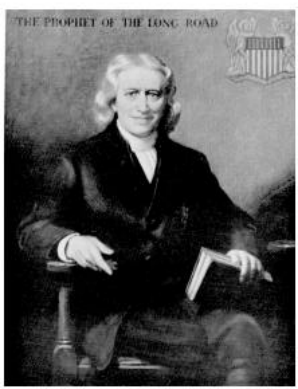
EDITORIAL STAFF
EDITORS
Elmer T. Clark, A.B., M.A., B.D., S.T.D., Litt.D., LL.D. — Secretary of the World Methodist Council; Secretary of the International Methodist Historical Society; Executive Secretary of the American Association of Methodist Historical Societies; Author of The Warm Heart of Wesley, An Album of Methodist History, etc.; Editor of What Happened at Aldersgate, etc
J. Manning Potts, A.B., M.A., Th.M., D.D. — Editor of The Upper Room; Member of the Executive Committee of the World Methodist Council and American Association of Methodist Historical Societies; Vice-President of the International Methodist Historical Society; President of the Southeastern Jurisdictional Methodist Historical Society; Collector of Asbury’s Letters.
Jacob S. Payton, A.B., B.D., D.D. — Sometime Washington Correspondent for The Christian Advocate; President of the Northeastern Jurisdictional Methodist Historical Society; Member of the Executive Committee of the International Methodist Historical Society and American Association of Methodist Historical Societies; Author of Our Fathers Have Told Us, The History of Methodism in Western Pennsylvania.
REGIONAL RESEARCH EDITORS
Frank Baker, A.B., M.A., Ph.D. — Executive Secretary of the Wesley Historical Society of Great Britain; Secretary of the International Methodist Historical Society; Author of A Charge to Keep, The Methodist Pilgrim in England, An Introduction to the People Called Methodists, Charles Wesley as Revealed by His Letters, etc. Albert Deems Betts, A.B., M.A., B.D. — Author of History of South Carolina Methodism.
Cullen T. Carter — President and Member of Commission on Historic Places and Relics of the Tennessee Conference Methodist Historical Society; Secretary of the Southeastern Jurisdictional Methodist Historical Society; Author of Methodist Doctrinal Beliefs, History of the Tennessee Conference of The Methodist Church.
John Owen Gross, D.D., L.H.D., Litt.D., LL.D., S.T.D., D.Sc.Ed. — Executive Secretary of the Department of Educational Institutions of the Board of Education of The Methodist Church.
Vernon Boyce Hampton, Ph.D., Litt.D. — President, Newark Conference Methodist Historical Society; Author of Francis Asbury on Staten Island, etc.
Wallace H. Harris, A.B., B.D., S.T.M. — Vice-President of the Northeastern Jurisdictional Methodist Historical Society; Biographical Secretary of the Philadelphia Conference Methodist Historical Society. Lewis O. Hartman, Ph.D., D.D., Litt.D., L.H.D. — Bishop of the Methodist Church; Librarian of the New England Methodist Historical Society. (Deceased.)
Brooks B. Little, A.B., M.A., B.D. — Editorial Associate and Librarian of The Upper Room; Associate Research Director and Collector of the Letters of Francis Asbury.
Isaac P. Martin, D.D. — Librarian-Historian of the Holston Conference Methodist Historical Society; Author of Elijah Embree Hoss, History of Methodism in Holston Conference, Church Street Methodists, A Minister in the Tennessee Valley.
Arthur Bruce Moss, A.B., M.A., B.D. — Pastor of Old John Street Methodist Church, New York City; Secretary of the New York City Methodist Historical Society.
Louis D. Palmer, B.A. — Author of Heroism and Romance: Early Methodism in Northeastern Pennsylvania.
Lawrence Sherwood, B.A., B.D. — Research Historian, West Virginia Conference Methodist Historical Society.
Wallace Guy Smeltzer, B.S., S.T.B., D.D. — Historian of the Pittsburgh Conference Methodist Historical Society; Vice-President of the Northeastern Jurisdictional Methodist Historical Society; Author of Methodism on the Headwaters of the Ohio.
William Warren Sweet, Ph.D., Litt.D., D.D. — Sometime Professor of American Church History at the University of Chicago and Southern Methodist University; Author of The Methodist Episcopal Church in the Civil War, Circuit Rider Days in Indiana, The Rise of Methodism in the West, The Story of Religion in America, Religion on the American Frontier, Methodism in American History, Virginia Methodism, A History, etc.
Lester A. Welliver, A.B., M.A., B.D., D.D., LL.D. — Sometime President of Westminster Theological Seminary; President of the Northeastern Jurisdictional Methodist Historical Society.
ASB_VOL1.PDF, p. 4
Acknowledgments
ATTENTION is called to the authorities cited in the footnotes and to the bibliography. The whole range of early Methodist literature, including periodicals, has been carefully searched. Contemporary maps have been studied to trace the routes of Asbury’s travels. For local details scores of histories of states, counties, cities, and churches have been ransacked. The archives of most of the states through which Asbury passed have been investigated, and archivists and librarians have been uniformly helpful. County historians and genealogists have been contacted; and these have searched the old public records for deeds, wills, and other documents that might throw light on passages in the Journal. The Editors have traveled widely in all the states to trace the exact movements of the great Circuit Rider. It would be impossible to mention by name the hundreds of persons who provided local data and co-operated with unfailing kindness in the vast volume of research which has gone into the production of the work. Without their help thousands of local facts would not have been secured. High credit is due to Mrs. Louise Stahl, my own secretary, who was responsible for a considerable part of the research and for drafting the whole Journal in its final form. She read numerous microfilms and photostats, accurately interpreted difficult handwritten documents, transcribed all the annotations, and with her helpers carried on the voluminous correspondence with the many persons who contributed much or little to the project.
Similar credit must be accorded to the Misses Annie and Clarice Winstead, secretaries to Dr. J. Manning Potts, for indefatigable work on the Letters. They co-operated in deciphering a large number of documents and transcribed all the Letters and the notes thereon.
In Washington the secretary to Dr. Jacob S. Payton, Miss Margery E. Rohman, rendered highly important service on large sections of the Journal. Proximity to the Library of Congress greatly enhanced her usefulness during the whole period of research.
Mr. Thoburn C. Lyon and Mr. Lewis Akin were responsible for making the maps used in this work. Each of Asbury’s trips in each state was traced on an outline map of the state involved, and the hundreds of maps thus resulting were furnished to Mr. Lyon for guidance. Our indebtedness to Mr. Erie Prior of Washington, the illustrator, is evident throughout the book.
To express suitable gratitude to all the persons who have co-operated in the present work would involve listing the ministers in nearly all the areas through which Asbury moved for nearly half a century. Among the hundreds who deserve the thanks of the Editors the following must be mentioned:
Georgia: Mrs. Z.W. Copeland, Professor E. Merton Coulter, Dean S. Walter Martin, The Rev. Dr. A.M. Pearce, North Georgia Conference Historical Society, Professor Robert C. Wilson.
Delaware And Maryland: Dr. William H. Best, Miss Annie P. Dalton, Mrs. S.J.L. DuLaney, Carlyle R. Earp, Dr. William M. Hoffman, Dr. Arthur J. Jackson, Ralph F. Martz, Dr. Walter M. Michael, Miss Hannah S. Parker, The Rev. Kenneth Ray Rose, The Rev. Edwin Schell, The Rev. Melvin Lee Steadman, The Rev. R.T. Thawley, Library of Congress, The Library of the Daughters of the American Revolution, Historical Society of the Peninsula Conference, Maryland Historical Society, Methodist Historical Society of the Baltimore Conference, The Rev. William O. Hackett.
Kentucky: The Rev. O.B. Crockett, Russell Dyche, Sr., C.H. Greer, W.S. Hudson, E.C. Watts.
New England: Mrs. William Kirk Kaynor, The Rev. Dwight H. McMahon, Mr. E. Farley Sharp, The Librarians of the Kent Memorial Library, The Public Library at Providence, R.I.
New Jersey: Dr. Lynn H. Corson, Dr. B. Harrison Decker, The Rev. Frank D. Dennis, The Rev. John L. Ewing, Dr. William R. Guffick, The Rev. Albert E. Hartman, The Rev. George T. Hillman, Walter W. Hoover, Dr. Roland L. Luerich, Loring McMillen, The Rev. Raymond E. Neff, Dr. John B. Oman, The Rev. Frank Ostertag, Dr. Olin Y. Shute, Dr. Harold N. Smith, Dr. Frank B. Stanger, Miss Laura Yetman, William H. Zelley.
New York: The Rev. C.W. Christman, The Rev. Robert H. Dolliver, Dr. Robert C. Hunsicker, Mrs. Elizabeth D. Meier, The Trustees of John Street Methodist Church, Bishop Frederick B. Newell, Miss Dorothy Woodruff.
North Carolina: Miss Alma Browning, Mrs. Mary L. Browning, The Rev. G.W. Bumgarner, W. Frank Burton, D.L. Corbitt, Department of Archives and History, Leon M. McDonald, Society of County Historians, Miss Amy Muse, S.T. Peace, William S. Powell, University of North Carolina Library, J.F. Pugh, Mrs. G.D.B. Reynolds, Stanley County Historical Society, Colonel Jeffrey F. Stanback, William S. Tarlton, Mrs. Stanley Whitaker, Mrs. Laura S. Worth, Randolph County Historical Society.
Pennsylvania: Dr. Raymond Martin Bell, Ellsworth H. Bringinger, The Rev. Charles C. Chayer, The Rev. A.L. Cliffe, Mrs. Gladys DuPuis, William H. Irelan, Miss Ernestine M. Kashlin, S.S. Lesh, The Rev. Howard N. Reeves, Jr., Miss Catherine T. Shulenberger, The Rev. Edgar F. Singer, L.E. Wilt, Dr. T. Kenneth Wood, Libraries of the Philadelphia Conference Historical Society, Pennsylvania Historical Society, The Friends’ Historical Society, The Germantown Historical Society, Delaware County Historical Society, The Historical Society of the Presbyterian Church, The Free Library of Philadelphia. South Carolina: Dr. J.H. Easterby, South Carolina Historical Commission, Miss Cora Page Godfrey, Herbert Hucks, Jr., Wofford College Library, Dr. R.L. Meriwether, Library of the University of South Carolina.
Tennessee: The Rev. Dr. E.P. Anderson, Judge W.W. Faw, Dr. Robert L. Kincaid, Judge H.B. McGinis, Mrs. James K. Taylor.
Virginia And West Virginia: Emory P. Barrow, Joseph Minton Batten (Deceased), Mr. and Mrs. H. Carstairs Bracey, Chaplain (Major- General) Charles I. Carpenter, Carroll C. Chowning, S.G. Cowan, Mrs. J.W. Dixon, Wallace R. Evans, R.H. Forrester, Bishop Paul Neff Garber, Miss Mabel F. Gardiner, The Library of Garrett Biblical Institute, Otis L. Gilliam, Garland E. Hopkins, J. Aubrey Hughes, H.H. Hughes, Frank A. Johnson, William A. Mabry, George Carrington Mason (Deceased), Mariner’s Museum, Fred Newbraugh, Mrs. Theodore G. Owen, Major T.T. Perry, Jr., George S. Reamey, Roland P. Riddick, Henley S. Roane, Ellis W. Shuler, John C. Simpson, C.A. Steiding, Leland B. Tate, C.L. Wilkins, L.H. Youell.
ASB_VOL1.PDF, p. 7
Introduction
Elmer T. Clark
THE place of Francis Asbury in American history is secure. In Washington there stands a noble equestrian monument of the great Circuit Rider which was unveiled and presented to the nation by the President of the United States, who said on that occasion: “His outposts marched with the pioneers, his missionaries visited the hovels of the poor, that all might be brought to a knowledge of the truth… Who shall say where his influence, written on the immortal souls of men, shall end?… It is more than probable that Nancy Hanks, the mother of Abraham Lincoln, had heard him in her youth. Adams and Jefferson must have known him, and Jackson must have seen in him a flaming spirit as unconquerable as his own… He is entitled to rank as one of the builders of our nation.” And Bishop Hamilton declared at the same ceremony: “He said, ‘I must ride or die.’ He printed the map of his ministry with the hoofs of his horse.”
At Drew University there stands another memorial in bronze, depicting the man and his horse. Several American cities and towns, and numerous streets are called “Asbury.” Many artists painted him in various moods and at different periods in his career. Across the land hundreds of churches and thousands of individuals bear his name, and notable institutions have been named for him. In stained-glass windows in many places the worshiping multitudes look into his blue eyes. In England his boyhood home has been designated as a notable site of history to be preserved by the Corporation which knew him as a lad.
Asbury was one of the greatest explorers of the American frontier. He was more widely traveled than any other man of his generation, and was known by more people. He was the welcome visitor in thousands of humble homes, and such notables as Washington, Meriwether Lewis, Ramsay, Rembert and Calhoun of South Carolina, Gough of Maryland, Bassett of Delaware, General Russell of Virginia, Governor Tiffin of Ohio, Lieutenant Governor Van Cortlandt of New York, and a multitude of others were numbered among his friends. For nearly fifty years he had no home save the road, and but a few months before his death he told a British correspondent that his mailing address was simply “America”; any postmaster would know that “the man who rambled America” would in due time pass that way. More than sixty times he crossed the eastern mountains; his annual circuit stretched from New England or New York to Charleston; his total mileage was more than a quarter of a million. As the bearer of a moral culture and its civilizing consequences to the frontier settlements of America, Francis Asbury has no peer in history. He and his circuit riders went into every new community and nearly every log cabin in the wilderness; they were never more than a few weeks behind the earliest pioneers. In their saddlebags they carried the fundamentals of civilization—the Bible, the hymnbook, and religious literature of a varied nature. They brought news of the outside world. They fought intemperance and every form of wrongdoing; and they made godly, law-respecting citizens out of people who might otherwise have been ruffians. Asbury preached a gospel of personal salvation, as did all others in his day. Our modern social problems and the so-called “social gospel” did not exist. But on nearly every page of his Journal there is evidence of his keen social conscience, and his message bore fruit in social betterment. Asbury was the educational pioneer of his day. He has long been credited with having established the first Sunday school in America. His preachers, most of whom had little formal education, were required to preach annually on education. Furthermore, they dotted their wide circuits with schools. As early as 1780, as will be noted in the Journal, a plan was drawn and money given for a school in North Carolina, although it was not opened for several years. In Virginia, Georgia, Kentucky, and both the Carolinas, Methodist schools were established; and the General Conference which organized the Church also founded a degree-conferring college in Maryland.
“How many institutions of learning, some of them rejoicing in the name of Wesleyan, all trace the inspiration of their existence to the service and sacrifice of this lone circuit rider!” exclaimed President Calvin Coolidge. Across the years Asbury’s successors have established hundreds of schools and colleges in practically all the states. Many of these were suspended when the progress of public education, learning from the preachers, rendered them no longer necessary; but they blazed the way and laid down the challenge to the states. More than 150 of them are in operation today, and some of these are among the greatest in America.
In 1789 Asbury was instrumental in starting a publishing house which today is the world’s largest religious publisher. In the same year he started a periodical which, under different names and with some lapses, has continued until this day. At once books and papers began to pour from the presses in a stream which has been constantly increasing in volume for more than a century and a half and is today far greater than it has ever been. He may almost be said to deserve the title of American Publisher Number One.
Such contributions give Francis Asbury a lasting and unique place in the history of the New World.
ASBURY’S EARLY LIFE
It has been pointed out that John Wesley’s intemperate attack on the American cause in his Calm Address to the American Colonies cost the great founder of Methodism his influence in the New World.1 Francis Asbury inherited that influence. He became the organizing genius and virtual father of American Methodism, and “the second man in Methodist history,” as Dr. James Dixon called him, second only to John Wesley himself. Wesley’s greatest biographer, Tyerman, regarded Asbury “with an almost equal veneration,” and declared that “if the reader wishes to see his monument, we invite him to step within the living walls of the present Methodist Episcopal Church of America, and there, while surveying the grand edifice of spiritual order and beauty, we ask him, as the inquirer in St. Paul’s Cathedral is asked, to ‘look around.’”2
His Journal and Letters and the annotations thereto cover his entire career except sections of his early life in England and his last days following the end of his record; and while no interpretative biography is here intended, there seems to be need for information covering these sections3 even though it covers ground already familiar to informed students. Elizabeth and Joseph Asbury were poor but godly parents whose home was open to the preachers and whose hearts were turned seriously to religion by the death of a small daughter, their only other child. Francis was sent to school at Snails’ Green, a mile away from the family home on Newton Road; and he was so apt in his studies that he could read the Bible at the age of six or seven years. The schoolmaster was a tyrant, however, and the boy’s formal education ended when he was thirteen years old. For a few months he was in service in the home of a prosperous but irreligious family, and then he became an apprentice at the Old Forge nearby. His immediate superior at the forge was a Methodist named Foxall. The work was of the manual sort, and all biographers have pointed out that the muscular strength developed by the hard labor admirably equipped Asbury for the tasks which were later to face him in the American wilderness. He also became an intimate of the superintendent’s son, Henry Foxall, who in after years became a rich iron merchant in America and built and named the Foundry Church in Washington, reminiscent of the forge in England and the business in which the donor had prospered. Bishop Francis Asbury dedicated the noted premises in 1810.
The Asburys attended the parish church at Great Barr, which was a chapel- of-ease to Aldrich, and also All Saints’ Church in West Bromwich. At the latter the young man heard the famous Edward Stillingfleet, who sympathized with and participated in the Wesleyan Revival. Among the parishioners was the rich and pious Earl of Dartmouth, who was a friend of Selina, Countess of Huntingdon, and whose seat at Sandwell Hall was open to the evangelical preachers like George Whitefield and Howell Harris, who were patronized by the Countess. Asbury himself has pointed out that he heard many notable preachers such as Ryland, Talbot, Mansfield, Hawes, and Venn.
Young Asbury naturally heard of the Methodists through Foxall and others, and with his mother’s consent he attended one of their services at Wednesbury. This town was the scene of the bitterest persecutions which Wesley and his preachers had endured, and a large society developed there. It was embraced in the Staffordshire Circuit and under the ministry of Alexander Mather, who was to become the second president of the British Conference after the death of John Wesley. Asbury was most favorably impressed by the singing and the extemporaneous nature of the prayer and sermon.
Among Asbury’s other intimates during the period were William Emery, Edward Hand, Thomas and Jabez Ault, James Bayley, Thomas Russell, and Richard Whatcoat, all of whom are mentioned in Methodist annals.4 He was converted while he and young Emery were praying in the old barn at the Asbury home. In a matter of weeks he was reading the Scriptures and giving out the hymns in the women’s meeting to which he accompanied his mother, and soon he was exhorting. At the age of eighteen he became a local preacher and delivered his first sermon while standing behind a chair in a cottage near Manwoods, a quarter of a mile south of Forge Mill Farm, a house erected in 1680 by a great-uncle of Dr. Samuel Johnson. Events now moved rapidly. Asbury was still a blacksmith, but he says that he traveled widely through the region and preached several times each week. In 1766 he left his work and took the place of an ailing itinerant for nine months in Staffordshire and Gloucestershire. During this service he was rebuked gently by the “assistant” or preacher in charge of the Staffordshire Circuit, W. Orp, because of certain alleged neglect.5 The following year he was admitted on trial as a traveling preacher and appointed to the Bedfordshire Circuit. Other assignments followed regularly: 1768, in full connection and appointed to Colchester; 1769, Bedfordshire again; 1770, Wiltshire. Up to this time it appears that Asbury had never attended a conference.6 But he had served well and made many friends.
Asbury seems to have had a sweetheart at Great Barr, named Nancy Brookes; and Dr. Tipple said that their romance was broken off by his mother.7 The message that he sent to his “dear heart” in a letter to his mother seems to indicate that she took offense because he left abruptly without seeing her, although he tried to do so.8 He apparently treasured his memories of her and declared that “what once befell me in England” was the first cause of his life-long celibacy,9 although in later years he mentioned other reasons.
The fact that Asbury was held in affection by those among whom he ministered is attested by letters from his parishioners at Whitchurch and a preacher who in 1768 had served the Staffordshire Circuit on which Asbury’s parents lived, but who at the time of writing was stationed in London.10
Such was the twenty-six-year-old man who attended the Bristol Conference in 1771 and answered, “Here am I, send me,” when John Wesley declared, “Our brethren in America call aloud for help.” Francis Asbury was five feet and nine inches tall. He was a slender man, with bright and piercing blue eyes and a lofty forehead with flowing fair hair; his voice was clear and full, his presence dignified and commanding. It surprises many people to learn that he had a preference for light blue clothing,11 He was a deeply serious man, though he had his moments of levity. His Journal is filled with references to his illnesses, and he suffered prolonged sickness on more than one occasion. Asbury was in general a robust and healthy man, and the fact that he traveled constantly and endured incredible hardships for nearly fifty years is proof enough of his strong constitution.12
BUILDING THE CHURCH
Francis Asbury holds first place as the builder of American Methodism. Others were in the New World before him and more followed him, but to this day none rivals him as the supreme factor in establishing the church and enabling it to sweep the land in the face of manifold difficulties. He has never had a peer in American Methodist history, just as John Wesley has had none in Britain.
His greatest contribution was his successful insistence upon the principle of itinerancy, which he learned from Wesley. This was undoubtedly the secret of Methodism’s amazing success during the frontier period. As the Journal reveals, he had been in the country only three weeks when he discovered the preference of the preachers for the city, and with prophetic insight he discerned that this would mean failure for the evangelical movement. So the new arrival did not hesitate to rebuke his superiors and seniors. They did not want to leave the cities, but he would show them the way! He desired “a circulation of preachers, to avoid partiality and popularity!” “I am fixed,” he wrote, “to the Methodist plan, and do what I do faithfully as to God. I expect trouble is at hand. This I expected when I left England, and I am willing to suffer, yes to die, sooner than to betray so good a cause by any means.”
Thus stubbornly did he stand against those who presumably knew America better than he did. In the end he won, and the Conference adopted a time limit of six months for the preachers, with three months for those in New York. Under this rule they rode the eastern seaboard and continued everywhere, until the words “Methodist circuit rider” became and remained a part of the American vocabulary. Not otherwise could they have kept up with the advancing frontier. They were responsible for the amazing growth of Methodism in America. They moved with the pioneers everywhere, and their Church far outgrew the population and outstripped those which had been established a century or more before the Methodists came. Asbury was called a dictator, and in a sense the charge was not wholly unfounded. When Dr. Thomas Coke came to ordain him and set up the Methodist Episcopal Church, Asbury insisted upon a democratic election, but he did not administer in democratic fashion. Had he done so, he might have averted some misunderstandings and schisms; but his church would not have spread to the Father of Waters and grown from 1,000 to 200,000 members in his lifetime. His control of the preachers and their appointments was the main element in this success, and he could not have exerted such control and escaped the charge of tyranny.
But if he was a dictator, he exercised a benevolent dictatorship. He loved his preachers next to God. He accepted the same small salary, endured the same hardships, lived the same life, and traveled more than any of them. He asked nothing of them that he did not impose on himself; and they knew that if he sent them on hard rounds, he had already made harder rounds and would make more. There were little rebellions, but they came to nothing. The schism led by O’Kelly was serious at first, leading even McKendree away for a brief period, and it gave the church a temporary setback; but when the Methodists numbered ten million souls, the O’Kellyites had grown not at all and had barely been able to survive.
If Francis Asbury was a dictator, he learned the art from John Wesley; and his dictatorship saved Methodism and built it into the largest Protestant body in all the land.
ASBURY’S JOURNAL
For more than a hundred years the great church which Francis Asbury built neglected his writings; his letters were never collected and his famous Journal, the basic document of the church, became unknown to two generations of people. In 1951 the National Historical Publications Commission of the United States Government included Asbury among the sixty-six great Americans whose works the body recommended for proper editing and publication, along with Washington, Jefferson, Adams, Lincoln, and the other immortals of the land. That recommendation was accepted by two Presidents and both Houses of Congress.
Then world Methodism moved in the matter. In September, 1951, the World Methodist Council at Oxford, England, acting unanimously on a report of its affiliated International Methodist Historical Society, endorsed the preparation of a Standard Annotated Edition of the Journal and Letters of Francis Asbury, and the implementation of the resolution was turned over to the Association of Methodist Historical Societies in the United States.
Following the example of John Wesley, Asbury opened his Journal on the ship which carried him to the New World. He continued it until he could no longer move unaided; and the pen fell from his faltering fingers at Granby, South Carolina, on Tuesday, December 7, 1815, three months and seventeen days before his death. From his Letters it will be observed that he expected what he had written to constitute something like a history of the Methodist movement in America during the early period. He was well aware of his literary shortcomings and took the most careful steps to ensure that his Journal would be in the best form when it was published. To this end he enlisted the aid of some of the outstanding Methodists of the day in selecting and editing the material to be preserved. Just what was eliminated we do not know, but much was undoubtedly discarded. A glance at one of the documents written by his own hand will show that extensive editing was necessary to cast his manuscripts in proper form.
The first publication of any part of Asbury’s Journal consisted of extracts which were printed in the Arminian Magazine. This publication, fashioned after the periodical of the same name started by Wesley in England, was launched by Asbury and John Dickins in Halifax County, North Carolina, in 1788. The first volume appeared the following year, and there was a second in 1790; both were printed in Philadelphia under the editorship of Dickins, who thus became the first publishing agent of American Methodism. The periodical was then discontinued, to be revived in 1818 under the name of the Methodist Magazine.
In the first volume of the Arminian Magazine Asbury published an extract from his Journal covering the period of August 7, 1771, to February 27, 1772. In the second appeared the Journal from March 26, 1772, to April 14, 1773. These extracts are of considerable interest because (1) they contain the full names of most of the persons who are referred to by initials only in the Journal which was published in book form thirty years later, and (2) they contain numerous passages which were omitted from the three-volume Journal which first appeared in 1821. Reference is made to these hereunder in the explanation of the method of the present work. The Journal passed through many later hands. On one occasion all or part of the manuscript was lost; in a letter to Ezekiel Cooper on October 4, 1798, Asbury declared that he had left his “long lost manuscript journal” with Mrs. Betsy Dickins, widow of the recently deceased John Dickins. Probably Dickins and his wife were the first editors. Dickins was educated at Eton and London, drew the plan for the first Methodist school in America, edited the first Discipline in the present form, edited the Arminian Magazine and its successor, the Methodist Magazine, and was the first book editor and publishing agent of American Methodism. He was well qualified to serve as redactor of his chief’s literary remains. Asbury paid a hundred dollars to a second and unknown man who corrected his papers.13
Then Thomas Haskins worked on them. He was a notable Methodist of the period, a member of the Christmas Conference in 1784, whose diary now reposes in the Congressional Library at Washington. His wife was Martha Potts, the granddaughter of Mrs. Rebecca Grace of Pennsylvania, who entertained Washington and his officers when the army was encamped at Valley Forge; she refused the marriage proposal of Benjamin Franklin because of his religious beliefs, or lack of them, but at his request she sat by his bedside when he died and pointed him to “the Lamb of God that taketh away the sins of the world.”14
Others who assisted Asbury with his documents were Joseph Lanston, Dr. Henry Wilkins, and Mrs. Ann Willis. Lanston was a preacher of prominence and the spiritual father of Henry Willis.
Dr. Wilkins was born in Annapolis, Maryland, in 1767, the son of Joseph Wilkins, who was a pioneer Methodist in Anne Arundel County before he moved from Annapolis to Baltimore. Dr. Wilkins was the editor of a book of family remedies entitled The Family Adviser; or, A Plain and Modern Practice of Physic; Calculated for the Use of Families Who Have Not the Advantages of a Physician, And accommodated to the Diseases of America, To Which is Annexed Mr. Wesley’s Primitive Physic. This book passed through several editions and had a large circulation among Methodists and the general public. It contained a preface addressed “To the Members of the Methodist Episcopal Church” and signed by Coke and Asbury. Dr. Wilkins was the host of the sick Bishop McKendree at his home north of Baltimore when John Wesley Bond’s messenger brought news of the death of Asbury.15
Ann Willis was the cultured widow of Henry Willis, the first preacher on whom Asbury laid ordaining hands, the daughter of Jesse Hollingsworth, a leading Baltimore merchant, and a sister of Francis Hollingsworth, the final transcriber of Asbury’s Journal.16
Francis Hollingsworth was the last editor through whose hands the Asbury documents passed. He prepared the prefatory statement, “Notice of the Transcriber,” and sent the material to the press. He lived near Baltimore and was a member of a prominent Methodist family. That he had the cultural ability to edit the Journal is brought out by a statement in the Journal of Bishop Beverly Waugh under the date of November 25, 1825: I called in the afternoon to see Mr. Francis Hollingsworth, a man of eccentricities, but possessing a mind highly cultured. He was the particular friend of the late venerable Asbury. I found him sitting by his table upon which his Bible and spectacles were laid. After some conversation relative to his health, he remarked that he saw clearly that he was afflicted. He had not read the Bible as much as he should have done; that such had been his fondness for literature that he had been too much occupied in examining Greek, Latin, French, and Spanish works.17
Asbury and Hollingsworth met at York, Pennsylvania, on June 29, 1815; and the bishop made this entry in his Journal: “I sit seven hours a day, looking over and hearing my transcribed journal; we have examined and approved up to 1807… I have buried in shades all that will be proper to forget, in which I am personally concerned.” Asbury had previously printed the extracts from his Journal up to 1780, and copies of this edition are in the Library of Congress and at Westminster Theological Seminary. It has been said that an “extension” of that extract was printed later, but such has never come to light. In Hollingsworth’s “Notice of the Transcriber,” which is included in this work, it will be seen that he did not see the published extract of Asbury’s Journal but confined his work wholly to the period following 1780. He points out that Asbury’s manuscript contained numerous errors of chronology and mistakes in the names of persons and places, and expressed the fear that his editorial work was not always correct.
Having undergone the scrutiny and revision of the numerous persons above-mentioned, the Journal, including the previously printed extract up to 1780, was published in 1821 by Nathan Bangs and Thomas Mason, the Methodist publishing agents at New York. It was reprinted in 1852 and again reprinted about two years later without date.
But before the first edition was published, there was another episode in the history of Asbury’s documents.
At the Baltimore Conference in March, 1817, Bishop McKendree presented the matter of a biography of Bishop Asbury, to which the conference responded by naming a committee to carry the plan into execution. The committee, composed of N. Reed, S.G. Roszel, J.W. Wells, W. Ryland, and Dr. Henry Wilkins, employed Samuel K. Jennings, M.D., who had been president of Asbury College at Baltimore, to prepare the volume. The unpublished manuscript of the Journal, other papers secured by Bishop McKendree from Hollingsworth, “one small package sent from the west by Mr. Thomas L. Douglass,” and twenty-five letters were turned over to Dr. Jennings as materials for the biography.
In 1818 Jennings outlined his plan orally to the conference, and it was “favorably received.” The following year he reported further progress, and in June of that year he delivered a manuscript of 269 pages to a special committee which had been appointed to consider it. This committee read the document twice and unanimously decided that it was not worthy of publication. This episode led to an unfortunate controversy. Dr. Jennings contended that the material delivered by him to the committee was not a finished biography of Asbury but a collection of notes and data from which a biography was to be prepared, and he charged the committee with prejudice because of his Reform principles which later led him to become one of the founders of the Methodist Protestant Church. The arguments for the committee were published in the Methodist Magazine (1831, 82-94), to which Dr. Jennings’ supporters replied in the appendix of his book An Exposition of the Late Controversy in the Methodist Episcopal Church (230-47).
Dr. Jennings reclaimed his materials and declined to deliver them again to the committee, and the final disposition of his manuscript or notes is not known. He returned the Journal, letters, and other materials to the committee. A number of the letters had been secured by John Emory, who later became a bishop; and his papers were deposited in the Emory Collection at Drew Theological Seminary. The manuscript Journal was burned in a fire which destroyed the publishing house in 1836. The Journal of Jesse Lee was lost in the same fire.
EDITORIAL METHOD
The above history of Asbury’s Journal largely determined the method employed by the Editors in producing the present work. They were not dealing with original manuscripts but with printed materials which had already been edited by several persons. Numerous alterations had admittedly been made, and there were numerous admitted inaccuracies. Asbury had little formal education, and his written documents had literary crudities and grammatical errors. His published letters were carefully edited. It was not possible to print his original work, and the Editors were not concerned about adhering exactly to the work of Hollingsworth. The purpose has been to produce an accurate and readable edition of Asbury’s Journal, never deviating from the bishop’s words and meaning but without perpetuating the chronological, biographical, geographical, and grammatical errors which appeared throughout the earlier transcription. In this the Editors followed the advice of experts in the field, especially the officials of the National Historical Publications Commission. It will be recalled that Hollingsworth mentioned the fact that he found certain chronological errors in Asbury’s manuscripts. These were indeed numerous. All the dates in the first edition of the Journal were carefully checked with Fitch’s The Perfect Calendar for Every Year of the Christian Era (Revised Edition, 1930), and it was discovered that more than three hundred mistakes were left by Hollingsworth in the first volume alone. Most of these were corrected in the second edition published in 1852, an indication that further editorial work was done after Hollingsworth. Many of these errors remained, however, and they were corrected without footnotes in the present work.
Scripture quotations were likewise checked, and numerous mistakes were found. These were also corrected without comment when possible. The names of all persons and places which were referred to by their initials only were inserted in the text when they could be identified. An interrogation (?) was added when identification was highly probable but not actually established.
Mention has been made above of the differences among the extracts which Asbury published in his own lifetime in the Arminian Magazine. These concerned the names of persons and places as well as several sentences which were omitted from the text as published by Hollingsworth. Inasmuch as the magazine extracts antedated the first printed Journal by thirty-two years and were evidently inserted by Asbury himself, the Editors have in general followed the magazine in the matter of the names, and they have included the omitted sentences in brackets.
ASB_VOL1.PDF, p. 10
Notes (17)
- Lewis, Francis Asbury, 11. ↩
- Tyerman, Life and Times of John Wesley, III, 250. ↩
- A sketch of Asbury’s life after he closed his Journal at Granby, South Carolina, on December 7, 1815, will be found at the end of the present work. ↩
- See Briggs, Bishop Asbury, ch. 2. ↩
- See the letter from W. Orp, May 23, 1766, in the Letters; also The Methodist Magazine, 1831, 189-91. ↩
- Briggs, op. cit., 23. But see note on the first entry in Asbury’s Journal. ↩
- Tipple, Francis Asbury, the Prophet of the Long Road, 316. ↩
- See Asbury’s letter to his parents, October 26, 1768. ↩
- See the letter to his parents June 7, 1784. ↩
- See the letter from his four parishioners on August 27, 1771, and the letter from the Rev. John Allen on January 20, 1772, in The Methodist Magazine, 1831, 194-96. ↩
- See his letter to George Roberts on June 6, 1801. ↩
- For descriptions of Asbury see Tipple, op. cit., 302-7; Briggs, op. cit., 3; Stevens, Memorials of Methodism, 145. ↩
- See letter dated June 26, 1801. ↩
- See Journal note under June 23, 1776. ↩
- Smith, Recollections of an Old Itinerant, 266-68; Paine, Life and Times of Bishop McKendree, 182. ↩
- Warriner, Old Sands Street Church of Brooklyn, 76; Roberts, Centenary Pictorial Album. ↩
- In his Centenary Pictorial Album, 56, Roberts says that the inscription at Hollingsworth’s grave states that he “died on February 4, 1826, age 32 years and six months.” He would thus have been only twenty-eight years old when he completed his work on the Journal, and only thirty-two when Waugh visited him. Miss Annie P. Dalton of Baltimore thinks that Roberts probably mistook the date of birth, 1773, for 1793, and that Hollingsworth finished the Journal at the age of fifty-two. ↩
Advertisement
THE FOLLOWING IS THE PREFACE WHICH MR. ASBURY PREFIXED TO THE FIRST NUMBER OF THE SECOND VOLUME OF HIS JOURNAL,
WHICH WAS PRINTED DURING HIS LIFETIME.
IN the month of September, in the year of our Lord one thousand seven hundred and seventy-one, I embarked in England for America; at which time the memoirs I have written of my life commenced. As I considered my station on the American continent, in the order of Divine Providence, as a situation in which I should frequently be exposed to censure and jealousy, I thought it highly expedient, for my own satisfaction and the confirmation of my friends, to keep an impartial diary of my intentions, resolutions, and actions, as a Christian and a minister, that I might have, through this medium, a constant and reasonable answer for mine accusers. From the nature and design of the work, it must have in it many things both unpleasing and uninteresting to curious and critical readers; and perhaps some things exceptionable even to those who enter into its spirit, and read it with affection. In keeping a journal of my life, I have unavoidably laboured under many embarrassments and inconveniences; my constant travelling, the want of places of retirement and conveniences to write, my frequent calls to the pulpit, my extensive epistolary correspondence, and my debility, and sometimes inability of body, have all been inseparable from my station in the Church, and so many impediments to the perfection of the account of my labours and sufferings in this country. The first volume of the extract of my journal was published, many years after it was written, under the management of others, it being out of my power to attend the press, or even to read over the copy before it was printed:1 several inconveniences attending that volume will be avoided in this. For many years I did not determine to publish a second volume of the extract of my journal: but the advice of my friends, and the prospects of my approaching dissolution, have determined me on its publication.2 As I have had no certain dwelling-place in America, my manuscripts have frequently been exposed to be lost and destroyed; but, by the permission of Divine Providence, I have collected them together.
The Methodists of late years have become a more numerous body, consequently more obnoxious to their enemies. The Scripture is fulfilled even amongst us, “Also of your own selves shall men arise, speaking perverse things, to draw away disciples after them.” Some, who were for a long time our confidential friends and fellow-labourers, are now become our most inveterate foes, and have written and published books against our characters, government, and discipline. And as I am considered the most ostensible character in the Methodist Church in America, I have frequently to bear the greatest weight of their invectives. But impartial readers will not, I am persuaded, give an implicit assent to the asseverations of those who may be under personal resentment against the body, or individuals, without duly considering the possibility of their being influenced by self-interest, jealousy, or prejudice. And as I have been (under God and my Brethren) the principal overseer of the work in America, and have constantly travelled from the centre to the circumference of the Connexion, I flatter myself that reasonable men will acknowledge that I have always had an opportunity of obtaining better information relative to the true state of the whole work than any other man could possibly have. Would it not then be highly injudicious to prefer a history of Methodism, written by men of small and contracted information, (and apostates from its principles,) to such a history of its progress as will be presented to the public in my journals? And, if I may be credited, I can declare, that in the critical and delicate circumstances that I have been necessitated to stand in relative to the characters of men, I have never knowingly deviated from the principles of that sacred charity which obligates us to treat each other with all possible tenderness.
If I have injured the character of man, woman, or child, in journal representation, I have done it inadvertently, and sincerely ask their pardon. In stationing the preachers I have known no man after the flesh; but have, to the utmost of my power, endeavoured to keep an eye to the glory of God, the usefulness of the ministry, and the benefit of the people. I have attempted to give a simple narration of facts in the integrity of my heart, and in the fear of God.
My intention is, as much as possible, to remove every hinderance out of the way, and to give no occasion for offence to any man. But if, after all, my attempts prove unsuccessful, I can, in the approbation of my own heart, and in the company of my old, faithful, and constant American friends and brethren, through the medium of my journal, look back upon what God has wrought, and say, “Hitherto the Lord hath helped.” We can thus comfort and console ourselves with the past lovingkindness of the Lord; and the years in which his right hand hath been bare, will thus, to us, be rendered more delightful.
I had thoughts of leaving my manuscripts to the executors of my will, to be published by them after my death, but found, upon reconsideration, that their contents respecting persons and things were of such a nature that no person could do it so well as myself.3 Should my life be spared, the volumes will be brought forward in course. As soon as one is disposed of, another will be put to press, until the whole is published. FRANCIS ASBURY
ASB_VOL1.PDF, p. 23
Notes (3)
- This volume, now reprinted, was corrected by the author. ↩
- This determination was not carried into effect, except one small number, which is now republished with the corrections of the author. ↩
- The greater part of the journal which follows was left in manuscript, but revised under the author’s inspection as far down as the year 1807. See the Notice of the Transcriber. ↩
Notice of the Transcriber
THE name of the venerable author of the following journal will create for the work so deep and enduring an interest, in the hearts and minds of those for whom it was more especially prepared, that it becomes proper the transcriber should give some account of the manner in which he conducted the work of transcribing, so that those who are concerned may have satisfactory assurances of its genuineness. The ill health by which Bishop Asbury was so much of his life a sufferer; the crowds in which he was too often compelled to live in the west and south; the succession of visitors he thought it his duty at all times of leisure to receive; his ministerial labours; and, above all, the constant occupation of mind which the important concerns of a Church, so great in membership, so widely extended and rapidly increasing, necessarily occasioned, left the first Superintendent of that Church few means of rendering his journal more perfect. The transcriber has not attempted to improve it by giving his own for the author’s. Some things in the original work he has taken the liberty of leaving out of the transcript; but there are not many of these, and they are most of them in that part of it which the bishop himself examined during his life. The transcriber not unfrequently found a confusion of dates; and sometimes, as he thinks, a mistake in the names of persons and things, more especially in the author’s geographical notices of the districts through which he made his annual tour; the emendations, in this last particular, are not, it is to be feared, always correct. In places where the author has left, by inadvertence, a sentence unfinished, a thing not uncommon, the transcriber has always tried to supply what was wanting; and where hurry has occasioned evident mistake, as is the case in a few instances, he has ventured upon correction; but he is not sure that in every attempt he has been successful. To those persons yet living, who had, by habits of intimacy with Bishop Asbury, become acquainted with the peculiarity of his conversational and epistolary manner of expressing himself, the style of the present work may not be so pleasing; because it is not so exactly the style they expected—not so decidedly the bishop’s. But they must recollect that the author’s intention in keeping his journal was, to make a faithful record for posterity; and the transcriber never forgot that its value, in this respect, would be better understood and more highly appreciated by those who can only know the author by his work. The abruptness of sentence in its beginning or its break—the sudden light flashed upon a subject by a suggestion conveyed in words few and strong; the names, descriptive as painting, he was wont to bestow upon persons and things—all these live only in the memory of his surviving friends; and with them must pass away; but that which is of more importance—the identity of Bishop Asbury in the commencement, the continuance, and wonderful increase of Methodism in this country, will give a perpetuity of interest in the record here offered which nothing else can give. The transcriber would not, however, have it supposed that he has entirely departed from Bishop Asbury’s style; on the contrary, he presumes he has been enough observant of this to satisfy most readers, inasmuch as the bishop himself, when he examined what had been transcribed up to 1807, altered but once, and then not much. The public may rest assured that the work is the author’s: but here the transcriber must be permitted to speak in the first person. When I give this assurance, I must be understood to mean from the year 1780 to the end of the journal; the original manuscript of all that preceded that date, I never saw: I only know that when printed it did not please the author. The journal of Bishop Asbury might have been better. I once ventured to express my unavailing wishes to him that he had left out many of the uninteresting incidents and travelling notices we find in it, and had put in more of the deep reflections and acute remarks on men, books, and passing events continually afloat in his powerful and observant mind; and that, for the sake of his brethren in the ministry who should follow him, he had made the skeletons of his sermons more perfect, and had added many more. His reply, uttered with much feeling, would have satisfied every candid mind that it was by no ordinary effort so much had been done.
F. HOLLINGSWORTH
March 28, 1821
ASB_VOL1.PDF, p. 26
Chapter 1816 closing account (vol. 2)
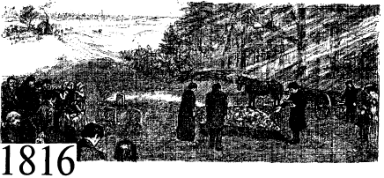
Burial of Asbury in the burying-ground
of George Arnold
A SHORT ACCOUNT OF HIS DEATH
By Francis Hollingsworth
Here the journal of Bishop Asbury closes. And having followed him through such a laborious and useful, and, very often, suffering life, it is thought the reader would be gratified in following him to his grave, that he might witness the end and final triumph of this apostolic minister of the Lord Jesus. The editors, therefore, take the liberty of subjoining a short account of the last moments of this great and good man. His character, as it was exhibited in the various relations of life he sustained, we leave to his biographers, who, it is hoped, will soon favour the Christian world with a faithful portrait of Bishop Asbury, both living and dying. The following sketch of the closing scene of his life is taken chiefly from the minutes of the conferences for the year 1816, the only documents now in our possession from which authentic information, in reference to this subject, can be derived.
It seems that, notwithstanding his extreme debility, which could not be witnessed without awakening the liveliest sensibilities, he flattered himself with the prospect of meeting the ensuing General Conference, which was to assemble in Baltimore on the 2d of May, 1816. In this expectation he was, however, disappointed; the disease with which he was afflicted, terminating in the consumption, made such rapid progress as to baffle the power of medicine, and to prostrate the remaining strength of a constitution already trembling under the repeated strokes of disease, and worn down by fatigue and labour. He appeared, indeed, more like a walking skeleton than like a living man.
His great mind, however, seemed to rise superior to his bodily weakness, and to bid defiance to the hasty approaches of dissolution. Hence, impelled on by that unquenchable thirst to do good, by which he had been actuated for more than fifty years, he continued with his faithful travelling companion, John W. Bond, in a close carriage, to journey from place to place, as his exhausting strength would permit, frequently preaching, until he came to Richmond, Virginia, where he preached his last sermon, March 24, 1816, in the old Methodist church. Previous to his entering upon this last pulpit exercise, perceiving his great weakness of body, some of his friends endeavoured to dissuade him from preaching; but he resisted their dissuasions by saying that he must once more deliver his public testimony in that place: yielding their own tenderness for his temporal welfare, to his desire to proclaim once more the counsel of his God, they carried him from his carriage in which he rode—for he was unable either to walk or stand— to the pulpit, and seated him on a table prepared for that purpose. Though he had to make frequent pauses in the course of his sermon, for the purpose of recovering breath, yet he spoke nearly an hour with much feeling from Romans 9:28: “For he will finish the work, and cut it short in righteousness: because a short work will the Lord make upon the earth.” This closed his public labours on the earth. The audience was much affected. Indeed how could it be otherwise? To behold a venerable old man, under the dignified character of an ecclesiastical patriarch, whose silver locks indicated that time had already numbered his years, and whose pallid countenance and trembling limbs presaged that his earthly race was nearly finished: to see in the midst of these melancholy signals of decaying nature, a soul beaming with immortality, and a heart kindled with divine fire from the altar of God:—to see such a man, and to hear him address them in the name of the Lord of hosts, on the grand concerns of time and eternity! what heart so insensible as to withstand the impressions such an interesting spectacle was calculated to produce?
After having delivered his testimony, he was carried from the pulpit to his carriage, and he rode to his lodgings.
On Tuesday, Thursday, and Friday, he journeyed, and finally came to the house of his old friend, Mr. George Arnold, in Spottsylvania. It was his intention to have reached Fredericksburg, about twenty miles farther, but the weather being unfavourable, and his strength continuing to fail, he was compelled to relinquish his design, and accordingly he remained under the hospitable roof of his friend, Mr. Arnold. Hearing brother Bond conversing with the family respecting an appointment for meeting, he observed that they need not be in haste. A remark so unusual with him gave brother Bond much uneasiness. As the evening came on his indisposition greatly increased, and gave evident intimations that his dissolution could not be far distant. About three o’clock next morning he observed that he had passed a night of great bodily affliction.
Perceiving his deep distress of body, and anxious to retain him as long as possible on the shores of mortality, his friends urged the propriety of sending for a physician; but he gave them to understand it would be useless, saying, That before the physician could reach him his breath would be gone, and the doctor could only pronounce him dead! Being asked if he had anything to communicate, he replied, That, as he had fully expressed his mind in relation to the Church in his addresses to the bishop and to the General Conference, he had nothing more to add.
About eleven o’clock on Sabbath morning, he inquired if it was not time for meeting; but recollecting himself, he requested the family to be called together. This being done agreeably to his request, brother Bond sung, prayed, and expounded the twenty-first chapter of the Apocalypse. During these religious exercises he appeared calm and much engaged in devotion. After this, such was his weakness, he was unable to swallow a little barley water which was offered to him, and his speech began to fail. Observing the distress of brother Bond, he raised his dying hand, at the same time looking joyfully at him. On being asked by brother Bond if he felt the Lord Jesus to be precious, exerting all his remaining strength, he, in token of complete victory, raised both his hands. A few minutes after, as he sat on his chair, with his head reclined upon the hand of brother Bond, without a struggle and with great composure, he breathed his last, on Sabbath, the 21st1 day of March, in the year of our Lord 1816, and in the seventy-first year of his age:—after having devoted to the work of the ministry about fifty-five years, forty-five of which were spent in visiting the cities, villages, and wildernesses of North America; during thirty of these he had filled the highly responsible office, and conscientiously discharged the arduous duties of general superintendent of the Methodist Episcopal Church. His immortal spirit having taken its flight to the regions of the blessed, his body was committed to the earth, being deposited in the family burying ground of Mr. Arnold, in whose house he died. His remains were, by order of the General Conference, and at the request of the society of Baltimore, taken up and brought to that city, and deposited in a vault prepared for that purpose, under the recess of the pulpit of the Methodist church in Eutaw Street. A vast concourse of the citizens of Baltimore, with several clergymen of other denominations, followed the corpse as it was carried from the General Conference room in Light Street to the place prepared for its reception in Eutaw Street; being preceded by Bishop M’Kendree as the officiating minister, and brother Black, a representative from the British to the American Conference, and followed by the members of the General Conference as chief mourners. The corpse was placed in Eutaw church, and a funeral oration pronounced by the Rev. William M’Kendree, the only surviving bishop; after which the body of this great man of God was deposited in the vault, to remain until the resurrection of the just and unjust.
It is needless to make reflections here, or to pass encomiums upon his character, not only because it would be anticipating his biography which is now preparing for the press, but because the preceding journal speaks for itself, and loudly proclaims the man deeply devoted to God, exerting all his powers of soul and body to promote “peace on earth and good-will to man”; and who ceased not his labours until compelled by the command of Him who first called him into being. Let those now denominated missionaries read this journal, and learn from the example of its author what it is to “endure hardness as good soldiers of the Lord Jesus.” May that Church which so long enjoyed the services of this eminent minister of the sanctuary, and for whose prosperity he so diligently and conscientiously toiled and suffered, not only cherish a grateful remembrance of his Christian and ministerial virtues, but be long blessed with a succession of ministers who shall make his virtues their exemplar, and transmit to posterity unsullied those pure doctrines of Christ which Francis Asbury so faithfully and so successfully proclaimed. NEW YORK, April 23, 1821.
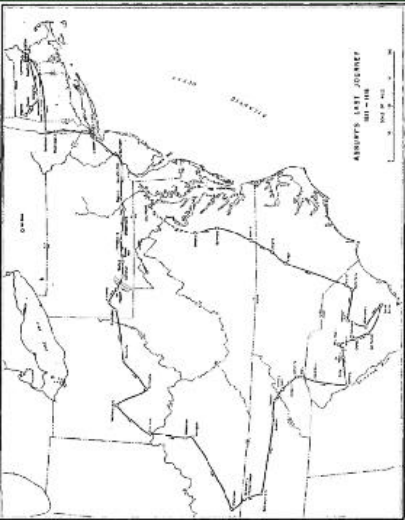
ASBURY’S LAST JOURNEY
By Elmer T. Clark
It is now possible to supplement the transcriber’s brief account and trace Asbury’s movements after the ailing bishop closed his Journal at Granby, South Carolina. In a vain effort to reach the seat of the approaching conference at Charleston, he proceeded to the home of Mrs. Rumph near Orangeburg courthouse and thence to the home of Squire Eccles on Cypress about thirty miles northwest of Charleston.2 Here he remained in daily communication with the conference. At this conference “all the remaining members of Mr. Hammet’s Church, consisting of a few whites and a considerable number of colored people, returned to our Church.”3 After the conference McKendree went northward, expecting to meet Asbury at the Virginia Conference. The two bishops never met again. Asbury went northward to John Whetstone’s, who lived near St. Matthew’s in Calhoun County about seventy miles from Charleston, where it seems that he remained two or three weeks. Here, on January 15, 1816, he dictated to Thomas Mason, who was on the Camden-Santee Circuit, a long letter to Dr. Joseph Benson in England in reply to a letter from the British Conference inviting him to visit England. This important letter was headed “South Carolina” with the date. This document is now in the Candler School of Theology at Atlanta, Georgia, and was printed in full in Duren’s Francis Asbury.4 Here also he wrote his last message to the General Conference of 1816, headed “On the Santee 70 miles above Charleston.” This is consistent with his presence at the Whetstone home.5 From Whetstone’s, Asbury went to his much-loved retreat at the Rembert settlement in Sumter County. William Capers, who had located, saw him there in January, 1816, and asked for a circuit. “I am a dying man,” replied Asbury, “or I would give you one. I will never see another Conference in Carolina. You had better wait for your Quarterly Conference to recommend you to a Presiding Elder.” Capers remarked that this was a sore disappointment to him, but there was no alternative.6 From Rembert Hall the bishop went eastward to Port’s Ferry and turned northward to Marion. Joseph Travis was headmaster of the Marion Academy, and Asbury stayed several days and nights with him “in the early part of the year.” It was evident to Travis that the end was near, and he reported that “when recovering from a paroxysm of pain, [Asbury] would shout aloud, ‘Hallelujah, hallelujah!’” and remarked that “my only hope of heaven is in the merits and righteousness of the Lord Jesus Christ.” Travis said there was some prejudice against Asbury because of the antislavery clause in the General Rules, but he regarded Bishop Coke as the real author of the trouble. “In all the conversational and epistolary intercourse that I have had with Bishop Asbury,” he wrote, “not one item was ever hinted to me in favor of Abolition from the good old man.” Asbury urged Travis to give up the school and re-enter the itinerant ranks; the latter promised to do so and was readmitted to the conference the following year.7
From Marion the bishop passed into North Carolina. He was not able to attend the Virginia Conference at Raleigh on January 24, 1816, but he was in Raleigh late in February and spoke to the society in the home of a Mr. King, perhaps one of the sons of Dr. John King.8
From Raleigh he went to the home of William Williams, eighteen miles from Louisburg, North Carolina. Here, on February 29, John Wesley Bond wrote a letter to Bishop McKendree in which he said that Asbury was a little better but still very feeble. Bond reported that his own expenses and quarterage were being paid by Asbury.9
The bishop now entered Virginia, intent on reaching the General Conference at Baltimore, an attempt which Bond opposed and which he realized was impossible. On March 4, 1816, they were at the home of Matthew Myrick in Brunswick County. Bond had not despatched the letter to McKendree, and he opened it to enclose another letter and also one from Asbury himself. These letters dealt mainly with sending missionaries to the German population, and Asbury suggested that Robert R. Roberts, presiding elder of the Schuylkill District, and Henry Boehm of the Chesapeake District should be exchanged because of Boehm’s knowledge of the German language.10
About the middle of March the feeble old bishop and his traveling companion reached Manchester, now South Richmond, and lodged with an old friend, John Potts. Here he was visited by the Rev. Philip Courtney. Sending Bond to fill “Father” Courtney’s appointment, Asbury outlined to the latter a plan whereby the local preachers in a given city might each travel an annual round of the circuit and select one of their number to attend the annual conference.11
Entering Richmond, Asbury lodged with the Rev. Archibald Foster, “who lived on Main street, a little above the Market bridge,” where he was confined to his room for a week. He sent for Bishop Moore, of the Protestant Episcopal Church, whom he warned against receiving and ordaining a British Methodist preacher whom Asbury regarded as unworthy. He furthermore suggested to Moore that the Episcopalians, who had few churches, should preach in the more numerous but plain Methodist meetinghouses.12
A few days later Asbury, unable to stand, was carried into the church at Nineteenth and Franklin streets in Richmond, where he was supported on a table while he preached his last sermon. Then he pushed on at a snail’s pace to the home of George Arnold in Spottsylvania County, where he died, as described in Hollingsworth’s “short account.”
Bishop McKendree was ill with rheumatism in the home of an old friend, Dr. Wilkins, between Baltimore and Philadelphia, when his colleague passed away. Here he received the news by a messenger from John Wesley Bond: “Our dear father has left us, and has gone to the Church triumphant. He died as he lived—full of confidence, full of hope—at four o’clock this afternoon, Sunday, March 31, 1816.’’13
Hollingsworth has told of the interment at Arnold’s and subsequent removal of the body to Eutaw Street Church in Baltimore. It rested there until June, 1854, when it was transferred to its final resting place among many other Methodist leaders in Mount Olivet Cemetery in Baltimore.14
ASB_VOL2.PDF, p. 700
Notes (14)
- The date here mentioned is an obvious error. Asbury died on March 31. ↩
- South Carolina Christian Advocate, July 29, 1858, art. by Bishop Andrew. ↩
- Paine: Life and Times of Bishop McKendree, 179. ↩
- pp. 241-55. ↩
- See these documents in the volume of Letters. ↩
- Capers: Autobiography, 185. ↩
- Betts, op. cit., 137, 138; Travis: Autobiography, 94—96. ↩
- Paine, op. cit., 180. ↩
- Ibid., 180. ↩
- Ibid. 180-82. ↩
- Bennett: Memorials of Methodism in Virginia, 611. ↩
- Ibid., 612. ↩
- Paine, op. cit., 182, 297. ↩
- Tipple: The Prophet of the Long Road, 293-99. ↩
Selected Bibliography (vol. 2)
For a complete list of the various works consulted see the references cited in the footnotes
Abbott. History of Old Zion Methodist Episcopal Church. New Jersey, 1907.
Allen. The Garrison Church, Sketches of the History of St. Thomas’ Church, Baltimore County, Maryland. New York, 1898. ——. Historical Notes of St. Ann’s Parish in Anne Arundel County. Allen and Pilsbury. History of Methodism in Maine, 1793-1886. Augusta, 1887.
Archer. An Authentic History of Cokesbury College. Armstrong. Old Baltimore Conference. Baltimore, 1907. Arminian Magazine. New York, 1789, 1790.
Arnold. History of Methodism in Kentucky. 2 vols. Winchester, Ky., 1935. Asbury, Francis. Journal of Rev. Francis Asbury. 1st ed. New York, 1821. 2nd ed. New York, 1852. 3rd printing, 1854. ——. A Selection of Hymns from Various Authors, Designed as a Supplement to the Methodist Pocket Hymn-book. New York, 1808. ——. Causes, Evils, and Cures of Heart and Church Divisions. Extracted from the Books of Burroughs and Baxter. New York, 1817. Asbury, Herbert. A Methodist Saint. New York, 1927. Atkinson. Centennial History of American Methodism. New York, 1884. ——. The Beginnings of the Wesleyan Movement in America. New York, 1896.
——. Memorials of Methodism in New Jersey. Philadelphia, 1860. Atmore. Methodist Memorial. Bristol, 1801.
Ayres. Methodist Heroes of Other Days. New York, 1916. Baker. A Methodist Pilgrim in England. London, 1951. Bangs. Life of Freeborn Garrettson. New York, 1838. ——. A History of the Methodist Episcopal Church. 2 vols. New York, 1839.
Barclay. History of Methodist Missions. 3 vols. New York, 1949-57. Barratt. Barratt’s Chapel and Methodism. Wilmington, Del., 1911. ——. Outline of the History of Old St. Paul’s Church. Bassett. Concise History of the Methodist Protestant Church. Pittsburgh, 1882.
Bennett. Memorials of Methodism in Virginia. Richmond, 1871. Betts. History of South Carolina Methodism. Columbia, 1952. Bibbins. How Methodism Came. Baltimore, 1945.
Boehm. Reminiscences, Historical and Biographical, of Sixty-four Years in the Ministry. New York, 1865.
Bowden. History of Savannah Methodism. Macon, 1929. Bowen. Story of Wilkes County, Georgia. Marietta, 1950. Bragg. A History of Methodism in Milford, Massachusetts. Briggs. Bishop Asbury. London, 1879.
Buckley. A History of Methodism in the United States. 2 vols. New York, 1898.
Buckley. Constitutional and Parliamentary History of the Methodist Episcopal Church. New York, 1912.
Butts. From Saddle to City by Buggy, Boat, and Railway. Richmond, 1922.
Candlin. History of the Methodist Episcopal Church in Marblehead, Massachusetts. Carroll. The Francis Asbury Centennial Volume. New York, 1916.
Carter. History of the Tennessee Conference. Nashville, 1948. Cathcart. Historical Address at the Anniversary of Old Rock Chapel. Centennial History of Ebenezer Church, Southport, Pennsylvania. Philadelphia, 1890.
Chaffee. History of the Wyoming Conference. New York, 1904. Chreitzberg. Early Methodism in the Carolinas. Nashville, 1897. Church. The Early Methodist People. London, 1949. Clark. The Methodist Episcopal Churches of Norwich, Connecticut. Norwich, 1867.
Clark. An Album of Methodist History. Nashville, 1952. ——. The Small Sects in America. Nashville, 1949. Clark. Discourse on the Formation and Progress of the First Methodist Episcopal Church in Lynn, Massachusetts.
Coke. Extracts of the Journals of the Late Rev. Thomas Coke. Dublin, 1816.
Colbert. A Journal of the Travels of William Colbert. Typescript in the World Methodist Building, Lake Junaluska, North Carolina. Cole and Baketele. History of the New Hampshire Conference. New York, 1929.
Coles. Heroines of Methodism. New York, 1869.
Colhouer. Sketches of the Founders of the Methodist Protestant Church. Pittsburgh, 1880. Conable. History of the Genesee Annual Conference. New York, 1876.
Cooper. Discourse on the Death of Asbury. Philadelphia, 1819. ——. Calendar of the Ezekiel Cooper Collection of Early American Methodist Manuscripts. Chicago, 1941.
Crook. Ireland and the Centenary of American Methodism. London, 1866.
Cummings. Early Schools of Methodism. New York, 1886. Daniels. Illustrated History of Methodism. New York, 1887. Davis. Historical Sketches of Franklin County, North Carolina. Raleigh, 1948.
Davis. History of the Methodist Episcopal Church in Newport, Rhode Island.
Disosway and Gregory. Earliest Churches of New York and Vicinity. Dix. A History of the Parish of Trinity Church in the City of New York. Dolliver. Story of John Street Methodist Church. New York, 1939. Douglas. History of Steele Creek Church.
Drew. The Life of the Rev. Thomas Coke. New York, 1818. Drinkhouse. History of Methodist Reform and Methodist Protestant Church. Pittsburgh, 1899.
Dromgoole. Manuscripts at the University of North Carolina. Chapel Hill. Drury. History of the United Brethren in Christ. Dayton, 1953. ——. The Life of Rev. Philip William Otterhein. Dayton, 1913. Du Bose. Francis Asbury. Nashville, 1916.
Duren. Francis Asbury, Founder of American Methodism and Unofficial Minister of State. New York, 1928.
Duren. The Top Sergeant of the Pioneers. Atlanta, 1930. Duvall. The Methodist Church and Education up to 1869. Eckman. History of the Morristown Methodist Church, New Jersey. Edwards. Life of John Wesley Childs. Richmond, 1852. Elliott. The Life of the Rev. Robert R. Roberts. New York, 1844. Elliott-Binns. The Early Evangelicals. Greenwich, 1953. Emory. A Defence of “Our Fathers,” and of the Original Organization of the Methodist Episcopal Church Against Alexander McCaine and Others. New York, 1827.
——. The Life of the Rev. John Emory, D.D. New York, 1841. Etheridge. Life of the Rev. Thomas Coke. London, 1860. Ewing. Information on 150 Years of Methodism in Bridgeton, New Jersey. New York, 1844.
Ferguson. Methodism in Washington, D.C. Baltimore, 1892. Ffirth. The Experiences and Gospel Labors of the Rev. Benjamin Abbott. New York, 1836.
Findlay and Hollingsworth. History of the Wesleyan Missionary Society. 4 vols. London, 1921-24.
Finley. Sketches of Western Methodism. Cincinnati, 1854. Fitch. The Perfect Calendar for Every Day of the Christian Era. Freeman. Francis Asbury’s Silver Trumpet. Nashville, 1950. Garber. Romance of American Methodism. Greensboro, N.C., 1931. Garrettson. The Experiences and Travels of Mr. Freeborn Garrettson. Philadelphia, 1791.
Garsie. Lives of Eminent Methodist Ministers. New York, 1859. Gewehr. The Great Awakening in Virginia. Durham, N.C., 1930. Gilmore. Life of Edward Tiffin, First Governor of Ohio. Chillicothe, 1897.
Glendenning. Life of William Glendenning. Philadelphia, 1794. Graham. History of the Troy Conference. Albany, 1908. Gregg. History of Methodism Within the Bounds of the Erie Annual Conference. New York, 1873.
Grissom. History of Methodism in North Carolina. Nashville, 1905. Guirey. History of the Episcopacy.
Hallman. The Garden of Methodism. Wilmington, n.d. ——. History of Asbury Church. Wilmington, 1889.
Halterman. History of Methodism in the South Branch Valley. Hampton. Staten Island’s Claim to Fame. New York, 1925. ——. Newark Conference Centennial History. Staten Island, 1957. ——. History of Chatham Methodism. New Jersey.
——. Francis Asbury on Staten Island.
Hannah. Centennial Services of Asbury Methodist Episcopal Church, Wilmington, Delaware.
Hartman. History of Methodism in Maryland.
Heads of Families, U.S. Census, 1790.
Hearne. One Hundred Years of Methodism in Snow Hill, Maryland. Heart. History of Methodism in Bennington, Vermont. Hedges. Crowned Victors.
Hill. History of Methodism in Norwalk, Connecticut. Hollingsworth. The Hollingsworth Family.
Hough. Christian Newcomer, His Life, Journal, and Achievements. Dayton, 1941.
Hubbell. History of Methodism on Staten Island.
Huffacre. Michael Huffacre and His Descendants.
Hurst. History of Methodism. 7 vols. New York, 1902. Hyde. The Story of Methodism. New York, 1888.
Jackson. Lives of Early Methodist Preachers Chiefly Written by Themselves. 6 vols. London, 1865.
Jarratt. Life of the Reverend Deveraux Jarratt Written by Himself in a Series of Letters Addressed to the Rev. John Coleman. Baltimore, 1806.
Jamison. A Century of Life, Woodrow Methodist Church. Staten Island. Jennings. An Exposition of the Late Controversy in the Methodist Episcopal Church, with Remarks on an Article Entitled Asbury’s Life by a Layman. Baltimore, 1831.
Johnston. Observations on the Present State of Religion in Cecil County, Maryland.
Kincaid. The Wilderness Road. New York, 1947.
Kirkley. Centennial Sketches of Methodism in Washington, D.C. Washington.
Larrabee. Asbury and His Coadjutors. 2 vols. Cincinnati, 1854. Lednum. A History of the Rise of Methodism in America. Philadelphia, 1859.
Lee. A Short History of the Methodists in the United States. Baltimore, 1810.
Lee. The Life and Times of the Rev. Jesse Lee. Richmond, 1848. ——. A Short Account of the Life and Death of the Rev. John Lee. Lee, Luccock and Dixon. Illustrated History of Methodism. New York, 1926.
Lewis. Francis Asbury. London, 1927.
Liggett. Methodist Sesquicentennial. Baltimore, 1934. Lundy. Holston Horizons. Bristol, Tenn., 1947.
Lytle. First Century of Newton Methodism.
MacClenny. The Life of the Rev. James O’Kelly. Raleigh, 1910. Mains. Francis Asbury. New York, 1909.
Marine. Sketch of Rev. John Hersey. Baltimore, 1879. Martin. Methodism in the Holston Conferences. Knoxville, 1945. Martz. The Clarksburg Methodist Church, Maryland. Mastin. One Hundred Years of Richmond Methodism. McCaine. History and Mystery of Methodist Episcopacy, the Defense of Truth and Letters on the Methodist Episcopal Church. Baltimore, 1850.
——. Letters on the Organization and Early History of the Methodist Church. Boston, 1850.
McClintock. History of the Coventryville Methodist Church. McFerrin. Methodism in Tennessee. 2 vols. Nashville, 1888. McLean. Sketch of Rev. Philip Gatch. Cincinnati, 1854. McTyeire. History of Methodism. Nashville, 1893. Meade. Old Churches, Ministers and Families of Virginia. Philadelphia, 1887.
Meredith. Jesse Lee. New York, 1909.
Miller. Souvenir History of the New England Southern Conference. Nantasket, Mass., 1897.
Mitchell. The Life and Times of Levi Scott.
Mooney. Centennial History of Rahway Methodism, New Jersey. Moore. Sketches of Pioneers of Methodism in North Carolina and Virginia. Nashville, 1884.
Mudge. History of the New England Conference. Boston, 1910. Neely. A History of the Origin and Development of the Governing Conference in Methodism. New York, 1892.
——. The Bishops and the Supervisional System of the Methodist Episcopal Church. New York, 1912.
O’Kelly. Life of the Reverend James O’Kelly.
Paine. Life and Times of Bishop McKendree. 2 vols. Nashville, 1869. Palmer. Heroism and Romance, Early Methodism in Northeastern Pennsylvania. Saylorsburg, Pa., 1950.
Parks. Troy Conference Miscellany. Albany, 1854. Payton. Our Fathers Have Told Us; the Story of the Founding of Methodism in Western Pennsylvania. Cincinnati, 1938. Peck. Early Methodism Within the Bounds of the Old Genesee Conference. New York, 1860.
Peck. Wyoming. New York, 1921.
Perrin. An Epitome History of the Inception of Methodism in Northeastern Pennsylvania.
Phoebus. Beams of Light on Early Methodism. New York, 1887. ——. Memoirs of the Rev. Richard Whatcoat. New York, 1828. Pierce. Lest Faith Forget: The Story of Methodism in Georgia. Atlanta, 1951.
Pitt. History of the Allentown Methodist Church, New Jersey. Playter. History of Methodism in Canada. Toronto, 1862. Porter. Compendium of Methodism. Boston, 1853.
Price. Holston Methodism. 5 vols. Nashville, 1912. Prince. The Romance of Early Methodism in and Around West Bromwich and Wednesbury. West Bromwich, 1923.
Pusey. The Wilderness Road to Kentucky. New York, 1921. Rankin. The Diary of Reverend Thomas Rankin, One of the Helpers of John Wesley. Typescript in the World Methodist Building, Lake Junaluska, North Carolina.
Redford. History of Methodism in Kentucky. 3 vols. Nashville, 1868. Reeves. Methodism in and Around Chester, Pennsylvania. Roberts. Centenary Pictorial Album, Being Contributions of the Early History of Methodism in the State of Maryland. Baltimore, 1866. Rose. The Story of the First Methodist Church, Bridgeton, New Jersey. Seaman. Annals of New York Methodism. New York, 1892. Simpson. Cyclopedia of Methodism. Philadelphia, 1876. ——. A Hundred Years of Methodism. New York, 1876. Scott. “The Journal of Thomas Scott.” Manuscript. Shipp. History of Methodism in South Carolina. Nashville, 1884. Smeltzer. Methodism on the Headwaters of the Ohio. Nashville, 1951. Smith. Life and Labors of Francis Asbury. Nashville, 1896. ——. History of Georgia Methodism. Atlanta, 1913. ——. History of Methodism in Georgia and Florida. Macon, 1877. ——. Early Georgia People.
Smith. Recollections and Reflections of an Old Itinerant. New York, 1848.
Snyder. History of the Smithville Methodist Church, Maryland. Sprague. Annals of the American Pulpit. Vol. VII. New York, 1861. Spencer. Reflections of William Spencer.
Stevens. History of the Methodist Episcopal Church in the United States of America. 4 vols. New York, 1864.
——. Life and Times of Nathan Bangs. New York, 1863. ——. Memorials of the Introduction of Methodism into the Eastern States. Boston, 1848.
——. The Centenary of American Methodism. New York, 1865. Strickland. The Pioneer Bishop: Life and Times of Francis Asbury. New York, 1858.
——. Life of Jacob Gruber. New York, 1860.
Summers. Biographical Sketches of Eminent Itinerant Ministers. Nashville, 1858.
Sutherland. Methodism in Canada. London, 1903.
Sweet. Men of Zeal. New York, 1935.
——. Religion on the American Frontier. Vol. IV, The Methodists. Chicago, 1946.
——. Methodism in American History. New York, 1953. ——. Virginia Methodism. Richmond, 1955.
——. Rise of Methodism in the West. New York, 1920. Tees. The Ancient Landmark of American Methodism. Nashville, 1941. ——. The Beginnings of Methodism in England and in America. Nashville, 1940.
——. Methodist Origins. Nashville, 1948.
Tevis. Sixty Years in a School Room.
Thrift. Memoir of Jesse Lee.
Tigert. A Constitutional History of American Episcopal Methodism. Nashville, 1894.
——. The Making of Methodism. Nashville, 1898.
Tipple. Francis Asbury, the Prophet of the Long Road. New York, 1916. ——. Freeborn Garrettson. New York, 1910.
——. The Heart of Asbury’s Journal. New York, 1904. Todd. Methodism of the Peninsula. Philadelphia, 1886. Townsend, Workman and Eayrs. A New History of Methodism. 2 vols. London, 1907.
Tracy. The Great Awakening. Boston, 1842.
Tyerman. Life and Times of John Wesley. New York, 1870. Upham. History of the Methodist Episcopal Church, Bristol, Rhode Island.
Wakeley. Heroes of Methodism. New York, 1856.
——. Lost Chapters Recovered from the Early History of American Methodism. New York, 1858.
Ware. Sketches of the Life and Travels of Rev. Thomas Ware. New York, 1839.
Warriner. Old Sands Street Church of Brooklyn. New York, 1885. Watters. A Short Account of the Christian Experiences and Ministerial Labors of William Watters. Alexandria, Va., 1806. ——. First American Itinerant of Methodism.
——. The Watters Family.
Wightman. Life of William Capers, D.D. Nashville, 1902. Wilkins. Family Adviser, or a Plain and Modern Practice of Physic. New York, 1814.
Wilson. Methodism in Athens, Georgia.
Wise. American Methodists. Englewood, N.J., n.d. Wittmer. History of Oldwick Methodist Church. New Jersey. Woodmason. The Carolina Backcountry on the Eve of the Revolution. Chapel Hill, 1953.
Wright. Sketches of the Life and Letters of James Quinn. Cincinnati, 1851.
Wrenshall. Manuscript Journal of John Wrenshall. Wesley. The Journal of the Rev. John Wesley, A.M. 8 vols. London, 1938. ——. The Letters of John Wesley. 8 vols. London, 1931. Young. Autobiography of a Pioneer. New York, 1857. Young. A History of the Most Interesting Events in the Rise and Progress of Methodism. New Haven, 1830.
ASB_VOL2.PDF, p. 708
Introduction to the Letters (vol. 3)
INTRODUCTION
IT is a tragic thing that relatively so little is known of Francis Asbury, though he traveled a territory much greater than John Wesley and left as his monument a Church in America which at this writing is more populous than any other Church. Too little has been written about him. There are a few outstanding works; but when one attempts to learn much about Asbury and his times, one is confronted at every step with difficulties and information is at a premium. The houses and churches which he visited have today largely disappeared. In whole states which he visited repeatedly, it is next to impossible to find a single place which is hallowed today by the associations of his life and preaching. About the only written thing that he left is his Journal. Very few copies of it are extant. It is little known, and until this effort it has never been annotated. When one examines Asbury’s letters and Journal minutely, one discovers that Asbury was a great student. He read the books of his day. He read his Hebrew and Greek Bibles daily. He knew Latin. He was familiar with the historians and the scholars. He was a learned man—and this in spite of his continuous travel over a period of forty-five years in America! He never had the advantage of a college education; however, he literally walked with the kings and princes of the then known educational world and was acceptable in many pulpits of other denominations. He knew and associated with every known condition of men. He knew President Washington, Governors Rodney, Tiffin, Bassett, Worthington, Dickinson, Wright, and Lieutenant-Governor Van Cortlandt. He stayed in homes of the common people, and on occasion was entertained by the great. Here was really a remarkable man. He had little time for writing. Much of nearly every day was consumed with his travels over vast distances, frequently with no place to write except in the open woods. When we compare him with John Wesley, we find that more than 2,600 letters have been collected which came from the pen of Wesley. An attempt has been made to estimate the number of letters Francis Asbury wrote. Certain it is that he wrote as many as Wesley. That was the only way he had of keeping in touch with the preachers and the people. On one occasion he referred to the fact that he wrote as many as a thousand a year. Frankly, this seems to be an exaggeration, though one would only have to write an average of less than three a day to make this figure. It is possible he did. However, in the first few years of his ministry he wrote relatively few. He did not know many people and he had not traveled very extensively. Also he had had few advantages of schooling, and the writing urge was evidently less developed in him. But as he went along, he did develop the urge.
Asbury had to keep in touch with the people. He was gradually creating an extensive ecclesiastical empire, and he must of necessity direct it and keep it going. The most tragic thing is that nearly all the letters have been lost. Frontier life knew paper to be one of the scarcest of articles. Witness the fact that Asbury’s traveling companions, Whatcoat, McKendree, Boehm, Bond, and others, mainly made their notes at the bottom of Asbury’s letters, if there was any space left. The letters which have been preserved show how little paper they had. N.B.’s and P.S.’s take up every spare place in the letters and sometimes on the envelopes. The difficulties of deciphering what was said are greatly accentuated, not only by the poor handwriting but by the crowded condition of the lines and the fact that every inch was used.
The matter of collecting the letters has not been easy. My interest in them and in Francis Asbury has not been an overnight interest. I was born in a Methodist preacher’s home. My father had a deep interest in Asbury. My grandfather, who for fifty-two years was a Methodist preacher, was born in 1831, fifteen years after Asbury’s death. His parents were disciples of Robert Strawbridge and Francis Asbury in Loudoun County, Virginia. Nine Methodist preachers have come from this one family, with an aggregate ministry of more than three hundred years. My interest in history has been a lifetime interest. Years ago I became interested in charting the journeys of Asbury in the state of Virginia and in the accuracy of the statements made about Asbury. Asbury himself calls attention to the fact that there were many errors in his Journal. He never had opportunity to correct most of it. Those errors confront one in the study of the Journal and in the sources of information. Errors have been made and repeated by the historians, and it will be found by future historians perhaps that some have been made by this writer and group of historians. At times we have been led astray by what others have mistakenly written. For instance, Tipple and others indicated that Asbury made 84 visits into the state of Virginia, which in Asbury’s day included the present West Virginia. This study of the Journal and letters shows more than 120 visits were made in that total area. Some of them were simply crossings over the end of the state. However, Asbury spent more time in Virginia than in any other state. Early a great awakening took place there, and the revival of 1776 under George Shadford is said by Asbury and others to have added eighteen hundred in one year on the Brunswick Circuit. Many of the earliest leaders came from that state, such as Bishops William McKendree, Enoch George, and John Early; and Jesse Lee, the father of Methodism in New England and the historian of early Methodism.
Asbury was a tower of strength in the early church and nation. Sad to relate, the average Methodist in America has a hard time answering any questions about him. Few historical shrines exist, and not much is done to revere his memory. He slept in far more places than George Washington is reputed to have slept in, but try to find one today. Many of his letters have been lost, and his Journal was neglected for more than a hundred years. An extended search has been made for the letters. Old books have been searched. The Arminian Magazine, The Methodist Magazine, The Quarterly Review, Advocates, and other possible sources have been examined and have yielded letters. Libraries have been contacted. Librarians have ably assisted in searching for originals or copies, All state libraries and many others within the area covered by Asbury were requested to help. The response has been remarkable, and many letters have come to light. They are properly credited to the various institutions. Some of these letters have been printed in one place or another, thanks to the historical interest in them. But even some of these are in old books which are in a bad state of preservation. A good wind would blow them away. Drew University has performed a valuable service in preserving some of the letters on microfilm; but these are mainly the ones collected in the libraries of Drew, Garrett Biblical Institute, and the Baltimore Conference (Lovely Lane Museum).
This collection of letters represents a geographical distribution of interest which covers a large part of the United States and England. Many persons have been interested in the search for the letters. The collection in Drew University numbers about a hundred. These, however, are not all originals. No volume of Asbury’s letters has ever been published prior to this one. Asbury had a feeling that he was the historian of early Methodism, as these letters indicate. He felt that it was necessary for him to collect a “focus,” namely the records of the early preachers. He thought that this would be achieved and that they would be put into a volume. However, only a small number of these letters from preachers telling the story of advances in Methodism were ever published. During Asbury’s day there were few newspapers. People to whom he wrote as a rule had no access to the newspapers. It was characteristic of Asbury that he felt he was responsible for spreading news, and he did it by writing letters.
A man is always known by his letters if he left any. It is natural to ask, “What did he say in those letters to his relatives, to his friends, to those who disagreed with him?” One wishes by some coincidence a trunk full of his letters could be found. However, so far no such trunk has turned up, and only a few more than three hundred letters have been discovered though the search has gone on for about five years. The letters which have been discovered have revealed far more of the real Francis Asbury than was known before. It has been repeatedly conjectured that he had never had any love interest. Without doubt he had at least one. However, little is known about this; but the letters reveal that her name was Nancy Brookes. Asbury even had some people who despised him, and the letters give some of the history of these conflicts. Persons who have been lost sight of have come to life, and new friends have been found because they were the friends of Francis Asbury. Insights into his character are discovered, and the human Asbury comes out more alive. The greatness of the man is revealed in his human characteristics. One is reminded of Abraham Lincoln in that the human side is often the attractive side. As with Lincoln, the glorified side is frequently unhistorical, not human, and unattractive. In order to see more of the real Asbury, a few letters which were written by others have been introduced into the correspondence. These are placed as a rule in chronological order to fit into the chronological development of Asbury’s life. Some of these will enable the reader to see the other side of the picture, and some throw more light on the human Asbury. As said above, though Asbury became an extremely well-informed man, he was entirely self-educated. He became a highly educated man, but only because he was self-educated. His writings are not English classics. However, as a rule the letters were fairly well written. The earlier letters were rather crude, but he speedily improved. The most serious criticism that could be made of his letters would be of the length of his sentences. Frequently they had no end. However, his grammar was good, and there were not many mistakes. There was a quaintness about them which was characteristic of the times. He uses words which were in use in that day but are now archaic. These have been preserved in this printing of them. Sometimes he uses interesting play on names and words to carry his point. He was exceedingly anxious about the way his written works would appear to posterity. He wanted them to appear grammatically correct. In a letter to Thomas Haskins on August 22, 1801, he says, “You will only say to Brother Cooper that you think I only ‘wish good pointing, and a few words to make it explicit.’ But it is not the Journal of Ezekiel Cooper, or any other but Francis Asbury, and as such I wish it to appear.” Again, to Ezekiel Cooper he writes on December 31, 1801, “I have been taught to understand that a printer should point; and if he could not point he could not print. I do not choose to print any man’s journal but my own. My language in preaching and writing is my own—good or bad.” To George Roberts on August 23, 1802, he writes, “I cannot blame Brother Cooper for my journals, first from my great affection to Thomas Haskins and high opinion of his literary abilities. I wished him to read, correct and strike out what was improper. Secondly, I desired Brother Cooper to print it as it was, except some pointings. I had stricken out many things; and oh that I had stricken out many more but I left chasms and incoherence in the copy. If I had left him (Cooper) at liberty it would have been done better.” It can be seen from these statements of Asbury that he was exceedingly interested in having his sentences correctly “pointed.” His directions were evidently followed out with the Journal and with the letters which were published in The Methodist and The Arminian Magazines. The originals of some of the letters have come to light, and one can see how they were edited by comparing them with the printed copies. Sometimes whole sections were left out.
When the question of how to print the letters arose, the problems had to be faced. Should they be printed as they appear in the originals? We would have preferred to have them printed just as Asbury wrote them. However, many of the letters could not be obtained in the originals. The printed copies are all that are extant. If the policy to print as Asbury wrote were followed, part would appear edited and the others would be copies of the originals. Asbury wished them to be edited if they were to be printed. He gave instructions to this effect when some were requested for printing in The Methodist Magazine; therefore his wishes were followed in the first printings. The above quotations of Asbury have determined the policy of printing here. “My language in preaching and writing is my own—good or bad,” he said; and Asbury’s language has been preserved. Pointings have been put in as he desired and in conformity with the early printings of some of the letters. The letters here printed follow the pattern of the Journal as it was published by Hollingsworth and upon which several had worked as editors. The rule has been to let the writer speak his own mind and have his say. How we wish there were more of the letters! What we have makes us wish for more. Asbury comes more alive as one reads his correspondence. A reader of the letters is at times exasperated because of the omissions of time between them. One wishes that the gaps could be filled. There are great chasms between the events. Fortunately, as a rule, the Journal supplies the information. However, when great issues are before Asbury and the Church, and one wishes to peer behind the scenes, he is frequently lost in the vacuum of no letters.
The letters present the real Asbury. They are the only source of his writing except the Journal, and it is largely done in an epitomized form. When one reads the Journal, he is exasperated at times because Asbury did not go into more detail. What there is of the letters is in more detail. Asbury had a real concern for the preachers. He had a concern for the homes, for widows and children, for his country, for the aged, and for animals. He loved scenery. He had no narrow view of religion. He was not narrowly sectarian in his viewpoint. As a rule, he loved preachers and was able to preach in pulpits of pastors of other denominations. One marvels that he could travel in spite of the many illnesses to which he was heir. At times he seemed to have the complex of Paul. He rejoiced in being a martyr. He was sensitive to criticism. He felt driven to preach and to travel. He had a sense of duty which drove him to constant exertion. Within him there was a drive to be educated, and his growth in his intellectual life was most astonishing. Asbury was a talented man. It was said of Wesley that he was a Method-ist. So was Asbury. He had a method for everything. He invented methods for the societies, the classes, the bands. He had methods for his daily travel, his sermons, the writing of his letters and Journal; methods for study, Bible reading, and prayer. However, he was so human that he was welcomed everywhere. He was called “Father” and became a Methodist saint among the people. He made enemies, but not many. The enemies he made were people who essentially differed from him on account of his policies of administration. They differed over the developing episcopacy. There were few differences with him over doctrines, though these letters refer to several who were accused of differences. Asbury was a man of humor. On some occasions he was accused of being too humorous. On Wednesday, December 11, 1782, he said:
I rode to Williamsburg—formerly the seat of government, but now removed to Richmond; thus the worldly glory is departed from it; as to Divine glory it never had any. I preached in James City court-house. The place has suffered and is suffering: the palace, the barracks, and some good dwelling-houses burnt. The capitol is no great building, and is going to ruin; the exterior of the college not splendid, and but few students; the Bedlam-house is desolate, but whether because none are insane, or all are equally mad, it might, perhaps, be difficult to tell.
There was a frankness in his letters which was refreshing. When the occasion demanded it, he wrote directly, even critically, to a person who needed criticism. He was a born leader, and this gift of leadership showed itself strongly at times in dealing with his friends.
I am conscious of the fact that the letters sometimes conflict with the histories which have been written. For instance, many interpretations of the relationship between Asbury and Coke have appeared in print. The historians have not agreed. Frequently their disagreements have been violent. The editor of the letters has included the Coke letters in the volume with the idea of letting them tell their own story. They speak for themselves. The last word has not been said upon this and other subjects, nor will the last word be said here. Again one could wish that we had much more of the correspondence. Further light would certainly be thrown upon some of the mooted questions. However, there are enough letters here to tell a story that is more correct because much light has been discovered in recent years. Again it can be said that the human qualities of the “Prophet of the Long Road” stand out in that this remarkable man becomes more remarkable as his actual characteristics are more fully understood from his letters. No wonder that the United States Government has paid tribute to this man, and no wonder that the National Historical Publications Commission is concerned that the Journal and the letters be published. It is hoped that the letters will create the kind of interest that will help writers in the future to write more perfectly of the real Francis Asbury. An arbitrary rule has been adopted as to the text of the letters to be used in this volume. Wherever possible, the originals have been used—in fact, in every instance where originals have come to life. Sometimes there are copies of the originals in other places, and these have been examined. The credit line at the bottom of the letter indicates the source from which the letter was taken. It does not refer to places where the letters have been published unless so stated. In some cases letters have been published several times.
We are delighted to make acknowledgment of the help we have received from many persons and agencies which have co-operated to bring this volume to completion. To Frank Baker, secretary of the Wesley Historical Society of England, we are deeply indebted for his great interest in this enterprise. He has not only transcribed and provided a number of the letters but also provided notes which have given the English background of the letters. His contribution has been outstanding. We are indebted to Mr. L.E.S. Gutteridge of the Epworth Press, who has helped in providing materials and has transcribed the longest letter, that to Joseph Benson, January 16, 1816. William Warren Sweet has allowed us the privilege of using the letters from his collection of copies. This prominent historian has placed his materials at our disposal. He has also been an invaluable source of historical information. Robert S. Dolliver, who for years has done work in this field, has loaned us his list of letters. He has provided some, and altogether has helped to make our list of letters complete. We acknowledge our debt of gratitude to Albert D. Betts, who has been of great assistance in providing information and transcribing some letters which have been found in South Carolina. He has searched in many places to give help. W.G. Smeltzer has likewise provided information and transcribed some letters with notes from the Pittsburgh Conference area. Lawrence Sherwood has assisted in many ways in research in reference to West Virginia and the surrounding areas, and has provided letters from various collections, including his own. He has also transcribed some of the letters. We are also indebted to Wallace H. Harris, who has provided photographs of letters and other information, and in addition helped with the materials in Pennsylvania. Arthur Bruce Moss has been most helpful in supplying information from New York and has repeatedly helped with the project. Herbert Hucks, Jr., Wofford College librarian, has been most helpful with some of the Asbury materials, including supplying copies of letters in the Wofford library. Robert B. Pierce has loaned the Journal of William Spencer, which has been a valuable addition to our study. Some of it is used in this volume. Mrs. Frederick Brown Harris has allowed the use of the letter from Francis Asbury to her distinguished ancestor Daniel Fidler. Mr. and Mrs. H. Carstairs Bracey have done much to locate historic names and places in several counties of Virginia and North Carolina. Miss Elizabeth Hughey has provided copies of letters in the library of the Methodist Publishing House in Nashville and helped in our research. A debt of gratitude is due to Gordon Pratt Baker, who has read the manuscript through and has made valuable contributions to it by suggestions in reference to the copy. It has been a great help to the editor to have the advice and the careful reading which have characterized his work with the copy. A debt of gratitude is also due to Harry Denman, the general secretary of the General Board of Evangelism of The Methodist Church, for his friendly interest in the project, and to D.E. Jackson, our business manager, and the staff of The Upper Room, who have taken such an interest in the project and helped in it in so many ways. Brooks B. Little, my editorial associate and the librarian of The Upper Room Devotional Library, has been of invaluable help. He has been indefatigable in his research, running down sources in libraries, discovering copies of letters, photographing them, collecting them, and in many other ways he has made his contribution. Over a period of about five years my secretary, Clarice Marie Winstead, has helped with the letters, studied them, typed them, and familiarized herself with them until she has become an authority on them. Likewise, her sister, Annie Lee Winstead, who has been called in to help over a period of months and who has lived with the letters through that time, has made an extraordinary contribution to the work. These ladies have had a most important part in the entire project. Mrs. Louise Stahl, Dr. Clark’s secretary, has frequently provided information, copies of letters, and other materials, and has made her contribution in a most worth-while way. Others who have helped with the copying of the letters are Willena Woodard, Katherine Campbell, Carrie B. Chenault, Sylvia Holloway, and Evelyn Butts.
We have also received help from Edward J. Fortney, formerly librarian at Drew University, who put at our disposal the resources of Drew library. Through him we have had much valuable advice and information. Kenneth R. Rose, pastor of Lovely Lane Methodist Church, Baltimore, has given us access to the historical collection there. It is an invaluable collection, and many of the materials have been used. Proper credits have been given to that library. Albert W. Cliffe, pastor of St. George’s Church and the librarian of the Philadelphia Historical Society, has made available everything at St. George’s Church. Many of the most valuable materials extant are in Old St. George’s Church, Philadelphia; and much material in this volume has been placed here through the help of the pastor. We are grateful to Harold H. Hughes for his research.
This ministerial family of mine has been an unending source of help through these years as I have worked with the letters and Journal. My mother, Mrs. R.H. Potts, who in her eighties has been blessed with a remarkable memory, has helped in many ways. Especially do I owe my wife, Agnes, more than I can estimate for her constant encouragement as she has worked with the magnifying-glass in deciphering letters, gone with me to out-of-the-way places to find materials, worked in libraries, helped with research, and with reading copy and proof.
Finally, we are indebted to many of the staffs of libraries and institutions which have provided invaluable help in locating, preparing copies, photographing, and helping in so many ways to provide materials for the volume. We also owe a great debt of gratitude to many persons across America who have had a particular interest in some one piece of historical material and have helped to point up that particular matter. To all these, and to many others, we are most indebted.
J. MANNING POTTS
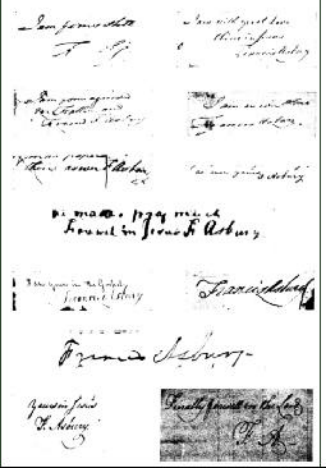
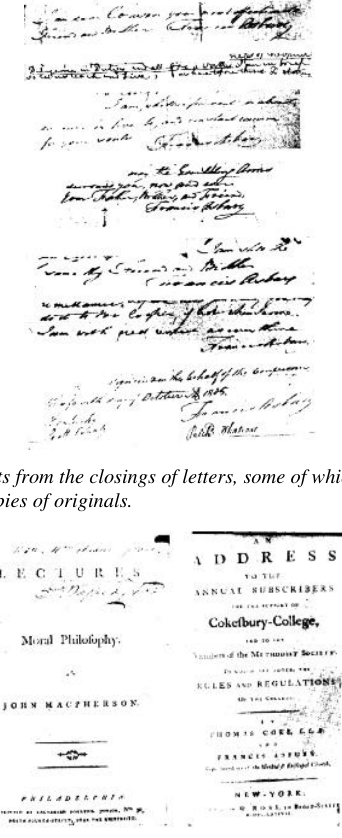
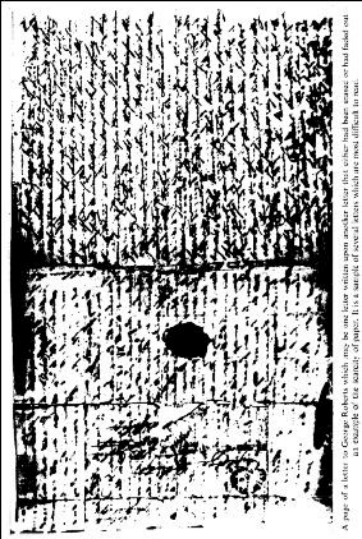
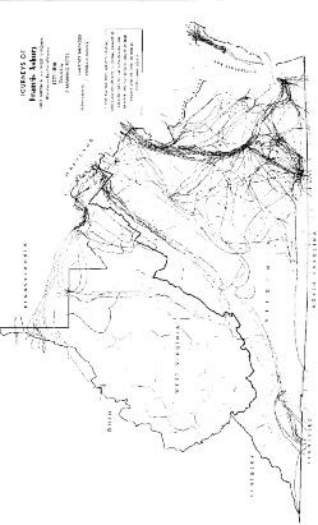
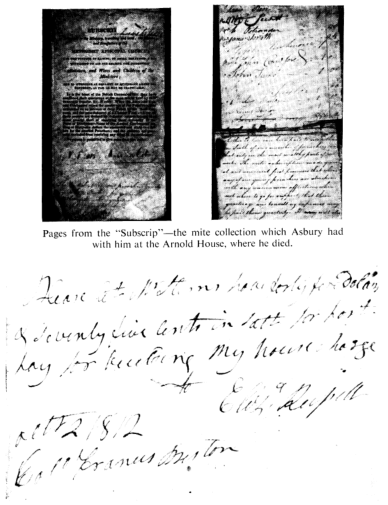
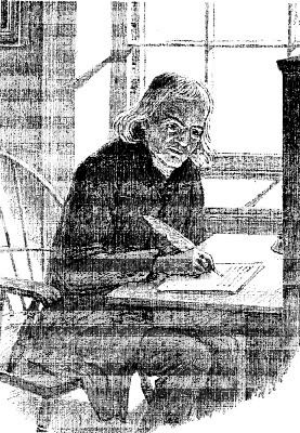
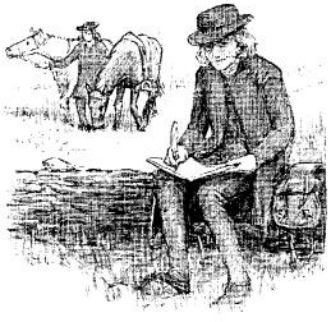
ASB_VOL3.PDF, p. 7