Chapter introductions
And the Philistines took the ark of God, and brought it from Ebenezer unto Ashdod.
Adam Clarke on 1 Samuel 5:1
Verse 1. Brought it from Eben-ezer unto Ashdod.] Ashdod or Azotus was one of the five satrapies or lordships of the Philistines.
Joseph Benson on 1 Samuel 5:1
Verse 1. The Philistines took the ark of God — Abarbinel gives several reasons why God suffered the ark of his presence to fall into the hands of these uncircumcised heathen: 1st, The Israelites were such great sinners that they were unworthy of this symbol of the divine presence among them: 2d, The idolatry of Micah remained to this day in the land, therefore God fulfilled his threatening, Leviticus 26:19-31: 3d, The sin of the priests highly provoked him to deliver up the ark, which was in their hands when they were killed: 4th, The Israelites greatly offended in carrying the ark into the battle without asking counsel of God: 5th, He resolved to demonstrate his power even among the enemies of Israel. And brought it from Eben-ezer — Where the Israelites were encamped before the battle, chap. 4:1; to Ashdod — One of their chief cities, in which, as also at Gaza and Garb, some of the Anakims, the giants, remained till the time of David.
Joseph Sutcliffe on 1 Samuel 5:1
Verse 1. Ashdod, afterwards called Azotus. Acts 8:40.
Daniel Whedon on 1 Samuel 5:1–12
THE ARK OF GOD AMONG THE PHILISTINES, 1-12.
The Philistine conquerors are soon to find that the ark is for them a fearful booty. With great rejoicing they carry it to their great idol’s temple, as if to say, Our God is mightier than the mighty God of Israel, and we will dedicate the ark to him. But miserable honours await Dagon, and fearful plagues visit his worshippers. Terror-smitten, they carry the ark from one place to another, supposing that change of locality might check its power for evil, but all without avail, for the presence of the ark spreads plague and terror everywhere.
Here we may see why Jehovah permitted the ark to fall into the hands of these idolaters. It would prove to them, in their own land, that Jehovah’s power was not in sword nor bow, nor chariot; that the ark alone, the mere symbol of his presence, could be used by him to crush their Dagon, and smite their land and its inhabitants with plagues. Nor was this capture of the ark without its salutary lessons for Israel. They never afterwards attempted to put it to a superstitious use. Their priests had defiled the tabernacle by their impiety, and had committed sacrilege in their use of the offerings. The sanctuary seems to have become totally neglected by several of the tribes of Israel, for as “men abhorred the offering of the Lord” (1 Samuel 2:17) at Shiloh, they turned to the practice of sacrificing on high places; or else, like Micah, (Judges 17:5,) made a tabernacle of their own with graven images, and set up an independent worship. Thus Israel failed to establish a central seat of worship, as well as a central government; the Levitical service became disorganized, and the worship at Shiloh a reproach; and the Lord allowed the ark of his presence to be taken from them as a judgment for their sins. Compare Psalm 78:56-66. “The loss and the recovery of the ark,” says Milman, “would tend powerfully to consolidate the disorganized realm. The tidings of that awful calamity, the capture of the ark, the seeming abandonment of his people by their God, would sound like a knell in the heart of every one born of Israel. From the foot of Lebanon to the edge of the desert, from the remotest pastures of Gilead to the seacoast of Asher, the dormant religious feeling would be stirred to its depths. Even those who had furtively cast their grain of incense on the altar of Baal would be roused by the terrible shock, and prostrate themselves in penitence, if not in despair. That universal religious movement, from grief, from shame, from fear, would be maddened to tumultuous excitement at the tidings, as rapidly, as widely spread, of the restoration of the inappreciable treasure — Jehovah’s return in all his power and majesty to the center of his chosen people.”
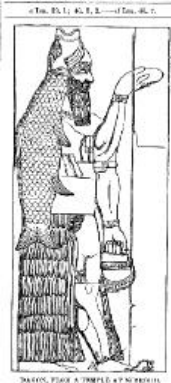
1. From Eben-ezer unto Ashdod — A distance of nearly thirty miles. Ashdod — in Greek, Azotus (Acts 8:40) — was one of the five chief cities of Philistia, (Joshua 13:3,) and the principal seat of the worship of Dagon.
Cited across the library (1 reference)
- DictionaryWatson’s Dictionary: Dagon
When the Philistines took the ark of God, they brought it into the house of Dagon, and set it by Dagon.
John Wesley on 1 Samuel 5:2
V. 2. By Dagon-By way of reproach, as a spoil and trophy set there to the honour of Dagon, to whom doubtless they ascribed this victory.
Adam Clarke on 1 Samuel 5:2
Verse 2. The house of Dagon] On this idol, which was supposed to be partly in a human form, and partly in that of a fish, see the note on Judges 16:23. Some think that this idol was the same with Dirceto, Attergatis, the Venus of Askelon, and the Moon.-See Calmet’s Dissertation on the gods of the Philistines.
The motive which induced the Philistines to set up the ark in the temple of Dagon, may be easily ascertained. It was customary, in all nations, to dedicate the spoils taken from an enemy to their gods: 1. As a gratitude-offering for the help which they supposed them to have furnished; and, 2. As a proof that their gods, i.e., the gods of the conquerors, were more powerful than those of the conquered. It was, no doubt, to insult the God of Israel, and to insult and terrify his people, that they placed his ark in the temple of Dagon. When the Philistines had conquered Saul, they hung up his armour in the temple of Ashtaroth, 1 Samuel 31:10. And when David slew Goliath, he laid up his sword in the tabernacle of the Lord, 1 Samuel 21:8, 9. We have the remains of this custom in the depositing of colours, standards, &c., taken from an enemy, in our churches; but whether this may be called superstition or a religious act, is hard to say. If the battle were the Lord’s, which few battles are, the dedication might be right.
Joseph Benson on 1 Samuel 5:2–3
Verses 2, 3. They set it by Dagon — By way of reproach, as a spoil and trophy set there to the honour of Dagon, to whom, doubtless, they ascribed this victory. Behold Dagon was fallen upon his face — In a posture of the most humble adoration, which was prostration; as acknowledging the God of Israel to be above all gods. They (the priests of Dagon) took Dagon and set him in his place — Supposing his fall to be casual.
Joseph Sutcliffe on 1 Samuel 5:2
Ver. 2. The ark—and set it by Dagon. See Judges 10:6. 16:23. Some make Dagon to be the same as Nereid, Triton, and the Syrens. Virgil, in several places, speaks of the spoiling of the temples as a great calamity. Æneid. 7. It is a custom of high antiquity to deposit in temples the trophies taken in war, and latterly in churches. During the late war with France we had many flags and standards suspended in St. Paul’s Cathedral, at Whitehall, &c.
Daniel Whedon on 1 Samuel 5:2
2. House of Dagon — Hebrew, Beth-Dagon; not here the name of a city, as at Joshua 15:41, and 19:27, but the house or temple (1 Chronicles 10:10) in which Dagon was worshipped. The Philistines placed the ark in Dagon’s temple as a dedicatory offering to their god, who had gotten them their victory. Dagon was the great national god of the Philistines. His image bore the body of a fish, and the face and hands of a man. Various representations of this idol have been found on the Assyrian monuments, and in them all the characteristic feature is the figure of a fish. See note and cut at Judges 16:23.
Cited across the library (2 references)
And when they of Ashdod arose early on the morrow, behold, Dagon was fallen upon his face to the earth before the ark of the LORD. And they took Dagon, and set him in his place again.
John Wesley on 1 Samuel 5:3
V. 3. They-The priests of Dagon. Set him-Supposing his fall was casual.
Adam Clarke on 1 Samuel 5:3
Verse 3. They of Ashdod arose early on the morrow] Probably to perform some act of their superstition in the temple of their idol. Dagon was fallen upon his face] This was one proof, which they little expected, of the superiority of the God of Israel.
Set him in his place again.] Supposing his fall might have been merely accidental.
Daniel Whedon on 1 Samuel 5:3
3. Dagon… fallen upon his face… before the ark — Not only will Jehovah not give his glory to another, nor his praise to graven images, but he will make idols themselves fall before him, (comp. Isaiah 19:1; 46:1, 2,) and thereby proclaim that he alone is God. Set him in his place again — Not knowing the cause of his fall, but perhaps supposing that it was by accident. How dim and low their notions of Deity!
And when they arose early on the morrow morning, behold, Dagon was fallen upon his face to the ground before the ark of the LORD; and the head of Dagon and both the palms of his hands were cut off upon the threshold; only the stump of Dagon was left to him.
John Wesley on 1 Samuel 5:4
V. 4. Cut off-The head is the seat of wisdom; the hands the instruments of action: both are cut off to shew that he had neither wisdom nor strength to defend himself or his worshippers. Thus the priests by concealing Dagon’s shame before, make it more evident and infamous. The stump-Heb. only dagon, that is, that part of it from which it was called Dagon, namely the fishy part, for Dag in Hebrew signifies a fish. It-Upon the threshold; there the trunk abode in the place where it fell, but the head and hands were slung to distant places.
Adam Clarke on 1 Samuel 5:4
Verse 4. Only the stump of Dagon was left] Literally, Only דגן dagon (i.e., the little fish) was left. It has already been remarked that Dagon had the head, arms and hands of a man or woman, and that the rest of the idol was in the form of a fish, to which Horace is supposed to make allusion in the following words:—
Desinat in piscem mulisr formosa superne
“The upper part resembling a beautiful woman; the lower, a fish.” All that was human in his form was broken off from what resembled a fish. Here was a proof that the affair was not accidental; and these proofs of God’s power and authority prepared the way for his judgments.
Joseph Benson on 1 Samuel 5:4–5
Verses 4, 5. Behold Dagon was fallen &c. — Which showed that his former fall was not by chance, but by the power of God, before whom he could not stand. The head of Dagon, and both his hands, were cut off — The head is the seat of wisdom; the hands the instruments of action; both are cut off, to show that he had neither wisdom nor strength to defend himself or his worshippers. Thus the priests, by concealing Dagon’s shame before, make it more evident and infamous. The stump — Hebrew, only Dagon; that is, saith Rabbi Kimchi, that part of it from which it was called Dagon, namely, the fishy part; for dag, in Hebrew, signifies a fish. Upon it — Upon the threshold; there the trunk abode in the place where it fell, but the head and hands were flung to distant places. Neither the priests tread on the threshold of Dagon — Out of reverence to it, looking upon it as a holy thing, by the touch of Dagon’s head and hands. So foolishly did they pervert the meaning of God, that instead of being convinced that Dagon was no god, they even honoured the threshold which his broken limbs had fallen upon! Unto this day — When this history was written, which, if written by Samuel toward the end of his life, was a sufficient ground for this expression.
Joseph Sutcliffe on 1 Samuel 5:4
Ver. 4. Only the stump. Hebrew, the dagon, the lower part of a fish, which gave the name to the idol: the superior formations were those of a woman.
Daniel Whedon on 1 Samuel 5:4
Editorial note: Source collation note — paragraph 1: “was left to him — רק דגון נשאר עליו, only dagon was left”. source PDF page 448: “was left to him עליו נשאר דגון רק only Dagon was left”. Compared with WHD_CO03.PDF PDF p. 448. The source-font or layout comparison does not securely establish every letter, mark or local sequence in these passages. The flagged language readings or layout are retained; the original source pages should be consulted for these specific readings. Additional-source investigation: an automated comparison of surrounding English text located possible corresponding passages in OCR from separately digitized printed volumes. The linked scan pages are research locators; their images have not been collated for this note's flagged readings. OCR agreement does not verify Greek or Hebrew letters, diacritics, word order, or table layout. The flagged readings or layout remain uncertain. WHD_CO03.PDF, PDF page 448; Additional printed-scan page locator (OCR context only; flagged reading unverified).
4. Only the stump of Dagon was left to him — רק דגון נשאר עליו, only Dagon was left upon him; Septuagint, only the spine (ραχις) of Dagon was left; marginal reading, only the fishy part was left. Those parts of the idol which resembled man, namely, the head and hands, were smitten off by Jehovah’s power, and thrown upon the sill of the door which led into the apartment of the temple where the idol stood; so there was left upon the pedestal only that part of the image which resembled a fish, and from which the idol received its characteristic name, Dagon.
Cited across the library (2 references)
Therefore neither the priests of Dagon, nor any that come into Dagon’s house, tread on the threshold of Dagon in Ashdod unto this day.
John Wesley on 1 Samuel 5:5
V. 5. This day-When this history was written, which if written by Samuel towards the end of his life, was a sufficient ground for this expression.
Adam Clarke on 1 Samuel 5:5
Verse 5. Tread on the threshold] Because the arms, &c., of Dagon were broken off by his fall on the threshold, the threshold became sacred, and neither his priests nor worshippers ever tread on the threshold. Thus it was ordered, in the Divine providence, that, by a religious custom of their own, they should perpetuate their disgrace, the insufficiency of their worship, and the superiority of the God of Israel.
It is supposed that the idolatrous Israelites, in the time of Zephaniah, had adopted the worship of Dagon: and that in this sense 1 Samuel 1:9 is to be understood: In the same day will I punish all those who leap upon the threshold. In order to go into such temples, and not tread on the threshold, the people must step or leap over them; and in this way the above passage may be understood. Indeed, the thresholds of the temples in various places were deemed so sacred that the people were accustomed to fall down and kiss them. When Christianity became corrupted, this adoration of the thresholds of the churches took place.
Daniel Whedon on 1 Samuel 5:5
5. Neither the priests of Dagon,… nor any… tread on the threshold — They deemed that place, on which the nobler portions of their god had fallen, a spot too holy for human feet to press. Here behold the blind infatuation of idolatry! They should have acknowledged Dagon’s nothingness before Jehovah, and have said that his head and hands, after such disgrace, were only to be trodden under foot, like the threshold of a door; but they only make this disgrace of their idol an occasion of plunging into deeper superstition.
But the hand of the LORD was heavy upon them of Ashdod, and he destroyed them, and smote them with emerods, even Ashdod and the coasts thereof.
John Wesley on 1 Samuel 5:6
V. 6. Emerods-The piles.
Adam Clarke on 1 Samuel 5:6
Verse 6. Smote them with emerods] The word עפלים apholim, from עפל aphal, to be elevated, probably means the disease called the bleeding piles, which appears to have been accompanied with dysentery, bloody flux, and ulcerated anus.
The Vulgate says, Et percussit in secretiori parte natium; “And he smote them in the more secret parts of their posteriors.” To this the psalmist is supposed to refer, Psalm 78:66, He smote all his enemies in the HINDER PARTS; he put them to a perpetual reproach. Some copies of the Septuagint have εξεζεσεν αυτοις εις τας ναυς, “he inflamed them in their ships:” other copies have εισ τας εδρας, “in their posteriors.” The Syriac is the same. The Arabic enlarges: “He smote them in their posteriors, so that they were affected with a dysenteria.” I suppose them to have been affected with enlargements of the hæmorrhoidal veins, from which there came frequent discharges of blood.
The Septuagint and Vulgate make a very material addition to this verse: και μεσον της χωρας αυτης ανεφυεσιν μυες, και εγενετο συγχυσις θανατου μεγαλη εν τη πολει; Et ebullierunt villæ et agri in medio regionis illius; et nati sunt mures, et facta est confusio mortis magnæ in civitate: “And the cities and fields of all that region burst up, and mice were produced, and there was the confusion of a great death in the city.” This addition Houbigant contends was originally in the Hebrew text; and this gives us the reason why golden mice were sent, as well as the images of the emerods, ( 1 Samuel 6:4,) when the ark was restored.
Joseph Benson on 1 Samuel 5:6
Verse 6. The hand of the Lord was heavy upon them of Ashdod — Since they were so blind as not to see his hand in throwing down their god, he smote them with such sore plagues in their own bodies as made them sensible of his power, by destroying great numbers of them. With emerods — The piles, a most painful and distressing disorder. Ashdod, and the coasts thereof — Not only the people of the city, but of the villages belonging to it, were smitten with this plague.
Joseph Sutcliffe on 1 Samuel 5:6
Ver. 6. The hand of the Lord was heavy upon them. The LXX, and the Vulgate, both contain the following addition to this verse. And the towns and fields throughout that region were broken up, and mice were produced, and the confusion of a great mortality prevailed in the city. This explains, probably, 1 Samuel 6:4, where golden mice are mentioned as part of the trespass offering sent up with the ark.
Daniel Whedon on 1 Samuel 5:6
6. Hand of the Lord was heavy upon them of Ashdod — Not only did Dagon suffer shame, but the persons and lands of his worshippers were visited with plagues. Destroyed them — Made them desolate and terror-stricken by fearful diseases on their bodies, and wasting devastation in their fields. The Hebrew word may be rendered, He caused them to be amazed, that is, by the fearful judgments with which he afflicted them. Emerods — There is some uncertainty as to the nature of the disease here indicated. The more proper English word is hemorrhoids, from the Greek αιμορροος, a flow of blood. Accordingly, Josephus and some English commentators understand it here to mean dysentery. Josephus says: “God sent a very destructive disease upon the city and country of Ashdod, for they died of the dysentery and flux, a sore distemper, that brought death upon them very suddenly; for before the soul could, as usual in easy deaths, be well loosed from the body, they brought up their entrails, and vomited up what they had eaten, and what was entirely corrupted by the disease.” But verse 12 clearly shows that the disease was not necessarily fatal. A more plausible explanation is, that which makes the word mean bleeding piles, and this is favoured by the English and several ancient versions of verse 9, where see note. The Hebrew word is the plural of עפל, a hill, and, used to designate some disease of the body, it would most naturally mean some rising or swelling of the flesh. Hence Gesenius, Furst, and Keil appropriately render the word by tumours or boils. In 1 Samuel 6:11, 17, the word שׂחורים is used, whose root, according to Furst, means to glow, to burn, to kindle, and may therefore be properly rendered inflammatory tumours. The Masoretes have substituted this latter word in the keri for עפלים, perhaps, as some suggest, to make the reading more euphemistical. In verse 9 the disease is spoken of as a breaking out, (נשׂתר,) an expression most naturally used of boils or tumours. We may safely conclude, therefore, that the word has essentially this sense. See further on verse 9. Ashdod and the coasts thereof — These words are grammatically in apposition with them, and are added to indicate the extent of the plague. The Septuagint, evidently in anticipation of what is said in 1 Samuel 6:5, adds the following: “And in the midst of that region were produced mice, and there was a great confusion of death in the city.” Besides this, the Vulgate also has, “The villas and fields in the midst of that region burst up.” These are doubtless interpolations from other passages, though Thenius takes them as evidences of corruption in the Hebrew text.
Cited across the library (2 references)
- DictionaryWatson’s Dictionary: Emerods
- DictionaryWatson’s Dictionary: Hand
And when the men of Ashdod saw that it was so, they said, The ark of the God of Israel shall not abide with us: for his hand is sore upon us, and upon Dagon our God.
Adam Clarke on 1 Samuel 5:7
Verse 7. His hand is sore upon us, and upon Dagon our god.] Here the end was completely answered: they now saw that they had not prevailed against Israel, on account of their god being more powerful than Jehovah; and they now feel how easily this God can confound and destroy their whole nation.
Joseph Benson on 1 Samuel 5:7–8
Verses 7, 8. The ark of the God of Israel shall not abide with us — Now their eyes were opened to see that, though they had vanquished the Israelites, they could not stand before the God of Israel. Let the ark be carried to Gath — They seem to have been possessed with a superstitious conceit that there was something in the place which was offensive to the God of Israel, and therefore removed the ark from Ashdod, to which and its coasts they supposed the plague, for some particular reasons, was confined. Or they thought it had come upon them by chance, or for putting the ark into Dagon’s temple, which they resolved they would not do.
Daniel Whedon on 1 Samuel 5:7
7. The ark… shall not abide with us — To idolaters, whether they be Israelitish or Philistine, Jehovah’s presence is a fearful scourge, and in idolatry they can have ease only by sending Him away.
They sent therefore and gathered all the lords of the Philistines unto them, and said, What shall we do with the ark of the God of Israel? And they answered, Let the ark of the God of Israel be carried about unto Gath. And they carried the ark of the God of Israel about thither.
John Wesley on 1 Samuel 5:8
V. 8. To Gath-Supposing that this plague was confined to Ashdod for some particular reasons, or that it came upon them by chance, or for putting it into Dagon’s temple, which they resolved they would not do.
Adam Clarke on 1 Samuel 5:8
Editorial note: Source collation note — paragraph 1: “rendered by the chaldee טורני tureney, tyrants. the syriac”. source PDF page 41: “rendered by the Chaldee שׂורני tureney, tyrants The Syriac”. Compared with CLA_1SA.PDF PDF p. 41. The source-font or layout comparison does not securely establish every letter, mark or local sequence in these passages. The flagged language readings or layout are retained; the original source pages should be consulted for these specific readings. Additional-source investigation: an automated comparison of surrounding English text located possible corresponding passages in OCR from separately digitized printed volumes. The linked scan pages are research locators; their images have not been collated for this note's flagged readings. OCR agreement does not verify Greek or Hebrew letters, diacritics, word order, or table layout. The flagged readings or layout remain uncertain. CLA_1SA.PDF, PDF page 41; Additional printed-scan page locator (OCR context only; flagged reading unverified).
Verse 8. The lords of the Philistines] The word סרני sarney, which we translate lords, is rendered by the Chaldee טורני tureney, tyrants. The Syriac is the same. By the Vulgate and Septuagint, satrapæ, satraps. Palestine was divided into five satrapies: Ashdod, Ekron, Askelon, Gath, and Gaza. See Joshua 13:8. But these were all federates and acted under one general government, for which they assembled in council. Let the ark-be carried about] They probably thought that their affliction rose from some natural cause; and therefore they wished the ark to be carried about from place to place, to see what the effects might be. If they found the same evil produced wherever it came, then they must conclude that it was a judgment from the God of Israel.
Daniel Whedon on 1 Samuel 5:8
8. They sent — Feeling now that, though they had vanquished the Israelites, they could not endure the severe hand of their God, the lords of the Philistines come together in solemn convocation, and the great question before them is: What shall we do with the ark of the God of Israel — Their prize has become a sore burden on their hands, and they know not how to dispose of it. At length they decide: Let the ark… be carried about unto Gath — They seem to have imagined that the difficulty might have arisen from some local cause, and that a change of place might disarm the ark of its power. The site of Gath has long remained unknown. In 1857 Revelation J.L. Porter explored Philistia in special search of it, and supposes he has identified it with Tell-es-Safieh, which is situated ten miles east of Ashdod, and nearly the same distance south of Ekron.
Cited across the library (1 reference)
And it was so, that, after they had carried it about, the hand of the LORD was against the city with a very great destruction: and he smote the men of the city, both small and great, and they had emerods in their secret parts.
John Wesley on 1 Samuel 5:9
V. 9. Hidden parts-In the inwards of their hinder parts: which is the worst kind of emerods, as all physicians acknowledge, both because its pains are far more sharp than the other; and because the malady is more out of the reach of remedies.
Adam Clarke on 1 Samuel 5:9
Verse 9. The hand of the Lord was against the city] As it was at Ashdod, so it was at Gath. The Vulgate says, Et computrescebant prominenter extales eorum; which conveys the idea of a bloody flux, dysentery, and ulcerated anus; and it adds, what is not to be found in the Hebrew text, nor many of the versions, except some traces in the Septuagint, Et fecerunt sibi sedes pelliceas, “And they made unto themselves seats of skins;” for the purpose of sitting more easy, on account of the malady already mentioned.
Joseph Benson on 1 Samuel 5:9
Verse 9. They had emerods in their secret (or hidden) parts — That is, internally, in their hinder parts; which is the worst kind of emerods, as all physicians acknowledge, both because their pains are far more sharp than those of the other kind, and because the malady is more out of the reach of remedies.
Daniel Whedon on 1 Samuel 5:9
9. Hand of the Lord was against the city — In Gath, as in Ashdod, the presence of the ark was the cause of plagues. A very great destruction — Rather, a very great consternation; that is, by reason of the fearful plagues it spread. מהומה is from הום, to agitate, to throw commotion; Septuagint, ταραχος, tumult, commotion; compare השם, to amaze, in verse 6. In their secret parts — These words are adopted from the ancient versions, (Septuagint, Chaldee, Vulgate,) but have nothing to support them in the Hebrew text. Literally the Hebrew, as we render, stands thus: And there broke out on them boils. But what part of the body was thus affected we are not informed. The versions above named, and rabbinical tradition, however, with singular unanimity, represent the disease as affecting the anus. Hence the plausibility of rendering עפלים bleeding piles. This is supposed to receive support from Psalm 78. 66, where it is said, in reference to this very judgment, He smote his enemies in the hinder parts. But אחור, translated hinder parts, may more properly be rendered back, or backwards, as is done by De Wette, Lengerke, and Alexander, in their works on the Psalms. There is nothing, therefore, in the Hebrew Scriptures to sustain the reference of this disease to any one particular part of the body. For aught that appears to the contrary, these swellings or boils may have broken out all over the body. It may, perhaps, be worth noticing in this connexion that Herodotus (1,105) mentions a plague, which he calls the female disease, (θηλειαν νουσον,) as being inflicted by a goddess of the Philistines upon some Scythians who plundered her ancient temple at Ascalon. According to Hippocrates, this disease came from continual exercise on horseback, and resulted in the loss of virility, whereupon the victims clothed themselves in the attire, and betook themselves to the habits and employments, of women.
Therefore they sent the ark of God to Ekron. And it came to pass, as the ark of God came to Ekron, that the Ekronites cried out, saying, They have brought about the ark of the God of Israel to us, to slay us and our people.
Daniel Whedon on 1 Samuel 5:10
10. They sent the ark… to Ekron — A city some ten miles north of Gath. Compare Joshua 13:3. From city to city does the ark of Jehovah spread terror and confusion.
So they sent and gathered together all the lords of the Philistines, and said, Send away the ark of the God of Israel, and let it go again to his own place, that it slay us not, and our people: for there was a deadly destruction throughout all the city; the hand of God was very heavy there.
John Wesley on 1 Samuel 5:11
V. 11. The city-In every city, where the ark of God came.
Adam Clarke on 1 Samuel 5:11
Verse 11. Send away the ark] It appears that it had been received at Ekron, for there was a deadly destruction through the whole city. They therefore concluded that the ark should be sent back to Shiloh.
Joseph Benson on 1 Samuel 5:11–12
Verses 11, 12. There was a deadly destruction through all the city — That is, in every city where the ark of God came, some were struck with the pestilence and died, and others lingered under intolerable pains, which made them cry out in an inexpressible manner. The cry of the city went up to heaven — A hyperbolical speech; things that are exceeding great, beyond expression, being often said to reach to heaven, Deuteronomy 1:28.
Daniel Whedon on 1 Samuel 5:11
Editorial note: Source collation note — paragraph 1: “throughout all the city — מהומה מות, confusion of death in”. source PDF page 451: “throughout all the city מות מהומה confusion of death in”. Compared with WHD_CO03.PDF PDF p. 451. The source-font or layout comparison does not securely establish every letter, mark or local sequence in these passages. The flagged language readings or layout are retained; the original source pages should be consulted for these specific readings. Additional-source investigation: an automated comparison of surrounding English text located possible corresponding passages in OCR from separately digitized printed volumes. The linked scan pages are research locators; their images have not been collated for this note's flagged readings. OCR agreement does not verify Greek or Hebrew letters, diacritics, word order, or table layout. The flagged readings or layout remain uncertain. WHD_CO03.PDF, PDF page 451; Additional printed-scan page locator (OCR context only; flagged reading unverified).
11. A deadly destruction throughout all the city — מהומה מות, confusion of death in all the city; that is, consternation caused by many sudden deaths. Ekron, as well as Gath and Ashdod, is smitten with the plague, and many die. Therefore they abandon all hopes of keeping their prize within their borders, and at once resolve to send it away to its own place.
And the men that died not were smitten with the emerods: and the cry of the city went up to heaven.
Adam Clarke on 1 Samuel 5:12
Verse 12. The men that died not] Some it seems were smitten with instant death; others with the hæmorrhoids, and there was a universal consternation; and the cry of the city went up to heaven-it was an exceeding great cry.
IT does not appear that the Philistines had any correct knowledge of the nature of Jehovah, though they seemed to acknowledge his supremacy. They imagined that every country, district, mountain, and valley, had its peculiar deity; who, in its place, was supreme over all others. They thought therefore to appease Jehovah by sending him back his ark or shrine: and, in order to be redeemed from their plagues, they send golden mice and emerods as telesms, probably made under some particular configurations of the planets. See Clarke at the end of “1 Samuel 6:21”. I SAMUEL
Joseph Sutcliffe on 1 Samuel 5:12
Ver. 12. Emerods. The critics here generally say boils, or sores. The silver images, 1 Samuel 6:5, would seem to intimate some species of vermin. Yet the critics in Poole’s Synopsis, and Stockius, contend that piles and dysenteries are here understood; diseases frequent in camps and wars from excessive fatigues.
Closing reflections and analysis
Joseph Sutcliffe
REFLECTIONS.
We have just seen the scattered fragments of Israel return; but unaccompanied by either ark or priest. The ear of him that heard tingled, and I-chabod was written on every countenance. On the contrary, Philistia shouted for joy; and more for the capture of the ark and its golden cherubim, than for the defeat of Israel; because they could now profanely boast that Dagon had vanquished Israel’s God, who had filled Egypt with the terrors of his name. But the war of the ark soon taught them better wisdom. Twice did Dagon fall before it; and twice were its priests obliged to aid and assist their god to recover his station; the latter time they could not dissemble its dismembered body.
The Lord, who had taken vengeance on the gods of Egypt, on the gods of Canaan, and now on Dagon, next took vengeance on the people. Many in Ashdod sickened of the pestilence, and were consumed: and while these calamities prevailed in the city, vermin consumed the increase of the field. At length the people, afflicted on every side, not daring to retain the cause of all their calamities, sent away the ark to Gath. But here, as in Ashdod, in Askelon, and Ekron, the plagues of heaven were repeated.
From the greatness and the variety of punishments inflicted on the cities and lands of the Philistines, we must infer the greatness of their sin. They knew, they well knew the character of the God of Israel, and the miracles his arm had wrought, both in Egypt and in the land of Canaan. They ought therefore to have surrounded the ark with devotion, not with insults in the house of their idols. Hence also, as this ark and its covenant were figurative of Christ, of the gospel, and of eternal glory, the christian world should learn to reverence a religion revealed from heaven. Let us never in thought, word, or deed, offer the slightest insult to the living God, or to the word of truth which is the only ground of all our hope. Especially, let us beware of doing this when in company with the wicked. An insult in the house of Dagon, heaven will not overlook.
If religion should happen to be oppressed, as it now was in Israel; if as in our own age and nation, we find the gayer circles of society inclined to disregard sacred things; and the poor, from the example of the rich, taking a license which dishonours the christian name; or if, as has often been the case, we find God’s people in exile and affliction, let us beware that we never reproach them, nor flatter the enemies of the Lord; for he will avenge every indignity offered to his name. How low soever we may find the people of God, he has afflicted his sanctuary for its purification, and for the instruction of the world. Zion shall yet arise and shine in all the glory of his covenant and promises; and they who have despised his name shall be put to confusion.
John Wesley
CHAPTER 5.
The Philistines carry the ark into the temple of Dagon, ver. 1, 2. Dagon is overthrown, ver. 3-5. The men of Ashdod and Gath plagued, ver. 6-9. The Philistines determine to send it back, ver. 10-12.
Adam Clarke
CHAPTER 5
The Philistines set up the ark in the temple of Dagon at Ashdod; whose image is found next morning prostrate before it, broken in pieces, 1-5. The Philistines are also smitten with a sore disease, 6. The people of Ashdod refuse to let the ark stay with them; and the lords of the Philistines, with whom they consulted, order it to be carried to Gath, 7, 8. They do so; and God smites the inhabitants of that city, young and old, with the same disease, 9. They send the ark to Ekron, and a heavy destruction falls upon that city, and they resolve to send it back to Shiloh, 10-12.
NOTES ON CHAP. 5
Joseph Benson
CHAPTER 5.
A.M. 2863. — B.C. 1141.
The Philistines carry the ark into the temple of Dagon, 1, 2. Dagon is overthrown, 3-5. The men of Ashdod and Gath plagued, 6-9. The Philistines determine to send it back, 10-12.
NOTES ON CHAPTER 5.
Joseph Sutcliffe
CHAPTER 5.
Daniel Whedon
CHAPTER 5.