1773
1 January 1773
Maryland
1773. My body has been weak for some time; but my mind has enjoyed a good degree of peace, and I have a strong desire to be kept in the meekness of Jesus Christ. My heart has been affected by reading, lately, part of Sewel’s History of the Quakers.1 How great was the spirit of persecution in New England, when some were imprisoned, some had their ears cut off, and some were hanged! O that our God would arise, and bow the nations to himself!
ASB_VOL1.PDF, p. 75
Notes (1)
- William Sewel (1654-1720) wrote The History of the Rise, Increase, and Progress of the Christian People called Quakers: Interspersed with several remarkable occurrences. Written in Low-Dutch and also translated into English. London, 1725. (Dictionary of National Biography, XVII, 1221.) ↩
2 January 1773
MarylandAfter preaching to several people at John Murray’s, a new place, I then rode back to Mr. Colgate’s1 and preached in the evening.
ASB_VOL1.PDF, p. 75
Notes (1)
- The text seems to indicate that Asbury rode back to Chamberlain’s, who is mentioned on December 29, 1772; however, in the extract of the Journal printed in the Arminian Magazine this man is called Mr. Colgate. In Hollingsworth’s edition he is referred to only as Mr. C. ↩
3 January 1773
MarylandRode to Baltimore,1 and had a large congregation at the house of Captain Patton at the Point. Many of the principal people were there; and the Lord enabled me to speak with power. At night I preached in town. The house was well filled with people, and we have a comfortable hope the work of the Lord will revive in this place. Bless the Lord, O ye saints! Holiness is the element of my soul. My earnest prayer is, that nothing contrary to holiness may live in me.
ASB_VOL1.PDF, p. 75
Notes (1)
- Asbury by appointment of the recent quarterly conference (see Journal entry for December 23, 1772) now made Baltimore his base of operations. Robert Williams and John King had preached in Baltimore before Joseph Pilmoor arrived on June 11, 1772, to spend eleven days. Pilmoor organized classes in Baltimore and at Fell’s Point, a mile distant. The latter took its name from two Quaker brothers, Edward and William Fell, who settled north of Jones’s Falls on land that projected into the northwest branch of the Patapsco River. At Fell’s Point, or “the Point,” lived Captain George Patton, “a friendly Irishman,” who in 1766 chose a site for a wharf and later offered his home as a Methodist preaching place. (Scharf: History of Baltimore City and County, 45-55; Pilmoor’s manuscript Journal, June and July, 1772, and May, 1773; Atkinson, op. cit., 333—42, 400, 401; Griffith: Annals of Baltimore (1824), 43.) ↩
4 January 1773
MondayMarylandRode to Sater Stephenson’s,1 and was much affected in preaching to the people. I then met and regulated the class.
ASB_VOL1.PDF, p. 75
Notes (1)
- Stephenson belonged to the society of Daniel Evans and, like his fellow members Isaac Rollins, Richard Owings, and Nathan Perigau, became a local preacher. (McLean: Sketch of Rev. Philip Gatch, 9; Lednum, op. cit., 19, 117; Smith: Recollections of an Old Itinerant, 206, 210.) ↩
5 January 1773
TuesdayMarylandThey were kind enough to offer me the court-house in town:1 but judging it unfit, I preached in another house; then met the society, and settled a class of men.
ASB_VOL1.PDF, p. 75
Notes (1)
- In 1768 a law was passed authorizing the erection of a courthouse and prison on the “uppermost part of Calvert Street near Jones’ Falls,” near the present Peace Monument. Because of rivalry between Oldtown and Fell’s Point, Asbury may have judged the courthouse “unfit” as compared with “another house” more neutrally located. (Preston, op. cit., 46; Scharf: The History of Baltimore City and County, 49-63.) ↩
6 January 1773
WednesdayMarylandWe had a pretty good gathering at Nathan Perigau’s, about six miles from town; I then rode back to town, and after preaching with comfort in the evening, I formed a class of women.
ASB_VOL1.PDF, p. 76
7 January 1773
ThursdayMarylandRose with a determination to live more to God. Preached twice in the country, met two classes, and settled them as well as I could. The class at Mr. Simm’s1 were lively, and had the power of God among them. They were the fruit of Nathan Perigau’s labours, and many of them could give a good account of their experience.
ASB_VOL1.PDF, p. 76
Notes (1)
- In the Simm’s home a class was organized, probably by Strawbridge, of which Philip Gatch was a member. (Lednum, op. cit., 19.) ↩
8 January 1773
FridayMarylandMy mind is fixed on God. I both desire and purpose to exercise fasting, prayer, and faith. After some exercise of mind, the Lord enabled me to preach with warmth at Mr. Samuel Merryman’s from these words: “Be not ye partakers with them.” I showed: First, whom the words were spoken to. Secondly, with whom they were not to be partakers. Thirdly, how they were not to partake with them; namely, In spirit—in judgment— in practice.
ASB_VOL1.PDF, p. 76
10 January 1773
SundayMarylandMany people attended at Joseph Presbury’s to whom I preached twice, with some life, and then went three miles into the Neck;1 and felt much power while preaching on perfect love. The more I speak on this subject, the more my soul is filled and drawn out in love. This doctrine has a great tendency to prevent people from settling on their lees.
ASB_VOL1.PDF, p. 76
Notes (1)
- Gunpowder Neck is a peninsula in Hartford County, Maryland, which projects into Chesapeake Bay between Gunpowder and Bush rivers. ↩
11 January 1773
MondayMarylandPreached with great plainness to many people at Daniel Ruff’s,1 and then rode to Mr. Dallam’s.
ASB_VOL1.PDF, p. 76
Notes (1)
- Daniel Ruff lived near Havre de Grace, Maryland. He was received on trial at the Philadelphia Conference, the second held in America, in 1774, and ceased to travel in 1781. He served extensively in New Jersey and experienced great trials in 1776 while stationed in New York City. Praise of Ruff by Asbury in his Journal in early March and May 18, 1774, and his membership on a committee of five at the Deer Creek Conference, May 20, 1777, “to act in the place of the general assistant (Thomas Rankin), in case they should all go before next conference” indicate his dependability. (Atkinson: Memorials of Methodism in New Jersey, 99-104; Wakeley: Lost Chapters Recovered from the Early History of Methodism, 255-58; Garrettson, op. cit., 26; Watters, op. cit., 57.) ↩
12 January 1773
TuesdayMarylandRode to Moses Brown’s; but as they had no previous notice, we collected but few. However, I preached, and afterward returned to Mr. Dallam’s, and preached to his family.
ASB_VOL1.PDF, p. 76
14 January 1773
ThursdayMarylandIt was late before I reached Samuel Litten’s, and as there was much rain and snow, the company was small. Young Doctor Andrews took me home with him. The young man, with his sister and mother, seemed tender; but his father appeared to be a stiff old man, and I did by no means like his spirit.
ASB_VOL1.PDF, p. 76
15 January 1773
FridayMarylandMany people attended preaching at Samuel Forwood’s. I was shut up in speaking, and afterward rode home with friend Preston.
ASB_VOL1.PDF, p. 76
16 January 1773
SaturdayMarylandThis morning I rose to glorify God, with a determination to do his will, and that only; to be wholly devoted to the Lord, in spirit, soul, and body. Many people came to hear the word of life to-day, though it was very cold.
ASB_VOL1.PDF, p. 77
17 January 1773
SundayMarylandPreaching to-day at friend Preston’s, on the barren fig-tree, I first showed that it was applicable to the Jews; and, secondly, to the Protestant Church; at the same time described the barren fig-tree as—one without leaves—or, one without blossoms—or, one without fruit—or, one that did not bear so much fruit as another might bear. I then rode to Josias Dallam’s, and preached to his family with a few others. On Monday but few people attended at Bond’s; and in the evening I preached at Mr. Duke’s, but was shut up. The next day many country people came to hear the word at Joppa, though but few from the town. There are about forty houses in this town, and it stands on a neck of land near the water; but the people seem to be buried in trade, sensuality, and superstition.
ASB_VOL1.PDF, p. 77
20 January 1773
WednesdayMarylandThe weather being cold, there were but few at James Baker’s; nevertheless I preached. If Israel be not gathered, yet I hope to be the Lord’s.
ASB_VOL1.PDF, p. 77
21 January 1773
ThursdayMarylandAfter preaching with liberty at Mr. Chamberlain’s, I went to Aquila Galloway’s, and found life in preaching there. The next day at John Murray’s, I preached to a stupid company, and then rode to John Colgate’s. I was favoured with liberty in dispensing the blessed word in the evening at Joshua Owing’s. How pleasant and profitable it is to feel Divine power in public exercises! Saturday, I rode to Baltimore, and had a large congregation.
ASB_VOL1.PDF, p. 77
24 January 1773
SundayMarylandI preached twice at the Point, and once in town.1 On Monday my heart felt great sorrow. This day I wrote to my mother;2 and in the evening found great consolation.
ASB_VOL1.PDF, p. 77
26 January 1773
TuesdayMarylandMy mind was wholly given up to God, and I have a great hope that the Gospel will yet spread in this town. On Wednesday there was a moving among the people while I preached at Nathan Perigau’s; and afterward returning to town, preached in the evening. On Thursday I felt power and life in my soul, while preaching to a large number of people at Mr. Gatch’s. On Friday I preached in the Gunpowder Neck and at Joppa.
ASB_VOL1.PDF, p. 77
30 January 1773
SaturdayMarylandPerceiving the great wickedness of the people who were swearing and drinking in a tavern, great struggles arose in my mind about preaching there; however I broke through every difficulty, and felt both life and power in dispensing the word among them.
ASB_VOL1.PDF, p. 77
31 January 1773
SundayMarylandThis was a day of power and comfort. I rode to Joseph Presbury’s, preached three times, and met the classes. Many of the people, through grace, were able to give a good account of their experience.
ASB_VOL1.PDF, p. 78
1 February 1773
MarylandWas favoured in preaching to a number of people at Daniel Ruff’s; and my mind has been kept by the grace of God.
ASB_VOL1.PDF, p. 78
2 February 1773
TuesdayMarylandWas greatly assisted in preaching to-day, both at Swan Creek1 and Mr. Dallam’s. The next morning I breakfasted with Richard Dallam, and found that he was very fond of Mr. Law’s works. He treated me with great kindness. After preaching and meeting the society at the ferry, I went to Jacob Giles’s,2 a man much talked of, but what he is, I know not. In principle he appeared to be a Quaker. He was much troubled with the gout, which, he told me, his father had before him. He said, his father cured himself of the gout by milk and moderate diet; but threw himself into a dropsy. On Thursday, after preaching at Deer Creek, I rode to Barnard Preston’s. My present purpose is, to put all the people who are fit for it into bands.
ASB_VOL1.PDF, p. 78
Notes (2)
- Swan Creek rises near the site of Bush Forest Chapel, flows north of Aberdeen, Maryland, into an estuary of Chesapeake Bay. ↩
- Jacob Giles, one of the owners of the Bush River Iron Works, acquired between 1735 and 1747 more than four thousand acres of land in Harford County. His kinsman Nathaniel Giles, who lived at Lapidum, Maryland, entertained Asbury on his first visit to the western shore. (Preston, op. cit., 33, 34; Mason: Historical Sketches of Harford County, Maryland, 21, 44, 57.) ↩
5 February 1773
FridayMarylandMany people attended at Forwood’s, and my soul was enlarged in preaching to them. I then rode back to Barnard Preston’s, and put the people into bands as I had designed.
ASB_VOL1.PDF, p. 78
6 February 1773
SaturdayMarylandMy mind was calm and serene this morning. I preached with some power, and we had a comfortable meeting. William Duke,1 a lad about sixteen or seventeen years of age, exhorted the people. He appeared to be a promising youth, and I gave him a license to exhort.
ASB_VOL1.PDF, p. 78
Notes (1)
- William Duke (1757-1840), in whose father’s house Asbury had preached on January 18, was admitted on trial in 1774 and withdrew in 1779. He was an intimate friend of Captain Thomas Webb, who presented him with his Greek New Testament. Duke entered the Protestant Episcopal Church, and in 1793 became the rector of the North Elk Parish on the eastern shore. Later in life he was professor of languages in St. John’s College, Annapolis, Maryland, and later the rector of the parish. He was the author of Observations on the Present State of Religion in Maryland, 1795. (See letter to William Duke, March 4, 1774; Johnston: History of Cecil County, Maryland, 456; Atkinson: Memorials of Methodism in New Jersey, 104; McLean, op. cit., 30; Duren: Francis Asbury, Founder of American Methodism and Unofficial Minister of State, 57, 68, which contains excerpt of a letter of Asbury to Duke dated March 4, 1774; Ethan Allen: Historical Notices of St. Ann’s Parish in Ann Arundel County, Maryland, Extending from 1649 to 1857, 102, 104.) ↩
7 February 1773
SundayMarylandSome great critics attended at the preaching-house to-day; but I preached twice, and spoke freely.
ASB_VOL1.PDF, p. 78
8 February 1773
MondayMarylandThough the weather was very cold, I went to William Bond’s,1 and enforced, on a dull congregation, these awful words of our Lord, “What shall it profit a man, if he shall gain the whole world, and lose his own soul?” I went afterward to the widow Bond’s, and spoke closely to the girls, who appeared to be somewhat serious.
ASB_VOL1.PDF, p. 78
Notes (1)
- William Bond probably resided near Fallston, Maryland. In 1776 he was enrolled in the census of Brush River Lower Hundred, and in 1778 as a Maryland justice he made the returns to the Harford County Court of persons who took the oath of fidelity. (Brumbaugh: Maryland Records, II, 127, 636.) ↩
9 February 1773
TuesdayMarylandAfter preaching to more people than usual, at Aquila Staniford’s, I went to Baker’s in the evening, and both met the class and formed some bands. I also gave them a copy of the proper deed for securing their preaching-house.1
ASB_VOL1.PDF, p. 78
Notes (1)
- This third meetinghouse of Maryland Methodists was erected by the society organized in the home of James Baker, who was converted after listening to John King preach on a Baltimore street corner in early 1772. The Log Meeting House on Sam’s Creek and the Bush Forest Chapel (1769) already were in use. (Lednum, op. cit., 101; The Methodist Quarterly Review, July, 1856, 439; The Methodist Review (New York), May, 1928.) ↩
10 February 1773
WednesdayMarylandI went to Chamberlain’s and preached. This perhaps will be the last time, for it is a disorderly house. I then went to Aquila Galloway’s and preached with some comfort. There is room to hope that the Lord will do something for the people here.
ASB_VOL1.PDF, p. 79
11 February 1773
ThursdayMarylandThe congregation was large at John Murray’s, and I preached with plainness, so that the sleepy people seemed to awake. I then went back to Colgate’s1 and preached with some satisfaction; but Satan was close at my heels: however, the Lord gave me power to resist him.
ASB_VOL1.PDF, p. 79
Notes (1)
- See note under January 2, 1772. The same situation applies here. ↩
12 February 1773
FridayMarylandThe Lord enables me to stand fast in the midst of temptations. My soul possesses inward and spiritual power. Many people attended preaching to-day at Joshua Owing’s; I afterward met the class, and then gave an exhortation in the evening.
ASB_VOL1.PDF, p. 79
14 February 1773
SundayMarylandMany country people came to hear the word of God at the Point; some came twelve miles before those of the town had left their houses; perhaps before some of them had left their beds. I found some life and power in preaching both at the Point and in Baltimore.
ASB_VOL1.PDF, p. 79
15 February 1773
MondayMarylandRose this morning with holy thoughts of God; and we had a good time in public worship.
ASB_VOL1.PDF, p. 79
17 February 1773
WednesdayMarylandI preached and met the society, and employed Mr. Moreton to draw up a deed for the house in Gunpowder Neck.
ASB_VOL1.PDF, p. 79
18 February 1773
ThursdayMarylandPreached with power, both at Nathan Perigau’s and Mr. Gatch’s.1
ASB_VOL1.PDF, p. 79
Notes (1)
- In Hollingsworth’s edition of the Journal this man is called Mr. Galloway; however, in the extract printed in the Arminian Magazine he is called Mr. Gatch. Philip Gatch (1751-1835) was converted in 1772 under the preaching of Nathan Perigau. The Gatch home, about five miles from Baltimore, had become the center of pronounced religious interest aroused by Robert Strawbridge. Gatch became a traveling preacher in 1773. Near Bladenburg, Maryland, he sustained physical injuries from which he never fully recovered. (See McLean, op. cit.) ↩
19 February 1773
FridayMarylandA few people attended at Mr. Merryman’s: going afterward about four miles to Mr. Dallam’s, I preached and met the society; most of them appeared to be under a good work of grace.
ASB_VOL1.PDF, p. 79
21 February 1773
SundayMarylandThe weather was excessively severe, yet many people came to hear the word at Joseph Presbury’s. I rode about six or seven miles to preach in the Gunpowder Neck, but never felt colder weather. The water froze as it ran from the horse’s nostrils; and a friend said, the water froze as it came from his eyes. However, after preaching to a few people, I returned.
ASB_VOL1.PDF, p. 79
22 February 1773
MondayMarylandI had sixteen miles to ride to preach to a few people, and five more to Josias Dallam’s to get my dinner. I have suffered a little by lodging in open houses this cold weather; but this is a very small thing when compared to what the dear Redeemer suffered for the salvation of precious souls.
ASB_VOL1.PDF, p. 80
23 February 1773
TuesdayMarylandGlory to God! I had peace.
ASB_VOL1.PDF, p. 80
24 February 1773
WednesdayMarylandAfter preaching with plainness to a considerable number of people, I then went to Josias Dallam’s, where many people attended, and we had a comfortable time. My old opponent, Mr. Edmiston (?),1 met me here, but he did not appear so forward as he had been. I rode thence to Rock Run, and preached there with satisfaction. Mr. Giles and his wife treated me with great kindness.
ASB_VOL1.PDF, p. 80
Notes (1)
- The extract of the Journal printed in the Arminian Magazine identifies the old opponent as Mr. Evans; however, there is no evidence that either John or Daniel Evans opposed Asbury, although John may have held pro-Strawbridge sentiments. Some students have thought that the “old opponent” was William Edmiston, who was dismissed from St. Thomas’ Parish, which included Garrison Church, for preaching against whigs and dissenters. Ethan Allen (op. cit., 29, 33, 35) identifies the Josias Dallam where Asbury met Mr. Edmiston as John Doughaday, a vestryman who lived near the Beaver Dam east of the Garrison Church. ↩
25 February 1773
ThursdayMarylandI had a good time and many people at Mr. Litten’s. Two letters came to hand to-day, one from New York, and one from Philadelphia. They entreat me to return, and inform me that trouble is at hand. But I cannot fear while my heart is upright with God. I seek nothing but him; and fear nothing but his displeasure.
ASB_VOL1.PDF, p. 80
28 February 1773
SundayMarylandAfter preaching yesterday at Samuel Forwood’s, I returned to friend Preston’s, and preached twice to-day. Then rode to Mr. Dallam’s, and spent the evening comfortably.
ASB_VOL1.PDF, p. 80
1 March 1773
MondayMarylandMr. Dallam and myself rode to Bond’s, where I spoke with great plainness of speech. There appears to be some reason to doubt of the people in general here; though the young women seem to be deeply serious and thoughtful. I then went to Captain S——’s; but found very little satisfaction. The man and his wife are, I fear, too fond of their own opinions. After preaching here, I went to Bond’s again, and spent some time in serious conversation; I afterward prayed and gave an exhortation. I then rode to Murray’s and preached; and returned to Chamberlain’s and preached there: but found the old man too much of a Quaker in principle. He objects against prayer in his family; and greatly discourages his daughter, who strives to live in the fear of God.
ASB_VOL1.PDF, p. 80
5 March 1773
FridayMarylandWent to Joshua Owings (?), where we had a melting time; and the people seemed much affected both in the day and in the evening. Satan has assaulted me very much of late: but hitherto the Lord hath helped and delivered me. I came next to Baltimore, and had many to hear the word.
ASB_VOL1.PDF, p. 80
6 March 1773
SaturdayMarylandWent to the Point but the people seemed very hard in their minds. In the evening at Baltimore, we had a moving, melting season. I humbly believe the labour was not in vain.
ASB_VOL1.PDF, p. 81
8 March 1773
MondayMarylandRose this morning with a determination to fight or die; and spent an hour in earnest prayer. Lord, keep me ever watchful. I was also much comforted by a letter which I lately received from Richard Owings, part of which was as follows: “I know not what it will come to. Almost every person seems to be under a religious concern. There are about twenty-two persons already joined in society at Seneca. At Georgetown four have been lately enabled to rejoice in God: and one at Rock Creek.1 Blessed be God; who hath not forgotten to be gracious.”
ASB_VOL1.PDF, p. 81
Notes (1)
- Seneca, Georgetown, and Rock Creek were appointments on the circuit called “Frederich County,” to which Strawbridge and Owings were assigned at the first quarterly conference in Maryland. Seneca is on the Potomac River near Seneca Creek, twenty-one miles northwest of Washington. Georgetown, where Methodism was introduced by Robert Williams and William Watters in October, 1772, is now a part of the District of Columbia; and Rock Creek is identified by Rock Creek Park in the same locality. (See Journal entry for December 22, 1772, and following; Watters: The First American Itinerant of Methodism, William Watters, 52.) ↩
9 March 1773
TuesdayMarylandThis was a day of sweet peace to my soul. Went to dine with one Mr. Litten, and found him and his wife both serious. Preached in the evening with power.
ASB_VOL1.PDF, p. 81
10 March 1773
WednesdayMarylandI went to Nathan Perigau’s. It was a rainy morning; but a time of power to those who were present. In going thence to Mr. Gatch’s, it was with great difficulty we crossed the water. The next morning I set off for Gunpowder Neck; but found the Great Falls very high; however, I got there about one o’clock, and found it a good time while preaching the word of God.
ASB_VOL1.PDF, p. 81
12 March 1773
FridayMarylandPreached a funeral sermon at John Wilson’s, from Isaiah 57:1, 2: “The righteous perisheth, and no man layeth it to heart: and merciful men are taken away, none considering that the righteous is taken away from the evil to come. He shall enter into peace: they shall rest in their beds, each one walking in his uprightness.” This was a solemn time indeed. What melting and weeping appeared among the people! There was scarce a dry eye to be seen. O that it may not be as seed sown by the wayside! After preaching I rode to Mr. Dallam’s,1 and met with brother King and brother Webster,2 and found myself abundantly comforted in their company.
ASB_VOL1.PDF, p. 81
Notes (2)
- Although the Journal extract published in the Arminian Magazine identifies this man as Josias Dallam, some students have thought him to be a Mr. Dixon, who lived near Georgetown Crossroads, now Galena in Kent County, Maryland. (Hallman, op. cit., 13, 109.) ↩
- Richard Webster was one of the earliest preachers raised up in America. (Boehm, op. cit., 24-25; Lednum, op. cit., 169.) ↩
14 March 1773
SundayMarylandPreached at Bohemia Manor. There were but few people; though it was a melting time. Rode then to Solomon Hersey’s, but was much shut up in preaching.
ASB_VOL1.PDF, p. 81
15 March 1773
MondayMarylandFound my mind this morning free to do the will of God; and was more than ever strengthened in prayer. But set out for Worton1 to-day, with my mind depressed in such a manner as I hardly ever felt it before. In my journey my heart sunk within me; and I knew not why. At a certain Mr. Dixon’s, at the Cross Roads,2 many people, who appeared to be strangers to the truth, were waiting to hear the word. I stood at the door and declared: “The time is fulfilled, the kingdom of God is at hand.” I spoke with great feeling, and exerted myself much, but could not get my spirit free. They persuaded me to stay all night; but it was as if I had been bound in chains.
ASB_VOL1.PDF, p. 81
16 March 1773
TuesdayDelawareWent to John Randall’s, and found myself delivered from my shackles; but still my spirit is not altogether at home—it longs for God. I do humbly and confidently hope to live more to God than ever. Lord, keep me every moment!
ASB_VOL1.PDF, p. 82
17 March 1773
WednesdayDelawareWent down to the lower church,1 but with some backwardness of mind. However, there were many people who were still and attentive; and I felt a melting sense of God in my own soul. DELAWARE
ASB_VOL1.PDF, p. 82
Notes (1)
- Lednum mistakenly identifies this as “Hinson,” or “Hynson,” Chapel, originally called Old Kent Meetinghouse. The society did not erect a place of worship until the following year. The reference probably is to St. Paul’s Anglican Church, known locally as “The Lower Church,” which was located between Chestertown and Rock Hall, Maryland, about one mile from the original site of Old Kent Meeting House. (Lednum, op. cit., 126; Hallman, op. cit., 14, 116; Hurst: American Methodism, III, 111.) ↩
19 March 1773
FridayDelawareI spoke with power to many people at Newcastle. Went thence to Wilmington, and spoke to a few people with great feeling.
ASB_VOL1.PDF, p. 82
21 March 1773
SundayDelawareBut few attended at Isaac Hersey’s,1 because of the rain; but I felt myself greatly assisted. Went thence, through the rain, to Newport where many people attended in the evening. They appeared to have very little sense of religious things.
ASB_VOL1.PDF, p. 82
Notes (1)
- Isaac Hersey, a kinsman of Solomon Hersey, lived near Wilmington, Delaware. (Marine, op. cit., 5, 6.) ↩
22 March 1773
MondayDelawareBeing a rainy day, we set out late for Marlborough. There was, notwithstanding, a large congregation waiting. Though unwell, I gave them an exhortation at night, and Isaac Rollins preached. He has been of some use to the people here.
ASB_VOL1.PDF, p. 82
23 March 1773
TuesdayDelawareMy mind was serene; and I felt a nearness to God—a determination to live to him alone.
Went to Thomas Ellis’s, and felt much life while preaching to a large company there; but was afflicted with a violent pain in the head.
ASB_VOL1.PDF, p. 82
24 March 1773
WednesdayDelawareMany great people attended the preaching at Woodward’s; and we had a comfortable time. Rode thence to Samuel Hooper’s;1 many Quakers were present, and it was a moving season. I then went about twenty miles, through wet weather and bad roads, to Mr. Tussey’s. The night was very dark, the road was through the woods, and it was late before we reached the place; but, by the help of a good guide, I got there safe at last.
“In all my ways, Thy hand I own,—
Thy ruling providence I see;
Assist me still my course to run,
And still direct my paths to Thee.”
I was somewhat troubled to hear of Mr. Williams,2 who had printed some of Mr. Wesley’s books for the sake of gain. This will not do. It does by no means look well.
ASB_VOL1.PDF, p. 82
Notes (2)
- Asbury was preaching on both sides of Brandywine Creek, where Methodism had been introduced by Isaac Rollins. The following year the societies there seem to have been included in the newly formed Chester Circuit. The Rev. George W. Lybrand locates the Woodward home on the Brandywine of West Chester, and that of Samuel Hooper in Goshen Township, both in Chester County, Pennsylvania. (See Futhy and Cope: History of Chester County, “Methodism,” 280; Hallman, op. cit., 111, 114, 123.) ↩
- Robert Williams, who had landed in Norfolk, Virginia, late in the summer of 1769, had been printing and selling the sermons of John Wesley. Members of the approaching Philadelphia Conference suspected him of doing so “for the sake of gain” and ordered him to cease publishing. Even during his lifetime his critics acknowledged that they had misjudged his motives. (See Journal entry for July 14, 1773; September 26, 1775; Lee, op. cit., 42, 43; Bangs, op. cit., I, 79; Minutes, 1773.) ↩
26 March 1773
FridayMaryland—DelawareMany young people attended among others, at Christeen- Bridge1 while I preached from Ecclesiastes 11:9: “Rejoice, O young man, in thy youth; and let thy heart cheer thee in the days of thy youth, and walk in the ways of thy heart, and in the sight of thine eyes: but know thou, that for all these things God will bring thee into judgment.” Deep seriousness sat on the faces of all; and the mouths of many gainsayers were in a great measure stopped.
MARYLAND—DELAWARE
ASB_VOL1.PDF, p. 83
Notes (1)
- This was the present Christiana, Delaware. ↩
27 March 1773
SaturdayMaryland—DelawareRode to Bohemia Manor and lodged with a Presbyterian elder. The next day I preached in the school house.1 But these people, who profess religion, could scarce be serious during the time of preaching. Mr. B——, and some other great opposers of our doctrine, were present at Solomon Hersey’s at three o’clock: I therefore changed my purpose, and preached from 1 John 3:23: “And this is his commandment, that we should believe on the name of his Son Jesus Christ, and love one another; as he gave us commandment.” And I had great hope that it was well received.
ASB_VOL1.PDF, p. 83
Notes (1)
- This was Thompson’s schoolhouse. (See note under April 12, 1772.) ↩
29 March 1773
MondayMaryland—DelawareRode twenty miles to Susquehanna River; and just got in, almost spent, time enough to preach at three o’clock. Hitherto the Lord hath helped me. Praised forever be his dear and blessed name!
ASB_VOL1.PDF, p. 83
30 March 1773
TuesdayMaryland—DelawareOur quarterly meeting began.1 After I had preached, we proceeded to business: and in our little conference, the following queries were propounded, namely:—
1. Are there no disorderly persons in our classes? It was thought not.
2. Does not dram-drinking too much prevail among our people?
3. Do none contract debts without due care to pay them? We found that this evil is much avoided among our people.
4. Are the band-meetings kept up?
5. Is there nothing immoral in any of our preachers?
6. What preachers travel now, and where are they stationed? It was then urged that none must break our rules, under the penalty of being excluded from our connexion. All was settled in the most amicable manner. Mr. Strawbridge preached a good and useful sermon from Joel 2:17: “Let the priests, the ministers of the Lord, weep between the porch and the altar,” &c. Many people were present at our love feast, among whom were some strangers: but all were deeply serious, and the power of God was present indeed. Brother Owings preached a very alarming sermon, and brother Stephenson gave a moving exhortation. The whole ended in great peace. And we all went, in the strength of the Lord, to our several appointments.
ASB_VOL1.PDF, p. 83
Notes (1)
- This quarterly meeting somewhere in “Susquehanna” was the second convened by Asbury in Maryland. Noticeable is the expanding scope of these meetings in which preaching, organization, and sociability were emphasized. (Stevens, op. cit., I, 138, 139; Lee, op. cit., 41, 42.) ↩
3 April 1773
SaturdayMaryland—DelawarePreached at Baltimore, where we had a comfortable meeting.
ASB_VOL1.PDF, p. 84
4 April 1773
SundayMaryland—DelawareI delivered a funeral discourse, but was much shut up in my mind. Went thence to the Forest (Garrison) and preached at seven o’clock, with great comfort. Several rich people attended preaching the last three days, and did not seem displeased with the plain truths of the Gospel. One or two persons here seem to be groaning for full redemption. My heart is grieved that I have not been entirely devoted to God; but have great reason to be thankful that I feel more and more desire after God.
ASB_VOL1.PDF, p. 84
8 April 1773
ThursdayMaryland—DelawareI left Baltimore. John King and three exhorters being present, we held a watch-night at Preston’s, and the Lord was powerfully with us.
ASB_VOL1.PDF, p. 84
9 April 1773
FridayMaryland—DelawarePreached at Litten’s with power. But found it a heavy cross while preaching at Mr. Giles’s.
ASB_VOL1.PDF, p. 84
11 April 1773
SundayMaryland—DelawarePreached at Bohemia Manor; but the people there seemed to be but little affected. Rode thence to Solomon Hersey’s, where many people attended, and I was enabled to speak with solemnity from Deuteronomy 30:19: “I have set before you life and death,” &c. Went thence to Newcastle (Delaware) but found them out of order. Then rode to Red Clay Creek,1 where I preached with power.
ASB_VOL1.PDF, p. 84
Notes (1)
- Asbury, en route to Philadelphia along the main road, stopped to preach at an undisclosed place near Red Clay Creek, a tributary of Christina River, which flows into the Delaware two miles from Wilmington. Mount Pleasant on the Philadelphia Pike, north of Wilmington, later became the site of Matson’s Chapel. Since late December when stationed with Baltimore as his base, Asbury had gone the rounds of his two-hundred-mile circuit, covering some six Maryland counties with appointments increasing to thirty. (Weslager: Delaware’s Forgotten River, the Story of the Christina, 3; Hallman, op. cit., 116, 117.) ↩
13 April 1773
TuesdayPennsylvania—New JerseyMany people came to hear the word at Mount Pleasant (Delaware).
PENNSYLVANIA—NEW JERSEY
ASB_VOL1.PDF, p. 85
14 April 1773
WednesdayPennsylvania—New JerseyCame very weary to Philadelphia; but the sight of my friends greatly revived me; and all seem to be in peace.
ASB_VOL1.PDF, p. 85
15 April 1773
ThursdayPennsylvania—New JerseyI preached for the first time, on this visit in Philadelphia, on Ruth 2:4. Many people attended, and the Lord filled my heart with holy gladness. All things are in peace here.
From Saturday, 17, till Thursday the 22, was spent in the Jerseys; where I preached at different places, and often to large congregations. The Lord was frequently with me in mercy and power; and my heart was greatly enlarged. How I long to be more holy—to live more with God, and for God! Troubles encompass me about; but the Lord is my helper. Before my return to Philadelphia I had the pleasure of seeing the foundation laid of a new preaching house, 35 feet by 30.1 Then I returned and preached on Thursday evening, the Lord being with me.
ASB_VOL1.PDF, p. 85
Notes (1)
- This was the first Methodist meetinghouse in New Jersey. It was located at the corner of Greene, now Broad, and Academy streets, Trenton. The deed to the ground provided that the preachers were “to preach in the said house on every weekday evening, every week, and every morning at five o’clock, and every Sabbath-day at such time as shall be thought proper.” The first society at Trenton had nineteen members, among whom was John Fitch, who built and operated a steamboat at Trenton twenty years before Robert Fulton launched his “Clermont” and in whose memory a memorial boulder has been erected near the site of the wharf where he landed. (Woodward and Hageman: History of Burlington County, 727; One Hundred Seventy-Fifth Anniversary Program and Church History, First Methodist Church of Trenton, 1772-1947.) ↩
23 April 1773
FridayPennsylvania—New JerseyThis morning my mind was in a calm and even frame—sweetly fixed on God as its prime object. But I greatly long for more grace—to receive esteem or disesteem with equal cheerfulness—to be something or nothing, as God would have me to be. My heart was at liberty, while employed in speaking for God this evening.
ASB_VOL1.PDF, p. 85
27 April 1773
TuesdayPennsylvania—New JerseyThe Lord has graciously assisted me in preaching every day; and my desires to be entirely devoted do still increase. But alas! what cause have I to mourn the want of life and zeal, both in public and private duties! Nevertheless, it is my determination to offer all I have to God. May he give me more to offer, and graciously accept the offering made! Had much conversation with Abraham Whitworth,1 but found him unwilling to spend all his time in travelling. However, he agreed to take a part with John King. So my intention is to send them to the upper part of the Jerseys, where they may labour alternately, a fortnight at a time.
ASB_VOL1.PDF, p. 85
Notes (1)
- Abraham Whitworth was a successful preacher whose efforts led to the conversion of the noted evangelist Benjamin Abbott. In 1774 or 1775 he became a victim of intemperance and was expelled from the ministry. He was believed to have been killed in battle while fighting with the British during the Revolution. He joined the conference in 1774. (McLean, op. cit., 31; Lee, op. cit., 319; Lednum, op. cit., 102, 128; Atkinson: Methodism in New Jersey, 90, 91; Ffirth: The Experience and Gospel Labors of the Rev. Benjamin Abbott, 25. See Journal entry for July 23, 1774.) ↩
29 April 1773
ThursdayPennsylvania—New JerseyMr. Shadford1 is just come from England, with strange accounts of their Calvinistic disputes. My mind is rather low, but serene and spiritual, and determined to follow Christ. How greatly do I long to die to every object which does not lead me to God! Blessed Master, hasten the time when I shall love thee according to the full extent of that desire which thou hast given me.
ASB_VOL1.PDF, p. 86
Notes (1)
- George Shadford (1739-1816) was a native of Lincolnshire, and after serving in the British army he was converted in 1762. He preached occasionally for two years on the Epworth Circuit, which included Wesley’s old home, and then became a regular itinerant. In 1773 he came to America with Captain Webb and the third contingent of Wesley’s missionaries. It was to him that Wesley wrote the famous admonition: “I let you loose, George, upon the great continent of America. Publish your message in the open face of the sun.” Shadford was the chief instrument of the great revival which broke out in the Brunswick Circuit in Virginia in 1775. This work reached fourteen Virginia counties and crossed the Roanoke River into North Carolina. In 1777 the Minutes show that 1,993 members were added in Virginia. Shadford probably stood first in Asbury’s affection, but he was a loyalist and could not take the oaths, so he returned to England with Rankin in 1778. (Sanford, op. cit., 244-84; The Virginia Magazine, I (1818), 11, 52, 90, 136, 169; Jackson: Lives of Early Methodist Preachers, VI, 137-81. See Journal entries for June 3, 1773, July 14, 1773.) ↩
1 May 1773
SaturdayPennsylvania—New JerseyThis was a day of delightful rest to my soul. After preaching in the morning, I spent part of the day in visiting some souls in distress. In the evening I preached again on these words, “Cut it down, why cumbereth it the ground?” My mind was much enlarged, perhaps to the offence of some, while showing the particular marks of such as do but cumber the ground in the Lord’s vineyard.
ASB_VOL1.PDF, p. 86
2 May 1773
SundayPennsylvania—New JerseyMy soul was favoured, both yesterday and this morning, with delightful and intimate accesses to God. In preaching this morning from these words, “Try the spirits whether they be of God,” I took occasion to show, 1st, That this is the duty of all that profess religion; and 2dly, That they should bring their experience and practice to the word of God, to know if they be genuine. After preaching to a large congregation in the evening, I met the society, and thought it necessary to deal closely with the members.
ASB_VOL1.PDF, p. 86
6 May 1773
ThursdayPennsylvania—New JerseyAfter spending a few days in a country tour, preaching to many people at Goshen, Marlborough,1 and other places, with some assistance, I returned and preached in Philadelphia this evening, on the subject of the stony-ground hearers. Some perhaps were displeased with me. But I must declare the whole counsel of God, and leave the event to him. This day a letter from Mr. Wesley came to hand, dated March 2, in which he informs me, that the time of his coming over to America is not yet, being detained by the building of the new chapel.
ASB_VOL1.PDF, p. 86
Notes (1)
- Goshen is in the present Chester County, Pennsylvania. The preaching place was known later as the Valley Meetinghouse and still later as Grove, the present appointment in the Philadelphia Conference. Marlborough is also in Chester County. (See Nolan: History of Southeastern Pennsylvania, 259.) ↩
9 May 1773
SundayPennsylvania—New JerseyMy heart was much affected last evening, while many of the people felt the power of God. And this day my soul was filled with sweet peace. I had also the pleasure of hearing Mr. Toy (?)1 preach with great sensibility.
ASB_VOL1.PDF, p. 86
Notes (1)
- This may have been Joseph Toy. (See Methodist Magazine, 1836, 438.) ↩
10 May 1773
MondayPennsylvania—New JerseyVisiting several families to-day afforded me great comfort of mind; and in preaching this evening, with close application to those who pursue earthly more than heavenly pleasures, my soul was filled with peace. Travelling through the Jerseys I met with William Budd,1 a man who has a great regard for us, but seems to be too much taken up with worldly cares. But speaking faithfully and closely to him, I showed him the deceitfulness of riches, in producing a spirit of independence towards God, hardness of heart, and pride in its various forms, while they promise us safety and happiness.
PENNSYLVANIA
ASB_VOL1.PDF, p. 86
Notes (1)
- William Budd lived at New Mills, the present Pemberton in Burlington County, New Jersey. (Lednum, op. cit., 235; see note under May 4, 1776.) ↩
13 May 1773
ThursdayPennsylvaniaThrough much rain I returned, wet and weary, to Philadelphia, after having preached at several places in the Jerseys, and sometimes with much freedom and power. Many people attended this evening, while I described an honest and good heart, under the similitude of the good ground which received the seed and brought forth fruit. This was free from the hardness of the way-side, from the shallowness of the stony ground, and from the obstructions of the thorny ground. The honesty of the heart appears in its conduct towards God, towards all mankind, and towards itself. As our Lord is pleased to denominate such a heart good as well as honest, is it not very wrong for a Christian to say he has a bad heart? Is not all that the Holy Ghost produces good? And so far as that blessed Spirit has changed the heart of a believer, is it not good? Through the unmerited grace of God, I have no desire to seek anything but Him, and that which may lead me to him.
ASB_VOL1.PDF, p. 87
16 May 1773
SundayPennsylvaniaIn preaching this morning from Genesis 18:19, I strongly enforced the great necessity of relative duties; and very pointedly pressed the same in meeting the society at night.
ASB_VOL1.PDF, p. 87
17 May 1773
MondayPennsylvaniaAll this day I was very unwell with a sore throat and violent pain in my head; but John King providentially came in and supplied my place. My indisposition continued also on Tuesday, so that I had but little power to read or think; but on Wednesday, I found myself, through mercy, much better. Although my body is weak, my soul is strong in the grace of God. May my heart, my lips, my hands, my life, my strength, my all, be constantly devoted to God!
ASB_VOL1.PDF, p. 87
24 May 1773
MondayPennsylvaniaSweet peace pervaded my soul; and my whole heart desired, prayed, longed, and panted to live a more spiritual life by faith in the blessed Son of God. In the evening I preached from Isaiah 62:6: “I have set watchmen,” &c.; and took occasion, First, to show that the Lord calls, authorizes, and qualifies all faithful ministers. Secondly, delineated their character as watchmen. Thirdly, observed that they were to keep watch on the walls. Fourthly, the duties enjoined, “they shall not hold their peace. Keep not silence.” While opening this passage the Lord greatly comforted my soul. The next morning I expatiated on Song of Solomon 1:7; and considered, First, the address, “Tell me, O thou whom my soul loveth.” Secondly, the request, “where thou feedest,” &c. This denotes the sincere desire of a true believer, in the time of division or persecution, or general declension of true piety. Thirdly, the humble query, “Why should I be as one that turneth aside by the flocks of thy companions?” This indicates a fear of being exposed to false teachers, who name the name of Christ, but deny him in experience, doctrine, and practice. How fearful is a pious soul of turning aside as a forlorn, neglected creature, exposed to the malice and designs of devils and ungodly men. Glory to God! Notwithstanding all the assaults of Satan, my soul is preserved in peace, and my heart is fixed, trusting in the Lord. My chief desire is to be found obedient and faithful at all times, and all occasions.
ASB_VOL1.PDF, p. 87
27 May 1773
ThursdayPennsylvaniaMy text was Isaiah 33:16: “He shall dwell on high. His place of defence shall be the munition of rocks,” &c. First, I inquired to whom this promise is made. Secondly, How “he shall dwell on high.” High in faith, love, and church-privileges—above the power of Satan, the world, and all dangers; so that none of them shall injure his soul. Thirdly, “His defence shall be the munition of rocks,”—Christ shall be the rock of his defence—and the love, truth, faithfulness, mercy, and power of God shall enclose him on every side. Fourthly, “His bread shall be given him”—all things needful for life and godliness.
ASB_VOL1.PDF, p. 88
28 May 1773
FridayPennsylvaniaIt was a gracious season at intercession to-day. My soul was favoured with love and power.
ASB_VOL1.PDF, p. 88
31 May 1773
MondayPennsylvaniaI went to Germantown,1 and preached with freedom and comfort to a large congregation assembled in the Dutch Presbyterian Church.2 I take God for my sufficient portion; and Christ is all in all to me.
ASB_VOL1.PDF, p. 88
Notes (2)
- Germantown, a suburb of Philadelphia and now incorporated in the city, was noted as the starting place of several churches in the country. Henry Boehm said that “in 1802-3 the Methodists had scarcely a foot-hold in Germantown. There was a small class but the members were poor and of but little influence. They had preached in the school house but were now excluded from it.” On February 9, 1803, Boehm started a subscription which resulted in the Haines Street Church and later First Church there. (See entries and notes under August 5, 1796; July 15, 1797; June 10, 1798; August 1, 1805; May 1, 1811; and so on.) ↩
- This is the present Market Square Presbyterian Church in Germantown. ↩
1 June 1773
TuesdayPennsylvaniaThis day my soul was under gracious exercises; and went out in ardent desires after God. He has engrossed all my affections; and my heart is taken up with him.
ASB_VOL1.PDF, p. 88
3 June 1773
ThursdayNew YorkTo my great comfort arrived Mr. Rankin,1 Mr. Shadford, Mr. Yearby,2 and Capt. Webb. Mr. Rankin preached a good sermon on these words, “I have set before thee an open door, and no man can shut it.” He will not be admired as a preacher. But as a disciplinarian, he will fill his place.
NEW JERSEY
ASB_VOL1.PDF, p. 89
Notes (2)
- Thomas Rankin (1736-1810) was born in Dunbar, Scotland. After eleven years as an itinerant he was appointed by Wesley in 1772 “to act as assistant” in America. The relationship between him and Asbury was one of strained compatibility. He returned to England in 1778, and resumed his association with Wesley, at whose death he was present. (Jackson: The Lives of Early Methodist Preachers; Autobiography and Journal of Rankin; Sanford: Memoirs of Mr. Wesley’s Missionaries in America, 172-243.) ↩
- Joseph Yearby, an English local preacher, also came with Captain Webb and his party. He was now stationed under Asbury on the Baltimore Circuit, and in 1774 he traveled the Chester Circuit. His name “unaccountably disappeared” from the General Minutes of 1775. (Lednum, op. cit., 115, 116.) ↩
6 June 1773
SundayNew YorkAfter preaching both yesterday and this morning at Burlington, I went to Church in order to receive the sacrament. But the parson gave us a strange discourse, full of inconsistency and raillery. Leaving him to answer for his own conduct, I took no further notice of it, but preached at night from these words, “The natural man receiveth not the things of the Spirit of God,” &c.; and showed, First, what the things of the Spirit of God are. Secondly, described the natural man. And, Thirdly, showed how they appear to be foolishness to him; and that he cannot know them, by the strength of his natural or acquired abilities. The little society in Burlington appears to be in a comfortable and prosperous state. On my way to Trenton, I met Abraham Whitworth on the road. We stopped at a house, and in the course of conversation I found he was much dejected in his mind; but before we parted he appeared to be somewhat comforted. Many people attended the preaching at Trenton, though the notice was but short.
ASB_VOL1.PDF, p. 89
10 June 1773
ThursdayNew YorkMy soul has been much assaulted lately by Satan; but by the grace of God it is filled with Divine peace. My heart thirsteth for God, even for the living God. I wrote to Mr. Wesley to-day, and in the evening addressed my discourse chiefly to the young people. May the Lord apply it to their hearts!
ASB_VOL1.PDF, p. 89
11 June 1773
FridayNew YorkMr. Rankin came to Trenton. After dinner and prayer, we set off together for Princeton.
NEW YORK
On Saturday we reached New York; and our friends there having previous notice of our coming, kindly met us on the dock where we landed. The sight of Mr. Richard Wright,1 with some other concurring circumstances, affected Mr. Rankin so that he appeared to be rather cast down in his mind.
ASB_VOL1.PDF, p. 89
Notes (1)
- Richard Wright had succeeded Boardman in the leadership of the New York society. The reason for Rankin’s disturbance on seeing him is not clear. Rankin sent Wright back to England after the conference in Philadelphia in 1774. (See Journal entry for May 25, 1774.) ↩
13 June 1773
SundayNew YorkI preached this morning to a considerable number of people. Mr. Rankin found his spirits raised, and was much comforted.1 In the afternoon Mr. Rankin, Capt. Webb, Mr. Wright, and myself went to St. Paul’s church, and received the sacrament.2 At night, Mr. Rankin dispensed the word of truth with power. It reached the hearts of many, and they appeared to be much quickened.
ASB_VOL1.PDF, p. 90
Notes (2)
- Rankin had been disturbed by a doubt of his wisdom in coming to America. (Stevens: History of the Methodist Episcopal Church, I, 158; Seaman, op. cit., 64.) ↩
- The ministers and members of the Methodist society were communicants of Trinity Parish, which included Trinity and St. Paul’s churches. The original St. Paul’s Church, built in 1766, still stands on Broadway at Fulton Street, and is the oldest church structure in New York. Washington attended services there. ↩
14 June 1773
MondayNew YorkMany were present while I preached from 2 John 1:4: “I have no greater joy than to hear that my children walk in truth.” The Lord favours me with great discoveries of my defects and unfaithfulness. But, blessed be God, my soul is humbled under these discoveries. My soul panteth for more of the Divine nature. When shall I be fully conformed to his blessed will? I received a letter this day from that venerable father in Christ, Mr. Wesley.1
ASB_VOL1.PDF, p. 90
Notes (1)
- This letter from Wesley does not appear in Telford’s standard edition of The Letters of John Wesley. ↩
16 June 1773
WednesdayNew YorkCaptain Webb set out for Albany, and I for New Rochelle. On Thursday, Mr. Lewis1 preached at Mr. Deveau’s,2 on these words, “To them that have obtained like precious faith with us.” He spoke plainly and much to the purpose; though he did not show the necessity of assurance. We had some free and friendly conversation afterward; in which I gave him to understand how we hold this point: that assurance is suspended on an evangelical act of faith, by which we apply the merits of Jesus Christ for the removal of our guilt; and that we then receive the testimony of the Spirit. (Romans 8:16.)
ASB_VOL1.PDF, p. 90
Notes (2)
- Mr. Lewis was the Rev. Ichabod Lewis, a Presbyterian minister residing at White Plains, about ten miles northwest of New Rochelle. ↩
- Ichabod Lewis occasionally preached at the home of Frederick Deveau. Williams and Pilmoor met him there in the spring of 1771 when Mrs. Deveau recognized Pilmoor as the man she had seen in the delirium of an illness and who rescued her from a swamp. She insisted that Pilmoor be allowed to preach, although Lewis objected because Pilmoor was not ordained. Mrs. Deveau was converted on that occasion. (Lednum, op. cit., 70. See note under January 14, 1772.) ↩
20 June 1773
SundayNew YorkSatan, that malicious enemy of mankind, is frequently striving to break my peace. And the Lord graciously shows me all my involuntary defects; so that my soul is bowed down as in the dust; but Christ is precious, and the Spirit of all grace comforts my heart. This day I preached three times at Mr. Deveau’s. The word reached the hearts of many, with Divine power. Our labours here have not been in vain. Many have a relish for religious exercises, and experience the spiritual benefit of frequently meeting together in the name of the Lord. My intention is to form a society here.1
ASB_VOL1.PDF, p. 90
Notes (1)
- Williams, Boardman, Pilmoor, and Wright had preached frequently in the New Rochelle area, and Asbury had established a circuit centering at the homes of Frederick Deveau and Peter Bonnette, but no organized society had been formed. Asbury completed the organization on the following Wednesday. ↩
21 June 1773
MondayNew YorkWhile preaching at Mr. Bonnette’s, the Lord favoured me with sweet liberty; and there was no small moving amongst the people. Several seemed willing to meet in society here also.
ASB_VOL1.PDF, p. 90
22 June 1773
TuesdayNew YorkI received an account of the case of Sarah Deveau.1 She is about sixteen years of age, and has been lately brought under serious and deep concern for the salvation of her soul. A few days after, she was taken ill, and was frequently troubled with fits; which, while they were on her, deprived her of her reason. About three days after she was taken ill, she was justified by faith, and had peace with God. She continued weakly in body about five weeks; but fasted, prayed, and sang, to the astonishment of all about her. After her recovery, she manifested a sound conversion—she had a settled peace, was conscientiously serious, meek, and patient in all her conduct; and the word of God was precious food to her soul.
ASB_VOL1.PDF, p. 90
Notes (1)
- Sarah Deveau (1757-1802) was the daughter of Mr. and Mrs. Frederick Deveau. She became the wife of the Rev. Sylvester Hutchinson, a Methodist itinerant. She died in May, 1802, at the home of her sister, Hester, wife of the Rev. John Wilson, pastor of the Forsyth Street Church in New York. Asbury conducted her funeral. (See Journal entry for May 30, 1802.) ↩
23 June 1773
WednesdayNew YorkAfter preaching with some power on these words, “Blessed are they that hear the word of God, and keep it,” I joined a few in society, and then set off for New York. I called on Mr. Bartow in my way, who renewed his former kindness, and treated me with great cordiality. On my return to New York, I found Mr. Rankin had been well employed in settling matters pertaining to the society.1 This afforded me great satisfaction, and more especially the revival of religion, which has lately taken place in this city.
ASB_VOL1.PDF, p. 91
Notes (1)
- Rankin insisted on discipline within the societies, as did Asbury. This displeased Asbury’s opponents in New York, who at one time threatened to exclude him from the chapel. (See Journal entry for July 16, 1773.) ↩
26 June 1773
SaturdayNew YorkHaving preached a few times in New York, since my return, I set off for Staten Island; but the heat was so extremely powerful, that I stopped at my old friend Justice Wright’s, and on the Lord’s day heard Mr. Peabody,1 a Presbyterian minister, preach twice; but thought he was too metaphysical and superficial. In the evening I preached in Mr. Wright’s yard, from Hebrews 5:12: “Ye have need that one teach you again which be the first principles of the oracles of God.” My mind is filled with the peace of God, and is drawn out in love to Him and all mankind. Blessed be the Lord!
ASB_VOL1.PDF, p. 91
Notes (1)
- Asbury mentions Mr. Peabody again on August 14-15, 1774. (See Journal entry for that date.) ↩
28 June 1773
MondayNew YorkWhile preaching to-day on Isaiah 62:6, Mr. Peabody, the minister, made one of the congregation. After service we had some conversation on religious subjects. He had imbibed that absurd scheme of Mr. B.’s; namely, that we are born again before we repent and believe. How strange, that any man should suppose the effect is produced before the instrumental causes exist! But, by the grace of God, none of these things shall move me from the gospel plan of salvation. Glory to God! He blesses me with the graces and comforts of his Holy Spirit in my own soul! The next day Mr. Peabody attended preaching again. I had lent him Mr. Fletcher’s Second Check.1 He approved of the latter part, though not of the first. May the truth of God spread here and in every place! Had some serious conversation with Mr. Israel Disoway and his wife. They both seem to have desires to be instructed in the ways of God. But the people in these parts appear in general to be ignorant of their own hearts; and are in danger of resting in the superficial knowledge of religion, without the power.
ASB_VOL1.PDF, p. 91
Notes (1)
- The reference is to John Fletcher’s famous Checks to Antinomianism, which was in several parts. ↩
30 June 1773
WednesdayNew YorkPreached at the house of Abraham Woglom to more people than were expected, and my soul had near and sweet access to God, being filled with that peace which passeth all understanding.
ASB_VOL1.PDF, p. 92
1 July 1773
ThursdayNew YorkSet off for New York, and having a tedious passage over the North River,1 I spent some time in serious conversation with two men in the boat, and hope it was not in vain. Then I came safe to New York, and preached from Habakkuk 3:2: “O Lord, revive thy work in the midst of the years!” On Friday arrived the sorrowful news of the destruction of Mr. Whitefield’s Orphan-house.2 As there was no fire in the house, it was supposed to have been set on fire by lightning, which had been in the morning, as some say, accompanied with a sulphureous smell. It broke out in a rapid flame about seven or eight o’clock at night, and consumed the whole building, except the two wings.
ASB_VOL1.PDF, p. 92
Notes (2)
- Asbury perhaps followed a different route, crossing the river at the Blazing Star Ferry and proceeding northward by road to Paulus Hook, the present Jersey City. This involved a roundabout trip for which no reason is given. ↩
- George Whitefield established his orphanage at Savannah, Georgia, in 1749. Asbury visited the ruins on January 29, 1793. It was later rebuilt, and its successor is still in operation. ↩
4 July 1773
SundayNew YorkMany people attended preaching both morning and night. In our love feast to-day, many were touched to the heart, and some were greatly comforted. Lord, let it not be as the morning dew! On Monday, my soul was in a delightful frame—my peace flowed as a river. I had power to resist every temptation of Satan before it could disturb my mind—and my heart was sweetly drawn out in love to all men.
ASB_VOL1.PDF, p. 92
6 July 1773
TuesdayNew YorkHaving reason to fear that I had been rather too much elevated, my heart was humbled before the Lord; and was now fixed on him as its all-sufficient good. When shall I appear before Him!
ASB_VOL1.PDF, p. 92
7 July 1773
WednesdayNew YorkMy soul is happy under a comfortable sense of God. May his grace always enable me to devote myself without reserve to him! The power of God was present while I preached to-day, behind the barracks1 to a number of soldiers and others. Afterward I met a class, and preached again in the evening. But my spirit has been grieved by the false and deceitful doings of some particular persons.2 Blessed be God! all are not so; some are faithful. But what is the chaff to the wheat? One undertook to reprove me, because I went in at a quarter after eight, and came out at twenty minutes after nine. What reason have I to be thankful, that this is the worst man can reprove me for! O that I had more zeal to preach the word in season and out of season!
ASB_VOL1.PDF, p. 92
Notes (2)
- The barracks were located on Barracks Street, between the present City Hall and Foley Square, in New York. The Methodists had contact with the soldiers from the beginning, and certain men of the Sixteenth Regiment attended the first service held by Philip Embury in 1766. (Seaman, op. cit., 22.) Journal entries in July, 1774, indicate Asbury’s contacts with men of the Twenty-third Regiment, then stationed in New York. ↩
- These persons were perhaps William Lupton, Henry Newton, and others who opposed Asbury because of his insistence on discipline within the society. ↩
9 July 1773
FridayPennsylvania—DelawareAfter intercession I went to see Mr. Lupton. Mr. Sause, Mr. White,1 and myself, were charged with winking at the follies of some. We had a little debate on the subject; and Mr. Lupton was pleased to say, “He did not know but the church door would be shut against me;”2 and that “some persons would not suffer matters to go on so.” He moreover told me, “the preachers’ gifts were taken away.” How dangerous it is to be addicted to pride and passion, going from house to house, speaking perverse things!
ASB_VOL1.PDF, p. 93
Notes (2)
- Richard Sause and Charles White. Lupton and Newton opposed Asbury, while Sause and White were friendly to him. After Boardman and Pilmoor returned to England in 1774, a reconciliation seems to have taken place. (See note under June 11, 1774.) ↩
- A similar threat was made against Rankin. (See Journal entry for July 16, 1773.) ↩
10 July 1773
SaturdayPennsylvania—DelawareAfter preaching this evening I enjoyed a comfortable time in meeting the leaders and band-society. My heart was blessed with a lively sense of God’s gracious presence.
On the Lord’s day I preached twice with great plainness to a large number of people; and then set off, in company with Mr. James Jarvis,1 towards Philadelphia. Came safe to the city on Thursday, but did not find such perfect harmony as I could wish for.
PENNSYLVANIA—DELAWARE
ASB_VOL1.PDF, p. 93
Notes (1)
- James Jarvis (1732-74), hatter and general merchant, was an early leader in the New York society and a contributor to the Wesley Chapel building fund. He frequently accompanied the preachers, and Pilmoor in his Journal mentions Jarvis several times as a traveling companion. Jarvis and John Southwell became trustees in 1770 when Philip Embury and Paul Heck left New York. He was the leader of an important class and succeeded Lupton as treasurer, continuing in that office until his death on November 4, 1774, when Sause and White became cotreasurers. (See Journal entries for November 3-7, 1774; John Street Church Records, numerous references; Wakeley, op. cit., 79-80; Seaman, op. cit., 69, 420, 425.) ↩
14 July 1773
WednesdayPennsylvania—DelawareOur general conference began:1 in which the following propositions were agreed to:—
1. The old Methodist doctrine and discipline shall be enforced and maintained amongst all our societies in America.
2. Any preacher who acts otherwise, cannot be retained amongst us as a fellow-labourer in the vineyard.
3. No preacher in our connexion shall be permitted to administer the ordinances at this time; except Mr. Strawbridge, and he under the particular direction of the assistant.
4. No person shall be admitted, more than once or twice, to our love feasts or society meetings, without becoming a member.
5. No preacher shall be permitted to reprint our books, without the approbation of Mr. Wesley, and the consent of his brethren. And that Robert Williams shall be allowed to sell what he has, but reprint no more.
6. Every assistant is to send an account of the work of God in his circuit, to the general assistant.
There were some debates amongst the preachers in this conference, relative to the conduct of some who had manifested a desire to abide in the cities, and live like gentlemen. Three years out of four have been already spent in the cities. It was also found that money had been wasted, improper leaders appointed, and many of our rules broken.
ASB_VOL1.PDF, p. 93
Notes (1)
- This was the first conference ever held in America. Asbury was one day late in arriving at St. George’s Church, Philadelphia, the seat of the conference. Others present were Rankin, Shadford, Pilmoor, Webb, Boardman, Wright, King, Whitworth, and Yearby. Of these by 1778 death, apostasy, or the approaching Revolutionary War left only Asbury in the American itinerancy. The six proposals agreed to at the conference showed the disciplinary influence of Rankin, which pleased Asbury. Of the three members who recorded their impressions, Pilmoor and Asbury indicate lack of harmony; and concerning this Rankin is silent, adding, “We parted in love.” (See their Journals for July 14-16 hitherto cited.) ↩
16 July 1773
FridayMarylandI set off for Chester,1 and had a comfortable time in preaching. Mrs. Withey and two young women in her house, appeared to be under some religious concern. May the Lord make bare his holy arm, and revive his glorious work! I understand that some dissatisfied persons in New York, threaten to shut the church door against Mr. Rankin. If they should be bold enough to take this step, we shall see what the consequence will be; and no doubt but the Lord will bring all their evil deeds to light. O that it may be for the salvation of their precious souls!
ASB_VOL1.PDF, p. 94
Notes (1)
- Asbury was appointed to the Baltimore Circuit with Robert Strawbridge, Abraham Whitworth, and Joseph Yearbry as colaborers. Appointed by Wesley October 10, 1772 to “act as assistant,” Asbury had now been superseded by Rankin. Maryland had 500 members of the total 1,160 in the American societies. (See Minutes.) ↩
18 July 1773
SundayMarylandMy soul has enjoyed great peace this week, in which I have rode near one hundred miles since my departure from Philadelphia, and have preached often, and sometimes great solemnity has rested on the congregations.
On Monday, brother Yearbry rode in company with me to Mr. Stedham’s, where I preached with sweet freedom to a few attentive people. We took friendly counsel together, and our time was profitably and comfortably spent. On Tuesday morning my heart was still with the Lord, and my peace flowed as a river. Glory be given to God! On Wednesday, at Newcastle, the company was but small, though great power attended the word. Perhaps the Lord will yet visit this people, though at present too many of them appear to be devoted to pride, vanity, and folly. But, through abundant mercy, my heart is devoted to God and to his work. O that it may never depart from him!
I received a letter from my dear brother Wesley, written in Ireland, with his usual plainness and honesty of heart.
MARYLAND
Thursday, I came to Robert Thompson’s, when the Lord enabled me to press home the word on the consciences of the people, many of whom had never heard us before. Set off the next day for Susquehanna and met with Isaac Rollins, who gave me an account of a considerable prospect of the work of God in Kent. In the evening we came, very wet and weary, to Josias Dallam’s. We were kindly entertained, and soon forgot our fatigue and pains.
ASB_VOL1.PDF, p. 94
25 July 1773
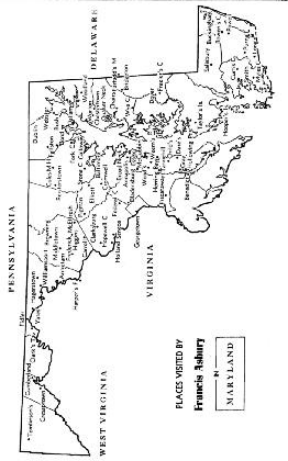
SundayMarylandI first preached in this neighbourhood, and then rode hard to reach Deer Creek in time. Was very unwell with a violent headache, but after preaching to many people, and meeting a large class, I felt myself much recovered. Thus the Lord graciously helpeth me! My soul is filled with peace, and drawn out in love to God and man.
ASB_VOL1.PDF, p. 95
26 July 1773
MondayMarylandMy heart is fixed, trusting in the Lord; and fully bent, through grace, to obey his holy will. How sweet is the peace, and how great is the power with which the Lord blesseth me! Part of the forenoon was spent in settling the class. Then brother Whitworth rode with me to Samuel Litten’s, where I met two more classes, and found them in a prosperous way. Then rode back to Henry Watter’s in great peace; and the next day I found the class increased in number at Samuel Forwood’s. Preached also in the evening; and found it a comfortable time. The young women in the house seemed determined to seek the salvation of their souls.
ASB_VOL1.PDF, p. 95
28 July 1773
WednesdayMarylandRichard Webster set off with me for his house. But before we rode far, a violent clap of thunder, which appeared to be just over my head, shook every limb in my body, and frightened my horse so much that I found it difficult to keep my saddle. But my body and mind soon recovered the shock, and my soul was comforted. Thus we see,
“Dangers stand thick through all the ground,
To push us to the tomb.”
But the Lord is the preserver of all that put their trust in him. Glory be given to God forever!
ASB_VOL1.PDF, p. 96
29 July 1773
ThursdayMarylandMet the class at Joseph Presbury’s, in Gunpowder Neck, and found the enemy had attempted to get in amongst them; but through their vigilance and the grace of God he was repelled, and could gain no admittance. I intended to go to Baltimore, but was prevented by a lameness in one of my feet; so my time was spent at Joseph Presbury’s. The Lord hath done great things for the people in this neighbourhood; many of them are very happy in religion, and some thirsting for full salvation. On Saturday, John King1 met me. I attempted to speak a little in public, but was afterward very unwell, and had a troublesome pain in my head. However, I was enabled to preach the next day with some energy.
ASB_VOL1.PDF, p. 96
Notes (1)
- The presence of John King in Maryland rather than in New Jersey where he had been appointed is not clear. It is probable that he, like other early itinerants, was inclined to ignore circuit boundaries. He left little trace of his travels in New Jersey this year. (McLean, op. cit., 27; Atkinson: Memorials of Methodism in New Jersey, 68, 69.) ↩
2 August 1773
MondayMarylandWe began our quarterly meeting. After our temporal business was done, I read a part of our minutes, to see if brother Strawbridge would conform;1 but he appeared to be inflexible. He would not administer the ordinances under our direction at all. Many things were said on the subject; and a few of the people took part with him. At the conclusion of our quarterly meeting, on Tuesday, we had a comfortable season, and many were refreshed, especially in the love feast. On Wednesday, I set out for Baltimore, but was taken very sick on the road; however, I pursued my way, though it was sometimes through hard rain and heavy thunder; and preached in Baltimore on Thursday, in Mrs. Triplett’s new house,2 which she freely lent for that purpose. There appeared to be a considerable moving under the word. After preaching the next morning at the Point, I went to see a woman, once happy in several respects, but now under distressing circumstances. Her husband was driven from her; and she was left with four children for three months. Many people in general attend the preaching in Baltimore, especially after we have been long enough in town for the inhabitants to receive full knowledge of our being there. And I have a great hope that the Lord will do something for the souls in this place, though the little society has been rather neglected, for want of proper persons to lead them. I rode to Patapsco Neck, and after preaching, reduced the class to some order. Nathan Perigau told me, he had been grieved by some who had manifested too great a forwardness to speak in public. I then returned to Baltimore, and went thence to Backriver Neck, where I found contention in the class; but, through grace, was enabled to bring them to peace and order. Then I went to Charles Harriman’s, and settled two classes in that neighbourhood. While preaching there, the Lord favoured us with a lively and profitable season. My mind has lately been much tortured with temptations; but the Lord has stood by and delivered me. O, my God! when will my trials end? At death. Lord, be ever with me and save me, or my soul must perish at last. But my trust is still in God, that he will ever help me to conquer all my foes.
Preached, and met the society, on Wednesday, at Joseph Presbury’s, and on Thursday, set off for Kent county, but was troubled with a very uncommon pain in my head. In public worship, at Mr. Gibbs’s, a serious Negro was powerfully struck; and though he made but little noise, yet he trembled so exceedingly that the very house shook. I then rode to Mr. Hinson’s,3 and was kindly entertained. Here we saw a little woman with neither hands nor feet; yet she could walk, card, spin, sew, and knit. And her heart rejoiced in God her Saviour. But what is she at this time?
ASB_VOL1.PDF, p. 96
Notes (3)
- Strawbridge had not attended the Philadelphia conference. Strawbridge insisted on administering the Communion in defiance of Wesley, Asbury, and the quarterly conference; but preventive measures that were eventually effective dated from the Philadelphia Conference. (See item 3 of the Journal entry for July 14, 1773.) ↩
- Proper names were variously spelled. Mrs. Tribolett, Tribulet, and now changed by historians to Triplett, was a widow whose new three-story brick house stood on the corner of Baltimore Street and Triplett Alley. A daughter, Caroline Tribolett, married John Conrad Zollickoffer, who served as an American officer in the Revolutionary War and became a Baltimore merchant. Their son, Daniel Zollickoffer (1790-1862), and grandson of Mrs. Tribolett, was one of the founders of the Methodist Protestant Church. (Colhouer: Sketches of the Founders of the Methodist Protestant Church, 253-60; Smith: Life and Labors of Francis Asbury, 18, 29, 30.) ↩
- Carvill Hinson (Hynson) lived near Rock Hall, Kent County, Maryland. The Hinson Chapel, also known as the Kent Meeting House, was between Rock Hall and Chestertown. In this area Robert Strawbridge preached the first Methodist sermon on the eastern shore of Maryland at John Randall’s near Worton, in 1769. The first society was organized near Hinson’s Chapel early in 1773, and the meeting house was completed the following year. It was the first Methodist chapel in the bounds of the present Peninsula Conference. (Hallman, op. cit., 113, 115, 313, 316; Lee, op. cit., 50.) ↩
13 August 1773
FridayMarylandThe spirit of holy peace reigns in my heart. Glory be given to God! I received information to-day of W.F., who had threatened to stone one of our preachers, but was taken sick and died in a few days. Also of another person who had been under conviction for sin, but resisting and shaking it off, he left the house, and died in the dark, speaking evil of the ways of God. Likewise of Mrs. H., who was under conviction from the Spirit of God, but going from the house and indulging a trifling spirit, she soon after died. Thus it seems, when men slight the mercies of God, he visits them with his judgments! The congregation to-day at Mr. Gibbs’s was very large, but they looked like fat bulls of Bashan, though they sat pretty still while I endeavoured to prove that the spirit, doctrine, sufferings, and practice of the holy apostles are exemplified in the people of God at this time. The Lord favoured me with freedom and power, as also in the evening at Mr. Hinson’s.
On Saturday, a multitude of people attended the preaching of the word, and the Lord was with us of a truth.
ASB_VOL1.PDF, p. 97
15 August 1773
SundayMarylandFor some time past, the Lord has blessed me with abundant peace and love; but my soul longs for all the fulness of God, as far as it is attainable by man. O, when shall it once be? When shall my soul be absorbed in purity and love? The congregation assembled under a tree, at Mr. Gibbs’s, and in the time of the first prayer, a woman fell down and lay there all the time of the sermon. The people here appear to be much affected with prejudice against Isaac Rollins; they will not bear with his rough address. But I know not what to do with them. If some other preacher could visit them in his stead, perhaps the work of God would prosper much better. But most of the society appears to be under a genuine work of grace; though a few of their cases are doubtful. The clerk of the church desired to be present in the class meeting; and was considerably affected.
ASB_VOL1.PDF, p. 98
17 August 1773
TuesdayMarylandAfter preaching to a number of people at Mr. Hinson’s, I was much delighted with the simple account of the work of God related and experienced by T.L., who I believe is saved from indwelling sin. He was born at Thornsbury, near Bristol in England; and came over to America about nineteen or twenty years ago. He was first brought to God in Gunpowder Neck; and was soon after in great distress for purity of heart. He said, he prayed and wept till his tears lay in small lakes on the floor; but was at last suddenly filled with spiritual glory. He was blessed with wonderful communications of peace and love. He appeared to be a holy, serious, happy man, and artless without colouring; so that there is no room to doubt but it is a genuine work of God.
ASB_VOL1.PDF, p. 98
18 August 1773
WednesdayMarylandSeveral friends, both men and women, accompanied me to the bay (Chesapeake); and when we came to the water side, we kneeled down and prayed, recommending each other to the grace of God.
ASB_VOL1.PDF, p. 98
19 August 1773
ThursdayMarylandI felt myself unwell, but my heart longs to overflow with love to God. My resolution is, through grace, to make a total and perpetual surrender of myself to him, and his service. At Daniel Ruff’s, on Friday, many people attended to hear the word, which was dispensed with some power; but my soul longs and pants for more of God. My heart rejoices in God, but I am troubled with too much freedom of temper, which may proceed from a great flow of animal spirits; but it has the appearance of levity. I long to be so guarded as to have a solemn, constant sense of the omnipresent God resting on my mind.
ASB_VOL1.PDF, p. 98
21 August 1773
SaturdayMarylandFrancis Hollingsworth1 invited me home with him; and I called to see Richard Dallam, but found him too wise for me to do him much good. Rode to Henry Watter’s, and preached with life and power from the first Psalm; and afterward met the class. Preached on the Lord’s day at Henry Watter’s in the morning at five, at Samuel Litten’s at ten, and at Samuel Forwood’s in the evening. My soul has been kept in tranquillity and peace.
ASB_VOL1.PDF, p. 99
Notes (1)
- This was doubtless the transcriber of Asbury’s Journal who wrote the “Notice of the Transcriber” signed “F. Hollingsworth, March 28, 1821.” The Hollingsworth family came from near Elkton, Maryland, to Fell’s Point about 1769. There Jesse Hollingsworth (1732-1810) built one of the docks and was a leader in erecting the Strawberry Alley Church. His daughter, Ann, became the wife of Henry Willis, whose services for thirty years were among the most extensive and distinguished in American Methodism. His youngest son, Francis Hollingsworth (1773-1826), mentioned above, married Mary Yellott, daughter of John Yellott. (Griffith, op. cit., 55; Armstrong, op. cit., 19, 20; Journal entry for June 29, 1815; Roberts: The Centenary Pictorial Album, 54-56; Hollingsworth: The Hollingsworth Family, 16.) ↩
24 August 1773
TuesdayMarylandMy heart swells with strong desire to live to God; and to trust constantly in him, that he may direct my paths. I.I., an honest old Friend, came to hear me. O that names and parties were done away! that Christians were all but one body! that pure love might reign alone in every heart! Lord, hasten the happy and desirable period.
ASB_VOL1.PDF, p. 99
25 August 1773
WednesdayMarylandMy body was very weak, but my soul was strengthened and blest with a delightful sense of God, while preaching to a large congregation at Mr. Bond’s; and I afterward met the class. God is the portion of my soul; and to do his will is my constant desire and determination. I spoke with two exhorters at Mr. Cromwell’s,1 and gave them license to act in that character.
ASB_VOL1.PDF, p. 99
Notes (1)
- The Cromwell family resided in Green Spring Valley, a locality also associated with the Owings, Merrymans, Moales, and other early Baltimore County Methodist families. Joseph and James O. Cromwell, brothers, became itinerant preachers; the latter accompanied Freeborn Garrettson to Novia Scotia and served as a presiding elder in New Jersey. Joseph located in 1793, and later while ill at the home of Josias Dallam he was persuaded to take brandy as medicine, against his own judgment. His former appetite for drink was revived, and he relapsed into intemperance and so died. John Jacob preached his funeral sermon. (Ridgly: The Old Brick Churches of Maryland, 101; Atkinson: Memorials of Methodism in New Jersey, 216-20; Payton: Our Fathers Have Told Us, 53, 54 n.; see Journal entry for August 25, 1804.) ↩
27 August 1773
FridayMarylandAt Mr. Cromwell’s we had a comfortable time; and the work of God seems to be reviving there. Satan is still haunting my mind, but the Lord gives me power to resist him, and keeps me in constant peace. On Saturday, all my soul was love; no desire for anything but God had place in my heart. Keep me, O Lord, in this delightful, blessed frame. This day I met with Philip Ebert,1 who has set out to preach, but I am doubtful of his call. Daniel Ruff, who lodged with me to-night, is under great exercises of mind from a conviction that it is his duty to preach. He ventured to open his mind to me on the subject, after he was in bed; and so exceedingly was he agitated, that the bed shook under him, while he was relating the exercises of his mind.
Lord’s day. After preaching at Mr. Joshua Owing’s in the morning, and at Mr. Daniel Evans’s in the afternoon, I rode thence to town under heavy exercises of mind. Surely there will be good done here, or the place must be given up.
On Monday, I spent part of my time in reading Poole’s account of the downfall of Antichrist.2 Lord, hasten the time. While preaching this evening in town, there was a gracious moving amongst the people. On Tuesday I rode to Mr. Dallam’s, where a few attended, and I trust not in vain; then returned to town groaning in spirit. I was in company with Brother Whitworth, and Brother Strawbridge, on Wednesday, but was much distressed on account of so few preachers well qualified for the work, and so many who are forward to preach without due qualifications. My foolish mind felt rather disposed to murmuring, pride, and discontent. Lord, pardon me, and grant me more grace! The next day my conscience checked me for the appearance of levity. How seriously should we consider the presence of the Deity; and ever remember that we must render an account of all our conduct!
ASB_VOL1.PDF, p. 99
Notes (2)
- Asbury’s misgivings about Philip Ebert were confirmed. Having been admitted on trial in 1774, he was dismissed from his circuit after a year because he accepted the heretical doctrines of Abraham Whitworth. (Hurst, op. cit., I, 130, 131; Atkinson, op. cit., 90; Sweet: Religion on the American Frontier, IV, 128-30, contains a pathetic letter by Ebert.) ↩
- The Catalogue of the British Museum lists twenty-seven published works by Matthew Poole (1624-79), an English Presbyterian. While none of the titles is identical with that suggested in the Journal, it is probable that Asbury was reading a work by this author. (See Dictionary of National Biography, XVI, 99, 100.) ↩
3 September 1773
FridayMarylandAfter enjoying a comfortable season with a few friends, at Mr. Hunt’s,1 about twelve miles from Baltimore, I preached at four o’clock at Mr. Joseph Armstrong’s, in Middle River Neck, where there is a good prospect, and lodged with Matthew Alexander (?), whose heart the Lord hath touched; and on Saturday returned to town.
ASB_VOL1.PDF, p. 100
Notes (1)
- The home of Phineas Hunt and his wife, Susan, located twelve miles from Baltimore, was a preaching place until about 1780 when Hunt’s Chapel was built. For sixty years prior to the death of Hunt in 1837 their home was a stopping place for Methodist preachers. (Lednum, op. cit., 117; Armstrong, op. cit., 155; Smith: Recollections and Reflections of an Old Itinerant, 208.) ↩
5 September 1773
SundayMarylandIn the morning I preached at town, and then at the Point, where the people seem more attentive; and afterward returned to town, and preached at night to a large congregation. It is a matter of great grief to me, to see the inhabitants of this town so much devoted to pride, spiritual idolatry, and almost every species of sin. Lord, visit them yet in tender mercy, to reform and save their souls. On Monday I went to visit William Lynch, in Patapsco Neck. How is the scene changed there! He is no more ashamed of the truth as it is in Jesus. His wife has lately experienced great agonies of soul; and was, in a wonderful manner, delivered, being filled with the peace and love of God. This, by the mercy of God, has produced a gracious effect on his heart. The next day he accompanied me to George Prestbury’s, and thence to Gunpowder Neck, where we had a comfortable time. Hitherto the Lord hath helped!
ASB_VOL1.PDF, p. 100
8 September 1773
WednesdayMarylandI crossed Bush River, and then rode to Josias Dallam’s: my heart was filled with peace and power; but what sore conflicts have attended me! I am weary of all that is wrong within me. Lord, purify my heart, make me wholly thine, and fill me with all the fulness of thy love! The next day I visited F—— H——, who treated me kindly. We entered into a close conversation on religious subjects; but I found he had been reading
Mr. M——’s mystery of errors more than the Gospel. He has some good qualities. But how weighty is his charge; he has a family of not less than eighty souls under his care! They were collected in the evening to join in prayer, and receive a word of exhortation. I rode to Deer Creek on Friday, and had a refreshing season, as also at Henry Watters’s in the evening at four o’clock. The Lord is still my friend, and fills me with peace and pure desire.
ASB_VOL1.PDF, p. 100
13 September 1773
MondayMarylandFound it necessary on a particular occasion to go to Pipe Creek; and while preaching to a large number of people at Richard Owings’s, the power of the Lord was present. My mind has been much stayed on God for some time past, and my body has felt but little weariness, though on some days I have preached four times. Came to William Lynch’s, and found Mr. Lynch in spiritual trouble; but I hope the Lord will soon deliver him, and give him the “oil of joy for mourning.” Glory to God! my mind is kept in sweet peace, and deeply engaged in every duty. Preached on Thursday at Mr. Lynch’s, and there appeared to be some small awakenings amongst the people. Thence rode to Nathan Perigau’s. He appears to be a man that fears God in some degree; but is very stiff, and in some things full of self-will. My mind was as it were in chains, while preaching at Mr. Harriman’s;1 but my soul was greatly blest while dispensing the word to a large congregation at Mr. Armstrong’s, in Middle River Neck. There is a prospect of some good being done, by the grace of God, in this place. After preaching on Saturday, with freedom and satisfaction, to a number of people in Gunpowder Neck, I was taken very unwell; and after a very restless night, with much profuse sweating, I rose in the morning exceedingly indisposed, and in much weakness of body went through the public duties of the day; but the Lord was graciously and powerfully with me, both in preaching and society meeting.
ASB_VOL1.PDF, p. 101
Notes (1)
- From this home Hezekiah Harriman (1770?-1818) was received into the Baltimore Conference in 1795. In 1800 he volunteered for pioneer work in Kentucky, and after five years returned to his home conference. (General Minutes; Redford, op. cit., I, 288. 292-95.) ↩
20 September 1773
MondayMarylandMy soul was refreshed with the love of God. How do I long for a mind thoroughly refined, filled with perfect purity, and constantly devoted to God! The prospect and hope of this frequently transports my soul. Lord, hasten the blessed period! Let all my soul be swallowed up in love! I have lately been reading Mr. W. on the ruin and recovery of man: he is a judicious writer, in the main, and generally illustrates his subjects well; but some of his sentiments relative to infants, I think, are very exceptionable.
ASB_VOL1.PDF, p. 101
21 September 1773
TuesdayMarylandI crossed the Chesapeake bay, in company with a few friends, to Kent County. After a good passage we reached the shore, sat down to rest and refresh ourselves, and then joined in prayer. We walked to John Randall’s, where we were informed of the opposition which one of our preachers met with. But the work is the Lord’s, and they that oppose his work oppose his omnipotence. On Tuesday my soul was kept in peace and rest. After preaching with some comfort, I was seized with a quartan ague, which was attended with much pain in my back and limbs. Mr. Kennard asked me home,1 and treated me with much civility and kindness. I now read Smollett’s description of the Methodists;2 and cannot wonder that his readers, who have no personal knowledge of them, should treat the Methodists with contempt. But the day is coming when every one will appear in his true colours, and be constrained to render an account of all his conduct to God. A high fever and heavy sweats were my companions in the night; and the next morning I was too unwell to speak in prayer; but I ventured to ride in a carriage as far as Mr. Hinson’s, in the afternoon.
ASB_VOL1.PDF, p. 102
Notes (2)
- Kennard resided near Worton, Kent County, Maryland. Asbury preached there July 27, 1778. (Hallman, op. cit., 115.) ↩
- Tobias George Smollett, M.D. (1721-71), popular English novelist who inveighed against evangelicals, generally made unusually splenetic attacks against the Methodists in his History of England. “Poor Doctor Smollett!” Wesley commented, “thus to transmit to all succeeding generations a whole heap of notorious falsehoods!” (Hurst: The History of British Methodism, III, 1165.) ↩
23 September 1773
ThursdayMarylandAt. Mr. Carvill Hinson’s the Lord was with me while preaching from Acts 14:10. Observing in John Randall the odious appearance of speaking too freely of absent persons, I felt a sense of my own imprudence; and saw both the propriety and necessity of retaining every such matter in my own breast, till an opportunity may offer of conversing with the person immediately concerned, face to face. Lord, pardon me in everything that is wrong in the least degree; and grant me more fortitude and evangelical wisdom for the time to come!
ASB_VOL1.PDF, p. 102
24 September 1773
FridayMarylandMy trials and exercises have been somewhat peculiar. May the God of mercy communicate more abundant power and love! Though this was the day in course for my ague to return, I preached to a small, serious congregation with inward power. My ague came on afterward with a severe pain in my back. I drove off the cold fit by walking and running, but went to bed in a high fever. The next morning my frame felt weak; but my heart was sweetly resigned.
ASB_VOL1.PDF, p. 102
25 September 1773
SaturdayMarylandWhile preaching to a large company at Mr. Gibbs’s,1 we had a moving, melting time. After preaching at nine o’clock the next morning at the same place, I went to church, and thought the minister intended to point at me, by speaking against idleness, and people who follow an unwarrantable employment, and doing what they have no business with. But, can any employment be more unwarrantable than the charge of souls without any real concern for their salvation? And, bad as idleness is, it is far preferable to leading immortal souls astray. The world can judge whether he is most like an idle man who reads a dry harangue every Lord’s day, or he who toils and labours both day and night to save the souls of men. But these things I leave with the Lord. Many people attended my preaching in the evening, while I took occasion, from 2 Corinthians 5:20, to show, amongst other things, the evangelical mission and life of a true ambassador of Christ.
Monday. We crossed the Chesapeake Bay, and rode to Jos. Presbury’s. My ague coming on I went to bed in great torture; and thought my frame could not long endure it. My body is greatly weakened by this disorder; and perhaps I shall be dumb for a season, either for my own unfaithfulness, or the unfaithfulness of the people. May the Lord fortify my soul with patience!
ASB_VOL1.PDF, p. 102
Notes (1)
- Asbury was again in that part of Kent County between Worton and Rock Hall where he had introduced Methodist preaching. In December, 1777, he returned to preach and meet a thriving society in Gibbs’s home. (Hallman, op. cit., 112.) ↩
30 September 1773
ThursdayMarylandThough very weak and low, the Lord favoured me with a good opportunity, life, and liberty, at Daniel Ruff’s.
ASB_VOL1.PDF, p. 103
1 October 1773
FridayMarylandI was exceedingly ill at Mr. Dallam’s; and now began to think my travelling would be interrupted. This is my greatest trouble and pain, to forsake the work of God, and to neglect the people, whose spiritual interest and salvation I seek with my whole soul. The next day, finding myself too weak to travel, I sent brother Ebert in my place; and must content myself to abide here awhile, where they treat me with the greatest care and kindness. My present purpose is, if the Lord spares and raises me up, to be more watchful and circumspect in all my ways. O Lord, remember me in mercy; and brace up my feeble soul!
ASB_VOL1.PDF, p. 103
3 October 1773
SundayMarylandEvery day I have endeavoured to use what little strength I had for God; and this day I felt something better in my body, and quite serene in my mind. Rode to Bush Forest Chapel, and preached to many people with considerable power. But had a violent fever at night, which held me nine hours. It is my desire to be resigned to the will of God in all things. Sent brother Whitworth in my place to supply the appointments.
ASB_VOL1.PDF, p. 103
6 October 1773
WednesdayMarylandMy disorder returned, and my body was in great pain for many hours. Felt some patience, but not enough. O that this affliction may answer the intended end! My will is quite resigned to the will of God, so that I cannot ask ease in pain; but desire to be truly thankful, and leave the disposal of all things entirely with him.
It is undoubtedly a gracious providence, that my lot should be cast in the family of Josias Dallam, during my indisposition to travel. I shall never forget the kindness, or discharge the obligations I am under, to Mrs. Sarah Dallam,1 who watched and waited upon me day and night. God grant, that the same measure which she has meted to me, may return upon herself and her children! On Thursday and Friday my mind was kept in peace, though I could do very little but read. The language of my heart is, Lord, thy will be done!
My disorder has increased, and for several days my indisposition has been so great that I kept no journal. My friends wept around, and expected my dissolution was near. But the Lord thought on both them and me, to raise me up from the borders of death. O that my few remaining days may be spent to his glory!—that every valuable end may be answered by my future life!
ASB_VOL1.PDF, p. 103
Notes (1)
- The home of Josias William Dallam and his wife, Sarah Dallam, was among the very first opened to Wesley’s missionaries when in the winter of 1769-70 Robert Williams preached there. It has been estimated that one-third of the time from midsummer 1773 to the end of the year, Asbury was confined to his bed. (Du Bose, op. cit., 66; Atkinson: The Beginnings of the Wesleyan Movement in America, 198-200.) ↩
27 October 1773
WednesdayMarylandMr. Dallam was so kind as to conduct me in a carriage to my friend Barnet Preston’s, at Deer Creek. On Friday I found myself much better, and my soul was kept in peace and purity. May the Lord ever keep me near to himself!
ASB_VOL1.PDF, p. 104
4 November 1773
ThursdayMarylandOur quarterly meeting came on,1 and I attended the private business, though in much weakness of body. Some of my brethren did not altogether please me. My hand appears still to be against every man. Mr. Rankin conducted the meeting. At the close of the whole, I discovered the affectionate attachment which subsisted between many of my dear friends and me. It cut me to the heart when we came to part from each other. They wept and I wept; especially brother Lynch and his wife. May the gracious Lord remember them in mercy and love!
ASB_VOL1.PDF, p. 104
Notes (1)
- At this quarterly meeting held at Bush Chapel, Asbury was too indisposed to attend other than the business sessions. His rather gloomy report is in sharp contrast to that given by Rankin, who presided. (Sandford, op. cit., 226.) ↩
6 November 1773
SaturdayMarylandWas able to sit up and write to my dear friend Mr. S——y. It is but little I can do; but, thanks be to God for any help! Heard brother Williams preach, and thought it my duty to blame him for speaking against the knowledge of salvation. Was better on Thursday; but threw myself into a violent fever by my own imprudence.
ASB_VOL1.PDF, p. 104
9 November 1773
TuesdayMarylandMy disorder seems to be going off, though I mend but slowly. On Wednesday I went to Mr. Dallam’s in a carriage, and met with Mr. Rankin, who preached there. The next day Mr. Rankin set off for Philadelphia, and left me still poorly.
ASB_VOL1.PDF, p. 104
13 November 1773
SaturdayMarylandThough I have not preached for a month, yet I ventured to attend the funeral of J. Gallin, a Presbyterian, but a man who had borne a Christian character. As they could get no preacher of their own profession, they made application to me. Many people attended on this solemn occasion; and it was a very moving time.
ASB_VOL1.PDF, p. 105
15 November 1773
MondayMarylandFound myself much better in health, and concluded to set off on my Master’s business as soon as I should be properly equipped. On Thursday my heart was fixed, trusting in the Lord; and as my body was gathering strength, I set out on Monday for Baltimore; and on Friday reached William Lynch’s, who entertained me with the greatest kindness. Here I had the pleasure of seeing our new church begun on Back River Neck.1 The next day he conducted me in his carriage to the Point, where I was enabled to preach with some power. Then returned to the Neck, and met with Mr. J. He heard the word of God with great freedom of mind; and I believe his false peace was broken. My spirit was greatly refreshed by meeting brother Yearby at Baltimore on Monday; and the next day I was much assisted in preaching to a large number of people in town, both rich and poor. May the Lord arise and show himself gracious to these people! Through abundant grace I feel nothing contrary to the purest intention; nor the least desire for anything but God. Bless the Lord, O my soul!
ASB_VOL1.PDF, p. 105
Notes (1)
- This was the Back River Meeting House about ten miles down Patapsco Neck and one mile east of Nathan Perigau’s farm, near the present Eastern Avenue and North Point Road, Baltimore. The Society was organized and the edifice begun by Robert Strawbridge. (See article by Mrs. Arthur Barneveld Bibbins, The Souvenir Book of the Methodist Sesqui-Centennial, October 10-14, 1934, p. 26; Nelson Reed manuscript diary, November 19, 1773; Archives of Baltimore Conference Historical Society.) ↩
25 November 1773
ThursdayMarylandHad occasion to go to Annapolis,1 and found some desire to preach there. But perceiving the spirit and practice of the people, I declined it. A tavern-keeper offered me the use of his house for preaching; but he was a Deist, and I did not feel free to open my mouth in his house. After my return to Baltimore, Mr. J., the person mentioned a few days ago, came and invited me to his house. The next morning, at breakfast, he showed much freedom in conversation, and there was great appearance of a change.
ASB_VOL1.PDF, p. 105
Notes (1)
- Asbury’s visit followed by about five months that of Joseph Pilmoor, who on July 11, 1772, preached the first Methodist sermon in Annapolis under a “very large tree on a fine piece of ground,” probably the old Treaty Tree on the campus of St. John’s College. (Atkinson, op. cit., 342-44; Bibbins: How Methodism Came, 76-78; Smith: Recollections and Reflections, 258, 259.) ↩
29 November 1773
MondayMarylandHave been able to officiate at the town (Baltimore) and Point every day; and the congregations rather increase. Lord, make me humble and more abundantly useful; and give me the hearts of the people that I may conduct them to thee! I feel great hopes that the God of mercy will interpose, and do these dear people good. This day we agreed with Mr. L. to undertake the brick work of our new building at the Point.1 At night I was seized with a violent fever; and as many of my friends thought it improper for me to go immediately into the circuit, I concluded to abide for a season in town. Many are under some awakenings here; and they are very kind and affectionate to me. My heart is with the Lord. He is my all in all.
ASB_VOL1.PDF, p. 105
Notes (1)
- This chapel located in Strawberry Alley on Fleet Street, Fell’s Point, was the first to be begun in what is now Baltimore. (See article by the Rev. W. Hamilton, The Methodist Quarterly Review, July, 1856; Griffith, op. cit., 55; Lee: History of Methodism, 49.) ↩
1 December 1773
WednesdayMarylandPreached at Nathan Perigau’s and William Lynch’s. At the latter place many more people attended than we could expect, considering the conduct of Abraham Rollins, who in his preaching had behaved more like a madman than anything else. Rode the next day to Richard Owings’s, where a few attended the word who understood the things of God. My soul is in peace. But I wish to bear all things with perfect patience, and feel less affected by all that men may say of me, and every act of disagreeable conduct towards me.
ASB_VOL1.PDF, p. 106
4 December 1773
SaturdayMarylandI returned to Baltimore; and the house of Mr. William Moore1 was crowded with people who attended to hear the word; and the next day I felt great satisfaction in preaching to a large number of people at the Point; most of them gave good attention, but some were unruly.
ASB_VOL1.PDF, p. 106
Notes (1)
- William Moore, an Irishman, arrived in Baltimore in 1762 and in 1770 built the stone house at the southeast corner of South and Water Streets to which Asbury refers. Two years later, on his first visit to Baltimore, Asbury with John King was a guest in this house, which soon became a center of Methodist activities. (Lednum, op. cit., 88, 89; Griffith: Annals of Baltimore, 39, 48; Hamilton, op. cit., July, 1856.) ↩
7 December 1773
TuesdayMarylandYesterday I was very ill all the day with a fever; but feel something better to-day. God is the portion of my soul. He favours me with sweet peace, and sanctifies all my afflictions. Lord, evermore keep me, and conduct me in safety to thy blessed presence above! I had a fever, and kept my bed on Wednesday, and should have thought the day had been lost, had it not been a season for the exercise of my patience. Preached on Friday with some satisfaction, though in great weakness of body, having been very ill in the preceding night. On Saturday my mind was serene; though I greatly long to have a deeper sense of God continually resting on my heart. My soul pants earnestly for closer communion with the Lord; and to die, to be crucified, to every other object.
ASB_VOL1.PDF, p. 106
12 December 1773
SundayMarylandWhile preaching at the Point, there was great solemnity very visible in the congregation. The power of God was eminently present, and one person fell under it. Such numbers of people attended to hear the word to-day in town, that we knew not how to accommodate them; and there appeared to be more seriousness than usual among them.
ASB_VOL1.PDF, p. 106
14 December 1773
TuesdayMarylandWe had a comfortable time at William Lynch’s. The next day Mr. Chase, a Church minister,1 was present at preaching. We had some conversation afterward, in which we did not disagree. But, poor man! one more ignorant of the deep things of God, I have scarcely met with, of his cloth. He knew brother King, and appearing to be angry with him, abused him for preaching in the church. Though very unwell, I rode twenty miles on Thursday, to preach at William Worthington’s,2 where a few of them felt the power of God. Mr. Worthington and his wife in particular were tenderly affected.
ASB_VOL1.PDF, p. 106
Notes (2)
- The Rev. Thomas Chase, a native of England, in 1741 arrived from near Princess Anne, Somerset County, Maryland, to become rector of St. Paul’s Church. He was the father of Samuel Chase, an associate justice of the Supreme Court and a signer of the Declaration of Independence. (National Cyclopaedia of American Biography, I, 24.) ↩
- Among early Methodist families in Elkridge, eight miles southwest of Baltimore, besides the Worthingtons were the Dorseys, the Howards, and the Hammonds. Asbury referred to the people at Elkridge as “wealthy and wicked.” (Lednum, op. cit., 116; Bibbins, op. cit., 59.) ↩
18 December 1773
SaturdayMarylandThough in a high fever, I rode twenty miles through the rain to Baltimore. But the Lord preserved me; and I was able to preach to a small company at night. Being unwell on the Lord’s day, I did not attempt to preach till night. But then the people were serious, and the power of God was present.
ASB_VOL1.PDF, p. 107
20 December 1773
MondayMarylandMrs. Huling introduced me to the family of Mrs. Rogers,1 where they treated me with great kindness and care. O that plenty may not hurt, nor ease destroy me! Lord, help me, in all things, to desire nothing but thee!
ASB_VOL1.PDF, p. 107
Notes (1)
- Philip Rogers was among the leaders and contributors toward the erection of the Lovely Lane Meeting House, Baltimore. His wife was the daughter of Mrs. Woodward whose second husband was John Hesselius, an eminent portrait painter. Rogers was an original trustee of Cokesbury College, who often entertained Asbury at Greenwood, his Maryland estate. (Armstrong, op. cit., 89; Bibbins, op. cit., 79-80; Warfield: Founders of Anne Arundel and Horner Counties, 62.) ↩
23 December 1773
ThursdayMarylandRichard Owings informed me that the work of God was gaining ground in Frederick county. I preached at John Deaver’s, in the old town, and had a wild, staring congregation. On Friday the Lord graciously blessed me with sweet peace, and much love. My heart is greatly affected at times for the town of Baltimore; and I am almost ready to doubt whether it is my duty to tarry here. Yet the seriousness of the people appears to increase, and a few are concerned for their salvation.
ASB_VOL1.PDF, p. 107
27 December 1773
MondayMarylandMy soul was happy in God. Brother Whitworth brought good accounts from the country, where the congregations are large, and some coming to the Lord. I have great hopes that my acquaintance with the family of Mrs. Rogers will be rendered a blessing to them; and I expect to see the mother and son bow to the cross of Christ.
ASB_VOL1.PDF, p. 107
28 December 1773
TuesdayMarylandGuyse’s paraphrase1 has lately afforded me great delight. It is a pity that such a man ever imbibed the Calvinistic principles. My soul was kept in peaceful composure to-day; and at night I made a religious visit, which I hope will not be labour lost. On my return home, I had great hopes that Philip Rogers will yet become a disciple of Jesus Christ. I still pray, and long, and wait, for an outpouring of the blessed Spirit on this town. O that the time were come! Lord, hasten it for thy mercy’s sake!
ASB_VOL1.PDF, p. 107
Notes (1)
- John Guyse (1680-1761) was an independent English minister who wrote An Exposition of the New Testament in the Form of Paraphrase, in three volumes. ↩