1807
1 January 1807
ThursdayNorth Carolina
On Thursday, January 1, 1807, we set out for Columbia, dining in the woods on our route: it was excessively cold. I preached in Mr. Harrison’s house in the evening. Next day we came to Camden. Saturday brought us to Rembert Hall. We have been redeeming time by riding two hundred and twenty miles in five days. It has been so cold, I have not been able to pray and meditate as I wished. I must now answer thirteen letters in two days. My body is afflicted, but I am kept in perfect love.
ASB_VOL2.PDF, p. 486
11 January 1807
SundayNorth CarolinaWe attended, as was meet, at Rembert’s chapel. I gave them a sermon on 1 Chronicles 28:9.
ASB_VOL2.PDF, p. 486
14 January 1807
WednesdayNorth CarolinaWe came away to M’Cullom’s ferry.1 I had finished my writing on Monday and Tuesday. On our way we dined at Woodham,2 and lodged with Jeremiah Heath. On Thursday we crossed Pee Dee, and came to Colonel Bethea’s.3
NORTH CAROLINA
Friday brought us through Lumberton, in North Carolina, lodging with Peter Gautier. We found ourselves obliged to ride on the Lord’s day, through the cold, to Wilmington, crossing two rivers in a snow and hail storm. I have ridden four hundred and twenty miles in ten days and a half—cold, sick, and faint: it was as much as I could well bear up under.
ASB_VOL2.PDF, p. 486
19 January 1807
MondayNorth CarolinaBusy making extracts from letters, and planning for conferences. Tuesday occupied as yesterday; in the evening I preached. I feel that God is here. On Wednesday brother Kendrick preached. Thursday, reading and writing; Joshua Wells preached.
ASB_VOL2.PDF, p. 486
23 January 1807
FridayNorth CarolinaI preached in the tabernacle, upon Matthew 11:28-30. It was a time of some quickening. On Saturday, reading Wesley’s Sermons, first volume; those who feel disposed to complain of the brevity of his Notes, should recollect the wonderful amount and variety of his literary labours, polemical and practical, besides the care of all the Churches in three kingdoms.
ASB_VOL2.PDF, p. 487
25 January 1807
SundayNorth CarolinaA high day on Mount Zion. At the rising of the sun, John Charles began the worship of the day; he chose for his subject Romans 8:1. At eleven o’clock I held forth on Hebrews 3:12-15. I spoke again at three o’clock on Isaiah 55:6, 7. Stith Mead preached at six o’clock in the evening. O that by any means we may save some! On Monday and Tuesday still reading Wesley’s Sermons: I have completed thirty nearly. On Tuesday evening I preached, and it was a serious time.
ASB_VOL2.PDF, p. 487
28 January 1807
WednesdayNorth CarolinaWe took our flight from Wilmington: what I felt and suffered there, from preachers and people, is known to God. At Nixon’s, Topsail, I preached on 2 Peter 3:14. On Thursday I rode forty miles to the Richlands, and preached at Lot Ballard’s. Friday evening found us at Perry’s. Saturday brought us to Newbern: we had an awful storm of rain.
ASB_VOL2.PDF, p. 487
1 February 1807
North CarolinaI preached on Sunday at eleven o’clock.
ASB_VOL2.PDF, p. 487
4 February 1807
WednesdayNorth CarolinaWe have used great diligence in our conference labours,1 and have been faithful to the pulpit. I preached to-day on 1 Corinthians 2:5. On the Sabbath I preached to the whites, on John 3:16; and to the Africans, on Ephesians 6:5-8. Much might be said; I will only observe that we have sixty-seven preachers, and have added three thousand one hundred and fifty-nine to this conference bounds; we have, since our sitting here, known that there are twenty whites converted, and as many blacks: these blessings on our labours pay all expenses, reward all toils in the midst of suffering and excessively cold weather.
ASB_VOL2.PDF, p. 487
Notes (1)
- It was at this conference that the resolution, begun by the Baltimore Conference, was presented in favor of calling a General Conference of seven delegates from each annual conference to meet in Baltimore in 1807 for the purpose of strengthening the episcopacy. The plan was vigorously opposed by Jesse Lee in the Virginia Conference, and it received only fourteen votes. Since the plan required the vote of all the conferences it was defeated by Virginia’s vote. All the other conferences reported in favor. (Bennett, op. cit., 505-9.) ↩
9 February 1807
MondayNorth CarolinaI gave them my last discourse on Psalms 34:15, 16; and next day came away to the widow Williams’s. On Wednesday at Pinner’s. The Roanoke had broken away with its ice. Thursday brought us to Murfreesboro: I preached upon 1 John 3:10, 11. It was the day after the celebration of Washington’s funeral: many of the respectables had come to town on this occasion, and still remained; these attended. I lodged at Doctor Key’s.
VIRGINIA
ASB_VOL2.PDF, p. 487
13 February 1807
FridayMarylandWe came to Suffolk. I had sent on a messenger, and found a congregation, to whom I spoke a few words, on 1 Peter 3:10-12. We felt a present God. Brother Yerbury: as dying and behold he lives, spiritually. I have time to make but few observations. We have had rain for three days past; bad roads for two hundred miles. Since I left Philadelphia I calculate having travelled two thousand four hundred and forty miles. At Norfolk I preached for them, and at Portsmouth. On Monday we came away to General Wells’s, Isle of Wight county; and next day called upon Willy Blunt on our way to Birdsong’s. Wednesday brought us through a proper storm to Petersburg: the streets were not easily passable. We lodged on Thursday night in Richmond at the house of the widow Tucker: the roads hither had well-nigh mired us. On Friday we lodged at William Smith’s: these are friends to camp meetings, and gracious souls. A long ride of forty-two miles brought us to Fredericksburg on Saturday; we got a little fodder for our horses, and took a cut of dry bread on the cold ground ourselves. My mind enjoys great peace; and yet there are subjects that might disturb it: but I pass them over; I am not fond of hurting the feelings of people.
ASB_VOL2.PDF, p. 488
22 February 1807
SundayMarylandI preached in the church; and then came away to Aquia Town, sixteen miles, and lodged at Mr. Bailey’s. On Monday I went over to Sandford’s on Pohick; next day the rain followed us to Alexandria: at night I gave them a discourse on Revelation 14:12, 13. MARYLAND
ASB_VOL2.PDF, p. 488
25 February 1807
WednesdayMarylandWe crossed over into Maryland at Georgetown (D.C.). Surely the roads are bad! My mind is in great peace. I had to preach a kind of funeral discourse, on the death of Bishop Whatcoat,1 on Thursday: and on Friday I came away to Bladensburg. Here I baptized a child, and prayed with the afflicted, and resumed my march eastward through mud and mire, arriving in the night in Baltimore.
ASB_VOL2.PDF, p. 488
Notes (1)
- Bishop Richard Whatcoat (1736-1806) had died in the home of Richard Bassett, Dover, Delaware, July 5, 1806. For the most complete account of the last illness and death of the bishop, by one who was present, see Boehm, op. cit., 138, 140-43. ↩
28 February 1807
SaturdayMarylandSnow. I rested and wrote.
ASB_VOL2.PDF, p. 488
1 March 1807
SundayMarylandLight Street Chapel; I preached upon Hebrews 12:2. At the African church1 my subject was Colossians 2:6.
ASB_VOL2.PDF, p. 489
Notes (1)
- This reference is probably to the Sharp Street Methodist Episcopal Church (1802-60) which was located on the west side of Sharp Street between Lombard and Pratt streets. Its successor is the Sharp Street Memorial Church, Etting and Dolphin streets, Baltimore. (Methodist Sesqui-Centennial Souvenir Book, 68; see note under May 25, 1797.) ↩
7 March 1807
SaturdayMarylandOur conference commenced1 its sitting on Monday, and rose this evening. There were a hundred and one members upon the list; eighteen of these were additions made. We sat six hours a day, and did much work in great peace. In the multiplicity of things that necessarily came before me, much must be left in shades; there were few complaints about stations. The increase within the bounds of the Baltimore Conference, is two thousand eight hundred and seventeen members. We had a great deal of faithful preaching. On the Sabbath I preached at the Point; and at Light Street I gave them my last discourse. I was in affliction and unwell, but always in peace; God is all in all.
ASB_VOL2.PDF, p. 489
Notes (1)
- Sixty-one preachers attended the session of the Baltimore Conference in Light Street Church. Of most far-reaching effect was the almost unanimous vote to ask the six other annual conferences to give consideration to the “propriety of a selected or delegated General Conference.” (Armstrong, op. cit., 146.) ↩
10 March 1807
TuesdayMarylandI left Baltimore for Perry Hall.1 I spent one night with the elders of the house and my old friends Jesse Hollingsworth, and Daniel Hitt, the faithful companion of my travels for three thousand miles. On Wednesday we left our kind friends, and came to Bennett’s.2 Next day I preached in brother Howell’s house, and came to North East. Friday brought us through rain and snow to Georgetown Cross Roads: here we called a meeting in the evening; my subject was 2 Corinthians 12:9. On Saturday we came in to Chestertown; it was damp and cold.
ASB_VOL2.PDF, p. 489
Notes (2)
- See letter to Daniel Asbury, March 9, 1807. ↩
- This was either Elisha Bennett, a trustee appointed to take a deed of land from Nicholas Harding to build a preaching house, or to the home mentioned by Colbert: “I traveled from Thomas Bennett’s to Baltimore about 20 miles.” (Baltimore Circuit Stewards’ Book, 1794-1815; William Colbert’s Journal, December 15, 1790.) ↩
15 March 1807
SundayMarylandHail, blessed day! The Sun of Righteousness within us, and the material sun once more gladdens the earth with his beams! Although we have taken five days to come from Baltimore to this place, a distance of one hundred miles, the stage drivers can tell that we have been pretty busy. At Chester I find that unpleasing prejudices have been excited by the publication of a pamphlet on succession in the Church; the author is one Kewley, who went from us.1 In the morning I preached upon Psalm 34:11: “Come, ye children,” &c. 1. Who are to be taught. 2. What they are to be taught. 3. Who are the teachers. 4. The happy consequences of being taught aright, and receiving and practising the instructions given. I spoke again in the afternoon, on Revelation 6:13, 14. My mind is in perfect peace.
ASB_VOL2.PDF, p. 489
Notes (1)
- The book was An Inquiry into the Validity of Methodist Episcopacy, with an Appendix, containing two original documents never before published by an Episcopalian of the State of Maryland. John Kewley, the author, was an Irishman and was reared in the Church of Rome. He was converted under the influence of Alexander McCaine and in 1801 was received on trial in the Methodist Episcopal Church. Subsequently he became an Episcopalian but died a priest in the Roman Catholic Church. (Drinkhouse: History of Methodist Reform, I, 401, 402.) ↩
16 March 1807
MondayMarylandCame to Centreville, and I preached. After dining with Thomas Wright,1 the brother of the present governor of Maryland, we came to Easton, and lodged with Mr. Lockerman.2 On Tuesday Daniel Hitt preached; I only exhorted. We met Joseph Everett, who conducted us to William Frazier’s to dine. On Wednesday we came to Thomas Foster’s. I was unwell, and Daniel Hitt preached. We rode on to Cambridge; Daniel Hitt preached in the evening.
ASB_VOL2.PDF, p. 489
Notes (2)
- Thomas Wright lived at Centreville and was a leader of Queen Annes County in promoting American independence. He was a trustee to whom on June 21, 1794, the lot was deeded on which that same year a chapel was erected. It was the forerunner of the present Epworth Church. Thomas Wright’s brother, Robert, was the governor of Maryland 1806-9. (Emory: History of Queen Anne’s County, 232, 233, 276, 277; see note under June 11, 1795.) ↩
- This was probably Theodore R. Lockerman, a prominent citizen of Talbot County. ↩
19 March 1807
ThursdayMarylandI took the pulpit at eleven o’clock; it was court time, it was cold, and the notice was short. My subject was 2 Corinthians 6:7: “The word of truth”—the grand doctrines of the Gospel, with special and general application. “The power of God”—in operation upon the souls of the people in numbers and degrees. “Armour of righteousness”—such as described in Ephesians, helmet of salvation, and so on. But more fully explanatory of the general subject in its analogy to the justifying and sanctifying operations of grace, and practical righteousness as it respects our relation to God and his Church. We returned to Thomas Foster’s.
ASB_VOL2.PDF, p. 490
20 March 1807
FridayMarylandAt Bethel, Brown’s chapel, Daniel Hitt preached, I only exhorted. We dined at father Davis’s, and lodged at his son William’s. The weather is excessively cold and disagreeably windy. On Saturday I preached at Deep Creek, and ordained two local preachers to the office of deacon. The day was unpleasant, and the house open. We dined with Deacon Baker, and then drove to George Parker’s, within four miles of Salisbury, for the night. I suffered so much in the last two days, that I could not keep my mind constantly engaged in prayer; this was my grief, but my patience bore me up.
ASB_VOL2.PDF, p. 490
22 March 1807
SundayMarylandAt Salisbury I preached upon Ephesians 4:1. The Episcopalians have had their day. Our appointment had not been made, nevertheless we preached; Daniel Hitt at eleven o’clock, and at night, and I at three o’clock in the afternoon; and we had people to hear us. VIRGINIA
ASB_VOL2.PDF, p. 490
23 March 1807
MondayMarylandWe came to dear William Downing’s, Accomack: I came in late and unwell.
ASB_VOL2.PDF, p. 490
24 March 1807
TuesdayMarylandWhen I should have gone to preach, I went to bed ill with a bilious colic and fever.
MARYLAND
We came to Snow Hill on Wednesday; my chill and sickness continued, and Daniel Hitt preached. We kept on to Poplartown, and stopped at C. Hazzard’s: still unwell.
DELAWARE
ASB_VOL2.PDF, p. 490
26 March 1807
ThursdayMarylandWe called to see brother Davis: he seemed to be dying by inches in a close room. We stopped at Mr. Clayton’s,1 Dagsboro, in Delaware: from hence we fled with speed to Lewistown, stopped and took coffee. I preached on 1 Thessalonians 2:11, 12; we had a crowded house and a gracious time.
ASB_VOL2.PDF, p. 490
Notes (1)
- This may have been James Clayton, a brother of Dr. Joshua Clayton. He lived at Dagsboro, Sussex County, Delaware, and was the father of John Middleton Clayton (1796-1856), senator, chief justice of Delaware, secretary of state in the administration of President Zachary Taylor, and negotiator of the Clayton-Bulwer Treaty. (Scharf: History of Delaware, I, 529.) ↩
27 March 1807
FridayPennsylvaniaAt Milford Bishop Whatcoat preached his last sermon, and as I preached here upon 2 Timothy 4:7, 8, it came as a matter of course to make some observations on his character, labours, piety, and death.
ASB_VOL2.PDF, p. 491
28 March 1807
SaturdayPennsylvaniaI preached in Dover, and the numbers present were so great, that I stood up outside to speak; the wind was cold, and I uncovered. I preached the same day at Smyrna, at four o’clock. I hear many things of the weal and woe of the work of God.
ASB_VOL2.PDF, p. 491
30 March 1807
MondayPennsylvaniaI gave them a sermon in Wilmington.
ASB_VOL2.PDF, p. 491
31 March 1807
TuesdayPennsylvaniaYesterday’s excessive cold is explaining itself in a snow storm.
PENNSYLVANIA
ASB_VOL2.PDF, p. 491
1 April 1807
WednesdayPennsylvaniaWe arrived in Philadelphia.1
ASB_VOL2.PDF, p. 491
Notes (1)
- See letter to the trustees of the African Methodist Episcopal Church, April 9, 1807, also letter to unnamed brother, April, 1807. ↩
10 April 1807
FridayPennsylvaniaOur conference commenced its session on Thursday the 2d, and finished to-day. We progressed and finished in great peace. The impeachment, trial, and examination of Richard Lyon1 took up most of a whole day: the affair was managed with prudence and impartiality, and, after a patient investigation of the case, it was determined not to give him the charge of a circuit this year. The preachers took their stations very willingly; for aught I know. The excessive labour of the last two days drove me to my bed during the recess of the sitting. Seven deacons and four elders were ordained. I may mention that a short reply was given to Doctor Coke’s long letter. On the Sabbath, at St. George’s, I preached on Revelation 2:10. The subject of Bishop Whatcoat was incorporated into my discourse at the Tabernacle: my text was Revelation 14:13. There was preaching in our houses as usual on conference occasions. NEW JERSEY
ASB_VOL2.PDF, p. 491
Notes (1)
- Richard Lyon was admitted on trial in 1797 and into full connection in 1802. Prior to the 1807 session of the conference he was at Smyrna, Delaware, as senior preacher. His appointment in 1807 was in company with John Walker on the Bristol Circuit, Pennsylvania, where he began his ministry. He located in 1808. ↩
11 April 1807
SaturdayPennsylvaniaI came into Jersey, and lodged with Daniel Bates.
ASB_VOL2.PDF, p. 491
12 April 1807
SundayNew JerseyI stood up once more at Bethel, and spoke on Revelation 22:14, 15. God hath been in this society—in the last year forty converts were added at one quarterly meeting: the people cease to oppose. We hope there have been three hundred souls converted in one year in this neighbourhood. John Duffield1 is buried to-day: he had fallen away, but was restored at the last quarterly meeting, and intended to have rejoined the society—we hope he has joined the Church triumphant.
ASB_VOL2.PDF, p. 492
Notes (1)
- John Duffield is noted in the New Jersey Archives as a witness to various wills and taking inventory of estates. (Abstracts of Wills, IV, 288; V, 60; VI, 403.) ↩
13 April 1807
MondayNew JerseyA great storm of rain located us to the house at William Dilkes’s.
ASB_VOL2.PDF, p. 492
14 April 1807
TuesdayNew JerseyRode to Salem, and preached; I was still very unwell. At Pittsgrove1 on Wednesday I was unable to preach: I rode home with father Early.2 The widow Ayres,3 one of the first Methodists in the place, has died in peace.
ASB_VOL2.PDF, p. 492
Notes (3)
- Pittsgrove is in Salem County, about seven miles from Woodstown. It is probable that Methodism originated in Pittsgrove in a class formed by Philip Gatch in 1773. Benjamin Abbott, who was converted October 12, 1772, averred that there was no Methodist society when he was converted. The class which was formed a short time later was joined by Mrs. Abbott and some of the Abbott children, and Benjamin Abbott was made class leader. (Atkinson, op. cit., 78-80.) ↩
- John Early (1738-1828) lived in Gloucester County and was one of the earliest Methodists in New Jersey. He was a native of Ireland and came to America in 1764. By 1770 he had embraced the doctrines of Methodism and served the church for about sixty years. For forty years he was a class leader and steward on the circuit to which he belonged. (Atkinson, op. cit., 25-26; New Jersey Archives, Abstracts of Wills, VIII, 212; Myers, op. cit., II, 11-12.) ↩
- This was Susannah Ayres. (See note under October 12, 1786.) ↩
16 April 1807
ThursdayNew JerseyI gave an exhortation and we then came on to Daniel Bates’s. At brother Azail Coate’s,1 on Friday, I was fit for bed only: Daniel Hitt preached at Lumberton.2
ASB_VOL2.PDF, p. 492
Notes (2)
- Asahel Coate (1781-1815) lived at Lumberton, a few miles from Mount Holly in Burlington County, and was a class leader there. Boehm mentions two brothers, Michael and Samuel; Michael became a Methodist preacher. Asbury was later to be cared for in a serious illness and nursed back to health in the home of Asahel Coate. (Boehm, op. cit., 419-20; Woodward and Hageman, op. cit., 348; New Jersey Archives, Abstracts of Wills, V, 98; VII, 47; see Journal entry for April 25, 1814.) ↩
- The New Jersey Guide says that the Methodist Church on Main Street in Lumberton was erected on Church Street in 1812 and later moved to its present location. Asbury, who did not preach on this occasion, preached in the church in 1813. (Gordon, op. cit., 171; New Jersey Guide, 620.) ↩
18 April 1807
SaturdayNew JerseyAt New Mills I gave a kind of funeral for Bishop Whatcoat. From Baltimore to this place I count having made six hundred and thirty miles. Sick or well, I have my daily labours to perform. I am hindered from that solitary, close, meditative communion with God I wish to enjoy. I move under great debility. I found old grandfather Budd1 worshipping, leaning upon the top of his staff—halting, yet wrestling like Jacob. Ah! we remember when Israel was a child; but now, how goodly are thy tents, O Jacob, and thy tabernacles (camp meetings), O Israel! Since October, 1771, I have visited Jersey, but never have I seen such prospects: to God the Lord be all the glory!
ASB_VOL2.PDF, p. 492
Notes (1)
- This was William Budd, who had welcomed Asbury to New Jersey in 1771. ↩
19 April 1807
SundayNew JerseyEditorial note: The supplied edition cites “Romans 10:26” (ASB_VOL2.PDF, PDF page 492), but this is not a valid reference in the library’s KJV numbering. The source’s own footnote discusses the difficulty: There are only twenty-one verses in this chapter. The context does not indicate what passage this may have been. The 1821 printed journal also reads “Rom. x. 26”; that older witness does not remove the citation difficulty. Francis Asbury, Journal (1821), PDF page 222.
In the Baptist chapel, Mount Holly,1 I spoke on Romans 10:26.2 I preached at Burlington at six o’clock.
ASB_VOL2.PDF, p. 492
Notes (2)
- Asbury’s reference to preaching in the Baptist chapel at this time supports the local story that a Mrs. McGowan, converted to Methodism under the preaching of James Rogers in Dublin, had become a resident of Mount Holly, and finding no Methodist society there, had joined the Baptist Church. After the reactivation of the Methodist class she rejoined the Methodists. Methodism had declined in Mount Holly over the past several years, and it appears that this visit of Asbury was responsible for its reawakening. The first Methodist Church in Mount Holly was erected about 1810. (Atkinson, op. cit., 341-43, 366.) ↩
- There are only twenty-one verses in this chapter. The context does not indicate what passage this may have been. ↩
20 April 1807
MondayNew JerseyI gave them a sermon at Trenton; and once more at Hopewell I stood up in my Master’s name. We had one hundred souls, but we want more fire: the time will surely come to favour them.
ASB_VOL2.PDF, p. 492
22 April 1807
WednesdayNew JerseyWe came to Reading1: I spoke to an insensible people upon Acts 2:21. I may weary myself in vain to heap up spiritual riches, if others will not gather them, and take care of them.
ASB_VOL2.PDF, p. 492
Notes (1)
- Reading was a community in the German-settled portion of Hunterdon County and was named for John Reading, one of the proprietors of West Jersey. ↩
23 April 1807
ThursdayNew YorkAt Asburytown I gave them a faithful talk upon Hebrews 2:3, 4. There are about forty houses in or near this village, of all descriptions. In Philip Cummins’s1 kitchen I spoke to a few souls on Friday: my hearers were serious whilst I commented on Luke 11:9-13. Rough roads, damp weather, and daily preaching, has brought me low: wherever I come, being a stranger, people expect me to speak. O that I could see as great a prospect in East as in West Jersey! Come, thou south wind, and blow upon this garden!
ASB_VOL2.PDF, p. 493
Notes (1)
- Philip Cummins lived in Vienna, in present Warren County, New Jersey. The house in which Bishop Asbury preached is still standing. (Letter to Vernon B. Hampton from Philip G. Palmer, pastor of Vienna Methodist Church, January 7, 1956.) ↩
25 April 1807
SaturdayNew YorkWe came to Andrew Freeman’s:1 our route brought us by the Drowned Lands2 upon Pequest Creek; this, doubtless, has once been a lake. I preached at Freeman’s, and we had a feeling season. About twenty years ago, I once preached at Log Jail church: I spoke once more on the Sabbath; my subject was Revelation 3:20, and I felt some enlargement. Daniel Hitt preached after me, and closed the meeting. We have preached, I suppose, to three thousand people in the Jerseys; and had we had good weather, it is quite probable we should have had six thousand. NEW YORK
ASB_VOL2.PDF, p. 493
Notes (2)
- Andrew Freeman lived in Johnsonburg, formerly known as Log Jail. (New Jersey Archives, Abstracts of Wills, VIII, 397.) ↩
- The Pequest River rises in Sussex County and flows through Warren County by a southwest course through Oxford township to the Delaware River. The “Drowned Lands” comprise the marshy lands at Great Meadows not far from Vienna which were reclaimed by engineering enterprise in the last century and today provide thousands of acres of fertile farmland. (Honeyman: Northwestern New Jersey, II, 711; Snell, op. cit., 474, 478.) ↩
27 April 1807
MondayNew YorkWe rode forty miles to lodge near Warwick.
ASB_VOL2.PDF, p. 493
28 April 1807
TuesdayNew YorkWe came to John Ellison’s at Windsor.
ASB_VOL2.PDF, p. 493
29 April 1807
WednesdayNew YorkAs we pursued our journey the rain came on whilst at Major David Ostrander’s, and we halted. At New Paltz,1 on Friday, we found there was no passage to be had across the river, so we drove six miles down to a new bridge; we dined, and came on to Kingston, or Esopus; here we also were disappointed, so we turned aside to Cornelius Cole’s, at Hurley. On Friday we made forty miles over desperate roads, and lodged at a tavern, seven miles short of Coeyman’s Patent, where the conference was to sit.
ASB_VOL2.PDF, p. 493
Notes (1)
- This town, with many residents of Dutch descent, was twelve miles south of Kingston. Between this point and Kingston the Walkill and Rondout Creeks had to be crossed. Esopus Creek also came in from the west back of Kingston. ↩
2 May 1807
SaturdayNew YorkWe met such of the members of the conference as were present.
ASB_VOL2.PDF, p. 493
3 May 1807
SundayNew YorkI preached once more on the subject of the death of our dear departed brother Whatcoat.
ASB_VOL2.PDF, p. 493
9 May 1807
SaturdayNew YorkWe concluded our labours. The preachers took their stations with the simple-heartedness of little children. I find two thousand and one added to the bounds of this conference. Eighteen preachers and three missionaries. We had much labour, and great peace; and although, from the badness of the weather, we came home every evening through damps and mud, I had more rest than I should have had, had we convened in a city. We had preaching every noon.
ASB_VOL2.PDF, p. 493
10 May 1807
SundayVermontI preached at Albany on John 3:17. I dined with one English family and lodged with another.
ASB_VOL2.PDF, p. 494
11 May 1807
MondayVermontWe set out on the turnpike road1 to brother Carpenter’s, dined, and lodged at Cambridge.
VERMONT
ASB_VOL2.PDF, p. 494
Notes (1)
- The Turnpike ran north from Albany, east of the Hudson River, through Troy. Asbury had used this road in reverse direction during late June, 1806. ↩
12 May 1807
TuesdayVermontTuesday, 12, brought us through Salem; we dined, talked, and prayed at Rupert’s:1 possibly God may save the tavern-keeper. We lodged at Branch’s: here we also prayed, but there was a tavern bar: we left, and came to Mr. Hireton’s; here the landlady wept and talked, but my faith for the poor woman was not strong. We came to Carpenter’s, at Chittenden, and hearing that Z. Andrews’s was a home for preachers, we turned aside to tarry for a night.
ASB_VOL2.PDF, p. 494
Notes (1)
- Rupert was a tavern keeper just across the Vermont line, for whom the town of Rupert was named. ↩
14 May 1807
ThursdayVermontWe boldly engaged the Green Mountain, of which we had heard awful accounts. I match it with rude Clinch, or rough Alleghany. We found snow in the gap. A tree was lying across the path; in leading the carriage over, it upset, but sustained little damage. Having dined at Pittsfield, we took fresh courage and proceeded on. When we came to White River we were obliged to lead the horses as they dragged the carriage up the heights, over rocks, logs, and cavings-in of the earth; arrived at the Narrows we found that the bank had given way and slidden down; I proposed to work the carriage along over by hand, whilst Daniel Hitt1 led the horses; he preferred my leading them, so on we went, but I was weak, and not enough attentive, perhaps, and the mare ran me upon a rock; up went the wheel, hanging balanced over a precipice of fifty feet— rocks, trees, and the river between us; I felt lame by the mare’s treading on my foot; we unhitched the beast and righted the carriage, after unloading the baggage, and so got over the danger and difficulty. But never in my life have I been in such apparent danger. O Lord, thou hast saved man and beast! We gladly stopped in Royaltown at brother Ayres’s. I have been happy under great temptations and hard labour. In every house, tavern and private, I have prayed and talked; this is part of my mission. I have two hundred miles before me for the next week—and can I accomplish this labour? what is impossible with me is possible with God.
ASB_VOL2.PDF, p. 494
Notes (1)
- Daniel Hitt was Asbury’s traveling companion on this trip. ↩
15 May 1807
FridayMaineWe came to Cox’s,1 and next day I preached at Barnard, and had an open season. I ordained five deacons, namely, Carpenter, Currier, Peck, Sterling, and Perkins. On the Sabbath day I preached in the woods: my text was 1 Timothy 2:15. It hailed, and in the afternoon snowed. We had three discourses, in and out of the house, and held a love feast. The work revives in this town.
ASB_VOL2.PDF, p. 495
Notes (1)
- George Cox (1762-1843) lived at Barnard, Vermont. He was one of the most prosperous citizens and deeply religious. (Cox: New England Cox Families, 11.) ↩
18 May 1807
MondayMaineWe came down White River, and crossed the Connecticut at Lyman’s bridge.1 We have made forty miles to-day. NEW HAMPSHIRE
ASB_VOL2.PDF, p. 495
Notes (1)
- Elias Lyman settled at the “Point,” or Hartford, Vermont, and built the bridge there about 1790. (Tucker: History of Hartford, Vermont, 339.) ↩
19 May 1807
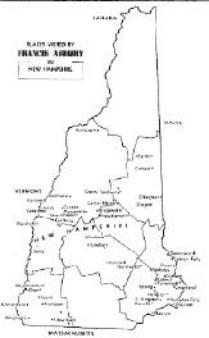
TuesdayMaineWe crossed the mountains and came into New Hampshire at Andover,1 and continued on, dining and praying at Salisbury, to Concord, forty miles: we lodged at Mr. Ambrose’s tavern:2 our host was polite and attentive. We came on Wednesday eighteen miles to dinner at Mr. Harvey’s,3 Northwood; then through Durham and Dover, into Berwick, the first town in the district, where we put up for the night. MAINE
On Thursday morning, we came sixteen miles to breakfast, but I had taken medicine. We kept on through Kennebunk, Saco, and Scarborough, into Portland: I was unwell, had travelled hard, rising at four o’clock every morning, yet I had to preach here at eight o’clock in the evening. God is here: brother David Batchelor’s labours have been blessed. I lodged with Major Illsley, still our great friend.
ASB_VOL2.PDF, p. 495
Notes (3)
- Asbury probably meant Hanover, the seat of Dartmouth College. ↩
- This tavern was located not in Concord but in Boscawen, a short distance north of the Contoocook River in the village of Penacook. (Williams, art., The Christian Advocate, New York, March 16, 1916.) ↩
- In 1916 the Harvey House was 183 years old and still in use. (Ibid.) ↩
22 May 1807
FridayMaineWe took up our journey through Falmouth to New Yarmouth and stopped at our brother Jabez Bradburg’s: we had six hours’ rain. It is an awful backward spring, and there is a great scarcity of hay. The wet weather prevents ploughing and seeding. Cold! cold!
ASB_VOL2.PDF, p. 495
23 May 1807
SaturdayMaineWe lodged with Mr. Dearborn,1 in Monmouth. We count having made two hundred and thirty miles this week, over hard roads in many senses: my work is for God—my reward from him: may I be made perfect through Christian and ministerial trials and sufferings!
ASB_VOL2.PDF, p. 495
Notes (1)
- This was Simon Dearborn, with whom he lodged during the conference of 1802. ↩
24 May 1807
SundayMassachusettsI preached in Monmouth, on Isaiah 35:3-6. At Major Cobb’s, where I lodged in Gray, I left my glasses when starting on Tuesday morning. On Tuesday I preached at Scarborough at five o’clock in the evening, upon Hebrews 3:12-14. We sent forward the preachers to call a meeting in the town of Berwick, in the District of Maine; on Wednesday I preached to them, and the people were attentive:—this is the beginning of Methodism in this place.
NEW HAMPSHIRE
ASB_VOL2.PDF, p. 496
28 May 1807
ThursdayMassachusettsWe dined at Epping, New Hampshire, and came on within six miles of Haverhill. To travel forty miles a day, and be under the necessity of going into dram and sin-infected taverns: it is such a journey that teaches us the value of hospitality in the South, and the excellency of Methodism everywhere: how laborious has it been; and expensive; and, it may be, unsuccessful! But my work and my judgement is with the Lord. MASSACHUSETTS
ASB_VOL2.PDF, p. 496
30 May 1807
SaturdayMassachusettsAt Waltham, I gave them a sermon on 1 Corinthians 10:12, 13; several preachers were present. It rained on the Sabbath. My Bible and plans for conference stations occupied my mind, and became the devotions of the day.
ASB_VOL2.PDF, p. 496
1 June 1807
MondayMassachusettsCame to Boston. On Tuesday we opened our conference, ninety-two preachers being on the list.
ASB_VOL2.PDF, p. 496
6 June 1807
SaturdayNew YorkOur conference rose. There were eight hundred dollars paid; and we were nearly three thousand insolvent. It kept us busy to preach five times a day, ordain fifty-nine to office, and inquire and examine into characters, graces, and gifts, and appoint the numerous stations. I preached on Wednesday, and an ordination sermon on Thursday, and on Saturday evening came away to the town of Lynn. And must I walk through the seven conferences, and travel six thousand miles in ten months?
ASB_VOL2.PDF, p. 497
7 June 1807
SundayNew YorkI preached in Lynn, administered the sacrament of the Lord’s supper, and came to Waltham. At Westborough I preached on Monday, on Luke 19:10. I lodged at brother Nicholas’s. In spite of heat and lameness, we were favoured to reach Wilbraham on Tuesday. To Westfield on Wednesday, crossing the bridge at Springfield. I am in peace; I dare not murmur, though in pain. I had an interview with a Baptist minister: he started at prayer—he called it talk to any sinner: the answer is, they cannot pray.
ASB_VOL2.PDF, p. 497
11 June 1807
ThursdayNew YorkWe crossed the mountain to Pittsfield, thirty-seven miles: we had a violent wind, excessive cold, and I was very lame. Methodism prevails in this quarter: in two societies, two hundred members have been added. A camp meeting is appointed to be held on Monday next. NEW YORK
On Saturday we made a great ride of forty miles to Waterford,1 in New York State. I was lame on the Sabbath, but I must preach: my subject was John 3:19.
ASB_VOL2.PDF, p. 497
Notes (1)
- This was Simon Dearborn, with whom he lodged during the conference of 1802. ↩
15 June 1807
MondayNew YorkFaint, sick, and lame. I made twenty miles to Schenectady,1 and was entertained at Isaac Johnson’s:2 he is a disciple of Woolman Hickson’s,3 gained by preaching in the streets of Brooklyn, Long Island. I rejoiced to hear that Robert Dillon4 preached in the market house at Troy. On Tuesday it rained, and I rested. Wednesday brought us over Yankee Hill5 to Frank’s. We came to Ellwood’s on Thursday, crossing Schoharie Creek. O fruitful banks of lovely Mohawk! On Friday we rode ten miles out of our way, and made a long journey of forty-five miles: we came in at nine o’clock at night to Elijah Davis’s.6 We have travelled one hundred miles up the Mohawk. My feet are much swelled, and I am on crutches; but I have been supported amongst strangers. O that we had two Low Dutch missionaries for the parts of Jersey and York west of the Hudson!
ASB_VOL2.PDF, p. 497
Notes (6)
- Schenectady is the first city of size west of Albany. The date of first Methodist preaching there is obscure, some thinking Captain Thomas Webb preached there in 1766 and 1767, but he established no class or society and such influence as he may have exerted was dissipated during the Revolution. Garrettson attempted to establish regular preaching, and William Colbert developed the work as part of the Albany District in 1802. The first church was erected in 1809. ↩
- Isaac Johnson, an early Methodist leader in Schenectady, had been converted while living in Brooklyn in 1788. His name appears as a member of the class of New York’s John Street Church which was made up of Brooklyn residents. He left Brooklyn prior to 1794. (Records of John Street Church, II.) ↩
- Woolman Hickson had established regular preaching in Brooklyn over the winter of 1787-88, only a few months before his untimely death in the late summer of 1788. ↩
- Robert Dillon was under appointment as “missionary within the bounds of New York Conference.” ↩
- This was in the vicinity of Amsterdam, approximately fifteen miles west of Schenectady. ↩
- Elijah Davis was a leader of the church at Utica in Oneida County. Garrettson is said to have preached here just before the turn of the century, the service being held in a dwelling, possibly the residence of Davis. ↩
21 June 1807
SundayNew YorkAfter Ebenezer White1 had preached in the meeting house, I went into a beautiful grove, where I spoke to about fifteen hundred people, on Colossians 1:28, 29. I ordained three deacons, namely, Stebbens, Parker, and Trueman,2 and rode to Westmoreland.3 I retired to B. Hannah’s, my feet highly inflamed and painful.
ASB_VOL2.PDF, p. 498
Notes (3)
- Ebenezer White was received on trial in 1802 and into full connection in 1804. His name disappears from conference lists after 1811. His entire ministry was given to this area, known at this time as the Genesee District of the Philadelphia Conference. His current appointment was to the Westmoreland Circuit. ↩
- These three were evidently local preachers, as their names do not appear as members of conference. ↩
- Westmoreland was approximately ten miles west of Utica and south of Mohawk River. ↩
22 June 1807
MondayNew YorkAt B. Holmes’s, in Vernon,1 I preached on Romans 10:13. Next day I rode to Silas Bliss’s,2 in Cazenovia.3 On Wednesday, on 1 John 5:14, 15; the Lord is with the people. Ten years have I been absent from this kind family; and O! the kindness of all the brethren: I cannot express it, nor my gratitude for the favours shown. I came home to Ebenezer White’s. I spoke at brother Nichols’s, in Manlius,4 on Thursday; my text was chosen from John 21:15-17; it was an open time. I ordained Ebenezer White an elder.5
ASB_VOL2.PDF, p. 498
Notes (5)
- Vernon was a village ten miles west of Westmoreland. ↩
- Asbury had had close relationship with this man and his family at some distant point, though no clue is found as to that location. Bliss seems to have been largely responsible for the rapid and solid growth of the church in Cazenovia. ↩
- Cazenovia is located at the southern end of Cazenovia Lake in Madison County. The Methodist work there culminated in the noted Cazenovia Seminary that has prepared many noted ministers of central and western New York State. Boehm says, “It would have been a glorious vision of the future could Bishop Asbury have foreseen the future prosperity of Methodism in Cazenovia and the noble seminary of learning erected there.” (Boehm, op. cit., 297.) ↩
- Manlius is in Onondaga County, ten or twelve miles northwest of Cazenovia. ↩
- The Minutes show that White had been voted elder at the 1806 conference. No clue is given as to the reason for delaying the rite of ordination. Asbury occasionally deferred ordination until he could perform the rite at a place of special suitability, in this instance at the person’s residence. ↩
26 June 1807
FridayNew YorkWe came fourteen miles to Onondaga court house; truly we saw gapers enough: my text was John 13:17. After taking a cup of tea, we rode to Skaneateles Lake,1 about sixteen miles in length, and three in breadth, at its widest part. Six more miles brought us to Owasco Lake, about the same size: the outlet of Aurelius River is here. We have had a day’s work of forty miles. I am still lame on both feet. Our lodging at Brutus2 was with B. Upshire. I preached on Saturday, in the widow Carpenter’s barn: in the afternoon I rode fifteen miles to David Eddy’s, in Scipio: here we were quite at home.
ASB_VOL2.PDF, p. 498
28 June 1807
SundayNew YorkI held forth to about five hundred souls, in Eddy’s barn: my subject was Hebrews 2:15, 16: the people were very attentive, but not much affected. Bathing my feet may have done good: they begin to mend. On Monday we rode to Milton Methodist meeting house, where I preached to about two hundred souls, on Galatians 5:7, 8. I was faint yet animated, in speaking. We dined with David Hamilton, and came back to Cayuga Lake: this sheet of water is about forty miles long, and four miles wide; it feeds the St. Lawrence.1 At Samuel Wayburn’s I preached on Tuesday, and on Wednesday we came by Milton to Bailey’s where we also had meeting: my subject here was 1 Peter 4:17; it was a most insensible congregation of about one hundred souls. Daily preaching and daily affliction keep me very low. I feel with sorrow the spiritual death of the people; it brings on great heaviness of body and mind.
ASB_VOL2.PDF, p. 498
Notes (1)
- Cayuga Lake does not flow directly into the St. Lawrence River, but empties into Lake Ontario somewhat south and west of Oswego. ↩
2 July 1807
ThursdayNew YorkWe dined at Geneva, on Seneca Lake: the lake is about forty miles in length, and from one to five miles wide. Our entertainer, Mr. Hagley, was exceedingly kind. We rode on to Daniel Dorsey’s,1 late of Liberty, Frederick county, Maryland, now an inhabitant of Lyonstown.2 This is a great land for wheat, rye, and grass; and the lakes, with their navigation of vessels and boats, and moving scenes, make the prospects beautiful.
ASB_VOL2.PDF, p. 499
Notes (2)
- Daniel Dorsey (1757-1823) spent his early life in Frederick County, Maryland, where Asbury knew him first. (See Journal entry for August 7, 1799.) Influenced by the success of a friend, John Cole, Dorsey moved to Lyons, New York, late in 1799, and bought over one thousand acres of land just south of Lyons. In 1801 he moved his complete entourage from Maryland, the persons (white and black) numbering over one hundred. He soon attained leadership in the community, serving for years as magistrate and as a member of the state assembly. He became a local Methodist preacher and district steward. In 1810 Asbury and McKendree created the Genessee Conference, holding the organizational session in Dorsey’s huge granary. At his death Dorsey was survived by his widow and twelve children. (Minutes of Central New York Conference, 1910; Boehm, op. cit., 297.) ↩
- Lyons is the seat of Wayne County, New York, located eighteen miles north of Auburn. In 1797 John Cole, local Methodist preacher, delivered the first Christian sermon of any denomination in Lyons, and a congregation was speedily formed. Cole, a convert of Wesley in England, had come to America after the Revolution, settling in Maryland. He moved to New York in 1796 or early 1797. ↩
4 July 1807
SaturdayNew YorkWe were greatly crowded in a small house in Lyonstown:1 my subject was Matthew 17:5. After meeting and dinner, we rode on to the sulphur springs, near Canandaigua,2 and lodged at the widow Ferguson’s.
ASB_VOL2.PDF, p. 499
Notes (2)
- The first services were held in the homes of Cole, then Daniel Dorsey, and of Richard Jones in the village. In 1802 or 1803 a lot on Broad Street was bought from George Carr, who had built a two-story log house. It was in this building, adapted for worship, that Asbury preached. It is believed to have been the first Methodist building in western New York and was the first stated place of worship in Lyons. (Records of Lyons Methodist Church; Landmarks of Wayne County, 247.) ↩
- This was probably the present Clifton Springs, fifteen miles southwest of Lyons. ↩
5 July 1807
SundayNew YorkI preached to about one thousand souls assembled in White’s barn: my subject was 2 Timothy 4:2: “Preach the word.” I. The primitive qualification, the call and commission to “preach the word”—the Gospel.
II. The right use of the Gospel, to convince, to reclaim the backslidden and disorderly.
III. “Exhort” all characters, “with longsuffering and doctrine.” Hear ye him; observe the dignity, eloquence, and power of the speaker. “Doctrine,’’ hear him on this point; hear him all men, of all grades and characters. My congregation was an unfeeling one. Now that my mind is in a great measure lightened of its load of thought and labour for the conferences, I feel uncommon light and energy in preaching: I am not prolix; neither am I tame; I am rapid, and nothing freezes from my lips. I suppose we shall preach to more than ten thousand souls in this district.
ASB_VOL2.PDF, p. 499
6 July 1807
MondayNew YorkIn R. Wrote’s barn,1 fifteen miles from Canandaigua, I preached to about four hundred unyielding souls, on Acts 3:22, 23.
ASB_VOL2.PDF, p. 499
Notes (1)
- Wrote’s barn was located in the vicinity of South Bristol near the southwest shore of Lake Canandaigua. ↩
7 July 1807
TuesdayNew YorkWe passed the lake,1 sixteen miles long, and one mile wide. At James Stokes’s, Ninth Town,2 I preached in the woods to a more attentive people, on Hebrews 10:38, 39.
ASB_VOL2.PDF, p. 499
8 July 1807
WednesdayNew YorkI preached in the Friends’ settlement1 with some power.
ASB_VOL2.PDF, p. 499
Notes (1)
- The lake area of south central New York State had, and still has, numerous communities of Quakers. This was probably in Orange Township, Schuyler County. ↩
9 July 1807
ThursdayNew YorkAt Cresse’s. We set out, dining at Dow’s, and came to Catharine, at the head of Seneca Lake, thirty miles; the swamps, sloughs, ruts, and stumps made it awful moving. We lodged at Baldwin’s tavern.1
ASB_VOL2.PDF, p. 499
Notes (1)
- Baldwin’s tavern was located ten miles south of Catharine, near the present Horseheads in Chemung County. ↩
10 July 1807
FridayNew YorkWe directed our route through Newtown,1 upon the East Branch of the Susquehanna, to Chemung;2 rested awhile at Jacob Cresse’s, and then passed the narrows of the river, continuing on by Shepherd’s mill to Taylor’s tavern; it was ten o’clock, and I was fearful of driving farther in the dark.
ASB_VOL2.PDF, p. 500
11 July 1807
SaturdayNew YorkBrought us to the camp meeting on Squire Light’s ground:1 we found it had been in operation two days; God is in the camp and with us. I preached on the camp ground, from Matthew 18:2: some sots were a little disorderly, but the greater part of the congregation were very attentive; weak as I was, I did not spare myself, my subject, or my hearers. It may be, I spoke to one thousand people. Since the last Sabbath We have travelled one hundred and twenty miles; and with good roads and even ground we might have made three hundred miles in the same time. The heights of the Susquehanna2 are stupendous; the bottom lands very fertile; but this river runs through a country of unpleasing aspect, morally and physically—rude, irregular, uncultivated is the ground; wild, ignorant, and wicked are the people: they have not been wearied by my labours; except the neighbourhood of Lancaster, and by what I may once have done in a visit to Wyoming, they are strangers to them. I am now on my first journey of toil and suffering through Genesee and Tioga.3
ASB_VOL2.PDF, p. 500
Notes (3)
- Squire Ludowick Light lived at Smithboro, about four miles east of Barton in Tioga County. Methodist preaching began at Barton in 1800, a class being organized in 1805, and another class was formed at Smithboro at Squire Light’s at about the same time. At a later date he erected a simple chapel on his property. The camp meeting referred to by Asbury was the first to be held in this entire area. (Chaffee: History of the Wyoming Conference, 776-77.) ↩
- This immediate sector appears to have been first visited by William Colbert in 1793. Valentine Cook and John Broadhead followed a few years later, but no society was formed at Nichols, near Smithboro, until 1819. (Ibid., 807.) ↩
- From the time he left Chemung until he moved downstream along Susquehanna, Asbury was in Tioga County. Methodist work was begun early in the 1790’s, and by 1807 the circuit had over thirty preaching places, covering a travel distance of four hundred miles. ↩
12 July 1807
SundayNew YorkMy subject was 2 Corinthians 5:20: my congregation may have doubled in numbers to-day; and there were no troublesome drunkards. I feel as if God would own this meeting now, and continue to own it many days, in various families and places. I ordained five worthy men local preachers, namely, Daniel Wilcox, John B. Hudson, Samuel Emmit, John M’Caine, and Nathaniel Lewis,1 to the office of deacon: had I not made this visit, these men might have waited a long time, or taken a long ride to find me. In the afternoon (Sabbath), there was an uproar amongst the people. Some intoxicated young men seated themselves by the women, and refused to move until compelled; they fought those men who came to take them away, and when the presiding elder interfered they struck at him, and one of the guards also, who was helping by order of the constables. There were magistrates (such as they were) to cry peace. The Owego gentry fled away cackling falsehood like wild geese. One Kemp, chief bully, arrested Anning Owen, on Monday morning, for the Sabbath breaking, drunkenness and fighting of this Kemp and his crew. The presiding elder was charged with having struck Kemp, and then running away; nor was the poor bishop spared—he too had been fighting: it was well for him that he was not on the ground at the time—I was quiet in my room.
PENNSYLVANIA
ASB_VOL2.PDF, p. 500
Notes (1)
- Nathaniel Lewis lived in Oakland Township, Pennsylvania, near Big Bend, where the Susquehanna River makes its sudden and short dip into Pennsylvania, about twenty miles east of Binghamton, New York. He held meetings in many communities of that section (Ibid., 484-85.) ↩
13 July 1807
MondayPennsylvaniaWe rode to Tioga,1 and brother Shippy2 gave us our dinner. A ride of sixteen miles brought us to Daniel Minier’s3 where we lodged. Tioga Point, at the junction of Chemung and the river, is a pleasant spot.
ASB_VOL2.PDF, p. 501
Notes (3)
- Tioga, or Tioga Point, is now Athens, Pennsylvania. (See Journal entry for March 10, 1807; Minutes, 1807.) ↩
- Shippy is mentioned in records at the Spalding Memorial Library at Athens as being a “blacksmith who held Methodist meetings in his house.” ↩
- Daniel Minier lived two miles south of Tioga, or Athens, on Queen Esther’s Flats. (Palmer, op. cit., 75; Spalding Memorial Library records, Athens.) ↩
14 July 1807
TuesdayPennsylvaniaTuesday, 14, we came six miles to Judge Gore’s:1 here I preached upon John 7:17. When we set out on Wednesday we found we were obliged to take the carriage over a precipice by hand.2 The road to the ferry was rough; and behold, the boat was gone, and the bank caved and washed away; a lock upon the wheel, and the assistance of a strap, enabled us to pass the sulky down by hand. Major Gaylord,3 at Wyalusing, lodged us well and freely.
ASB_VOL2.PDF, p. 501
Notes (3)
- Judge Obadiah Gore (b. 1744) came to the Wyoming section from Norwich, Connecticut, at the age of twenty. He served in the Continental Army and lost three brothers and two brothers-in-law in the battle of Wyoming. In 1785 he established a store at (New) Sheshequin and was one of the first commissioners of Luzerne County. (Ibid., 156.) ↩
- This precipice was a few miles below Judge Gore’s and was known as Breakneck Hill. ↩
- Major Justus Gaylord, Jr., a Revolutionary soldier, was an early and prominent settler in the region. He lived on a nine-hundred-acre tract on the north side of Wyalusing Creek. His wife was the widow of Amos York, whose whole family were captured by the Indians, and he was killed; their son, Miner M., became a Presbyterian preacher. (Ibid.) ↩
16 July 1807
ThursdayPennsylvaniaWe came eleven miles to breakfast at Sturdevant’s;1 and eleven miles more brought us to Hunt’s ferry:2 after dining at Frosbury’s,3 free and kind, we went on to Newton Smith’s,4 ten miles farther; I ordained my host a deacon in his own house.
ASB_VOL2.PDF, p. 501
Notes (4)
- “Old Elder” Samuel Sturdevant was an eccentric Baptist preacher, who lived at Black Walnut Bottom above Meshoppen. His second wife was a Methodist, and members of the family later became Methodists. (Ibid., 41.) ↩
- Hunt’s ferry was at Mehoopany. ↩
- Frosbury was probably Vosburg, who lived at Tunkhannock. ↩
- Newton Smith lived at Osterhout. ↩
17 July 1807
FridayPennsylvaniaTo Sutton’s1 ten miles: the house neat as a palace; and we were entertained like kings, by a king and queen; it was no small consolation to lie down on a clean floor after all we had suffered from dirt and all its consequences. Once more I am at Wyoming. We have wearied through and clambered over one hundred miles of the rough roads of wild Susquehanna. O, the precipitous banks, wedging narrows, rocks, sideling hills, obstructed paths, and fords scarcely fordable, roots, stumps, and gullies!
ASB_VOL2.PDF, p. 501
Notes (1)
- James Sutton was a Quaker who became a Methodist and a class leader when he married Sarah, the daughter of W.H. Smith, M.D. They lived variously at Wilkes-Barre, Forty Fort, and Exeter. Sutton and Dr. Smith set up the Lackawanna Forge at what became known as Old Forge, Pennsylvania. A daughter, Deborah Sutton, married James Bedford, who became a prominent Methodist in the Wyoming Valley. (Ibid., 61 ff.) ↩
18 July 1807
SaturdayPennsylvaniaI must take medicine; the preachers wish me to remain in my lodging.
ASB_VOL2.PDF, p. 501
19 July 1807
SundayPennsylvaniaI went to the woods1 and preached and ordained Thomas and Christian Bowman,2 deacons. Before I got through my discourse the rain came on, and I made a brief finish: the people were attentive. In the afternoon the preachers and many of the people went to a barn; there were showers of rain and thunder whilst service was performing. My first visit to Wyoming was in great toil and to little purpose; I am afraid I shall have no better success now.
ASB_VOL2.PDF, p. 501
Notes (2)
- In these woods near the present Forty Fort was then being erected the old Forty Fort Church which still stands, the oldest in the whole area. It was in use the following year. The one-room structure with high pulpit and box-like pews situated in its cemetery, is seldom used now but is carefully preserved. (Palmer, op. cit., 156, 160.) ↩
- The Bowmans had come thirty miles from Briar Creek. Thomas was the grandfather of Bishop Thomas Bowman (1817-1914) of the Methodist Episcopal Church. At this service William Butler knelt beside Asbury and held an umbrella over the bishop to protect him from the rain. The bearing of Asbury during the storm so impressed little Deborah Sutton, who was present with her mother, that it led to her conversion. (Ibid., 157; Peck: Early Methodism Within the Bounds of the old Genesee Conference, 155, 156.) ↩
20 July 1807
MondayPennsylvaniaWe set out upon a turnpike road; but O, dreadful! I came sliding down a dug road precipice, dark and deep, but safe. About nine o’clock we made Mr. Merwin’s1 tavern: and here were drink, and smoke, and wagoners—but we closed with prayer. We came along, early on Tuesday, through the Wind Gap,2 seventeen miles to Heller’s,3 and breakfasted. I took a look at the Moravian town of Nazareth;4 it may contain forty houses built in the German taste and style: the brethren’s house is a large building of, possibly, one hundred and forty feet in length, and fifty feet in width, with a Dutchified tower like a cupola, in the centre—the whole edifice has the exterior appearance of a college. The land in the vicinity was not so fertile, nor the grounds as highly improved, as I expected to have found them. Seventeen miles farther brought us to far-famed Bethlehem,5 which I had long wished to see. The stream that runs west of the town6 is pretty and useful, as it works a machine which raises the water one hundred and fifty feet into two reservoirs, for the use of the inhabitants. We found ourselves at the grand tavern7 at the north end, the property of the brethren: the house is large, but a plain building: the entertainment good at a dollar a night for man and horse. On the second step of the high grounds on the main street, which begins on the hill above, stand the church buildings: on the east and west are rooms appropriate to the institution, and certainly the west end has a grand appearance. On the same street below stands the brethren’s house, one hundred feet front, five stories high, very plain, and much German taste discoverable everywhere; add to this the majestic Lehigh, and you have the most striking features of this celebrated place. But, ah! religion—Reader, I am a Methodist. I asked the young man who managed the tavern, if they ever permitted any minister to preach amongst the brethren; he could not answer—he was a servant, and knew not how to answer. Next day came the master of the ceremonies, the cicerone of the establishment, who shows the wonders of the place; I asked him—I was told that on that night there was private worship in the church—the minister must perform himselbst. Daniel Hitt and two gentlemen from York, who had given money for the sights shown here for money, went to the church meeting. And what did they see and hear? A man read in German they knew not what, sung and played upon the four thousand dollar organ: sermon or prayer they heard not. I doubt much if there is any prayer here, public or private, except the stated prayers of the minister on the Sabbath day. But the brethren have a school for boys at Nazareth, and one for girls at Bethlehem; and they have a store and a tavern; the society have worldly wealth and worldly wisdom: it is no wonder that men of the world, who would not have their children spoiled by religion, send them to so decent a place.
ASB_VOL2.PDF, p. 502
Notes (7)
- Merwin’s tavern was at Merwinsburg, thirty-five miles from Wilkes- Barre. (Palmer, op. cit., 178; see Journal entry for August 4, 1811.) Asbury left the Wyoming Valley by way of Wilkes-Barre and over the mountains to the southeast. ↩
- Wind Gap is a gap in the Blue Mountain, fourteen miles northwest of Easton, Pennsylvania. The town of Wind Gap is situated on the south side of the dry gap. ↩
- Heller’s Tavern was located at the southern end of the town of Wind Gap. It was later operated by a Mr. Leibert, whose daughter married a Dr. Keller. Keller converted the building into a residence and office. It is now occupied by Dr. Dreher of Wind Gap as a residence and office. ↩
- Nazareth is located in Northampton County, Pennsylvania, on the head of a small branch of Bushkill Creek. The first Moravians had crossed the Atlantic in 1735, and George Whitefield secured their services to erect a large school building for Negro orphans on a five-thousand-acre tract of land in the forks of the Delaware River, which he had named Nazareth. In May, 1740, Peter Boehler led a small band of workers to Nazareth, and in six months they had erected two log buildings. The main building, named “Ephrata” and also known as Whitefield House, is still standing and is used as a Moravian museum. Nazareth was laid out as a town in 1744. (Heller: History of Northampton County, 497.) ↩
- Late in 1740 the Moravian leaders and Whitefield had some disagreement over doctrine, and the latter dismissed the Moravians from his employ. Bishop David Nitschmann, commissioned by the Moravian Church in the Old World to begin a settlement in Pennsylvania, arrived in America in December, 1740, in time to relieve Moravian troubles. In April, 1741, he bought from William Allen, a five-hundred-acre tract of land at the confluence of Lehigh River and Monocacy Creek, and thus the foundation of the city of Bethlehem was laid. The northern headquarters of the Moravian Church are located at Bethlehem, and some of the original buildings are still standing at the northern end of the hill bridge over the Lehigh River. ↩
- This was Monocacy Creek, a tributary of the Lehigh River. ↩
- This was the Sun Inn, built in 1758-59. The first inn built in Bethlehem was the Crown, erected in 1745. ↩
22 July 1807
WednesdayPennsylvaniaWe crossed the Lehigh1 to Allentown,2 beautifully situated—superior in this respect, perhaps, to Bethlehem. We breakfasted at the end of twelve miles, and came on to Kutztown.3 On Thursday morning we bent our course through Reading;4 the views of meadows and fields were grand—beautiful. Reading may have two hundred houses, one street in a style of grandeur approaching to that of Philadelphia, as it respects the houses; the rest have much of the German feature. Through Adamstown,5 where we breakfasted, we came on over rocks and hills to New Holland; here, as at Reading, there are fine new churches for the German Lutherans and the German Calvinists:6 these are the citadels of formality—fortifications erected against the apostolic itinerancy of a more evangelical ministry. Ah! Philadelphia, and ye, her dependencies, the villages of the State of Pennsylvania, when will prejudice, formality, and bigotry, cease to deform your religious profession, and the ostentatious display of the lesser morals give place to evangelical piety? At Soudersburg we rested one day. I wrote three letters.
ASB_VOL2.PDF, p. 503
Notes (6)
- The Lehigh River rises as the result of creeks flowing from the Pocono Mountains in Monroe County. It flows westward into Luzerne County, then generally southward through Carbon County, between Lehigh and Northampton Counties, and then eastward into the Delaware River at Easton. ↩
- Allentown is located at the confluence of the Jordan and Lehigh rivers fifty-seven miles north of Philadelphia. It was first settled by the Allen family in 1751 and was laid out as a town in 1762 by James Allen, a son of the chief justice of the province, William Allen. The town was originally named for Judge Allen, who settled in Trout Hall in 1702. When it was incorporated as a borough in 1811, the name was changed to Northampton, but the original name was restored in 1838. ↩
- Kutztown is in Berks County, Pennsylvania, on the road leading from Reading to Allentown. It was incorporated in March 1815. (Gordon: Gazetteer of the State of Pennsylvania, 226.) ↩
- Reading is the county seat of Berks County, on the east bank of the Schuylkill River one mile below the mouth of the Tulpehocken Creek, and was laid out in 1748 by Thomas and Richard Penn. (Gordon, op. cit., 392.) ↩
- Adamstown is in Cocalio Township, Lancaster County, Pennsylvania, on the road between Lancaster and Reading. ↩
- The German Lutheran immigrants’ religious roots were in the Lutheran reformation in Germany; the religious background of the German Calvinists was in the Zwinglian reformation in Switzerland. ↩
25 July 1807
SaturdayPennsylvaniaWe came through Lancaster to Columbia. On the Sabbath day I preached in a lot near the river: we may have had seven hundred people; my subject was 2 Corinthians 5:14. The missionaries, Boehm and Hunter,1 were present. On Monday I came to Little York. Here I met with Nelson Reed. This week I am occupied in writing about thirty letters;2 yet, not unmindful of the word of God and prayer. It is but too manifest that the success of our labours, more especially at camp meetings, has roused a spirit of persecution against us—riots, fines, stripes, perhaps prisons and death, if we do not give up our camp meetings: we shall never abandon them, but shall subdue our enemies by overcoming evil with good. What hath God wrought in America! In thirty-six years we find one hundred and forty-four thousand five hundred and ninety in number: in England, after seventy-seven years, they count one hundred and fifty thousand nine hundred and seventy-four: they may have thirty millions of souls in the three kingdoms to labour amongst; and we not more, perhaps, than five millions. Our travelling preachers, five hundred and thirty-six, at present; the rest, local and official, about fourteen hundred; but all these are poor men, and unlearned—without books, money or influence. Not unto us, not unto us!—O, Lord, take thou, the glory!
ASB_VOL2.PDF, p. 503
Notes (2)
- At the conference of 1807 Henry Boehm and William Hunter received appointment as “missionaries to Pennsylvania.” William Hunter (1755- 1833) was born in Ireland and was intimately acquainted with John Wesley, having traveled with him in Ireland. He came to America in 1790. ↩
- See Asbury’s letters to Daniel Asbury, July 30, 1807; to Mrs. Mary Tabb, July 30, 1807; to Stith Mead, July 30, 1807; to Jacob Gruber, July 31, 1807. ↩
1 August 1807
SaturdayPennsylvaniaConstant application whilst here. Reading the Bible and writing about sixty pages of letters found me employment. On the Sabbath I preached at eleven o’clock at our chapel in York: I spoke on Colossians 1:27, 28—short and temperate. We might have about six hundred hearers. In the afternoon I spoke on Colossians 3:12, 13: I spoke longer than in the morning. We have the form of the power of goodness, for we shout, and we stamp, and jump, and are very happy— who but we!—but we are contentious, and mingle and mix, by off-hand marriages, believers with unbelievers, and other things we do: but, for once, I have delivered my own soul. I think it begins to be time for another visitation at York.
I have my paradise at brother Weirich Pentz’s; but I have much labour, and some temptations. I now fare sumptuously every day; but O, what is before me?—three thousand five hundred miles before I reach the Georgetown Conference.
ASB_VOL2.PDF, p. 504
4 August 1807
TuesdayPennsylvaniaI took my leave of my kind friends at Weirich Pentz’s, and rode to dinner to George Nailor’s:1 that night we passed under the roof of the widow Hollopeter. On Wednesday I preached at Stickle’s school house:2 the room was full, and I spoke for an hour on 1 Peter 4:10,
11. We came that evening to Lewisberry. O my God, help me in soul and body, through my approaching labours and sufferings! Thursday brought us through an obscure town3 to brother Weaver’s;4 our host and his wife are Germans—in their first love.
ASB_VOL2.PDF, p. 504
Notes (4)
- George Nailor was one of the founders of the church in York and a member of the first board of trustees. ↩
- Stickle’s schoolhouse, located near Lewisberry, was named after Peter Stickle, one of the organizers of the Lewisberry church. ↩
- This was probably Shiremanstown. ↩
- Casper Weaver owned a tract of land near Shiremanstown. (Warner and Beer, op. cit., 39.) ↩
7 August 1807
FridayPennsylvaniaAt Carlisle. Saturday, occupied in reading Burder’s Village Sermons, &c.
ASB_VOL2.PDF, p. 504
9 August 1807
SundayPennsylvaniaI preached upon Galatians 5:7-9; in the afternoon on 2 Corinthians 4:1, 2: my body faint; my spirit fervent. On Monday, at Shippensburg, I preached upon 2 Peter 3:17, 18, and ordained John Davis a deacon: it was very warm, but we had an open season. We lodged with brother John Scott, one of my hearers thirty years ago, in Chester county, now warm in the cause of God. After a heavy rain had passed away on Monday, on Tuesday we began our mountain toil: we crossed three, dined with the junior, and lodged with the senior Ramsay: no people need be kinder than were these.
ASB_VOL2.PDF, p. 504
12 August 1807
WednesdayPennsylvaniaWe set out again, and the rain attended us into Bedford. We lodged at the stage house: Mr. Graham, my host, had known me in my early visits—I had preached at his father’s: the son was kind as a king could be, and charged us not a cent for our entertainment: in a hundred public houses, possibly, that I have thus stopped at in the year, I have received no such favours. We reached Berlin on Thursday, and found friend Johnson and his wife kind indeed.
ASB_VOL2.PDF, p. 505
14 August 1807
FridayPennsylvaniaWe dined and prayed at the Twenty Mile house, and were obliged to stop at an ordinary twelve miles farther—drunken people; but they behaved as well as they could: any port in a storm. On Saturday we came on eight miles to breakfast at Anthony Banning’s:1 from thence we rode through Connellsville to Union. We put up with the widow Henthorn, intending to be at the camp meeting. And now I have ridden since I left Baltimore in March, two thousand five hundred miles; and have had, as usual, many a jolt over rocks, and rocks again, on the American Alps, and dangers and difficulties, and a head bruised by the iron rods of my carriage.2 I have been enabled to suffer patiently pains and sickness for the good of souls.
ASB_VOL2.PDF, p. 505
Notes (2)
- Anthony Banning was an itinerant preacher in western Pennsylvania from 1789 to 1791. He married in 1791, located, and lived near Connellsville. He served as Valentine Cook’s second and timekeeper in the famous western Pennsylvania debate on Calvinism and free grace between the Rev. Valentine Cook, Methodist, and the Rev. John Jamieson, Presbyterian, on June 12, 1793. (Smeltzer, op. cit., 78-79; Payton, op. cit., 88-89.) ↩
- This was Asbury’s twelfth trip across the mountains to western Pennsylvania. This reference is to the hardship which he endured in all of his numerous mountain crossings. ↩
16 August 1807
SundayPennsylvaniaI ordained, on the camp ground,1 Dobbins, Fell, and Wakefield,2 to the office of deacons. I preached on 2 Corinthians 5:11: “Knowing the terror of the Lord.” I made two general heads: 1. The Gospel is a general, gracious, persuasive, characteristic ministry; in which the ministers thereof are manifest to God, and to the consciences of their hearers in their characters, their sins, their sayings, ways, &c. 2. The Gospel was armed with terror to the disobedient, impenitent, and to apostates from it. Knowing the terror of the Lord—Knowing how God is to be feared—when insulted by disobedience, the Trinity is roused into indignation; every attribute, and all the perfection of Deity is arranged on the side of vengeance and vindictive wrath. There was not a sufficiency of seats for the congregation; but they behaved as well as could be expected; there was nothing vicious seen—no plan of opposition was discoverable. On Monday I went to camp again, and spoke upon Matthew 5:46, 47. What the followers of Christ professed more than others; and what God had done for them more than others, as Christians and ministers; that therefore God, the Father, Son, and Spirit, requires more from them than from others. By application—to a variety of cases;—what do ye more than others?
ASB_VOL2.PDF, p. 505
Notes (2)
- The historic first campground was at Jackman’s on the Monongahela River where the first camp meeting was held in 1803. ↩
- These three men were ordained as local preachers. Their names do not appear in the list of deacons in the General Minutes. Peter Fell (1771- 1839) was the son of Benjamin Fell for whom the original Fells Church in the forks of the Youghiogheny is named. His brother, John Fell, was admitted on trial in 1796 and served as an itinerant preacher for one year. (Smeltzer, op. cit., 69.) ↩
18 August 1807
TuesdayOhioWe found our horses had been taken or had strayed away. I read Hervey on the Tombs, and wrote the Station Book.
ASB_VOL2.PDF, p. 506
19 August 1807
WednesdayOhioWe set out and came to the Old Fort; crossed the Monongahela, and lodged with Dr. Wheeler:1 he and his lady are Londoners; and O, how kind they were! How did the salvation of the souls of these kind friends rest upon me! The doctor’s mother had been in band society with Mr. Wesley. From six in the morning to seven in the evening of Thursday, we made about forty miles, over some rough roads and desperate hills: we wished to redeem time, that we might refit at John Beck’s,2 near West Liberty; so we ate not on the route, though we fed the horses twice. I had had pain of a rheumatic kind for some days. WEST VIRGINIA
ASB_VOL2.PDF, p. 506
Notes (2)
- Dr. Charles Wheeler was the first physician of Fayette County, Pennsylvania. He settled near Brownsville about 1780. In 1788 Robert Ayres, who had ridden the Methodist Redstone Circuit in 1786-87, entered the ministry of the Episcopal Church, was ordained at Philadelphia, and was sent back to western Pennsylvania to establish Episcopalianism in Brownsville and vicinity. Dr. Wheeler was a prominent leader in the early establishment of the Episcopal Church in the region, and Ayres made the Wheeler home his headquarters for some time. (Buck: The Planting of Civilization in Western Pennsylvania, 338; Robert Ayres manuscript Journal.) ↩
- The home of Colonel John Beck was an early Methodist preaching and stopping place of the itinerant preachers. It was located near the Pennsylvania-West Virginia line, three miles east of West Liberty in Ohio County, West Virginia. (Payton, op. cit., 135.) ↩
21 August 1807
FridayOhioMarked letters to transcribe, read, took medicine, and nursed myself. On Saturday I preached in Beck’s new house, on Philippians 2:12, 13. On the Sabbath I preached in an excellent stone meeting house, at Short Creek, to about one thousand souls, from 2 Corinthians 3:7, 8. OHIO
We crossed over into the State of Ohio on Monday: and I gave them a sermon in the court house at St. Clairsville.
By hard labour we reached Frankfort on Tuesday; thence we made Spears’s on Wednesday: on Thursday came to Densenbury’s; on Friday to Teal’s: in four days and a half we have travelled one hundred and thirty miles—mud, gullies, stumps, and hills. I was sick with an inflammatory sore throat; my trials were great, nature failed, but grace supported. Every family shall know me by prayer. Saturday I devoted to rest. I have hastily marked above two hundred hymns, taken from the congregational hymn book, to add to a new American edition, which, I hope, will be as good as any extant.
ASB_VOL2.PDF, p. 506
30 August 1807
SundayOhioAt the stand on the camp ground near Hockhocking1 I spoke on Hebrews 4:1: “Let us therefore fear.” There were about eight hundred hearers, and it was a time of feeling and solemnity to professors. Monday was diligently taken up with my pen, and prayer with my friends: the hymns for a new collection occupied my mind much. My poor mare is worn down, and my carriage is wrecked somewhat, and must be repaired. On Thursday we came to New Lancaster: I preached in a schoolhouse on Luke 19:10. We afterward came on to Mr. Vanmeter’s, and just escaped an awful storm of thunder, hail, and rain.
ASB_VOL2.PDF, p. 507
Notes (1)
- This is Asbury’s first reference to a camp meeting in Ohio, this being his third journey across the new state. The circuit on the Hockhocking had been commenced in 1803 under the leadership of Edward Teal, with Asa Shinn as its first preacher. (Smeltzer, op. cit., 86.) ↩
4 September 1807
FridayOhioWe came away to Chillicothe: O, the mud and the trees in the path! Reading closely on Saturday. In our neat, new house1 I preached on the Sabbath morning to about five hundred hearers, on 1 Peter 4:17, 18; I spoke about an hour. There are some pleasing and some unpleasing accounts here; some little trouble in the society, but great prospects all around in the country. The sitting of conference will be of God for good to souls: we have been praying the whole year for this. By letters from brothers Mead and Bruce I learn that prospects brighten in old Virginia: they have had blessed meetings.
Monday and Tuesday, closely reading. On Wednesday we rode to Deer Creek. Thursday, Friday, and Saturday selecting hymns and reading Marshall’s Life of Washington, nearly three thousand pages in four volumes: only as a Life of Washington can I give it the preference to Gordon’s History of the Revolutionary War.
ASB_VOL2.PDF, p. 507
Notes (1)
- This was the first Methodist church building in Chillicothe. ↩
13 September 1807
SundayOhioAt the Deer Creek camp ground I gave them a discourse on 2 Corinthians 6:1. In the evening we returned to Chillicothe. On Monday, we opened our conference1 in great peace and love, and continued sitting day by day, until Friday noon. A delegation of seven members was chosen to the General Conference.2 There were thirteen preachers added, and we found an addition of two thousand two hundred members to the society in these bounds; seven deacons were elected and ordained, and ten elders; two preachers only located; sixty-six preachers were stationed.
Finding my work done, and my carriage sold, I ventured once more to take horse, with a determination to visit the frontier settlements on the Great Miami River. We came away, leaving fifty or sixty preachers at the camp meeting near the seat of conference, and got to brother Waugh’s for the night.
Saturday, we reached Hinkstone’s to dine, and thence, by riding late, got into Cesarsville, and stopped with Peter Pelham: we have made sixty-five miles from Chillicothe. A great rumour is abroad of an expected Indian war; and many fled for fear; but the report was idle wind. The whole matter was, that about a thousand Indians had assembled upon the frontiers for social, and it may be, religious and moral purposes. General Worthington and Colonel M’Carthy magnanimously offered to take a talk and a belt of wampum from the governor to the congregated savages: the ambassadors found peace; and brought in four chiefs as hostages, with assurances that no ill was designed to the whites. It is said there is a prophet risen up among the Indians.
At Frederick Bonner’s I preached upon Hebrews 4:1, 2: it was an open season.
ASB_VOL2.PDF, p. 507
Notes (2)
- As early as 1807 it was becoming a common practice to hold a camp meeting near the seat of the conference session, thereby taking advantage of the assembling of the preachers for a spiritual ministry. ↩
- This session of the Western Conference was held at Chillicothe, the first capital of the state of Ohio, and was the first Methodist conference held in that state. It included the preachers of Tennessee, Kentucky, and Ohio. The distance of the conference from Baltimore, where the General Conference of 1808 was scheduled to be held on May 6, caused the adoption of the principle of sending an official delegation before the enactment of the legislation making the General Conference a delegated body. ↩
21 September 1807
MondayOhioI rested at John Sale’s. Busy writing. On Tuesday we started away and came to Samuel Hitt’s; dined, prayed, talked, and came away to Lebanon: we found the court in session. We lodged at Jeremiah Lawson’s. There is now a great talk about the Shakers; they are said to consist of two hundred people: three Presbyterian ministers have joined them; a heavy declension!
ASB_VOL2.PDF, p. 508
23 September 1807
WednesdayOhioWe bent our course down Little Miami: there are many fine situations for mills on this stream, and the land appears to be, generally, very fertile. We found a lodging with Andrew M’Grew, lately from Baltimore county, Maryland. I preached on Thursday at Philip Gatch’s, on Hebrews 4:2. On Friday we stopped in Cincinnati, and dined with Mr. Farris: Solomon and Oliver Langdon had come on, and were of the company.
ASB_VOL2.PDF, p. 508
26 September 1807
SaturdayOhioRested, read, and wrote. I am young again, and boast of being able to ride six thousand miles on horse-back in ten months; my round will embrace the United States, the Territory, and Canada; but O, childhood, youth, and old age, ye are all vanity! My companions and myself are busy compiling the new hymn book. Our brethren here have built a proper little stone house for worship, forty feet by thirty.1 Sabbath, 27. I preached at eleven o’clock: many could not get seats. I met the society. I also ordained W. M’Neachan and William Whitaker to the office of deacon. Notwithstanding opposition from more than one quarter, our last camp meeting was successful; the fruit is immediate; and where it is not, it will yet be seen: we live by faith in a prayer-hearing, soul-converting, soul-sanctifying, soul-restoring, soul-comforting God. KENTUCKY
ASB_VOL2.PDF, p. 508
Notes (1)
- This was the first Methodist church building in Cincinnati. ↩
28 September 1807
MondayKentuckyOur morning’s ride brought us, hungry and weary, into Kentucky: after refreshing at the widow Stevens’s, we pushed on to Grant’s Lick,1 and lodged at John Daniel’s. In the morning we came away across the forks, and over the hills of Licking, twenty-eight miles, to sister Ritchie’s, a widow indeed. Our evening’s ride was dark and rough, along an unknown path to Cynthiana: we stopped at J. Jacques’s. I judge we made fifty miles to-day.
Whilst resting on Thursday and Wednesday, I read Atmore’s Memoirs,2 of about five hundred pages; and I wrote a memoir of George Dougharty.3 All my occupations, however toilsome, are pleasant when I enjoy God in pure and perfect love.
ASB_VOL2.PDF, p. 509
Notes (3)
- Grant’s Lick was in Kenyon County, Kentucky. ↩
- Charles Atmore was one of Wesley’s outstanding preachers in England. Wesley ordained him or “set him apart” for Scotland and named him in the Deed of Declaration as one of the one hundred preachers who should constitute the legal conference. (See Wesley’s Journal, VIII, 338; Tyerman: Life and Times of John Wesley, III, 441, 604.) ↩
- George Dougherty was one of the leading preachers in South Carolina. He died on March 23, 1807, at Wilmington, North Carolina, and was buried in the African church there. (See Minutes, 1808; Betts: History of South Carolina Methodism, 170, 289.) ↩
2 October 1807
FridayKentuckyAttended the camp meeting at Mount Gerizim. On Saturday I spoke on 2 Timothy 2:19. On Sunday my text was Isaiah 45:23. Possibly we had two thousand souls to hear us: there were fifteen tents, and twenty wagons. We had a Sabbath love feast and sacrament; and doubtless there were precious souls converted (report says about thirty) and sanctified. I conversed with Valentine Cook1 on the subject of a mission; he held back; Ah! how hardly shall they who have families growing up, enter into and keep in the travelling connexion! I came from the camp ground every night to Samuel Brodwell’s. My host has put my name upon one of his sons: Lord, put thy new name upon the lad, that he may bear it for generations to come, and to be born!
ASB_VOL2.PDF, p. 509
Notes (1)
- Valentine Cook (1765-1820) was one of the outstanding preachers of the period. He was born in Virginia and educated at Cokesbury College in Maryland. He went to Kentucky in 1798 and the following year became the principal of Bethel Academy. He located in 1800 and devoted himself to teaching and conducting camp meetings and preaching in Lexington, Cincinnati, Pittsburgh, New York, Philadelphia. (Simpson: Cyclopedia of Methodism, 253; McTyeire: History of Methodism, 448; Redford: Methodism in Kentucky, I, 232- 46.) ↩
5 October 1807
MondayKentuckyWe set out, and stopped at Martin Hitt’s, took dinner and continued on a dark ride through the woods, to William Burke’s,1 thirty miles. On Tuesday we held a hasty meeting at Irvine’s, Madison county. Wednesday we reached Williams’s; Thursday, Freeman’s;2 Friday, Dorton’s; and on Saturday came to Peter Huffacre’s,3 Powell’s Valley. TENNESSEE
ASB_VOL2.PDF, p. 509
Notes (3)
- William Burke (1770-1855) of Virginia was sent to the Holston region in 1790. He organized the first society in Ohio at Cincinnati in 1811 and was postmaster there for twenty-eight years. He was suspended by the conference in 1818 and organized an independent church, which flourished awhile and then failed. His standing in the conference was restored by the General Conference in 1836. Burke was a member of the committee which drafted the constitution or the restrictive rules of the church in 1808. (Simpson, op. cit., 146; Arnold: Methodism in Kentucky, I, 117, 118; see his autobiographical sketch in Finley: Sketches of Western Methodism, 22-56.) ↩
- See Journal entry and note for October 12, 1805. ↩
- Asbury had now entered the Holston area of East Tennessee and Virginia. Peter Huffacre was the son of Michael Huffacre. (See note under May 6, 1788; Michael Huffacre and His Family, 67.) Huffacre was originally Halfacre. ↩
11 October 1807
SundaySouth CarolinaI preached on Luke 4:18. O, when shall this wilderness rejoice? I have perfect peace, but great toil. Since the conference we have travelled three hundred and sixty miles. There is a serious want of water, generally, in the western lands.
ASB_VOL2.PDF, p. 510
12 October 1807
MondaySouth CarolinaWe had a heavy ride to Holston, forty miles. We stopped with Martin Stubblefield.
On Tuesday we rested; and it may be allowed, considering our six days’ ride through heat, great heat and drought. At night I preached from 1 Thessalonians 4:3; and weary and faint as I was, I felt strongly disposed to sing and shout away as loud as the youngest. I have been, and am happy in God.
ASB_VOL2.PDF, p. 510
16 October 1807
FridaySouth CarolinaWe reached Wamping’s. I suffered much to-day; but an hour’s warm bath for my feet relieved me considerably.
NORTH CAROLINA
On Saturday we rode to Killian’s.
ASB_VOL2.PDF, p. 510
18 October 1807
SundaySouth CarolinaAt Buncombe court house I spoke from 2 Kings 7:13-15. The people were all attention. I spent a night under the roof of my very dear brother in Christ, George Newton, a Presbyterian minister, an Israelite indeed. On Monday we made Fletcher’s; next day dined at Terry’s, and lodged at Edwards’s. Saluda ferry brought us up on Wednesday evening.1
SOUTH CAROLINA
ASB_VOL2.PDF, p. 510
Notes (1)
- Asbury again went over Saluda Gap to South Carolina. Terry lived in the upper part of Greenville County near Marietta; he is shown on the old maps and is not to be confused with the Terry at Fork Shoals twenty miles below Greenville. ↩
25 October 1807
SundaySouth CarolinaFor three days past I have been busy in seeking appropriate portions of Scripture for the new hymns designed to enlarge our common hymn book. Our journey hither from Chillicothe has brought us through five States. Report says there is an awful affliction in Charleston—the mortal fever! I preached today at Salem1 on 2 Chronicles 6:29-31; we had a serious time. My mind is kept in great peace: surely, God is love! At Elijah Moore’s2 on Monday I preached on Luke 11:9, 10: my labour I think is not entirely in vain. On Tuesday at Jeremiah Robinson’s, we had but twelve souls to hear us: the people are too busy with their fine crops of corn. My body fails, but I have great peace of mind. GEORGIA
On Wednesday Daniel Hitt3 preached at John Oliver’s:4 our host has a son-in-law converted at camp meeting. Our preachers have passed by this town, but the Lord will not pass by Petersburg, but will visit precious souls here.
Thursday, to Tait’s: here I spoke to a few persons on Rev. 3:4, 5; and God was with us of a truth. On Friday I preached at James Halston’s on 1 John 1:6, 7: it was not in vain: both colours filled the house. On Saturday we rode to Coldwater.
ASB_VOL2.PDF, p. 510
Notes (4)
- Asbury had preached at Salem Church on October 27, 1805. (See note under that date.) He doubtless stayed at the Staunton home again. ↩
- Moore lived near Lowndesville in Abbeville County. ↩
- Daniel Hitt was Asbury’s traveling companion this year. (See note under November 9, 1806.) ↩
- Major John Oliver, a convert of Lorenzo Dow’s, lived in Wilkes County. (Bowen, op. cit., 137.) ↩
1 November 1807
SundayGeorgiaI preached on 1 John 2:17: I had help. It is wonderful to see how flush the streams are, and excellent the crops, considering the want of rain for three months past. In the sandy lands the waters do not fail in a drought as they do elsewhere. My soul is happy in God continually. It has been reported to me that at the two camp meetings held, the one in Elbert county, the other in Franklin county, about one hundred souls professed converting grace.
ASB_VOL2.PDF, p. 511
2 November 1807
MondayGeorgiaWe came to James Marks’s.1
ASB_VOL2.PDF, p. 511
Notes (1)
- See note under November 21, 1813. ↩
3 November 1807
TuesdayGeorgiaBoth Daniel Hitt and myself preached.
ASB_VOL2.PDF, p. 511
4 November 1807
WednesdayGeorgiaWe were diligently occupied with our projected hymn book.1 I make it a rule where I stop to pray after every meal.2
ASB_VOL2.PDF, p. 511
Notes (2)
- The hymnbook was published in 1808 by John Wilson and Daniel Hitt, the book agents, at New York. It contained 326 hymns without music and was entitled A Selection of Hymns from Various Authors, Designed as a Supplement to the Methodist Packet Hymn-book, Compiled under the Direction of Bishop Asbury and Published by Order of the General Conference. ↩
- Giving thanks after the meal became an old custom in South Carolina. ↩
5 November 1807
ThursdayGeorgiaI felt the tears and sorrows of the family when parting. We crossed Webb’s ferry into Oglethorpe county, passing through Lexington to James Freeman’s; a ride of thirty miles, through wind and rain. James Halston told me that his cousin, Colonel Halston, had unfortunately beaten and killed a pious soldier during the war of the revolution: the Colonel settled in Georgia, and whilst everything seemed to prosper round him, he was one night shot in his bed by one of his slaves; the child which lay in his arms was unhurt.
ASB_VOL2.PDF, p. 511
6 November 1807
FridayGeorgiaWe were engaged with our collection of hymns. I preached at Henry Pope’s1 at night: it was a time of power and liberty.
ASB_VOL2.PDF, p. 511
Notes (1)
- See note under December 9, 1814. ↩
7 November 1807
SaturdayGeorgiaWe came to General John Stewart’s.
ASB_VOL2.PDF, p. 511
8 November 1807
SundaySouth CarolinaDaniel Hitt and myself both preached: we felt the state of the people. O! what necessity is there to urge the doctrine of sanctification in this State!—it is a doctrine almost forgotten here.
ASB_VOL2.PDF, p. 512
9 November 1807
MondaySouth CarolinaI preached at John Crutchfield’s, on 1 Peter 1:4. O, the precious promises! We did not speak without a present God. Next day Daniel Hitt preached at B. Bush’s. Liberty: there has been a good and gracious work in this society.
ASB_VOL2.PDF, p. 512
12 November 1807
ThursdaySouth CarolinaI was taken ill with an influenza.
ASB_VOL2.PDF, p. 512
23 November 1807
MondaySouth CarolinaI have been one week sick at Sparta. This evening I arrived, a sick, weak old man, at Mr. Bush’s. I took another emetic.
ASB_VOL2.PDF, p. 512
25 November 1807
WednesdaySouth CarolinaWe rode to W. Bonner’s. I found it good to stay here and take some more medicine. My complaint is a pleurisy, and deep affection of the breast.
ASB_VOL2.PDF, p. 512
30 November 1807
MondaySouth CarolinaIt was as much as I could this day do to reach Tindall’s.
ASB_VOL2.PDF, p. 512
1 December 1807
TuesdaySouth CarolinaWe came into Augusta.
SOUTH CAROLINA
ASB_VOL2.PDF, p. 512
2 December 1807
WednesdaySouth CarolinaI rode up to Martin Hitt’s, on Steven’s Creek.1
ASB_VOL2.PDF, p. 512
Notes (1)
- Asbury went from Augusta into South Carolina on December 2. Martin Hitt lived on Stevens Creek in Edgefield County. ↩
3 December 1807
ThursdaySouth CarolinaWe reached Spann’s.1 I judge we have travelled nine hundred miles since the Western Conference. Judge William Stith2 died at Milledgeville, suddenly, and, I believe, safely called home in peace. The mortality has been very general and very great in these parts. We had a blessed rain in Georgia. The weather and indisposition hold me at Spann’s. My soul is happy in God in sickness and in health.
ASB_VOL2.PDF, p. 512
Notes (2)
- Spann lived near Ridge Spring, where he founded Spann’s Church, which still stands. He had removed from North Carolina, where he had also built a meetinghouse. See Journal entry for December 13, 1795. ↩
- Judge Stith, a prominent Georgia citizen, had been a Deist but was converted in a Methodist revival in 1807. Jesse Lee, who had been assigned with two other preachers to Sparta but actually had a roving commission in Georgia, sat by his side singing, “Happy soul, thy days are ended,” as he died and preached his funeral in the house of Dr. Thomas Bird. (Smith: Georgia Methodism, 84.) ↩
6 December 1807
SundaySouth CarolinaI preached.
ASB_VOL2.PDF, p. 512
7 December 1807
MondaySouth CarolinaWe started away to Fridge’s, thirty-six miles. As it was a day of general parade on Tuesday at Columbia, I returned to General Hutchinson’s. Next day we reached Camden. Thursday I preached in Camden.1 I spent Friday at Rembert Hall, reading and writing.2 Sabbath, 13. I preached at Rembert’s chapel. Mr. Rembert was thrown out of his sulky; but there was no mischief done, except that some old bruises were wakened up. My subject to-day was Matthew 24:45. The good servant—in spiritual wisdom, in fidelity, his diligence to perform his duties. The wicked servant—backslidden, false, and falsely secure. His Lord delayeth his coming—therefore he maltreats his fellow-servants who are better than himself. He is sensual; his portion is hell.
ASB_VOL2.PDF, p. 512
20 December 1807
SundaySouth CarolinaAt Rembert’s chapel, I spoke, on Deuteronomy 5:29. O that God would visit these people! Last week I have occasionally ridden out for exercise; but I am pretty busy with writing, family duty, and reading. My mind is wholly devoted to God and his work.
ASB_VOL2.PDF, p. 513
21 December 1807
MondaySouth CarolinaIt rained. On Tuesday we went to Bradford’s.1 Wednesday evening we lodged at Simpson’s tavern.2 On Thursday at Monk’s Corner.3 Friday, Christmas day, brought us to Charleston. Saturday was devoted to reading and receiving visits.
ASB_VOL2.PDF, p. 513
27 December 1807
SundaySouth CarolinaI preached at the old church,1 on Matthew 7:21. At Bethel, on Deuteronomy 10:12.
ASB_VOL2.PDF, p. 513
Notes (1)
- The old church was the Cumberland Street meetinghouse. ↩