Chapter introductions
Whosoever believeth that Jesus is the Christ is born of God: and every one that loveth him that begat loveth him also that is begotten of him.
John Wesley on 1 John 5:1
V. 1. The scope and sum of this whole paragraph appears from the conclusion of it, 1 John 5:13: "These things have I written to you who believe, that ye may know that ye who believe have eternal life." So faith is the first and last point with St. John also.
Every one who loveth-God that begat loveth him also that is begotten of him-Hath a natural affection to all his brethren.
Adam Clarke on 1 John 5:1
Verse 1. Whosoever believeth, &c.] Expressions of this kind are to be taken in connection with the subjects necessarily implied in them. He that believeth that Jesus is the Messiah, and confides in him for the remission of sins, is begotten of God; and they who are pardoned and begotten of God love him in return for his love, and love all those who are his children.
Joseph Benson on 1 John 5:1–4
Verses 1-4. Whosoever, &c. — The apostle having discoursed in the preceding chapters, on the privileges of the children of God, now adds a further illustration of the great essential parts of their character, in order that those to whom he wrote might be enabled to form a more accurate judgment of their own concern in the matters spoken of. And the scope and sum of the whole first paragraph appears from the conclusion of it, verse
13. These things have I written to you who believe, &c. Whosoever believeth — Namely, with a living faith, a faith of the divine operation; that Jesus of Nazareth is the Christ — The true Messiah, the Son of God, so as to be ready to confess this, even when the confession of it might expose him to imprisonment and martyrdom; is born of God — Is a child of God, not only by adoption, but by regeneration; he is renewed, in a measure at least, after the divine image, and made a partaker of the divine nature. See on John 3:6. And every one that loveth him that begat — That is, God, who begat him again by the influence of his word and Spirit, 1 Peter 1:23; Titus 3:5; loveth him also that is begotten of him — Hath a natural affection to all the children of his heavenly Father, whom he views as his brethren and sisters in Christ, and as joint heirs with him of the heavenly inheritance. By this we know — This is a plain proof; that we love the children of God — Namely, as his children, in that we love God, and keep his commandments — In the first place, and then love his children for his sake. “Grotius, to render the apostle’s reasoning clear, thinks the original should be construed and translated in the following manner: By this we know that we love God, when we love the children of God, and keep his commandments. But not to mention that this construction is forced, it represents the apostle as giving a mark by which we know when we love God; whereas his intention is to show how we may know that we love the children of God in a right manner. Now this was necessary to be showed, since men may love the children of God because they are their relations, or because they are engaged in the same pursuits with themselves, or because they are mutually united by some common bond of friendship. But love, proceeding from these considerations, is not the love of the children of God which he requireth. By what mark, then, can we know that our love to the children of God is of the right sort? Why, saith the apostle, by this we may know that we love the children of God in a right manner, when we love God, and, from that excellent principle, keep his commandments, especially his commandment to love his children, because they bear his image. True Christian love, therefore, is that which proceeds from love to God, from a regard to his will, and which leadeth us to obey all his commandments?” — Macknight. For this is the love of God — The only sure proof of it; that we keep his commandments — That we conscientiously and carefully shun whatever we know he hath forbidden, and that we do whatever he has enjoined; and his commandments are not grievous — To any that are born of God; for, as they are all most equitable, reasonable, and gracious in themselves, and all calculated to promote our happiness in time and in eternity, so fervent love to him whose commandments they are, and to his children, whom we desire to edify by a holy example, will make them pleasant and delightful to us. For — Whereas the great obstruction to the keeping of God’s commandments is the influence of worldly motives and considerations on men’s minds; whatsoever — An expression which implies the most unlimited universality, (the word used by the apostle being pan, the neuter gender, to comprehend all sorts of persons, males and females, old and young, Jews and Gentiles, freemen and slaves,) is born of God, overcometh the world — Conquers whatever it can lay in the way, either to allure or fright the children of God from the line of duty to God, their fellow-creatures, or themselves, or from keeping his commandments. And this is the victory that overcometh the world — The grand means of overcoming it; even our faith — The faith which is the evidence of things not seen, and the subsistence, or anticipation, of things hoped for; a full persuasion especially, 1st, That Christ is the Son of God, (verse 5,) and consequently that all his doctrines, precepts, promises, and threatenings, are indisputably true, and infinitely important; 2d, That there is another life after this awaiting us, wherein we shall be either happy or miserable beyond conception, and for ever; 3d, That Christ has overcome the world for us, (John 16:33,) and hath obtained grace for us to enable us to overcome it; and that we have an interest by faith in all he hath done, suffered, or procured for us. “The power of faith, in enabling men to overcome the temptations laid in their way by the things of the world, and by worldly and carnal men, is finely illustrated by examples. (Hebrews 11.,) which show that before the coming of Christ the children of God, by believing the things which he discovered to them, whether by the light of natural reason or by particular revelations, resisted the greatest temptations, sustained the bitterest sufferings, and performed the most difficult acts of obedience, and thereby obtained a great and lasting fame. But now that Christ hath come, and made the gospel revelation in person and by his apostles, the faith of the children of God, by which they overcome the world, hath for its object all the doctrines and promises contained in that revelation, and particularly the great doctrine which is the foundation of all the rest, namely, that Jesus is the Son of God, and Saviour of the world, as the apostle observes in the following verse.”
Joseph Sutcliffe on 1 John 5:1–5
Verse 1-5. Whosoever believeth that Jesus is the Christ, is born of God. The faith which embraces him as the Lord of glory, has a regenerating influence on the heart. The immediate fruit is love to God, and to his children; love is the test of the change, for before conversion we regarded them with indifference or contempt. And this is the proof and demonstration of our love to God, that we keep his commandments, which to the regenerate are not grievous; for then we delight in the law of God after the inward man. Another mark of our adoption is, victory over the world; for he that committeth sin is of the devil. Where grace reigns, concupiscence is vanquished; and every sacrifice is made for religion, which religion itself requires. Oh christians, your souls are not safe unless you fully enter into the spirit of all the doctrines taught here. Nor can you overcome the world, unless your faith be built upon the Godhead of Christ. The conquerors are those who believe that Jesus is the Son of God. And whosoever confesses this fundamental truth, God dwelleth in him, and he in God: 1 John 4:15. This is the sure foundation, the stone which God hath laid in Zion. This is the pillar and ground of truth, — God was manifest in the flesh. 1 Timothy 3:15, 16. This is the foundation which supported the believing Hebrews, as demonstrated by eight arguments in the first chapter of the epistle to the Hebrews.
Daniel Whedon on 1 John 5:1–21
I. POWER OF THIS REGENERATION THROUGH FAITH IN CHRIST, 1-21.
1. Its effects—love, spontaneous obedience, victory, 1-5. Becoming sons of God by faith, we love the sons of God, and love our divine Father’s commandments through a world-conquering faith, 1-5. The object of our faith—Christ—is attested by the threefold reliable testimony, 6-10. The contents of this faith are eternal life, (13,) the answer of prayer, (14, 15,) especially for an erring brother, (16-18,) and the knowledge of our unity with the true God, in separation from idols, 19:21.
1. Whosoever believeth—In order to a full communion with God in Christ, full hearty assent of intellect, heart, and will, must be conceded to Christ. This faith embraces him as Christ, that is, as anointed Son of God, with all his offices of propitiator and giver of eternal life. Whosoever so believeth is born of God. He is child of God, as Christ is only-begotten Son of God. Loveth… begat… loveth… begotten—He that loves the Father loves the Father’s Son, and loves the Father’s sons. They are, indeed, his brothers by a celestial parentage. Our filial love ascends to our Father, God, and thence comes down upon all his sons. And all form one great communion of love.
Cited across the library (7 references)
- SermonSermon 18: The Marks of the New Birth
- SermonSermon 77: Spiritual Worship
- WorksThe Works of John Fletcher (vols 1–4) — Salvation By the Covenant of Grace:
- WorksThe Works of John Fletcher (vols 1–4) — Section 8.
- WorksThe Works of John Fletcher (vols 1–4) — The Second Point of Doctrine, Insisted Upon By The True Minister, Is a Living Faith.
- WorksElements of Divinity — Questions on Chapter 31.
- DictionaryWatson’s Dictionary: Regeneration
By this we know that we love the children of God, when we love God, and keep his commandments.
John Wesley on 1 John 5:2
V. 2. Hereby we know-This is a plain proof. That we love the children of God-As his children.
Adam Clarke on 1 John 5:2
Verse 2. By this we know that we love the children of God] Our love of God’s followers is a proof that we love God. Our love to God is the cause why we love his children, and our keeping the commandments of God is the proof that we love him.
Daniel Whedon on 1 John 5:2
2. Love the children of… love God—In 1 John 4:12, (where see note,) our love to the brethren proves our love to God; while here, reciprocally, our love to God proves love to the brethren. The former goes in the order from effect to cause, the latter goes from cause to effect. Commandments—The keeping of commandments is the external form and expression of our love to God.
For this is the love of God, that we keep his commandments: and his commandments are not grievous.
John Wesley on 1 John 5:3
V. 3. For this is the love of God-The only sure proof of it. That we keep his commandments: and his commandments are not grievous-To any that are born of God.
Adam Clarke on 1 John 5:3
Verse 3. For this is the love of God] This the love of God necessarily produces. It is vain to pretend love to God while we live in opposition to his will.
His commandments] To love him with all our heart, and our neighbour as ourselves, are not grievous-are not burdensome; for no man is burdened with the duties which his own love imposes. The old proverb explains the meaning of the apostle’s words, Love feels no loads. Love to God brings strength from God; through his love and his strength, all his commandments are not only easy and light, but pleasant and delightful. On the love of God, as being the foundation of all religious worship, there is a good saying in Sohar Exod., fol. 23, col. 91: “Rabbi Jesa said, how necessary is it that a man should love the holy blessed God! For he can bring no other worship to God than love; and whoever loves him, and worships him from a principle of love, him the holy blessed God calls his beloved.”
Daniel Whedon on 1 John 5:3
3. Love… commandments—A still more explicit identification of love with obedience. Not grievous—Love loves to obey. The loving heart runs eagerly out to service. Love makes duty delight. When the cross of duty is heavy it is a sign of feeble love. When his commandments are grievous, it is because our heart is disobedient and our faith is low. We are then liable to be conquered by the world, and to sin a sin unto death.
Cited across the library (5 references)
- SermonSermon 10: The Witness of the Spirit
- SermonSermon 18: The Marks of the New Birth
- WorksThe Works of James Arminius (vols 1–3) — The Law of God
- WorksThe Works of John Fletcher (vols 1–4) — The Fictitious and Genuine Creed.:
- WorksThe Works of John Fletcher (vols 1–4) — The True Minister Preaches Christian Charity.
For whatsoever is born of God overcometh the world: and this is the victory that overcometh the world, even our faith.
John Wesley on 1 John 5:4
V. 4. For whatsoever-This expression implies the most unlimited universality.
Is born of God overcometh the world-Conquers whatever it can lay in the way, either to allure or fright the children of God from keeping his commandments.
And this is the victory-The grand means of overcoming. Even our faith-Seeing all things are possible to him that believeth.
Adam Clarke on 1 John 5:4
Editorial note: Source collation note — paragraph 2: “which is often termed עולם הזה olam hazzeh, this world”. source PDF page 60: “which is often termed הזה עולם olam hazzeh this world.”. Compared with CLA_1JO.PDF PDF p. 60. The source-font or layout comparison does not securely establish every letter, mark or local sequence in these passages. The flagged language readings or layout are retained; the original source pages should be consulted for these specific readings. Additional-source investigation: an automated comparison of surrounding English text located possible corresponding passages in OCR from separately digitized printed volumes. The linked scan pages are research locators; their images have not been collated for this note's flagged readings. OCR agreement does not verify Greek or Hebrew letters, diacritics, word order, or table layout. The flagged readings or layout remain uncertain. CLA_1JO.PDF, PDF page 60; Additional printed-scan page locator (OCR context only; flagged reading unverified).
Verse 4. Whatsoever is born of God] pan to gegennhmenon.
Whatsoever (the neuter for the masculine) is begotten of God: overcometh the world. “I understand by this,” says Schoettgen, “the Jewish Church, or Judaism, which is often termed עולם הזה olam hazzeh, this world. The reasons which induce me to think so are, 1. Because this κοσμος, world, denied that the Messiah was come; but the Gentiles did not oppose this principle. 2. Because he proves the truth of the Christian religion against the Jews, reasoning according to the Jewish manner; whence it is evident that he contends, not against the Gentiles, but against the Jews. The sense therefore is, he who possesses the true Christian faith can easily convict the Jewish religion of falsity.” That is, He can show the vanity of their expectations, and the falsity of their glosses and prejudices. Suppose we understand by the world the evil principles and practices which are among men, and in the human heart; then the influence of God in the soul may be properly said to overcome this; and by faith in the Son of God a man is able to overcome all that is in the world, viz., the desire of the flesh, the desire of the eye, and the pride of life.
Daniel Whedon on 1 John 5:4
4. This overcoming the world is a key-note to John’s apocalypse. Revelation 2:7, 11, 17, 26. It implies that the hostile world seeks, both by temptations and by persecutions, to seduce or to destroy the sons of God. It is faith in Christ that causes, and even constitutes, the victory of the faithful over all the hostilities of the world. The for commencing this verse indicates that it gives a reason why his commandments (verse 3) are not grievous, but joyous. Faith and victory render an exultant obedience to his commandments a delight. Faith in his leader, and assurance and enjoyment of victory render the Christian soldier joyously obedient to his captain’s orders.
Cited across the library (7 references)
- WorksThe Works of James Arminius (vols 1–3) — Modern Divines
- WorksThe Works of James Arminius (vols 1–3) — Fifth Part
- WorksThe Works of John Fletcher (vols 1–4) — Chapter 1.
- WorksThe Works of John Fletcher (vols 1–4) — A Concluding Address to the Serious Reader Who Inquires, "What Must I Do to Be Saved?"
- WorksThe Works of John Fletcher (vols 1–4) — Outline 10.
- JournalFrancis Asbury’s Journal (1801-10-16)
- JournalFrancis Asbury’s Journal (1802-06-26)
Who is he that overcometh the world, but he that believeth that Jesus is the Son of God?
John Wesley on 1 John 5:5
V. 5. Who is he that overcometh the world-That is superior to all worldly care, desire, fear? Every believer, and none else. The seventh verse 1 John 5:7 (usually so reckoned) is a brief recapitulation of all which has been before advanced concerning the Father, the Son, and the Spirit. It is cited, in conjunction with the sixth and eighth, 1 John 5:6, 8 by Tertullian, Cyprian, and an uninterrupted train of Fathers. And, indeed, what the sun is in the world, what the heart is in a man, what the needle is in the mariner's compass, this verse is in the epistle. By this the sixth, eighth, and ninth verses 1 John 5:6, 8, 9 are indissolubly connected; as will be evident, beyond all contradiction, when they are accurately considered.
Adam Clarke on 1 John 5:5
Verse 5. He that believeth that Jesus is the Son of God?] That he is the promised Messiah, that he came by a supernatural generation; and, although truly man, came not by man, but by the power of the Holy Ghost in the womb of the Virgin Mary. The person who believes this has the privilege of applying to the Lord for the benefits of the incarnation and passion of Jesus Christ, and receives the blessings which the Jews cannot have, because they believe not the Divine mission of Christ.
Joseph Benson on 1 John 5:5
Verse 5. Who is he that overcometh the world — That is superior to all earthly care, desire, fear? Who is the man, and where is he to be found? Surely none have gained, or will gain, this important victory, but they who believe that Jesus is the Son of God — “The great principles,” says Doddridge, “peculiar to our divine religion, a sense of redeeming love, and the prospect of such a sublime and perpetual happiness as the gospel opens upon us, can alone be sufficient to teach us to triumph over these transitory vanities, and to establish a uniform character, superior to the variety of temptations with which we may be assaulted: while the boasted triumphs of others, upon meaner principles, have been very partial and imperfect, and they have evidently been seduced by one vanity, while they have gloried in despising another.” “That the Jews,” says Macknight, “universally believed their Messiah, or Christ, was to be the Son of God, appears from many passages of the New Testament, especially from the following: Peter answered, Thou art the Christ, the Son of the living God, Matthew 16:16. Devils also came out of many, crying out, Thou art Christ, the Son of God, Luke 4:41. These things are written that you might believe that Jesus is the Christ, the Son of God, John 20:31. And that the Jews universally believed the Son of God to be God, appears from the following passages: Jesus answered, My Father worketh hitherto, and I work. Therefore the Jews sought the more to kill him, because he not only had broken the sabbath, but said also that God was his Father, making himself equal with God, John 5:17, 18. The Jews answered, For a good work we stone thee not, but for blasphemy, because thou, being a man, makest thyself God, John 10:33. The high-priest said, I adjure thee, &c., that thou tell us whether thou be the Christ, the Son of God. Jesus saith to him, Thou hast said. Then the high-priest rent his clothes, saying, He hath spoken blasphemy: what think ye? they answered, He is guilty of death, Matthew 26:63. “The high-priest and council, composed of men of the highest learning and rank among the Jews, equally with the common people, believed that the Messiah was to be the Son of God, and that the Son of God is himself God, otherwise they could not have reckoned Jesus a blasphemer for calling himself Christ, the Son of God. From these indisputable facts it is evident that the modern Socinians contradict the gospel history in two of its essential articles, when they affirm that the first Jewish Christians, before their conversion, had no idea that their Messiah was to come down from heaven, having never been taught to expect any other than a man like themselves. Next, since John hath so frequently declared, and, in what followeth the verse under consideration, hath proved that Jesus is the Christ and the Son of God, the same Socinians must be mistaken when they affirm, that in this epistle John is silent concerning the divinity of Christ, and hath not in any part of it censured those who deny it.”
Daniel Whedon on 1 John 5:5
5. Same truth in triumphant and personal form. Who—Find the true world-conqueror, and tell us who and what he is. Believeth—And the secret of his all-conquering strength, what is it? Faith. Faith in whom? In Jesus as the Son of God, with whom all the brethren are conquerors of the world and winners of eternal life.
2. And Christ, divinely attested by the threefold, witnesses, is supremely worthy of faith, 6-10.
Cited across the library (1 reference)
This is he that came by water and blood, even Jesus Christ; not by water only, but by water and blood. And it is the Spirit that beareth witness, because the Spirit is truth.
John Wesley on 1 John 5:6
V. 6. This is he-St. John here shows the immovable foundation of that faith that Jesus is the Son of God; not only the testimony of man, but the firm, indubitable testimony of God.
Who came-Jesus is he of whom it was promised that he should come; and who accordingly, is come. And this the Spirit, and the water, and the blood testify.
Even Jesus-Who, coming by water and blood, is by this very thing demonstrated to be the Christ.
Not by the water only-Wherein he was baptized.
But by the water and the blood-Which he shed when he had finished the work his Father had given him to do. He not only undertook at his baptism "to fulfil all righteousness," but on the cross accomplished what he had undertaken; in token whereof, when all was finished, blood and water came out of his side.
And it is the Spirit who likewise testifieth-Of Jesus Christ, namely, by Moses and all the prophets, by John the Baptist, by all the apostles, and in all the writings of the New Testament. And against his testimony there can be no exception, because the Spirit is truth-The very God of truth.
Adam Clarke on 1 John 5:6
Verse 6. This is he that came by water and blood] Jesus was attested to be the Son of God and promised Messiah by water, i.e. his baptism, when the Spirit of God came down from heaven upon him, and the voice from heaven said, This is my beloved Son, in whom I am well pleased. Jesus Christ came also by blood. He shed his blood for the sins of the world; and this was in accordance with all that the Jewish prophets had written concerning him. Here the apostle says that the Spirit witnesses this; that he came not by water only-being baptized, and baptizing men in his own name that they might be his followers and disciples; but by blood also-by his sacrificial death, without which the world could not be saved, and he could have had no disciples. As, therefore, the Spirit of God witnessed his being the Son of God at his baptism, and as the same Spirit in the prophets had witnessed that he should die a cruel, yet a sacrificial, death; he is said here to bear witness, because he is the Spirit of truth.
Perhaps St. John makes here a mental comparison between CHRIST, and Moses and Aaron; to both of whom he opposed our Lord, and shows his superior excellence. Moses came by water-all the Israelites were baptized unto him in the cloud and in the sea, and thus became his flock and his disciples; 1 Corinthians 10:1, 2. Aaron came by blood-he entered into the holy of holies with the blood of the victim, to make atonement for sin. Moses initiated the people into the covenant of God by bringing them under the cloud and through the water. Aaron confirmed that covenant by shedding the blood, sprinkling part of it upon them, and the rest before the Lord in the holy of holies. Moses came only by water, Aaron only by blood; and both came as types. But CHRIST came both by water and blood, not typically, but really; not by the authority of another, but by his own. Jesus initiates his followers into the Christian covenant by the baptism of water, and confirms and seals to them the blessings of the covenant by an application of the blood of the atonement; thus purging their consciences, and purifying their souls.
Thus, his religion is of infinitely greater efficacy than that in which Moses and Aaron were ministers. See Schoettgen.
It may be said, also, that the Spirit bears witness of Jesus by his testimony in the souls of genuine Christians, and by the spiritual gifts and miraculous powers with which he endowed the apostles and primitive believers. This is agreeable to what St. John says in his gospel, John 15:26, 27: When the Comforter is come, the Spirit of truth, which proceedeth from the Father, he shall testify of me; and ye also shall bear witness, because ye have been with me from the beginning. This place the apostle seems to have in his eye; and this would naturally lead him to speak concerning the three witnesses, the SPIRIT, the WATER, and the BLOOD, 1 John 5:8.
Joseph Benson on 1 John 5:6
Verse 6. This is he that came by water and blood — Here the apostle evidently alludes to the testimony borne by him in his gospel, that when the soldier pierced Christ’s side, forthwith there came out blood and water; a fact which the apostle represents as of great importance; adding, He that saw it bare record, and his record is true: and he knoweth that he saith true, that ye might believe. It was important, not only, 1st, As being a full proof, in opposition to the doctrine of the Docetæ, that Christ came in the flesh, and really died; of which see on John 19:34: but, 2d, Because it was emblematical of the offices which he sustained, and of the salvation he hath procured for his people. For the water was a symbol of the purity of his doctrine, instructing men in the purest morals, and of his own pure and holy example; and, what is of still greater importance, of the purifying grace of which he is the fountain, sanctifying and cleansing such as believe in him, from all filthiness of flesh and spirit: while the blood which issued from him was an emblem both of the sufferings which awaited his followers, who were to seal the truth with their blood, and of his own sufferings, whereby he hath made atonement for the sins of the world, and procured for his followers a free and full justification. Thus, as an eminent divine observes, he also manifested himself to be the Son of God, the promised Messiah, by fulfilling those types and ceremonies of the law which were performed by water and blood: the former whereof, denoting purification from sin, he fulfilled by cleansing us by his Spirit, (signified by water, John 7:38, 39,) from the corruption of nature, and the power and pollution of sin, and so restoring the image of God in us, Ezekiel 36:25, 27; Ephesians 5:25, 26; Titus 2:14; 3:5. The latter, which prefigured the expiation of our sin, he fulfilled by shedding his blood to atone for our sins, and to procure for us deliverance from the guilt and punishment of them, (Romans 5:9; Galatians 3:13; Ephesians 1:7,) and to restore us to the favour of God again. Not by water only — Not only was his doctrine pure, and his life holy, and not only may purifying grace be derived from him, but he came by blood, shed for the expiation of our guilt, for these things must go together; because it will not avail us to be enabled to avoid sin, and to live in a holy manner for the time to come, except the sins of the time past be expiated. And it is the Spirit that beareth witness — To these things, namely, in the writings of the ancient prophets, who have spoken largely concerning both, and in the discourses and writings of the apostles, who have borne a still more clear and full testimony to them; and also in the hearts of all the faithful, who, as they are fully convinced of their need of both pardon and holiness, so through the merits and Spirit of Christ they receive both.
Joseph Sutcliffe on 1 John 5:6
Ver. 6. This is he that came by water and blood. — It is the Spirit that beareth witness, because the Spirit is truth. The water alludes to our Lord’s baptism, as in Matthew 3:17; and John lays great emphasis on this sacred ordinance. The water also designates the sanctifying graces of the Spirit. Ezekiel 36:25. The blood of atonement was presignified by the ancient types. Numbers 19:4.
Daniel Whedon on 1 John 5:6
6. This… Jesus, named in previous verse. He that came—For this Jesus is truly the great he… that came. He was God’s predicted COMER; and his coming was the Advent. And he came, attested by two tokens divinely appointed, namely, water and blood. There have been many fanciful interpretations of the water and blood; but the best commentators now agree that the water was the water of Christ’s baptism, and the blood the propitiating blood of his crucifixion. And thus, as Huther well notes, the commencement and the ending of our Lord’s ministry are symbolized by these two elements. The came, therefore, refers not to his birth, but to his office and earthly life, which are thus one extended coming. Yet John uses the past tense came to denote that definite historical fact, and not any continuous spiritual coming through ages. The preposition by should rather be through, and the meaning is, that he came into manifestation and proof as Son of God and Messiah through these two attesting tokens. Not by water only… blood—John the Baptist came by water only; not also by blood. His water would have been of no avail but for the Propitiator’s blood. It was the blood which, with its divine self-sacrifice by the Sufferer, and its power of propitiation, gave all the value to the water. The Greek prepositions here before water and blood are neither by nor through, but are expressively changed to in with the article: in the water and in the blood. Our apostle beholds the mystical coming, the coming as of his person, enveloped in these elements. Spirit… witness—At his baptism the descending Spirit, in form as a dove, identified him as the Son in whom God was “well pleased.” The same Spirit was secured by his death to be the witnessing heritage of the Church, commencing his work on the memorable day of Pentecost. Spirit… truth—The Spirit is not only true, but is very truth itself, as God is very love itself. It is the Spirit whose testimony gives force to the tokens, water and blood; which elevates and transforms them into witness; by which means the witnesses are three.
Cited across the library (1 reference)
For there are three that bear record in heaven, the Father, the Word, and the Holy Ghost: and these three are one.
John Wesley on 1 John 5:7
V. 7. What Bengelius has advanced, both concerning the transposition of these two verses, and the authority of the controverted verse, partly in his "Gnomon," and partly in his "Apparatus Criticus," will abundantly satisfy any impartial person.
For there are three that testify-Literally, testifying, or bearing witness. The participle is put for the noun witnesses, to intimate that the act of testifying, and the effect of it, are continually present. Properly, persons only can testify; and that three are described testifying on earth, as if they were persons, is elegantly subservient to the three persons testifying in heaven.
The Spirit-In the word, confirmed by miracles.
The water-Of baptism, wherein we are dedicated to the Son, (with the Father and Spirit,) typifying his spotless purity, and the inward purifying of our nature.
And the blood-Represented in the Lord's supper, and applied to the consciences of believer.
And these three harmoniously agree in one-In bearing the same testimony,-that Jesus Christ is the divine, the complete, the only Saviour of the world.
Adam Clarke on 1 John 5:7
Editorial note: Source collation note — paragraph 1: “son; the word or λογος, logos, who bears testimony”. source PDF page 61: “Son; the or λογος Logos who bears testimony”. Compared with CLA_1JO.PDF PDF p. 61. The source-font or layout comparison does not securely establish every letter, mark or local sequence in these passages. The flagged language readings or layout are retained; the original source pages should be consulted for these specific readings. Additional-source investigation: an automated comparison of surrounding English text located possible corresponding passages in OCR from separately digitized printed volumes. The linked scan pages are research locators; their images have not been collated for this note's flagged readings. OCR agreement does not verify Greek or Hebrew letters, diacritics, word order, or table layout. The flagged readings or layout remain uncertain. CLA_1JO.PDF, PDF page 61; Additional printed-scan page locator (OCR context only; flagged reading unverified).
Verse 7. There are three that bear record] The FATHER, who bears testimony to his Son; the WORD or λογος, Logos, who bears testimony to the Father; and the HOLY GHOST, which bears testimony to the Father and the Son. And these three are one in essence, and agree in the one testimony, that Jesus came to die for, and give life to, the world. But it is likely this verse is not genuine. It is wanting in every MS. of this epistle written before the invention of printing, one excepted, the Codex Montfortii, in Trinity College, Dublin: the others which omit this verse amount to one hundred and twelve.
It is wanting in both the Syriac, all the Arabic, Æthiopic, the Coptic, Sahidic, Armenian, Slavonian, &c., in a word, in all the ancient versions but the Vulgate; and even of this version many of the most ancient and correct MSS. have it not. It is wanting also in all the ancient Greek fathers; and in most even of the Latin.
The words, as they exist in all the Greek MSS. with the exception of the Codex Montfortii, are the following:-
“6. This is he that came by water and blood, Jesus Christ; not by water only, but by water and blood. And it is the Spirit that beareth witness because the Spirit is truth. 7. For there are three that bear witness, the Spirit, the water, and the blood; and these three agree in one. 9. If we receive the witness of man, the witness of God is greater, &c.”
The words that are omitted by all the MSS., the above excepted, and all the versions, the Vulgate excepted, are these:—
[ln heaven, the Father, the Word, and the Holy Spirit, and these three are one, and there are three which bear witness in earth.]
To make the whole more clear, that every reader may see what has been added, I shall set down these verses, with the inserted words in brackets. “6. And it is the Spirit that beareth witness, because the Spirit is truth. 7. For there are three that bear record [in heaven, the Father, the Word, and the Holy Ghost, and these three are one. 8. And there are three that bear witness in earth,] the Spirit, and the water, and the blood, and these three agree in one. 9. If we receive the witness of men, the witness of God is greater, &c.” Any man may see, on examining the words, that if those included in brackets, which are wanting in the MSS. and versions, be omitted, there is no want of connection; and as to the sense, it is complete and perfect without them; and, indeed much more so than with them. I shall conclude this part of the note by observing, with Dr. Dodd, “that there are some internal and accidental marks which may render the passage suspected; for the sense is complete, and indeed more clear and better preserved, without it. Besides, the Spirit is mentioned, both as a witness in heaven and on earth; so that the six witnesses are thereby reduced to five, and the equality of number, or antithesis between the witnesses in heaven and on earth, is quite taken away. Besides, what need of witnesses in heaven? No one there doubts that Jesus is the Messiah; and if it be said that Father, Son, and Spirit are witnesses on earth, then there are five witnesses on earth, and none in heaven; not to say that there is a little difficulty in interpreting how the Word or the Son can be a witness to himself.”
It may be necessary to inquire how this verse stood in our earliest English Bibles. In COVERDALE’S Bible, printed about 1535, for it bears no date, the seventh verse is put in brackets thus:—
And it is the Sprete that beareth wytnes; for the Sprete is the truth. (For there are thre which beare recorde in heaven: the Father, the Woorde, and the Holy Ghost, and these thre are one.) And there are thre which beare record in earth: the Sprete, water, and bloude and these thre are one. If we receyve, &c.
TINDAL was as critical as he was conscientious; and though he admitted the words into the text of the first edition of his New Testament printed in 1526, yet he distinguished them by a different letter, and put them in brackets, as Coverdale has done; and also the words in earth, which stand in 1 John 5:8, without proper authority, and which being excluded make the text the same as in the MSS., &c.
Two editions of this version are now before me; one printed in English and Latin, quarto, with the following title:—
The New Testament, both in Englyshe and Laten, of Master Erasmus translation-and imprinted by William Powell-the yere of out Lorde M.CCCCC.XLVII. And the fyrste yere of the kynges (Edw. VI.) moste gratious reygne. In this edition the text stands thus:—
And it is the Spirite that beareth wytnes, because the Spirite is truth (for there are thre whiche beare recorde in heaven, the Father, the Worde, and the Holy Ghost, and these thre are one.) For there are thre which beare recorde, (in earth,) the Spirite, water, and blode, and these thre are one. If we receyve, &c.
The other printed in London “by William Tylle, 4to; without the Latin of Erasmus in M.CCCCC.XLIX. the thyrde yere of the reigne of our moost dreade Soverayne Lorde Kynge Edwarde the Syxte,” has, with a small variety of spelling, the text in the same order, and the same words included in brackets as above.
The English Bible, with the book of Common Prayer, printed by Richard Cardmarden, at Rouen in Normandy, fol. 1566, exhibits the text faithfully, but in the following singular manner:—
And it is the Spyryte that beareth witnesse, because the Spyryte is truthe. (for there are three which beare recorde in heaven, the Father, the Woorde, and the Holy Ghost; and these Three are One) And three which beare recorde* (in earth) the Spirite, and water, and bloode; and these three are one. The first English Bible which I have seen, where these distinctions were omitted, is that called The Bishops’ Bible, printed by Jugge, fol. 1568. Since that time, all such distinctions have been generally disregarded. Though a conscientious believer in the doctrine of the ever blessed, holy, and undivided Trinity, and in the proper and essential Divinity of our Lord Jesus Christ, which doctrines I have defended by many, and even new, arguments in the course of this work, I cannot help doubting the authenticity of the text in question; and, for farther particulars, refer to the observations at the end of this chapter.
Joseph Benson on 1 John 5:7
Verse 7. For there are three, &c. — It is well known that the authenticity of this verse has been a subject of much controversy. “The arguments, on both sides of the question, taken from ancient Greek MSS. and versions, and from quotations made by the fathers, and from printed editions, have been stated with the greatest fidelity and accuracy by Mill in his long note at the end of John’s first epistle, where he observes that this verse is wanting in all the ancient Greek MSS. of the New Testament which have come down to us, except a few, which shall be mentioned immediately. It is wanting likewise in the first Syriac, and other ancient versions, particularly the Coptic, Arabic, and Ethiopic, and in many of the present Latin MSS. With respect to quotations from the fathers, Mill acknowledges that few of the Greek writers, who lived before the council of Nice, have cited this verse. The same he observes concerning those who, after that council, wrote in defence of the Trinity against the Arians, and other heretics; which, he thinks, shows that this verse was not in their copies.” But, on the other hand, the proofs of the authenticity of this verse are,” 1st, Some of the most ancient and most correct Vatican Greek copies, from which the Spanish divines formed the Complutensian edition of the Greek Testament, and with which they were furnished by Pope Leo X.,” one of which Mill speaks of as peculiarly eminent, of great antiquity, and approved fidelity. “2d, A Greek copy, called by Erasmus, Codex Britannicus, on the authority of which he inserted this verse in his edition anno, 1522, but which he had omitted in his two former editions. This is supposed to be a MS. at present in the Trinity College library, Dublin, in which this, verse is found with the omission of the word αγισν, holy, before πνευμα, Spirit. It likewise wants the last clause of verse 8, namely, and these three are one. All Stephens’s MSS., being seven in number, which contain the catholic epistles, have this verse: only they want the words εν ουρανω, in heaven. 4th, The Vulgate version, in most of the MS. copies and printed editions of which it is found, with some variations. 5th, The testimony of Tertullian, who alludes to this verse, Praxeam, c. 25, and who lived in an age in which he saith, Præscript, c. 30, the authenticæ literæ (the authentic writings) of the apostles were read in the churches. By authenticæ literæ Mill understands, either the autographs of the apostles, which the churches, to whom they were written, had carefully preserved, or correct transcripts taken from these autographs. Also the testimony of Cyprian, who flourished about the middle of the third century, and who, in his epistle to Jubajanus, expressly cites the latter clause of this verse. The objections which have been raised against the testimonies of Tertullian and Cyprian, Mill hath mentioned and answered in his long note at the end of 1 John 5., which see in page 582 of Kuster’s edition. 6th, The testimony of many Greek and Latin fathers in subsequent ages, who have cited the last clause of this verse; and some who have appealed to the Arians themselves as acknowledging its authenticity. Lastly, the Complutensian edition, anno 1515, had this seventh verse exactly as it is in the present printed copies, with this difference only, that instead of these three are one, it hath substituted the last clause of verse 8, And these three agree in one, and hath omitted it in that verse. These arguments appear to Mill of such weight, that, after balancing them against the opposite arguments, he gave it as his decided opinion that, in whatever manner this verse disappeared, it was undoubtedly in St. John’s autograph, and in some of the copies which were transcribed from it.”
“Instead of passing any judgment in a matter so much contested,” says Macknight, “I shall only observe, 1st, That this verse, instead of disturbing the sense of the verses with which it is joined, rather renders it more connected and complete. 2d, That in verse 9, the witness of God is supposed to have been before appealed to: If we receive the witness of men, the witness of God is greater. And yet, if verse 7 is excluded, the witness of God is nowhere mentioned by the apostle. 3d, That in the opinion of Beza, Calvin, and other orthodox commentators, the last clause of verse 7 hath no relation to the unity of the divine essence. If so, the Trinitarians, on the one hand, need not contend for the authenticity of this verse, in the view of supporting their doctrine, nor the Arians, on the other, strive to have it excluded from the text as opposing their tenets. 4th, That the doctrine which the Trinitarians affirm to be asserted in this verse is contained in other places of Scripture. So Wall saith. Dr. Benson likewise, in his Dissertation, written to prove this verse not genuine, saith, ‘If it were genuine, there could nothing be proved thereby but what may be proved from other texts of Scripture.’” The reader who wishes for more satisfactory information respecting the authenticity of the text, may find it in Dr. Calamy’s Vindication of it, annexed to his Sermons on the Trinity, preached at the lecture at Salter’s Hall, and published in 1722. There are three that bear witness, &c. — When there is a cause depending in any court, and proof is to be given in order to the decision of it, witnesses are produced, and if they are credible, and liable to no just objection, the cause is determined according to the evidence they give, unless they, to whom it belongs to determine the matter, are partial or biased. Now St. John, aiming at the establishment of those in the truth to whom he wrote this his first epistle, represents the cause depending before them as very weighty; a cause of such consequence, that it highly concerned them to weigh all matters well before they came to a determination. It was really no less a matter than whether Christianity was true or a forgery: and he intimates to them that they had very good evidence to assist them in determining. There were two sets of witnesses, the one above, the other below; and both of them unexceptionable. The one was of persons, and the other of things, which, by a figure, are represented as witnesses. The persons witnessing were, of all others in the universe, the most worthy of credit and regard, being all truly and properly divine persons, even the Father, the Word, and the Holy Ghost — Persons with whom none that had the least knowledge of Christianity could be unacquainted. For these are the very persons in whose name they had been baptized, and to whom they had been most solemnly dedicated. There is only this difference to be observed, that the second witness mentioned has another name given him. In the form of baptism he is called the Son, but here the Word; a name or title which St. John seems to have taken a peculiar pleasure in giving to the Lord Jesus, for he begins his gospel with it, John 1:1, repeats it again in verse 14 of the same chapter, and in entering upon this epistle, represents it as the great subject about which he was going to write; and mentions it again in the Apocalypse, Revelation 19:13. And as for the third witness, the Holy Ghost, he would not have been mentioned separate from the other two if he were not distinct from both. For the apostle does not speak of three names as bearing record, but three distinct persons, acting different ways and in different capacities. It is also hereby intimated that the evidence given is very full and convincing, no one of the witnesses being liable to any just objection: so that Christianity, the truth of which is so well attested, must necessarily have a firm foundation. Observe, reader, the witnesses brought forth and appealed to on this occasion, are the same that our Lord himself had mentioned as attesting his divine mission and Messiahship in the days of his flesh, as John 5:37, where he speaks of the Father that sent him as bearing witness of him; and John 8:18, where he says that he bore witness of himself; and John 15:26, where he mentions the Comforter, the Spirit of truth, as testifying of him. Accordingly we learn from the gospel history, 1st, That the Father bore witness to Jesus with an audible voice three sundry times; first, when he was baptized, Matthew 3:16, 17; a second time when he was transfigured, Matthew 17:5; and a third time after he had raised Lazarus from the dead, when many flocked out of Jerusalem to meet and applaud him, John 12:28; and the two former of those times, the testimony borne is the same with that here mentioned by St. John, verses 1, 5, namely, that Jesus is God’s beloved Son, and therefore the true Messiah and Saviour of the world. 2d, The Word made flesh, the Lord Jesus himself, several times bore the same testimony; as, for instance, to the woman of Samaria, John 4:26; to the Jews, John 8:24, 58; 10:30, 36; and especially when adjured by the high-priest, in the name of the living God, to tell them whether he was the Christ, the Son of God, Matthew 26:63; Mark 14:61. And he, in effect, bore the same testimony when he showed himself to dying Stephen, as standing at the right hand of God in all the splendour of the divine glory, — when he appeared to Paul on his way to Damascus, surrounded with a light above the brightness of the sun, — and when he manifested himself to John in the isle of Patmos, to give him the wonderful visions contained in the Apocalypse. And, 3d, The Holy Ghost in many ways bore the same testimony, as by his descending on Jesus immediately after his baptism, and in a glorious manner remaining on him, John 1:32, 33, and working miracles by the disciples sent out during his life: by coming down on the apostles in fiery tongues ten days after our Lord’s ascension, thereby publicly declaring to all present, and to all to whom a well-attested account of that fact should come, that he really was the Son of God, exalted to the right hand of the Majesty on high; a truth which these same apostles boldly testified from that day forward in Judea, and all the world over. Thus we see what the apostle means when he says, the Father, the Word, and the Holy Ghost witnessed in heaven. Or, as the words may be rendered, there are three in heaven that bear, or that bore witness, (for μαρτυρουντες is a participle of the imperfect as well as of the present tense,) distinguished from the other three witnesses mentioned in the next verse, that are on earth. The meaning is, not that they bear, or bore, witness to the angels and blessed spirits that are in heaven, but only that they speak from heaven, while the others speak on earth. They witness while they are in heaven, notwithstanding that they are so much above us, and so far distant from us: and therefore the testimony they bear is to be the more regarded, and we shall be the more inexcusable if we do not acquiesce in it, and improve by it.
And these three are one — The word is not εις, one person, but εν, one thing, expressing evidently the unity of the three, and that not only as to their testimony, but also and especially with respect to their nature; it being evident, from a variety of other texts, that each of the three is truly and properly God, as has been abundantly proved in the course of these notes. If unity of testimony had only been intended, it is probable the expression would have been as in the close of the next verse, where the three witnesses on earth are spoken of, these three εις το εν εισιν, agree in one.
Joseph Sutcliffe on 1 John 5:7
Ver. 7. There are three that bare record [the Greek is witness] in heaven, the Father, the Word, and the Holy Ghost, and these three are one. The three celestial witnesses attest that Jesus, come in the flesh, is the Son of God, and that those who believe in him with the heart unto righteousness, are the children of God. Of these witnesses let us speak distinctly, following the learned Erasmus.
The Father, who testified at his baptism, with a voice from heaven, “This is my beloved Son, in whom I am well pleased.” The Word witnessed his own divine person and godhead by his ministry, his miracles, and by his death and resurrection, thus declaring himself to be the true God and eternal life. The Holy Ghost coincides in evidence by descending like a dove, and lighting upon him at the Jordan; and afterwards by anointing the holy apostles, and enduing them with power from on high. He testifies our adoption, inspiring us to cry, Abba, Father. John lays an emphasis on what he saw at the crucifixion, the issuing of water from the pericardium, and the blood which followed, figurative of sanctification, and of the price paid for our redemption. John 19:34, 35.
We must now put on the whole armour of God, and be strengthened by the girdle of truth. Dr. Mill, the learned editor of a Greek Testament, and defender of the authenticity of this text, admits that it is not found in the Coptic, the Arabic, and the Syriac versions. But Du Pin, the most voluminous of ecclesiastical historians, and whose work is now before me, says, that the three last versions were made from the Syriac; and he adds, that there are doubts whether the Syriac be of earlier date than the fifth or the sixth century, because it contains modern words, as eucharist for bread, &c. Il y a même lieu de douter si elle est plus ancienne que le cinquieme ou le sixieme sïecle. At the bar of criticism those editions can have but little weight, being all productions of the seat of Arianism. On the three heavenly witnesses, father Jerome, whose veracity was never impeached, ought to be heard in self-defence against the Arians. In the preface to his catholic epistles, he says, Hunc septimum versum ab infidelitus; id est, Arianis translatoribus, &c. That “this seventh verse, which very openly comprises the mystery of the Holy Trinity, and the Divinity of Christ, was erased from some copies of the Greek by faithless Arian translators.” He then adds, that it was extant in all the Greek copies that he had.
Tertullian, who wrote to Praxeas about the year two hundred, alludes to this verse, as contained in what he calls authenticæ literae, the autographs of the apostles, then preserved in the churches to whom the apostles had written. This reference, like a pillar, stands unrebutted. Cyprian, in 240, and seventy years before Arius, wrote a Latin work, which is now before me, on the unity of the church, and which has these words, Et hi tres unum sunt; and these three are one. By consequence, the text existed before any suspicion could arise.
Du Pin mentions Erpenitus, who possessed an ancient Greek manuscript which contained this seventh verse of the three heavenly witnesses, a man whom our modern unitarians call “a fellow of no credit.”
Erasmus, whom we all regard as a father in biblical criticism, on becoming acquainted with the Irish manuscript which came into the possession of archbishop Usher, and is now in Trinity college, Dublin, put this text into the third edition of his Latin testament; and the argument which weighed with him cannot but weigh with others. His words are, “Truly without dissembling, it is found in one English Greek copy which contains what is wanting in the Vulgate.” His remarks extend to fifty lines. To this we add the testimony of Professor F. Turrentine of Swisserland, who has left a compendium of theology in Latin. Replying to the Arian objection, that this verse is wanting in various copies, and adulterated in others, he says, “Nay, it is extant in the most ancient Greek copies, as Jerome testifies, in his prologue to his canonical epistles. Erasmus also confesses it is extant in the most ancient copies of Britain, and in the most laudable editions of the Greek testament, as the Complute, and the Antwerp editions, and those of Montanus and of Valton, which all have the above text.” He might have added, that the Russian bibles likewise contain those words; a strong argument, and less known.
To these he adds the words which require this verse, otherwise they have no meaning. “And there are three that bear witness in earth.” Unless we suppose that there are three that bear witness in heaven, we have lost the chain of argument.
How strange then it is that Mr. T. H. Horne should say, “That this clause is not to be found in a single Greek manuscript written before the sixteenth century.” On the contrary, it was in all St. Jerome’s copies. Tertullian, the most polished of writers, refers to it; and Cyprian cites the last clause. What do I say, St. John only repeats here the words of Christ, that the Father bore witness of him, and that the works wrought by the Holy Spirit testified that the Father had sent him. John 5:32, 36. 10:17, 30. These facts being fairly and historically stated, that Jerome’s copies contained it; that Tertullian refers to it; that St. Cyprian quotes the latter clause, “and these three are one;” that the Irish copies had it, for Turrentine uses the plural number; that all the Spanish editions contain it, as well as those of Russia; that Erpenitus had a copy which possessed it; that the sense of the passage is confused without it, — what are the conclusions we ought to draw? Certainly, that the testimony of Jerome is true; that the orthodox could have no motives to interpolate it, seeing they have the same three witnesses in St. John’s gospel; and that his charge against the Arians for erasing the text is a clear assertion, for in the controversy it was alleged that some Arians had cited the text.
Now to concede the three heavenly witnesses to the Arians, the strong foundation stone, as the reward for depraving the sacred text, would be great injustice to Jerome and two other fathers, and the foulest injustice also to the faith. It would equally throw an odium on all the councils who have adopted the text, and complete the triumph of those who have an undeviating aim to substitute philosophy for revelation. — See Hammond’s defence of this text.
Daniel Whedon on 1 John 5:7
7. For—Scholars are agreed, at the present day, that this entire verse and the words in earth in the following verse are not genuine; being a late interpolation and not the words of St. John. They are omitted in all Greek manuscripts previous to the sixteenth century; by all the Greek fathers, and by many of the Latin fathers. They are omitted in the early editions of the Latin Vulgate. The text was never used by the Orthodox fathers of the early Church in defending the doctrine of the Trinity against Arius. That doctrine was established in the Church without any aid from this text. It is not needed for that purpose now, and it cannot be justifiably quoted as proof in that discussion.
Cited across the library (12 references)
- SermonSermon 55: On the Trinity
- WorksThe Works of James Arminius (vols 1–3) — On the Sufficiency and Perfection of the Holy Scriptures in Opposition to Human Traditions
- WorksThe Works of James Arminius (vols 1–3) — On the Holy Spirit
- WorksThe Works of John Fletcher (vols 1–4) — Chapter 12.
- WorksThe Works of John Fletcher (vols 1–4) — Letter 8.
- WorksThe Works of John Fletcher (vols 1–4) — Footnotes
- WorksElements of Divinity — Chapter 4. — The Personality and Divinity Of The Holy Spirit.
- WorksElements of Divinity — Chapter 5. — The Holy Trinity.
- WorksTheological Institutes (vols 1–4) — Part Second. Doctrines of the Holy Scriptures
- WorksTheological Institutes (vols 1–4) — Chapter 9. — Trinity. — Scripture Testimony.
- WorksClarke's Commentary - Ancillary Data — T
- JournalJohn Wesley’s Journal (1775-05-07)
And there are three that bear witness in earth, the Spirit, and the water, and the blood: and these three agree in one.
John Wesley on 1 John 5:8
V. 8. And there are three that testify in heaven-The testimony of the Spirit, the water, and the blood, is by an eminent gradation corroborated by three, who give a still greater testimony.
The Father-Who clearly testified of the Son, both at his baptism and at his transfiguration.
The Word-Who testified of himself on many occasions, while he was on earth; and again, with still greater solemnity, after his ascension into heaven, Revelation 1:5; 19:13.
And the Spirit-Whose testimony was added chiefly after his glorification, 1 John 2:27;John 15:26;Acts 5:32;Romans 8:16. And these three are one-Even as those two, the Father and the Son, are one, John 10:30. Nothing can separate the Spirit from the Father and the Son. If he were not one with the Father and the Son, the apostle ought to have said, The Father and the Word, who are one, and the Spirit, are two. But this is contrary to the whole tenor of revelation. It remains that these three are one. They are one in essence, in knowledge, in will, and in their testimony.
It is observable, the three in the one verse are opposed, not conjointly, but severally, to the three in the other: as if he had said, Not only the Spirit testifies, but also the Father, John 5:37; not only the water, but also the Word, John 3:11; 10:41; not only the blood, but also the Holy Ghost, John 15:26, &c. It must now appear, to every reasonable man, how absolutely necessary the eighth verse is 1 John 5:8. St. John could not think of the testimony of the Spirit, and water, and blood, and subjoin, "The testimony of God is greater," without thinking also of the testimony of the Son and Holy Ghost; yea, and mentioning it in so solemn an enumeration. Nor can any possible reason be devised, why, without three testifying in heaven, he should enumerate three, and no more, who testify on earth. The testimony of all is given on earth, not in heaven; but they who testify are part on earth, part in heaven. The witnesses who are on earth testify chiefly concerning his abode on earth, though not excluding his state of exaltation: the witnesses who are in heaven testify chiefly concerning his glory at God's right hand, though not excluding his state of humiliation.
The seventh verse, therefore, with the sixth, 1 John 5:7, 6 contains a recapitulation of the whole economy of Christ, from his baptism to pentecost; the eighth, 1 John 5:8 the sum of the divine economy, from the time of his exaltation.
Hence it farther appears, that this position of the seventh and eighth verses, 1 John 5:7, 8, which places those who testify on earth before those who testify in heaven, is abundantly preferable to the other, and affords a gradation admirably suited to the subject.
Adam Clarke on 1 John 5:8
Verse 8. The Spirit, and the water, and the blood] This verse is supposed to mean “the Spirit-in the word confirmed by miracles; the water-in baptism, wherein we are dedicated to the Son, (with the Father and the Holy Spirit,) typifying his spotless purity, and the inward purifying of our nature; and the blood-represented in the Lord’s Supper, and applied to the consciences of believers: and all these harmoniously agree in the same testimony, that Jesus Christ is the Divine, the complete, the only Saviour of the world.”-Mr. Wesley’s notes.
By the written word, which proceeded from the Holy Spirit, that Spirit is continually witnessing upon earth, that God hath given unto us eternal life. By baptism, which points out our regeneration, and the renewing of the Holy Ghost, and which is still maintained as an initiatory rite in the Christian Church, we have another witness on earth of the truth, certainty, importance, and efficacy of the Christian religion. The same may be said of the blood, represented by the holy eucharist, which continues to show forth the death and atoning sacrifice of the Son of God till he comes. See Clarke’s note on “1 John 5:6”.
Joseph Benson on 1 John 5:8
Verse 8. And there are three that bear witness on earth — To the same important doctrine concerning Christ, the Son of God, and salvation through him; the Spirit, the water, and the blood — The Spirit here, distinguished from the Holy Ghost in the preceding verse, seems to mean, 1st, That influence of the Spirit, which, in a peculiar manner, attended the preaching of the gospel by the apostles and first ministers of the Word, in that early age of Christianity: together with the extraordinary gifts of the Spirit, which remained with the church for a considerable time. 2d, The inspired writers of the apostles and the evangelists, bearing witness to the doctrine of Christ, when they were deceased; including the predictions uttered by holy men of old, as they were moved by the Holy Spirit, concerning the coming and character of the Messiah, which had been punctually fulfilled in him; and including also the predictions uttered by Christ concerning the destruction of Jerusalem, and the calamities coming on the Jewish nation, with divers other predictions, particularly those concerning the coming of false Christs and false prophets, which were already in part accomplished when St. John wrote this epistle and the rest, he knew, soon would be accomplished. Certainly, the inspired Scriptures, including the predictions of the prophets, and of Christ and his apostles, sealed by their accomplishment, are one grand proof on earth of the truth of Christianity, and of the doctrine of salvation contained therein. And the water — Of baptism, emblematical of the washing of regeneration, and of that purity of life consequent thereon, to which we are obliged, and which we in effect promise when we devote ourselves to the Father, Son, and Holy Ghost in that ordinance: and which, when evidenced in our conduct, is a convincing proof of the truth of Christianity, and of our title to that eternal life which is revealed in it. And the blood — The Lord’s supper, appointed as a memorial of, and testimony to, the sacrifice of the death of Christ, till his second coming; and which exhibits the atoning blood of Christ, from age to age, as the procuring cause of the pardon of sin, and all the spiritual blessings consequent thereon, bestowed on true believers. It may be proper to observe here, that there is also another respect in which these two ordinances of baptism and the Lord’s supper may be considered as evidences of the truth of Christianity. It is certain that such ordinances are in use among Christians: now, how came this to be the case? When, and how were they introduced? What was their origin? The gospels inform us. If we admit the account they give, we must of necessity admit the truth of Christianity, with which that account is closely connected. If any do not admit that account, let them give another: but this they cannot do. That account therefore is just; and, of consequence, Christianity is not a forgery, but a divine institution. As the blood here implies the testimony which Christ bore to the truth of the gospel, especially of that most essential article of it, his being the Son of God, so it may also represent that testimony which is borne to the truth by the sufferings of those who, in different ages and nations, have sealed it with their blood; which is a strong proof of the conviction they had of its truth and importance, and of the virtue and excellence of that religion which enabled them so to do. And these three agree in one — In bearing one and the same testimony, namely, that Jesus Christ is the Son of God, the Messiah, the only Saviour of sinners; in and through whom alone the guilty, depraved, weak, and miserable children of men can obtain spiritual and eternal life; the testimony specified verses 11, 12.
Bengelius thinks there has been a transposition of these two verses, and that this latter, concerning the three that bear witness on earth, was placed by St. John before that which respects the witnesses in heaven; and that it must appear to every reasonable man how absolutely necessary the contested verse is. “St. John,” says he, “could not think of the testimony of the Spirit, and water, and blood, and subjoin, the testimony of God is greater, without thinking also of the testimony of the Son and Holy Ghost; yea, and mentioning it in so solemn an enumeration. Nor can any possible reason be devised why, without three testifying in heaven, he should enumerate three, and no more, who testify on earth. The testimony of all is given on earth, and not in heaven; but they who testify are part on earth, part in heaven. The witnesses who are on earth, testify chiefly concerning his abode on earth, though not excluding his state of exaltation. the witnesses who are in heaven testify chiefly concerning his glory at God’s right hand, though not excluding his state of humiliation. The former, therefore, concerning the witnesses on earth, with the 6th verse, contains a recapitulation of the whole economy of Christ, from his baptism to pentecost: that concerning the witnesses in heaven, contains the sum of the divine economy, from the time of his exaltation. Hence it further appears, that the position of the two verses, which places those who testify on earth before those who testify in heaven, is abundantly preferable to the other, and affords a gradation admirably suited to the subject.”
Joseph Sutcliffe on 1 John 5:8
Ver. 8. There are three that bear witness in earth. The Spirit, shed on Christ and his apostles; the water of baptism, when a voice came from heaven; and the blood which flowed on the cross. And this threefold testimony was sealed by the blood of the martyrs. See notes on the eighth chapter of John.
Daniel Whedon on 1 John 5:8
8. And… witness—Literally, And three are they who bear witness. It is remarkable that the words three are masculine, implying persons, and one is neuter, implying thing or substance. It is not without a shadow of reason, therefore, that Augustine found an indication of the Trinity in the words. Very similar is the Greek in the words “I and my Father are one,” where “one” is neuter. The water represents the Father, the author of our regeneration; the blood represents the propititiating Son; and these, with the Spirit, ever witness in the world to the Messiahship of him that came. And as the Spirit, so the water and the blood are ever present witnesses in the Church through the sacraments of baptism and eucharist. Agree in one—Literal Greek, these three are into one. The three persons converge into a unit.
It can hardly be doubted that there is an intended correspondence between these words and those in John 19:34, 35. John there states, with great emphasis, that he beheld and bare record to the marvellous fact that blood and water came forth from the Saviour’s side. It is obvious that he viewed that water and blood as witnesses to the fact that the dying Jesus was truly a Saviour, both by atoning blood and by purifying water. Similarly striking are the Baptist’s words attesting the Spirit’s testimony of the divine Sonship. “I saw, and bare record that this is the Son of God.” John 1:34.
From all this we derive a solemn proof that the ordinances of baptism and the Lord’s supper are a perpetual institution of the Church, bearing record with the Spirit that Jesus is our permanent propitiation and sanctification. In the eucharist we “show forth the Lord’s death until he come.” And the baptismal commission extended “to the end of the world.” 1 Corinthians 11:26; Matthew 28:19, 20.
Cited across the library (1 reference)
If we receive the witness of men, the witness of God is greater: for this is the witness of God which he hath testified of his Son.
John Wesley on 1 John 5:9
V. 9. If we receive the testimony of men-As we do continually, and must do in a thousand instances.
The testimony of God is greater-Of higher authority, and much more worthy to be received; namely, this very testimony which God the Father, together with the Word and the Spirit, hath testified of the Son, as the Saviour of the world.
Adam Clarke on 1 John 5:9
Verse 9. If we receive the witness of men] Which all are obliged to do, and which is deemed a sufficient testimony to truth in numberless cases; the witness of God is greater-he can neither be deceived nor deceive, but man may deceive and be deceived.
Joseph Benson on 1 John 5:9
Verse 9. If we receive the testimony of men — As we do continually, and must do, in a thousand instances, if we would not give over all business, and even refuse taking necessary nourishment. The testimony of two or three credible witnesses, according to the law of Moses, was deemed sufficient to prove any matter of fact; and indeed human affairs in general, even the most important, are conducted and determined by depending on the testimony of men. Nay, and we not only receive the testimony of men, when they bear their testimony in a solemn manner, upon oath, before magistrates, but we rely on one another’s word from time to time, and sometimes concerning things of great moment: the testimony of God is greater — More valid, of higher authority, and much more worthy to be received than the witness of men, be they ever so numerous, or ever so respectable for their understanding and their integrity; so that we may rely on it with the greatest assurance. For this is the testimony of God — Namely, this six-fold testimony, and especially that of the last three mentioned witnesses, of the Father, the Word, and the Holy Ghost: which he hath testified of his Son — As the true Messiah, the Saviour of the world, able to save, even to the uttermost, all that come unto God by him; and actually saving all that believe in him with their heart unto righteousness.
Daniel Whedon on 1 John 5:9–10
9, 10. The surety of this august witness or testimony, verses 9 and 10. It is far above all human testimony, as God is above man. Witness of men—On the testimony of two or three unimpeached oaths of men we take the life of a fellow-being by the courts. Deuteronomy 17:6; 19:15. For—The clause and I say this for, or because, is here to be mentally supplied, and the emphasis is to be laid on God. The testimony from Christ is from God, and therefore comes under the law that God’s witness is greater than man’s. Man may swear falsely, but God cannot be a liar or perjurer.
Cited across the library (3 references)
- WorksThe Works of James Arminius (vols 1–3) — Some of the Principal Subjects of the Christian Religion
- WorksThe Works of James Arminius (vols 1–3) — On the Sufficiency and Perfection of the Holy Scriptures in Opposition to Traditions
- WorksThe Works of James Arminius (vols 1–3) — On the Sufficiency and Perfection of the Holy Scriptures in Opposition to Human Traditions
He that believeth on the Son of God hath the witness in himself: he that believeth not God hath made him a liar; because he believeth not the record that God gave of his Son.
John Wesley on 1 John 5:10
V. 10. He that believeth on the Son of God hath the testimony-The dear evidence of this, in himself: he that believeth not God, in this, hath made him a liar; because he supposes that to be false which God has expressly testified.
Adam Clarke on 1 John 5:10
Verse 10. He that believeth on the Son of God] This is God’s witness to a truth, the most important and interesting to mankind. God has witnessed that whosoever believeth on his Son shall be saved, and have everlasting life; and shall have the witness of it in himself, the Spirit bearing witness with his spirit that he is a child of God. To know, to feel his sin forgiven, to have the testimony of this in the heart from the Holy Spirit himself, is the privilege of every true believer in Christ.
Joseph Benson on 1 John 5:10
Verse 10. He that believeth on the Son of God, with such a faith, hath the testimony in himself — Namely, knows by experience, that what God hath testified concerning his Son, and salvation in and through him, is indeed true, being already saved by him from the guilt and power of sin, into the favour and image of God, and a state of communion with him. He knows by experience, that Jesus is the Son of God in such a sense as to be an all-sufficient Saviour, and that he came by cleansing water, and by atoning blood, having received justification through the latter, and sanctification through the former. Or, which is to the same purpose, he hath received the testimony mentioned verse 11. For, as in that verse, “the witness, by a usual metonymy, is put for the thing witnessed, and the thing witnessed being, that God hath given us eternal life through his Son, he who believeth on the Son of God, may justly be said to have eternal life, the thing witnessed, in himself; because, by his faith on the Son, being begotten of God, he hath, in the dispositions of God’s children communicated to him, eternal life begun in him; which is both a pledge and a proof that God, in due time, will completely bestow on him eternal life through his Son.” — Macknight. Add to the above, that eternal life is begun in him, and that God will, in due time, bestow on him the full enjoyment of it, he hath the testimony of the Father, Son, and Holy Ghost; the Father having lifted up the light of his countenance upon him, and thereby put joy and gladness into his heart, Psalm 4:6, 7; Christ dwelling in his heart by faith, and being precious to his soul, Ephesians 3:17; 1 Peter 2:7; and the Holy Ghost, as a Spirit of adoption, witnessing with his spirit that he is a child of God, and producing in him love, joy, and peace, Romans 8:15, 16; Galatians 5:22. And he hath the witness of the Spirit in himself, mentioned verse 8, or of the inspired writings, which bear witness to the genuineness of his religion, and his title to eternal life, and which are the food of his soul, the sweetness of which he tastes, and is nourished thereby; tastes the good word of God, Hebrews 6:5. He hath the witness of the water in himself, having been baptized with water, and had the sign, and also the thing signified thereby, the regenerating grace of God; and the witness of the blood, having received the atonement, and pardon through it, and taking all opportunities of receiving the Lord’s supper, when the bread that he breaks is to him the communion of Christ’s body; and the wine which he drinks, the communion of his blood; and he feeds on Christ in his heart by faith, with thanksgiving. On the other hand, he that believeth not God — As to his testimony concerning Christ, when at his baptism, and on the mount of transfiguration, he declared him to be his Son by a voice from heaven; and when, after his death, he demonstrated him to be his Son by raising him from the dead; hath made him a liar — That is, by refusing to believe these testimonies, he hath acted as if he judged God to be a liar, or false witness. Some MSS. and ancient versions, particularly the Vulgate, instead of He that believeth not God, have, He that believeth not the Son; which Grotius and Bengelius think the true reading. But, like most of the various readings, this makes no alteration in the sense of the passage.
Joseph Sutcliffe on 1 John 5:10
Ver. 10. He that believeth on the Son of God hath the witness in himself. The Father, the Word, and the Spirit are one. Beholding as in a glass, a speculum, or a pool of water, the glory of the Lord, he is changed into the same image. Light, and life, and love, the emanations of deity, shine into his heart, as is the comment on John 1:4. 17:3. This is the inward witness of christianity: the grace we receive on earth in answer to the prayers addressed in the name of Christ, are to us proofs that he is glorified in heaven; and proofs that Christ dwells in our hearts, in all the quickening influences of eternal life.
Daniel Whedon on 1 John 5:10
10. Witness in himself—As it is the Spirit (as noted above) which gives force and life to the water and blood, by which they become witnesses, so that Spirit becomes indwelling, with its three-fold testifying power, in the believer’s soul. And as that Spirit is God and truth, so we have an inward surety of demonstration far above what men as witnesses, or narratives, can impart. The testimony, the witness, the record, is within us as a divine intuition, possessing the highest conceivable certainty. He that believeth not God—As we believe not a perjuring human witness. A liar—Our apostle allows not the unbeliever the chance of saying, Perhaps it is not God who testifies. It is not only a sure testimony, but it is just as sure that the testifier is God. If, therefore, the truth of the testimony is denied, the divine veracity is impeached. It is a personal issue between man and God. Record—In all these verses the word record and witness are the same Greek word, signifying testimony, and should have been translated uniformly.
3. The results of faith are eternal life, with present answered prayer, 11-17.
Cited across the library (6 references)
- SermonSermon 4: Scriptural Christianity
- SermonSermon 77: Spiritual Worship
- WorksThe Works of James Arminius (vols 1–3) — The Certainty of Sacred Theology
- WorksElements of Divinity — Questions on Chapter 31.
- WorksElements of Divinity — Chapter 35. — Adoption — Witness of the Spirit.
- JournalFrancis Asbury’s Journal (1801-10-13)
And this is the record, that God hath given to us eternal life, and this life is in his Son.
John Wesley on 1 John 5:11
V. 11. And this is the sum of that testimony, that God hath given us a title to, and the real beginning of, eternal life; and that this is purchased by, and treasured up in, his Son, who has all the springs and the fulness of it in himself, to communicate to his body, the church, first in grace and then in glory.
Adam Clarke on 1 John 5:11
Verse 11. This is the record] The great truth to which the Spirit, the water, and the blood bear testimony. God hath given us eternal life-a right to endless glory, and a meetness for it. And this life is in his Son; it comes by and through him; he is its author and its purchaser; it is only in and through HIM. No other scheme of salvation can be effectual; God has provided none other, and in such a case a man’s invention must be vain.
Joseph Benson on 1 John 5:11–12
Verses 11, 12. And this is the record — Η μαρτυρια, the testimony; the sum of God’s testimony concerning his Son, and salvation through him: this is the thing testified by the six witnesses — the three in heaven, and the three on earth; that God hath given to us — Hath sincerely and freely offered to mankind in general, and hath actually conferred on true believers in particular; eternal life — Namely, a title to it, in their justification and adoption, Titus 3:7; Romans 8:17; a meetness for it, in their new creation or sanctification, Colossians 1:12; 2 Corinthians 5:17; Ephesians 4:22, 24; and a foretaste or earnest of it, by the indwelling of the Holy Spirit in their hearts, Ephesians 1:14; giving them to enjoy communion with the Father and the Son, 1 John 1:3; and through that, as it were, to sit in heavenly places in Christ Jesus, and have their conversation in heaven, Ephesians 2:6; Philippians 3:20. And this life is in his Son — Whose doctrine hath revealed it; whose merits have procured it; whose Spirit hath imparted the beginning of it; and whose example will conduct us to the complete possession of it. In other words, by whom it is purchased, and in whom it is treasured up; so that he has all the springs, and the fulness of it, in himself, to communicate to his body, the church, first in grace and then in glory. “Though the apostle, in what goes before, has spoken particularly of the three in heaven, and of the three on earth, who bear witness continually, he deferred mentioning, till now, what it is they are witnessing; that by introducing it last of all, and after so much preparation, it might make the stronger impression on the minds of his readers.” He that hath the Son — That hath the saving knowledge of him communicated by the Spirit of wisdom and revelation, Ephesians 1:17; Matthew 11:27; that hath living faith in him, working by love, Galatians 2:20; 5:6; and hereby hath a real interest in him, as a wife hath in her husband, Romans 7:4; and vital union with him, such as a branch hath with the tree in which it grows, John 15:4; or such as a member of the human body has with the head thereof, 1 Corinthians 12:27; Romans 12:5; and who, in consequence of that interest in him, and union with him, hath a conformity to him; hath in him the mind that was in Christ, and walks as he walked, Philippians 2:5; or he, to whom Christ is made of God wisdom, righteousness, sanctification, and redemption; see on 1 Corinthians 1:30; such a one in these respects having the Son, hath life — Hath spiritual life here, and is entitled to, made in a degree meet for, and has an earnest of, eternal life hereafter. But he that hath not the Son of God — Hath not that interest in his merits, that union with him through the Spirit, that conformity, more or less, to his image: he, whom Christ has not enlightened as his wisdom, justified as his righteousness, renewed as his sanctification; whatever he may profess, whatever orthodoxy of sentiment, regularity of conduct, or form of godliness; hath not life — Hath neither spiritual life here, being still alienated from the life of God, Ephesians 4:18; nor is in the way to eternal life hereafter. He hath no part or lot therein.
Joseph Sutcliffe on 1 John 5:11
Ver. 11. This is the record, that God hath given to us eternal life, and this life is in his Son. The apostle had just been speaking of indubitable witnesses to the truth of the gospel, of three in heaven and three on earth; to this he adds another species of evidence, from what is written in the scriptures of truth, and which admits of no controversy. God hath placed it on record, on infallible record, both in the old and new testament, especially in the apostolic epistles, that he hath given eternal life to all that believe in the name of his beloved Son.
This being the free gift of God implies that we have forfeited all by sin, and that eternal life cannot be obtained by our own personal obedience or desert, but that we must be wholly indebted to the riches of divine grace. This life being in his Son shows us the way in which it is bestowed, and that it is wholly through the mediation of Christ, which includes all that he did and suffered for our salvation. This is the distinguishing peculiarity of the gospel, which rendered the doctrine of the cross a stumbling-block to the jews, and to the greeks foolishness, but which is the power of God to all them that believe. These sententious words of John are in effect an epitome of the whole gospel, a record never to he forgotten or erased. The concern we have in it is of unutterable importance. We are sinners, who must be saved or lost to all eternity. We cannot go back into nonexistence, we must go forward, immortality is impressed upon our nature. There is but one way of escape from the wrath to come. Having had the written word, we cannot now occupy the place of unenlightened heathen; we must embrace Christ, in whom alone there is life and salvation, or perish everlastingly. The record that God has written can never be disannulled, it is engraven in the rock for ever, and shall survive when the earth and the heavens are no more.
Daniel Whedon on 1 John 5:11–12
11, 12. Of this testimony, so divinely sure, we now are to have, through the rest of the chapter, the result. It is summed up in the word life; life in Christ and Christ in us, so that in us is the life. In the background, death, verse 16, and the wicked one, 18, and the world, 19, shadow a dark contrast. So we have the great antithesis, the battle-array, in which faith is the sure conqueror, verse 4, and life, present and future, the sure prize.
Cited across the library (3 references)
He that hath the Son hath life; and he that hath not the Son of God hath not life.
John Wesley on 1 John 5:12
V. 12. It plainly follows, he that hath the Son-Living and reigning in him by faith.
Hath this life; he that hath not the Son of God hath not this life-Hath no part or lot therein. In the former clause, the apostle says simply, the Son; because believers know him: in the latter, the Son of God; that unbelievers may know how great a blessing they fall short of.
Adam Clarke on 1 John 5:12
Verse 12. He that hath the Son hath life] As the eternal life is given IN the Son of God, it follows that it cannot be enjoyed without him. No man can have it without having Christ; therefore he that hath the Son hath life, and he that hath not the Son hath not life. It is in vain to expect eternal glory, if we have not Christ in our heart. The indwelling Christ gives both a title to it, and a meetness for it. This is God’s record. Let no man deceive himself here. An indwelling Christ and GLORY; no indwelling Christ, NO glory. God’s record must stand.
Joseph Sutcliffe on 1 John 5:12
Ver. 12. He that hath the Son hath life, he that hath not the Son of God hath not life. The adoring views which John had of the Saviour induced him more frequently than any other writer to denominate him the Son of God, the beloved of the Father, in whom his soul delighteth; and careful is he on every occasion to make the whole of true religion to consist in a supreme affection for Christ. He is the unspeakable gift of God, the great depositary of the divine fulness, all the blessings of eternal life are treasured up in him; whosoever therefore receive and believe in him inherits all things. Having not only the promise of everlasting life, but the possession of it, the earnest of that which is to come. John 3:36. He that hath not the Son of God hath not life. The Saviour is God’s first gift, and therefore must be first received, or we can have no part in him. John 1:14. The branch must be united to the vine, or it can derive from it neither fruit nor nourishment. In the order of things, union with Christ must presede every other blessing. 1 Corinthians 1:30. The Father loves to bestow the riches of his grace on those who believe in his well-beloved Son, but we must go to Christ for all, for it hath pleased the Father that in him should all fulness dwell, that we may all receive, and grace for grace. But where he is rejected, or lightly esteemed, the sinner has nothing to expect. He that hath not the Son hath not life: he alone is the Lord, the Prince and giver of life, there is no other fountain to which we can repair. He that believeth not the Son shall not see life, but the wrath of God abideth on him. John 3:36.
Cited across the library (4 references)
- WorksThe Works of James Arminius (vols 1–3) — Concerning the Order and Mode of Predestination
- WorksThe Works of John Fletcher (vols 1–4) — Section 4.
- WorksThe Works of John Fletcher (vols 1–4) — A Concluding Address to the Serious Reader Who Inquires, "What Must I Do to Be Saved?"
- WorksThe Works of John Fletcher (vols 1–4) — Sermon 10. - On What Terms Christ Gives Life.
These things have I written unto you that believe on the name of the Son of God; that ye may know that ye have eternal life, and that ye may believe on the name of the Son of God.
John Wesley on 1 John 5:13
V. 13. These things have I written-In the introduction, 1 John 1:4, he said, I write: now, in the close, I have written.
That ye may know-With a fuller and stronger assurance, that ye have eternal life.
Adam Clarke on 1 John 5:13
Verse 13. That ye may know that ye have eternal life] I write to show your privileges-to lead you into this holy of holies-to show what believing on the Son of God is, by the glorious effects it produces: it is not a blind reliance for, but an actual enjoyment of, salvation; Christ living, working, and reigning in the heart.
And that ye may believe] That is, continue to believe: for Christ dwells in the heart only by FAITH, and faith lives only by LOVE, and love continues only by OBEDIENCE; he who BELIEVES loves, and he who LOVES obeys. He who obeys loves; he who loves believes; he who believes has the witness in himself: he who has this witness has Christ in his heart, the hope of glory; and he who believes, loves, and obeys, has Christ in his heart, and is a man of prayer.
Joseph Benson on 1 John 5:13
Verse 13. These things have I written unto you — The things contained in the former part of this chapter concerning the fruits of regenerating faith, and the water and the blood, and the witnesses in heaven and on earth, and especially concerning the things which they have witnessed, mentioned in the two last verses; to you that believe on the name of the Son of God — With a faith grounded on a saving knowledge of him, and productive of the fruits spoken of verses 1-4; that ye may know — On the testimony of all the evangelists and apostles, and of Christ himself; that ye have eternal life — That ye are heirs of it, notwithstanding your past sins and present infirmities, and the imperfection of your knowledge and holiness, and the various defects of your love and obedience; and that you may believe — That is, may persevere in believing; on the name of the Son of God — May continue in the faith grounded and settled, and not be moved away from the hope of the gospel; knowing that the just man shall live by faith, but if he draw back, God’s soul will have no pleasure in him. See John 15:6, and Romans 11:22.
Daniel Whedon on 1 John 5:13
13. Have I written—I wrote, the epistolary Greek tense. A retrospective glance over the whole epistle, implying an approaching close. Believe… know—To awaken your belief, and show you how the believe may solidify into a know. Have eternal life—Already deposited within you, to be unfolded and perpetuated in the eternal future. Note on John 4:14. Believe—And the know becomes again a permanent and realizing believe. The intuitive assurance itself is a ground to believe in the reality of the thing so known.
Cited across the library (4 references)
- WorksThe Works of James Arminius (vols 1–3) — On the Sufficiency and Perfection of the Holy Scriptures in Opposition to Traditions
- WorksThe Works of James Arminius (vols 1–3) — On the Sufficiency and Perfection of the Holy Scriptures in Opposition to Human Traditions
- WorksThe Works of John Wesley, vol. 8 — Minutes of Some Late Conversations
- JournalFrancis Asbury’s Journal (1797-03-01)
And this is the confidence that we have in him, that, if we ask any thing according to his will, he heareth us:
John Wesley on 1 John 5:14
V. 14. And we-Who believe.
Have this farther confidence in him, that he heareth-That is, favourably regards, whatever prayer we offer in faith, according to his revealed will.
Adam Clarke on 1 John 5:14
Verse 14. This is the confidence] παρρησια, The liberty of access and speech, that if we ask any thing according to his will, that is, which he has promised in his word. His word is a revelation of his will, in the things which concern the salvation of man. All that God has promised we are justified in expecting; and what he has promised, and we expect, we should pray for. Prayer is the language of the children of God. He who is begotten of God speaks this language. He calls God Abba, Father, in the true spirit of supplication. Prayer is the language of dependence on God; where the soul is dumb, there is neither life, love, nor faith. Faith and prayer are not boldly to advance claims upon God; we must take heed that what we ask and believe for is agreeable to the revealed will of God. What we find promised, that we may plead.
Joseph Benson on 1 John 5:14–15
Verses 14, 15. And this is the farther confidence — Παρρησια, boldness; that we have in, or with, him, that if we ask any thing — See on Matthew 7:7; according to his will — His revealed will, (for his word shows us what things we may lawfully ask,) he heareth us — Not only observes and takes notice of our petitions, but favourably regards them, and will assuredly grant them if he sees, and as far as he sees, that it will be for our present and eternal good to have them granted: see verse 15. Archbishop Tillotson supposes that this refers particularly to the apostles. “But so few of the apostles could be concerned in this advice of St. John, and there are so many promises of the answer of prayer scattered up and down in the Old and New Testaments, that I,” says Dr. Doddridge, “would by no means thus confine the interpretation.” The truth is, with regard to all spiritual blessings, such as illumination of mind, remission of sins, the divine favour, adoption into God’s family, regeneration and sanctification through his Holy Spirit, grace to help us in time of need, and eternal life, we may be sure God will grant them, if we ask them sincerely, importunately, perseveringly, and in faith, complying, in the mean time, through his grace, with the conditions or terms, on our complying with which God hath suspended the accomplishment of his promises of these blessings, namely, repentance toward him, and faith in our Lord Jesus Christ, and in the truths and promises of his gospel. But with respect to temporal blessings, as we do not know how far it would be good for us to receive them, we must ask them with entire submission to the divine will, persuaded that if we seek first the kingdom of God and his righteousness, other things, that he knows to be needful and useful, shall be added unto us; and that he who gives grace and glory, will withhold no good thing from them that walk uprightly. And if we know that he heareth us, we know — Even before the event, (for faith anticipates the blessings,) that we have the petitions that we desired of him — And when they are received, we know they are given in answer to our prayers. The meaning of this is, that God’s hearing is not in vain; but that, as he hears in general, so he will grant in due time, and in his own way, those particular mercies which we ask of him.
Joseph Sutcliffe on 1 John 5:14
Ver. 14. If we ask any thing according to his will, he heareth us. He will give grace and glory, as promised in the new covenant, and no good thing, if it be suited to our state and condition, will he withhold from those that walk uprightly. Psalm 84:11. John 16:23. St. Paul lays great emphasis on the prayers of the church, as the means of obtaining the richest blessings.
Daniel Whedon on 1 John 5:14
14. This is included in the confidence embraced in the above believe and know. This confidence is a firm feeling of the heart embodying itself in free expression. The indwelling life puts forth a confident utterance. According to his will—The utterance expresses both our will and God’s. Heareth us—As we are not dumb, arising from our life, so he is not deaf, like the idols of verse 24, or like the “unknown absolute” of the pantheist. The common life of God and us constitutes a medium of blessed intercommunication. Our lips are vocal and his ear is sensitive.
Cited across the library (2 references)
- JournalFrancis Asbury’s Journal (1807-06-22)
- DictionaryWatson’s Dictionary: Prayer
And if we know that he hear us, whatsoever we ask, we know that we have the petitions that we desired of him.
John Wesley on 1 John 5:15
V. 15. We have-Faith anticipates the blessings. The petitions which we asked of him-Even before the event. And when the event comes, we know it comes in answer to our prayer.
Adam Clarke on 1 John 5:15
Verse 15. And if we know that he hear us] Seeing we are satisfied that he hears the prayer of faith, requesting the things which himself has promised; we know, consequently, that we have the petitions-the answer to the petitions, that we desired of him; for he cannot deny himself; and we may consider them as sure as if we had them; and we shall have them as soon as we plead for and need them. We are not to ask to-day for mercy that we now need, and not receive it till to-morrow, or some future time. God gives it to him who prays, when it is needful.
Daniel Whedon on 1 John 5:15
15. Know that he hear us—If we live in a consciousness that we have access to the divine ear. We also know, in spite of apparent failures, that we have the petitions or askings, either in the things themselves or some blessed equivalents. We desired—Rather, (in the perfect tense,) we have ever asked of him. Our askings have never been in vain, even though the specified thing has never come. They all redound upon us in divine blessedness.
Cited across the library (1 reference)
If any man see his brother sin a sin which is not unto death, he shall ask, and he shall give him life for them that sin not unto death. There is a sin unto death: I do not say that he shall pray for it.
John Wesley on 1 John 5:16
V. 16. This extends to things of the greatest importance. If any one see his brother-That is. any man.
Sin a sin which is not unto death-That is, any sin but total apostasy from both the power and form of godliness.
Let him ask, and God will give him life-Pardon and spiritual life, for that sinner.
There is a sin unto death: I do not say that he shall pray for that-That is, let him not pray for it. A sin unto death may likewise mean, one which God has determined to punish with death.
Adam Clarke on 1 John 5:16
Editorial note: Source collation note — paragraph 2: “sin unto death;” and חטאה לא למיתה chattaah lo lemithah, “a”; “law, where there was חטאה למיתה chattaah lemithah, “a sin”. source PDF page 67: “sin unto death;” and למיתה לא חשׂאה chattaah lo lemithah “a”; “law, where there was למיתה חשׂאה chattaah lemithah “a sin”. Compared with CLA_1JO.PDF PDF p. 66, CLA_1JO.PDF PDF p. 67. The source-font or layout comparison does not securely establish every letter, mark or local sequence in these passages. The flagged language readings or layout are retained; the original source pages should be consulted for these specific readings. Additional-source investigation: an automated comparison of surrounding English text located possible corresponding passages in OCR from separately digitized printed volumes. The linked scan pages are research locators; their images have not been collated for this note's flagged readings. OCR agreement does not verify Greek or Hebrew letters, diacritics, word order, or table layout. The flagged readings or layout remain uncertain. CLA_1JO.PDF, PDF page 66; CLA_1JO.PDF, PDF page 67; Additional printed-scan page locator (OCR context only; flagged reading unverified).
Verse 16. A sin which is not unto death] This is an extremely difficult passage, and has been variously interpreted. What is the sin not unto death, for which we should ask, and life shall be given to him that commits it? And what is the sin unto death, for which we should not pray? I shall note three of the chief opinions on this subject:—
1. It is supposed that there is here an allusion to a distinction in the Jewish law, where there was חטאה למיתה chattaah lemithah, “a sin unto death;” and חטאה לא למיתה chattaah lo lemithah, “a sin not unto death;” that is, 1. A sin, or transgression, to which the law had assigned the punishment of death; such as idolatry, incest, blasphemy, breach of the Sabbath, and the like. And 2. A sin not unto death, i.e. transgressions of ignorance, inadvertence, &c., and such is, in their own nature, appear to be comparatively light and trivial. That such distinctions did exist in the Jewish synagogue both Schoettgen and Carpzovius have proved.
2. By the sin not unto death, for which intercession might be made, and unto death, for which prayer might not be made, we are to understand transgressions of the civil law of a particular place, some of which must be punished with death, according to the statutes, the crime admitting of no pardon: others might be punished with death, but the magistrate had the power of commuting the punishments, i.e. of changing death into banishment, &c., for reasons that might appear to him satisfactory, or at the intercession of powerful friends. To intercede in the former case would be useless, because the law would not relax, therefore they need not pray for it; but intercession in the latter case might be prevalent, therefore they might pray; and if they did not, the person might suffer the punishment of death. This opinion, which has been advanced by Rosenmuller, intimates that men should feel for each other’s distresses, and use their influence in behalf of the wretched, nor ever abandon the unfortunate but where the case is utterly hopeless.
3. The sin unto death means a case of transgression, particularly of grievous backsliding from the life and power of godliness, which God determines to punish with temporal death, while at the same time he extends mercy to the penitent soul. The disobedient prophet, 1 Kings 13:1-32, is, on this interpretation, a case in point: many others occur in the history of the Church, and of every religious community. The sin not unto death is any sin which God does not choose thus to punish. This view of the subject is that taken by the late Rev. J. Wesley, in a sermon entitled, A Call to Backsliders.-WORKS, vol ii. page 239.
I do not think the passage has any thing to do with what is termed the sin against the Holy Ghost; much less with the popish doctrine of purgatory; nor with sins committed before and after baptism, the former pardonable, the latter unpardonable, according to some of the fathers. Either of the last opinions (viz., 2 and 3) make a good sense; and the first (1) is not unlikely: the apostle may allude to some maxim or custom in the Jewish Church which is not now distinctly known. However, this we know, that any penitent may find mercy through Christ Jesus; for through him every kind of sin may be forgiven to man, except the sin against the Holy Ghost; which I have proved no man can now commit. See the note on Matthew 12:31, 39.
Joseph Benson on 1 John 5:16–17
Verses 16, 17. If any man, &c. — As if he had said, Yea, he hears us not only for ourselves, but others also; see his brother — That is, any child of man; sin a sin which is not unto death — That is, any sin but that which is marked out in the awful words of our Lord Jesus Christ as unpardonable, namely, the blasphemy against the Holy Ghost, of which see on Matthew 12:31; Mark 3:29. Or, which may rather be intended, the sin of total apostacy from both the power and form of godliness; he shall ask, and God shall give him life — Repentance unto life, and, in consequence thereof, pardon and salvation for that sinner. There is a sin unto death; I do not say that he shall pray for it — That is, let him not pray for it. A sin unto death may likewise mean one which God has determined to punish with temporal death. All unrighteousness is sin — Every deviation from perfect holiness is sin; but all sin is not unpardonable, nor does God determine to punish every sin with temporal death.
Joseph Sutcliffe on 1 John 5:16
Ver. 16. There is a sin unto death. This is no doubt the abjuration of the faith, that Jesus is the Son of God, which stands foremost in the class of crimes. The Israelites perished in the wilderness through unbelief. Hebrews 10:28. He that despised the law of Moses died without mercy. But as we are not the judges, we should lean all we can to charity, and pray for the fallen.
Daniel Whedon on 1 John 5:16
16. If—A specific example of a prayer heard, with its possibility of apparent failure. Yet it is not only a specific instance, but it lies within the category of life, illustrating how the life may be conservative of life. Sin… not unto death—And so the prayer accords with the divine will, verse 14, as it would not in the case of a sin unto death.
But the much mooted question here encounters us, What is this sin unto death? The phrase was familiar to the Jews. Upon Numbers 18:22 the rabbies based a distinction of sins unto death and not unto death. But when the phrase is transferred to the New Testament it does not necessarily retain precisely the same import. Whitby assumes that the case supposed is that of a sick brother, smitten with a penal disease. The prayer of the faithful can raise him, unless the sin has been an irrevocably mortal one. To this Huther objects that the death must be the antithesis to the eternal life of this entire chapter, and therefore cannot be a bodily but an eternal death. To this objection it seems a fair reply to say, that death by divine penalty is truly a part of, and truly is, eternal death. The true refutation of Whitby, we think, is: 1. That the brother is not seen suffering the penalty of the sin, but actually committing it, or sinning a sin, as the Greek literally is; and, 2. We can hardly imagine that so important a part of the condition of the brother as sickness would be left unmentioned: Huther (followed by Alford) maintains, that the sin unto death is such an apostasy that the brother passes from the condition of life eternal to that of the eternal death, which is its opposite, on earth. It would then seem to follow, that if we see one once a Christian actually denying Christ’s mission, he is not to be prayed for.
But before giving our own conclusion let us raise the query: Does our apostle assume that it is really known whether the sin of the brother is a sin unto death? We think clearly not. For John goes on to reaffirm, as a thing they need to fully learn, that there is such a distinction as unto death, and not. And he gives it as an explanation why in the case the prayer is not (according to verse 15) granted; namely, because (according to verse 14) it was not according to his will. We, therefore, hold that the sin unto death is the “unpardonable sin,” the sin against the Holy Ghost of Matthew 12:31, 32, where see our notes. He shall, if he pleases, ask; it shall be his divine privilege. And he shall give him life—Grammatically this he, like the former, means the praying man, who gives by the power of prayer. But let him not charge God with unfaithfulness if the prayer fail of fulfilment, and the sinning brother prove hard and obdurate. His was then a sin unto death; and life for him was not according to his will, verse 14. There is—A deliberate reaffirmation of the actuality of such a sin. It is reaffirmed both as a most solemn fact and as a solution of ungranted prayer. Huther correctly says that I do not say is no absolute prohibition. It is only a declining to advise prayer if the deadly nature were known. Let him leave that to God, pray in hope, but be not disappointed, or discontented with God, if it prove the unpardonable sin.
Cited across the library (7 references)
- SermonSermon 86: A Call to Backsliders
- WorksThe Works of James Arminius (vols 1–3) — On Actual Sins
- WorksThe Works of James Arminius (vols 1–3) — To John Uytenbogard
- WorksThe Works of John Fletcher (vols 1–4) — Section 3.
- WorksThe Works of John Fletcher (vols 1–4) — Section 4.
- WorksThe Works of John Fletcher (vols 1–4) — An Objection Answered.
- WorksClarke's Commentary - Ancillary Data — S
All unrighteousness is sin: and there is a sin not unto death.
John Wesley on 1 John 5:17
V. 17. All deviation from perfect holiness is sin; but all sin is not unpardonable.
Adam Clarke on 1 John 5:17
Verse 17. All unrighteousness is sin] πασα αδικια, Every act contrary to justice is sin-is a transgression of the law which condemns all injustice.
Daniel Whedon on 1 John 5:17
17. Unrighteousness—All wrongdoing or voluntary wrong-being. It may be an offence against man; it may be a corrupting of our own nature; it may be a small act, even a thought; but in each and every case it is appropriated by God as an offence against himself, and so is a sin. Not unto death—It may be a small offence, a shortcoming, a moral error, and then, though a sin, it is not unto death. There may be an underlying spirit of repentance, of elastic repellance, so that it may not forfeit our justification or destroy our regeneration. And even if it render us unregenerate, it is not, therefore, necessarily unpardonable. Repentance may restore our sonship of God.
4. Summarizing conclusion, with final admonition, 18-21.
We know that whosoever is born of God sinneth not; but he that is begotten of God keepeth himself, and that wicked one toucheth him not.
John Wesley on 1 John 5:18
V. 18. Yet this gives us no encouragement to sin: on the contrary, it is an indisputable truth, he that is born of God-That sees and loves God. Sinneth not-So long as that loving faith abides in him, he neither speaks nor does anything which God hath forbidden.
He keepeth himself-Watching unto prayer.
And, while he does this, the wicked one toucheth him not-So as to hurt him.
Adam Clarke on 1 John 5:18
Verse 18. Whosoever is born of God sinneth not] This is spoken of adult Christians; they are cleansed from all unrighteousness, consequently from all sin, 1 John 1:7-9.
Keepeth himself] That is, in the love of God, Jude 1:21, by building up himself on his most holy faith, and praying in the Holy Ghost; and that wicked one-the devil, toucheth him not-finds nothing of his own nature in him on which he can work, Christ dwelling in his heart by faith.
Joseph Benson on 1 John 5:18–19
Verses 18, 19. We know, &c. — As if he had said, Yet this gives no encouragement to sin. On the contrary, it is an indisputable truth, that whosoever is born of God — That is, regenerated and made a new creature; see on 1 John 2:29; sinneth not — Doth not commit any known sin, so long as he lives by faith in the Son of God, and by that faith has union with Christ; but he that is begotten of God — By the word of truth, (James 1:18; 1 Peter 1:23,) accompanied by the influence of the Divine Spirit; keepeth himself — By the aid of divine grace watching unto prayer, denying himself and taking up his cross daily; and that wicked one — Namely, the devil; toucheth him not — So as to overcome and lead him into known, wilful sin. And we know — By the testimony of the Holy Spirit and our own consciences; that we — Who believe in Christ, (verse 13,) and are born of God, and made partakers of the divine nature; are of God — Belong to him, as his children and his heirs; and the whole world — All the rest of mankind, that are not such, all who have not his Spirit, are not only touched by him, but very generally are guilty of idolatry, fraud, violence, lasciviousness, impiety, and all manner of vice; lieth in wickedness — Rather, in the wicked one, as εν τω πονηρω signifies. They are under his dominion: just as it is said of believers in the next verse, that they are εν τω αληθινω, in the true one. “The power of Satan in this lower world, and over its inhabitants, is often spoken of in Scripture. Thus Ephesians 2:2, he is called the spirit which now worketh in the children of disobedience: 2 Corinthians 4:4, he is termed the god of this world, and is said to blind the minds of them that believe not: 1 Peter 5:8, he is called our adversary, and is said to be going about as a roaring lion, seeking whom he may devour. Further, 2 Timothy 2:26, wicked men are said to be held in the snare of the devil, who (Ephesians 6:11) is said to use wiles for the destruction of mankind, and (2 Corinthians 11:3) to have beguiled Eve by his subtlety.”
Daniel Whedon on 1 John 5:18
18. Sinneth not—The continuous present again. For the very case presented above of a sin committed by a brother, which is not unto death, presupposes that the regenerate can and does commit a sin. He does not live in the practice of sin as an unregenerate does. See notes on 1 John 3:8, 9. He does not, like the Nicolaitan, live in unrighteousness, and say it is not sin. He does not, like the regular sinner, sin without repugnance or repentance, as if it were natural and congenial to him. Keepeth himself— Watches and guards himself. Unless he does this he loses his regenerate character.—the character incompatible with free sinning. Wicked one— The devil. Toucheth him not—Rather, gets not possession of him; that is, so long as he keepeth himself. Keepeth and toucheth are instances of the continuous present tense.
Cited across the library (6 references)
- SermonSermon 1: Salvation by Faith
- SermonSermon 77: Spiritual Worship
- WorksThe Works of John Fletcher (vols 1–4) — Section 1.
- WorksThe Works of John Fletcher (vols 1–4) — A Dialogue Between a Minister and One of His Parishioners, on Man’s Depravity and Danger in His Natural State.
- WorksThe Works of John Wesley, vol. 8 — Primitive Christianity.
- WorksThe Works of John Wesley, vol. 10 — Some Remarks on Mr. Hill’s "Farrago Double-Distilled."
And we know that we are of God, and the whole world lieth in wickedness.
John Wesley on 1 John 5:19
V. 19. We know that we are children of God-By the witness and the fruit of his Spirit, 1 John 3:24.
But the whole world-All who have not his Spirit, not only is "touched" by him, but by idolatry, fraud, violence, lasciviousness, impiety, all manner of wickedness.
Lieth in the wicked one-Void of life, void of sense. In this short expression the horrible state of the world is painted in the most lively colours; a comment on which we have in the actions, conversations, contracts, quarrels, and friendships of worldly men.
Adam Clarke on 1 John 5:19
Verse 19. We know that we are of God] Have the fullest proof of the truth of Christianity, and of our own reconciliation to God through the death of his Son.
The whole world lieth in wickedness.] εν τω πονηρω κειται. Lieth in the wicked one-is embraced in the arms of the devil, where it lies fast asleep and carnally secure, deriving its heat and power from its infernal fosterer. What a truly awful state! And do not the actions, tempers, propensities, opinions and maxims of all worldly men prove and illustrate this? “In this short expression,” says Mr. Wesley, “the horrible state of the world is painted in the most lively colours; a comment on which we have in the actions, conversations, contracts, quarrels and friendships of worldly men.” Yes, their ACTIONS are opposed to the law of God; their CONVERSATIONS shallow, simulous, and false; their CONTRACTS forced, interested, and deceitful; their QUARRELS puerile, ridiculous, and ferocious; and their FRIENDSHIPS hollow, insincere, capricious, and fickle:-all, all the effect of their lying in the arms of the wicked one; for thus they become instinct with his own spirit: and because they are of their father the devil, therefore his lusts they will do.
Joseph Sutcliffe on 1 John 5:19
Ver. 19. We know that we are of God, and the whole world lieth in wickedness. The apostle here addresses such as are believers in Christ, called to be saints, and who are here contradistinguished, not only from the unbelieving world around them, but from those false teachers who sought to bring in another gospel, delaying both the incarnation and the deity of Christ. Those who walk in the light can discern their own path, and also that of others who are walking in darkness. He that is spiritual judgeth all things, yet he himself is judged of no man; he is placed in an advantageous position for observing the way that others are going, while he himself is unobserved.
All real christians are of God, are born of God, and separated from the world and sin. They have embraced the truth, and know it to be the truth. All human speculations are uncertain, often dangerous, but the faith of Christ is being sure. All who are of God are on God’s side, in the great controversy that is going on with the powers of darkness. They are attached to his righteous government, they deprecate every principle that would impugn its equity, or weaken our obligations to obedience. Those who are of God are of God’s mind, they think of things as he thinks and speaks in his holy word, and so are spiritually-minded. They think of the Saviour as he thinks, who being chosen of God and precious, is precious also to them that believe. Seeing themselves as sinners, utterly ruined and undone, they feel an entire and exclusive dependence on Christ for salvation, and reject with abhorrence whatever derogates from his infinite dignity, or the richness and freeness of his grace.
All the rest, even the whole world, are lying in wickedness, folded in the arms of the wicked one, and under his dominion. Men may talk about respectable individuals, and of virtuous heathens at home and abroad; but after all there are but two classes in the world, believers and unbelievers, those who are of God, and those who are of the world. This is the grand distinction made in the scriptures, and which will finally be made in the day of judgment. There may be various degrees of sin and shades of character, some foul, and some fair, but the turning point of salvation and the foundation of all real goodness is, faith in the Son of God, and a humble reliance upon him for eternal life. Virtue, as it is called, will not grow in any other soil.
Daniel Whedon on 1 John 5:19
19. We know—Six times has the apostle pronounced this know. His religion is not a guess so, or a hope so, but a know so. And this know so arises from the witness in himself, (verse 10;) namely, the divine witness of the divine three of verse 8. There is no uncertainty about it, though the world deny it; for the testimony of God is greater than that of men, verse 9; and the testifier is the divine Spirit, who is the very truth itself, verse 6. In wickedness—Rather, in the wicked one, as it is translated, the very same Greek word, in verse 18. So the regenerate are said to be in Christ; so in the next verse they are said to be in the true One. The Church is Christ’s mystical body, and into him every regenerate member is mystically embodied. And so in fearful contrast the unregenerate world lieth in the antichrist, Satan. Note on 1 John 2:15.
Cited across the library (7 references)
- WorksThe Works of James Arminius (vols 1–3) — On the Righteousness and Efficacy of the Providence of God Concerning Evil
- WorksThe Works of John Fletcher (vols 1–4) — How the Prophets, Jesus Christ, His Forerunner, and His Apostles, Prepared Sinners For Repentance.
- WorksThe Works of John Fletcher (vols 1–4) — Part 1.
- WorksTheological Institutes (vols 1–4) — Chapter 18. — Fall of Man — Doctrine of Original Sin.
- WorksClarke's Commentary - Ancillary Data — W
- JournalFrancis Asbury’s Journal (1780-04-09)
- DictionaryWatson’s Dictionary: Devil
And we know that the Son of God is come, and hath given us an understanding, that we may know him that is true, and we are in him that is true, even in his Son Jesus Christ. This is the true God, and eternal life.
John Wesley on 1 John 5:20
V. 20. And we know-By all these infallible proofs. That the Son of God is come-Into the world.
And he hath given us a spiritual understanding, that we may know him, the true one-"The faithful and true witness." And we are in the true one-As branches in the vine, even in Jesus Christ, the eternal Son of God. This Jesus is the only living and true God, together with the father and the Spirit, and the original fountain of eternal life. So the beginning and the end of the epistle agree.
Adam Clarke on 1 John 5:20
Verse 20. We know that the Son of God is come] In the flesh, and has made his soul an offering for sin; and hath given us an understanding-a more eminent degree of light than we ever enjoyed before; for as he lay in the bosom of the Father, he hath declared him unto us; and he hath besides given us a spiritual understanding, that we may know him who is true, even the TRUE GOD, and get eternal life from him through his Son, IN whom we are by faith, as the branches in the vine, deriving all our knowledge, light, life, love, and fruitfulness from him. And it is through this revelation of Jesus that we know the ever blessed and glorious Trinity; and the Trinity, Father, Word, and Holy Ghost, in the eternal, undivided unity of the ineffable Godhead.
Joseph Benson on 1 John 5:20–21
Verses 20, 21. We know — By all these infallible proofs; that the Son of God is come — Into the world; and hath given us an understanding — Hath enlightened our minds; that we may know him that is true — The living and true God, namely, the Father, of whom the apostle appears here to speak; and we are in him that is true — In his favour, and in a state of union and fellowship with him; even — This particle is not in the Greek; in — Or rather; through; his Son Jesus Christ — Through whose mediation alone we can have access to, or intercourse with, the Father. This — Ουτος, he, namely, Christ, the person last mentioned; is the true God and eternal life — He partakes with the Father in proper Deity, and our immortal life is supported by union with him. Little — Or beloved; children, keep yourselves from idols — From all false worship of images, or of any creature, and from every inward idol: from loving, desiring, fearing any thing more than God. Seek all help and defence from evil, all happiness, in the true God alone.
Joseph Sutcliffe on 1 John 5:20–21
Ver. 20, 21. We know that the Son of God is come — this is the true God, and eternal life. He is very God of very God. He has also given us an understanding, that we may know him, and that in him dwells all the fulness of the Godhead bodily. This is the eternal, the uncreated, the incarnate deity that we adore. There can be no idolatry, no misplaced worship, for when we call on the name of the Lord Jesus, we worship him, and only him that created all things. In death, we surrender our spirit to him, because he gave us breath, and delivered us from the wrath to come. Therefore, little children, keep yourselves from idols, and the inordinate love of the present world.
Daniel Whedon on 1 John 5:20
20. Is come—Literally, cometh. This does not allude to any perpetual coming of Christ; but the present is used to indicate what takes place in the divine order. Adam falls and Christ comes. It refers to his first advent, as the past tense of hath given shows. Him that is true—Rather, the true One, God. The word true does not signify veracious or truthful, but genuine or real, in opposition to the idols of next verse, which are fictitious or unreal gods. Many of John’s readers had been their worshippers, and Christ had come and given them understanding of the sole true God. In him that is true—In the true One, as if identified with and embodied in him, as the world lieth in the wicked one. Even—The Italics indicate that this word is not in the Greek, but supplied by the translators, incorrectly. The meaning is, that we are in God by being in his Son. This… true God—The question is, Does this refer to God or Christ? If to the latter, it is a strong text in proof of the divinity of Christ. Hence, as Alford affirms, the older commentators divided in their interpretations according to their doctrinal prepossessions. But later exegetes acting, like himself, from purely exegetical reasons, refer it to God—him that is true.
For referring it to Christ: 1. Christ is the nearest antecedent, being last named. 2. Christ is called life, and God never. To the first it is replied: 1. God is the main and leading subject in mind, and Christ is merely incidental, and in such cases the more distant noun is often held the true antecedent. 2. The continued epithet true implies the continuity of the same subject, God. 3. God is the more natural antithesis to idols, and is, therefore, the unchanged subject through both verses. To the second there seems no very clear reply; yet Alford answers: 1. By quoting John 17:3, “This is life eternal, that they might know thee the only true God, and Jesus Christ whom thou hast sent.” This is a striking parallel passage; yet not God, but the knowledge of God, is therein declared to be eternal life. 2. By saying that Christ is never called eternal life, but life; which is true, and yet eternal life is meant when life is thus predicated. On the whole, the argument is very evenly balanced, with a slight preponderance in favour of God. At any rate, the text cannot be quoted with any very just confidence in proof of the divinity of Christ.
Cited across the library (10 references)
- SermonSermon 77: Spiritual Worship
- WorksThe Works of John Fletcher (vols 1–4) — Section 5.
- WorksThe Works of John Fletcher (vols 1–4) — Chapter 3.
- WorksThe Works of John Fletcher (vols 1–4) — Chapter 5.
- WorksThe Works of John Fletcher (vols 1–4) — Chapter 7.
- WorksThe Works of John Fletcher (vols 1–4) — Letter 8.
- WorksThe Works of John Fletcher (vols 1–4) — Footnotes
- WorksElements of Divinity — Questions on Chapter 2.
- WorksTheological Institutes (vols 1–4) — Part Second. Doctrines of the Holy Scriptures
- WorksTheological Institutes (vols 1–4) — Chapter 12. — The Titles of Christ.
Little children, keep yourselves from idols. Amen.
John Wesley on 1 John 5:21
V. 21. Keep yourselves from idols-From all worship of false gods, from all worship of images or of any creature, and from every inward idol; from loving, desiring, fearing anything more than God. Seek all help and defence from evil, all happiness in the true God alone.
Adam Clarke on 1 John 5:21
Verse 21. Little children] τεκνια. Beloved children; he concludes with the same affectionate feeling with which he commenced.
Keep yourselves from idols.] Avoid the idolatry of the heathens; not only have no false gods, but have the true God. Have no idols in your houses, none in your churches, none in your hearts. Have no object of idolatrous worship; no pictures, relics, consecrated tapers, wafers, crosses, &c., by attending to which your minds may be divided, and prevented from worshipping the infinite Spirit in spirit and in truth.
The apostle, says Dr. Macknight cautioned his disciples against going with the heathens into the temple of their idol gods, to eat of their feasts upon the sacrifices they had offered to these gods; and against being present at any act of worship which they paid them; because, by being present, they participated of that worship, as is plain from what St. Paul has written on the subject, 1 Corinthians 8:10, where see the notes. That is a man’s idol or god from which he seeks his happiness; no matter whether it be Jupiter, Juno, Apollo, Minerva, Venus, or Diana; or pleasure, wealth, fame, a fine house, superb furniture, splendid equipage, medals, curiosities, books, titles, human friendships, or any earthly or heavenly thing, God, the supreme good, only excepted. That is a man’s idol which prevents him from seeking and finding his ALL in God.
Wiclif ends his epistle thus: My little sones, kepe ye you fro mawmitis, i.e. puppets, dolls, and such like; for thus Wiclif esteemed all images employed in religious worship. They are the dolls of a spurious Christianity, and the drivellings of religion in nonage and dotage. Protestants, keep yourselves from such mawmets!
Amen.] So be it! So let it be! And so it shall be, God being our helper, for ever and ever!
Subscriptions in the VERSIONS:—
The end of the Epistle of the Apostle John.-SYRIAC.
The First Epistle of John the apostle is ended.-SYR. Philoxenian. Nothing in either the COPTIC or VULGATE.
Continual and eternal praise be to God!-ARABIC.
The end.-ÆTHIOPIC;
In this version the epistle is thus introduced:-
In the name of the Father, and of the Son, and of the Holy Spirit, one God, the Epistle of John, the son of Zebedee, the evangelist and apostle of our Lord Jesus Christ; may his intercession be with us for ever and ever! Amen.
In the MANUSCRIPTS:—
The First of John.-AB.
The First Epistle of John the evangelist.
The First catholic Epistle of St. John the divine, written from Ephesus.
The Epistle to the Parthians.-See several Latin MSS.
The word amen is wanting in all the best MSS. and in most of the versions.
For other matters relative to the epistle itself see the preface: and for its heavenly doctrine and unction read the text, in the original if you can; if not, in our own excellent translation.
Daniel Whedon on 1 John 5:21
21. Idols—As above remarked, John’s immediate readers were probably expected to be mostly Gentiles brought by Christ to an understanding of the true One. They were surrounded on every hand with idols in Ephesus and in all Asia Minor. In Ephesus the temple of Artemis (Diana) was still standing in pride and power. Hence it became the little body of Christians, one and all, to beware of idols. It is the last tender warning of the venerable apostle to his little children at this same Ephesus, to keep themselves from Artemis and her images, and adhere to the true God in his Son Jesus Christ. John closes with as emphatic an abruptness as he commences this epistle. Note on 1:1. But there was a special danger arising from the seductions of the errorists condemned in this epistle; who, in fact, advocated the participating in the sacrificial banquets of the pagan temples. An idol is an image, a pretence, a phantom, an unreality, in opposition to the true God, (verse 20,) who is the infinite reality.
Cited across the library (5 references)
- SermonSermon 78: Spiritual Idolatry
- WorksThe Works of James Arminius (vols 1–3) — The Case of All the Protestant Or Reformed Churches, With Respect to Their Alleged Secession
- WorksThe Works of James Arminius (vols 1–3) — On Idolatry
- WorksThe Works of John Fletcher (vols 1–4) — Section 1.
- WorksThe Works of John Wesley, vol. 10 — Section 3
Closing reflections and analysis
Adam Clarke
OBSERVATIONS ON THE TEXT OF THE THREE DIVINE
WITNESSES.
Accompanied with a plate, containing two very correct facsimiles of 1 JOHN, 1 John 5:7-9, as they stand in the first edition of the New Testament, printed at Complutum, 1514, and in the Codex Montfortii, a manuscript marked G. 97, in the library of Trinity College, Dublin.
panta dokimazete, to kalon katecete. 1 Thessalonians 5:21. The seventh verse of the fifth chapter of 1 JOHN, has given rise to more theological disputes than any other portion of the sacred writings. Advocates and antagonists have arisen in every quarter of the civilized world: but the dispute has been principally confined to the Unitarians of all classes, and those called Orthodox; the former asserting that it is an interpolation, and the latter contending that it is a part of the original text of St. John. It is asserted that (one excepted, which shall be noticed by and by) all the Greek MSS. written before the invention of printing omit the passage in dispute. How the seventh and eighth verses stand in these may be seen in the following view, where the words included between brackets are those which are wanting in the MSS.
JOti treiv eisin oi marturountev Îentw ouranw, o pathr, o λογος, kai to agion pneuma. kai outoi oi treiv en eisi. kai treiv eisin oi marturountev en ghÐ to pneuma, kai to udwr, kai to aima. kai oi treiv eiv to en eisin.
Of all the MSS. yet discovered which contain this epistle, amounting to one hundred and twelve, three only; two of which are of no authority, have the text, viz.:-
1. The Codex Guelpherbytanus G, which is demonstrably a MS. of the seventeenth century; (for it contains the Latin translation of Beza, written by the same hand,) and therefore of no use or importance in sacred criticism.
2. The Codex Ravianus or Berolinensis, which is a forgery, and only a copy of the Greek text in the Complutensian Polyglot, printed in 1514, and so close an imitation of it, that it copies even its typographical errors; hence, and from the similarity of the letters, it appears to have been forged that it might pass for the original MS. from which the Complutensian text was taken. In this MS. some various readings are inserted from the margin of Stevens’ edition of 1550.
3. The Codex Montfortii, or Codex Dubliniensis, cited by Erasmus, under the title of Codex Britannicus, in Trinity College, Dublin. This may be said to be the only genuine MS. which contains this text; as no advocate of the sacred doctrine contained in the disputed passage would wish to lay any stress whatever on such evidence as the two preceding ones afford. Michaelis roundly asserts, vol. iv., page 417, of his Introductory Lectures, that this MS. was written after the year 1500. This, I scruple not to affirm, is a perfectly unguarded assertion, and what no man can prove. ln 1790 I examined this MS. myself, and though I thought it to be comparatively modern, yet I had no doubt that it existed before the invention of printing, and was never written with an intention to deceive. I am rather inclined to think it the work of an unknown bold critic, who formed a text from one or more MSS. in conjunction with the Vulgate, and was by no means sparing of his own conjectural emendations; for it contains many various readings which exist in no other MS. yet discovered. But how far the writer has in any place faithfully copied the text of any ancient MS. is more than can be determined. To give the reader a fair view of this subject, I here subjoin what I hope I may call a perfect fac-simile of the seventh and eighth verses, as they exist in this MS., copied by the accurate hand of the Rev. Dr. Barrett, the present learned librarian of Trinity College. FAC-SIMILE of 1 John 5:7-9,
From the Codex Montfortii in Trinity College, Dublin.
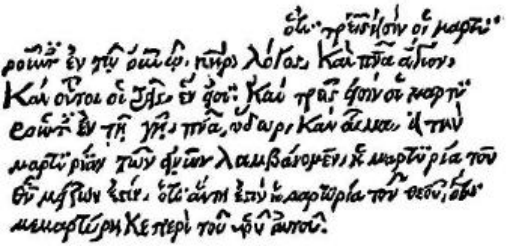
When I examined the original myself, though I took down a transcript, yet I neglected to take a fac-simile. That no mistake might be made in a matter of so much importance, I got a fac-simile, and after it was engraved, had it collated with the MS. by Dr. Barrett himself, and the plate finished according to his last corrections; so that I hope it may be said every jot and every tittle belonging to the text are here fairly and faithfully represented; nothing being added, and nothing omitted. I have examined this MS. since, and have not been able to detect any inaccuracy in my fac-simile. To it I have annexed a perfect facsimile of the same words, as they stand in the Complutensian Polyglot, which the curious reader will be glad to see associated with the other, as they are properly the only Greek authorities on which the authenticity of the text of the Three Witnesses depends. FAC-SIMILE of 1 John 5:7-9,
From the Editio Princeps of the Greek Testament, printed at Complutum, in 1514.
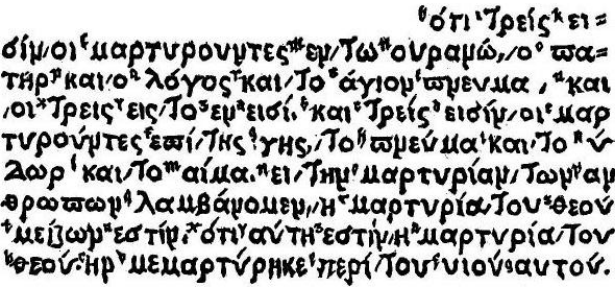
It may be necessary to observe,
First, That the five first lines of the fac-simile of the text in the Complutensian edition are at the top of the opposite page to that on which the other four lines are found. The alphabetical letters, mingled with the Greek text, are those which refer to the corresponding words in the Latin text, printed in a parallel column in the Complutensian Polyglot, and marked with the same letters to ascertain more easily the corresponding Greek and Latin words, for the benefit, I suppose, of learners. The column containing the Latin text, which is that of the Vulgate, is not introduced here, being quite unnecessary.
Second. The sixth and seventh lines of the fac-simile of the Codex Montfortii belong to the second page of that leaf on which the other five lines are written.
This MS. is-a thick duodecimo, written on paper, without folios. There is an inscription in it in these words, Sum Thomæ Clementis, olim fratris Froyhe. On this inscription Dr. Barrett remarks: “It appears Froyhe was a Franciscan; and I find in some blank leaves in the book these words written (by the same hand, in my opinion, that wrote the MS.) insouv maria fragkiskov; by the latter, I understand the founder of that order.” If St. Francis d’Assise be here meant, who was the founder of the order of Franciscans, and the inscription be written by the same who wrote the MS., then the MS. could not have been written before the thirteenth century, as St. Francis founded his order in 1206, and died in 1226, and consequently quotes that the MS. could not have been written in the eleventh century, as Mr. Martin of Utrecht, and several others, have imagined.
Much stress has been laid on the dots over the i and u which frequently appear in this MS. Montfaucon has observed, Palæographia Græca, page 33, that such dots were in use a thousand years ago: hence the advocates of the antiquity of the Codex Montfortii have inferred that this MS. must have been written at least in the tenth or eleventh century. But as these are found in modern MSS. (see Palæog. pages 324, 333,) they are therefore no proof of antiquity. In Michaelis’ Introduction, vol. ii., page 286, where he is describing the MSS. of the Greek Testament, he gives the text in question as it is supposed to exist in the Codex Montfortii, in which two dots appear over every iota and upsilon in the whole five lines there introduced; but on comparing this of Michaelis with the fac-simile here produced, the reader will at once perceive that the arrangement is false, and the dotting egregiously inaccurate. Deceived by this false representation, Dr. Marsh, (bishop of Peterborough,) in his notes on the passage, page 754, observes, “that no MS. written in small characters before the twelfth century has these dots. That a MS. written in the twelfth century has these dots sometimes on the iota, but never on the upsilon; but MSS. written in the fourteenth century have these dots on both letters, but not in all cases. Now as these letters are dotted always in the Codex Montfortianus, but not always in the MSS. of the thirteenth and fourteenth centuries, and still less often in those of the twelfth century, we may infer that the Codex Montfortianus is at least as modern as the fifteenth century.”
On this quotation I beg leave to make a few remarks.
Dr. Marsh says, “that no MS. written in small letters previous to the twelfth century has these dots.” This excellent critic has only to consult the Palæographia Græca, page 293, in which he will find No. 1, a fac-simile of one of the Colbert MSS. (No. 4954,) written A. D. 1022, where the iota appears thrice dotted; and in No. 2, on the same page, another fac-simile of a MS. written A. D. 1045, the iota is dotted in the word ihsou. Ibid., page 283, (No. 7,) a MS. written in 986, has the iota twice dotted in the word iemenei. Ibid., page 275, (No. 2,) a MS. of the ninth or beginning of the tenth century, has the iota dotted in acaiav. and in No. 3, a specimen of the Codex Regius, (No. 2271,) written A. D. 914, the iota is dotted in qeikhn. Ibid., page 271, (No. 4,) written about 890, the iota is dotted in ierwn. and in Spec. v. in the word poiia. See also Ibid., page 320, No. 3, another of the Colbert MSS. (4111,) written A. D. 1236, where the iota is dotted seven times. All these specimens are taken from MSS. written in small characters, and, as the dates show, (the last excepted,) long before the twelfth century. As to these dots being more frequent in manuscripts of the fifteenth than those of the twelfth, thirteenth, and fourteenth centuries, I cannot say much; it is certain they became more frequent towards the fourteenth century than they were in the twelfth, and yet this was not a general case. In two well-written manuscripts now before me, one of which I suppose to be of the fourteenth century, and the other of the fifteenth, these dots often occur, but they are by no means regular. I have noticed several pages in the oldest manuscript where they occur but once; and in other pages they may be met with ten or twelve times. On the contrary, in the more recent manuscript, whole pages occur without one of them; and where they do occur, they are much less frequent than in the former. So that it rather appears from this evidence; that they began to disappear in the fifteenth century. Dr. Marsh, misled by the specimen in Michaelis, vol. ii. page 286, says: “The letters in question are always dotted in the Codex Montfortianus.” By referring to the fac-simile, the reader will be able at once to correct this mistake. The iota in the fac-simile occurs thirty times, and is dotted only in five instances; and the upsilon occurs nineteen times, and is dotted only in seven.
But arguments for or against the age of any MS., on account of such dots, are futile in the extreme; as the most ancient MSS. have them not only on the iota and upsilon, but upon several other letters, as may be seen in the Codex Alexandrinus, the Codex Rescriptus, published by Dr. Barrett, and the Codex Bezæ; in the latter of which they seem to occur more frequently than they do even in the Codex Montfortii.
On the evidence of these dots, Mr. Martin of Utrecht supposed the Dublin manuscript to be as old as the eleventh century and on the same evidence Dr. Marsh argues, “that it is at least as modern as the fifteenth.” Both these judgments are too hastily formed; medio tutissimus ibis is the best counsel in such a case; the manuscript is more likely to have been a production of the thirteenth than of either the eleventh or fifteenth. The former date is as much too high as the latter is too low; the zeal of the critics for and against this controverted text having carried them, in my opinion; much too far on either side.
In comparing the writing of the Codex Montfortii, with the different specimens given by Montfaucon in the Palæographia Græca, it appears to approach nearest to that on page 320, No. 4, which was taken from one of the Colbert manuscripts, (No. 845,) written in the year of our Lord 1272, which I am led to think may be nearly about the date of the Codex Montfortii; but on a subject of so much difficulty, where critics of the first rank have been puzzled, I should be sorry to hazard any more than an opinion, which the reader is at liberty to consider either correct or incorrect, as may seem best to his own judgment.
Though a conscientious advocate for the sacred doctrine contained in the disputed text, and which I think expressly enough revealed in several other parts of the sacred writings, I must own the passage in question stands on a most dubious foundation. All the Greek manuscripts (the Codex Montfortii alone excepted) omit the passage; so do all the ancient versions; the Vulgate excepted; but in many of the ancient MSS. even of this version it is wanting. There is one in the British Museum, of the tenth or eleventh century, where it is added by a more recent hand in the margin; for it is wanting in the text. It is also variously written in those manuscripts which retain it. This will appear more plainly by comparing the following extracts taken from four manuscripts of the Vulgate in my own possession:-
1. ——Quoniam tres sunt qui testimonium dant in cœlo, Pater, Verbum, et Spiritus Sanctus, et hii tres unum sunt. Et tres sunt qui testimonium dant in terra, spiritus, sanguis, et aqua. This is the same with the text in the Complutensian Polyglot, only aqua is placed before sanguis.
2. ——Quoniam tres sunt qui testimonium dant in terra, spiritus, aqua, et sanguis, et hii tres unum sunt. Et tres sunt qui testimonium dant in cœlo, Pater, Verbum, et Spiritus Sanctus, et hii tres unum sunt.
3. ——Quoniam tres sunt qui testimonium dant in cœlo, Pater, et Filius, et Spiritus Sanctus, et hii tres unum sunt. Et tres sunt qui testimonium dant in terra, spiritus, aqua, et sanguis.
4. ——Quoniam tres sunt qui testimonium dant in terra, spiritus, aqua, et sanguis, et hii tres unum sunt. Et tres sunt qui testimonium dant in cœlo, Pater, et Filius, et Spiritus Sanctus, et hii tres unum sunt.
5. ——Quoniam tres sunt qui testimonium dant in terra, spiritus, aqua, et sanguis, et tres sunt qui testitnonium perhibent in cœlo, Pater, Verbum, et Spiritus Sanctus, et hi tres unum sunt. This last I took from an ancient manuscript in Marsh’s library, St. Patrick’s, Dublin.
In what has been denominated the Editio Princeps of the Latin Bible, and supposed to have been printed between 1455 and 1468, the text stands thus: “Quoniam tres sunt qui testimonium dant in cœlo, Pater, Verbum, et Spiritus Sanctus, et hii tres unum sunt. Et tres sunt qui testimonium dant in terra. Spiritus, aqua, et sanguis, et tres unum sunt.”
In the Bible printed by Fradin and Pinard, Paris, 1497, fol., the text is the same with No. 2, only instead of testimonium dant, it reads dant testimonium.
The reader will observe that in Nos. 2, 4, and 5, the eighth verse is put before the seventh, and that 3 and 4 have filius instead of verbum. But both these readings are united in an ancient English manuscript of my own, which contains the Bible from the beginning of Proverbs to the end of the New Testament, written on thick strong vellum, and evidently prior to most of those copies attributed to Wiclif.
For three ben that geven witnessing in heven the Fadir, the Word or Sone and the Hooly Goost, and these three ben oon. And three ben that geven witnessing in erthe, the Spirit, Water, and Blood, and these three ben oon.
As many suppose the Complutensian editors must have had a manuscript or manuscripts which contained this disputed passage, I judge it necessary to add the note which they subjoin at the bottom of the page, by which (though nothing is clearly expressed) it appears they either had such a manuscript, or wished to have it thought they had such. However, the note is curious, and shows us how this disputed passage was read in the most approved manuscripts of the Vulgate extant in the thirteenth century, when St. Thomas Aquinas wrote, from whom this note is taken. The following is the whole note literatim:—
“Sanctus Thomas in oppositione secunde Decretalis de suma Trinitate et fide Catholica, tractans istum passum contra Abbatem Joachim, ut tres sunt qui testimonium dant in celo, Pater, Verbum, et Spiritus Sanctus; dicet ad literam verba sequentia. Et ad insinuandam unitatem trium personarum subditur. Et hii tres unum sunt. Quodquidem dicitur propter essentie Unitatem. Sed hoc Joachim perverse trahere volens ad unitatem charitatis et consensus, inducebat consequentem auctoritatem. Nam subditur ibidem: et tres sunt qui testimonium dant in terra, S. Spiritus: Aqua; et sanguis. Et in quibusdam libris additur: et hii tres unum sunt. Sed hoc in veris exemplaribus non habetur: sed dicitur esse appossitum ab hereticis arrianis ad pervertendum intellectem sanum auctoritatis premisse de unitate essentie trium personarum. Hec beatus Thomas ubi supra.”
If the Complutensian editors translated the passage into Greek from the Vulgate, it is strange they made no mention of it in this place, where they had so fair an opportunity while speaking so very pointedly on the doctrine in question and forming a note for the occasion, which is indeed the only theological note in the whole volume. It is again worthy of note that, when these editors found an important various reading in any of their Greek manuscripts, they noted it in the margin: an example occurs 1 Corinthians 13:3, and another, ibid. xvi.; why was it then that they took no notice of so important an omission as the text of the three witnesses, if they really had no manuscript in which it was contained? Did they intend to deceive the reader, and could they possibly imagine that the knavery could never be detected? If they designed to deceive, they took the most effectual way to conceal the fraud, as it is supposed they destroyed the manuscripts from which they printed their text; for the story of their being sold in 1749 to a rocket-maker (see Michaelis, vol. ii., page 440) is every way so exceptionable and unlike the truth, that I really wonder there should be found any person who would seriously give it credit. The substance of this story, as given by Michaelis, is as follows: “Professor Moldenhawer, who was in Spain in 1784, went to Alcala on purpose to discover these MSS., but was informed that a very illiterate librarian, about thirty-five years before, who wanted room for some new books, sold the ancient vellum MSS. as useless parchments, to one Toryo who dealt in fireworks, as materials for making rockets.” It is farther added that “Martinez, a man of learning, heard of it soon after they were sold, and hastened to save these treasures from destruction; but it was too late, for they were already destroyed, except a few scattered leaves which are now in the library.” On the whole of this account, it is natural to ask the following questions: Is it likely that the management of so important a trust should be in the hands of a person so ignorant that he could not know a Hebrew or Greek MS. from a piece of useless parchment? Could such a person be intrusted to make a purchase of new books for the library, for which he wanted room? or if they were purchased by the trustees of the library, is it likely they would leave the classification and arrangement of these to such a Goth as this librarian is said to be? Would such a librarian, or indeed any other, be permitted to dispose of any part of the library which he might deem useless? If Mr. Martinez heard of it soon after they were sold, and hastened to rescue them, is it likely that almost the whole should have been converted into rockets before he got to the place, when we are informed they were so many as to cost originally 4,000 aurei; and that even the price which the librarian sold them for was so considerable, that it had to be paid at two different installments? Was it possible that in so short a time the rocket-maker could have already consumed the whole? The whole account is so improbable that I cannot help saying, Credat Judæus Apella; non ego. It is more likely the manuscripts were destroyed at first, or that they are still kept secret, to prevent the forgery (if it be one) of the text of the three witnesses from being detected; or the librarian already mentioned may have converted them to his own use. If they were not destroyed by the Complutensian editors, I should not be surprised if the same manuscripts should come to light in some other part of the world, if not in the Alcala library itself.
It is worthy of remark that Luther never admitted the text of the three witnesses into any of the editions of his translation; it is true it was afterwards added, but never during his lifetime. On this Professor Michaelis makes the following observation: “It is uncandid in the extreme for one Protestant to condemn another for rejecting 1 John 5:7, since it was rejected by the author of our Reformation.” Any conscientious Trinitarian may innocently hesitate to receive the feebly supporting evidence of this disputed text, in confirmation of a doctrine which he finds it his duty and interest to receive on the unequivocal testimony of various other passages in the book of Gad.
Professor Griesbach, who does not appear to be an enemy to the doctrine, and who has carefully and critically examined all the evidences and arguments, pro and con, has given up the text as utterly defenceless, and thinks that to plead for its authenticity is dangerous. “For if,” says he, “a few dubious, suspicious, and modern evidences, with such weak arguments as are usually adduced, are sufficient to demonstrate the authenticity of a reading, then there remains no longer any criterion by which the spurious may be distinguished from the genuine; and consequently the whole text of the New Testament is unascertained and dubious.”
Much stress has been laid on Bengel’s defence of this text: Michaelis has considered the strength of his arguments in a candid and satisfactory manner.
“The ancient writers which Bengel has produced in favour of 1 John 5:7, are all Latin writers, for he acknowledges that no Greek father has ever quoted it. Now, if no objection could be made to Bengel’s witnesses, and the most ancient Latin fathers had quoted in express terms the whole of the controverted passage, their quotations would prove nothing more than that the passage stood in their manuscripts of the Latin version, and therefore that the Latin version contained it in a very early age. But it will appear upon examination that their evidence is very unsatisfactory. The evidence of Tertullian, the oldest Latin writer who has been quoted in favour of 1 John 5:7, is contained in the following passage of his treatise against Praxeas, book 1:, chap. 25: Ita connexus Patris in Filio et Filii in Paracleto, tres efficit cohærentes, alterum ex altero; qui tres unum sunt, non unus; quomodo dictum est: Ego et Pater unum sumus. Hence it is inferred, that because tres unum sunt stand at present in the Latin version, 1 John 5:7, these words stood there likewise in the time of Tertullian, and that Tertullian borrowed them from the Latin version. But this inference is wholly without foundation; for Tertullian does not produce these words as a quotation, and the bare circumstance of his using the expression tres unum sunt will not prove that he found that expression in the Bible. On the contrary, it is evident, from what immediately follows, that 1 John 5:7 was not contained in the Latin version when Tertullian wrote. For, in proof of this assertion, qui tres unum sunt, he immediately adds, quomodo dictum est: Ego et Pater unum sumus, which is a quotation from St. John’s gospel, John 10:30. Now as this quotation relates only to the Father and the Son, and not to the Holy Ghost, surely Tertullian would not have proved the unity of the Trinity from this passage, if 1 John 5:7, which is much more to the purpose, had then been contained in any Latin manuscript with which he was acquainted. At any rate, the mere use of the words tres unum sunt affords no argument in favour of the controverted passage; and if any inference is to be deduced from their agreement with our present copies of the Latin version in 1 John 5:7; it is this: that the person who afterwards fabricated this passage retained an expression which had been sanctioned by the authority of Tertullian. So much for the evidence of this Latin father, the only writer of the second century to whom appeal has been made.
“Of the Latin fathers who lived in the third century, Cyprian alone has been produced as evidence in favour of 1 John 5:7. From the writings of Cyprian two passages have been quoted as proofs that 1 John 5:7 was contained in his manuscript of the Latin version. The one is from his epistle to Jubaianus; where Cyprian writes thus: Si baptizari quis apud hæreticum potuit, utique et remissam consecutus est, et sanctificatus est, et templum Dei factus est; quæro cujus Dei? Si Creatoris; non potuit; qui in eum non credidit: si Christi, non hujus potest fieri templum, qui negat, Deum Christum: si Spiritus Sancti, cum tres unum sint, quomodo Spiritus Sanctus placatus esse ei potest, qui aut Patris aut Filit inimicus est? Here it must be observed, that the words cum tres unum sint, though inserted in the later editions of Cyprian’s works, are not contained in that edition which was published by Erasmus; and even if they were genuine, they will prove nothing more than the same words just quoted from Tertullian. The other passage, which is much more to the purpose; is in Cyprian’s treatise, De Ecclesiæ Unitate, where Cyprian writes thus: Dicit Dominus: Ego et Pater unum sumus; et iterum de Patre et Filio, et Spiritu Sancto, scriptum est: Et tres unum sunt. Now, admitting that the words et tres unum sunt were quoted by Cyprian from 1 John 5:7, I seriously ask every impartial judge whether a passage found in no ancient Greek manuscript, quoted by no Greek father, and contained in no other ancient version than the Latin, (and not in all copies of this,) is therefore to be pronounced genuine; merely because one Latin father of the three first centuries, who was bishop of Carthage, where the Latin version only was used, and where Greek was unknown, has quoted it? Under these circumstances, should we conclude that the passage stood originally in the Greek autograph of St. John? Certainly not; for the only inference which could be deduced from Cyprian’s quotation would be this, that the passage had been introduced into the Latin version so early as the third century. “The preceding answer is sufficient to invalidate Cyprian’s authority in establishing the authenticity of 1 John 5:7, on the supposition that Cyprian really quoted it; but that he did so is more than any man can prove. The words tres unum sunt are contained not only in the seventh, but also in the eighth verse, which is a part of the ancient and genuine text of St. John; and therefore it is at least possible that Cyprian took them not from the seventh, but from the eighth verse. It is true that he says these words are written of the Father, Son, and Holy Ghost; whereas tres unum sunt, in the eighth verse, relates only to the spirit, the water, and the blood. But it must be observed that the Latin fathers interpreted spiritus, aquas et sanguis, not literally, but mystically; and some of them really understood by these words, Pater, Filius, et Spiritus Sanctus, taking aqua in the sense of Pater, sanguis in the sense of Filius, and spiritus in the sense of Spiritus Sanctus. “This is expressly asserted by Eucherius in his Questiones N. T. difficiliores; for after having quoted 1 John 5:8, thus: Tria sunt, quæ testimonium perhibent, aqua, sanguis, et spiritus, he adds, soon after, plures tamen hic ipsam interpretatione mystica intelligere Trinitatem; aqua Patrem, sanguine Christum, spiritu Spiritum Sanctum manifestante. But if Cyprian really thought that aqua, sanguis, et spiritus, 1 John 5:8, denoted Pater, Filius, et Spiritus Sanctus, he might say of tres unum sunt, 1 John 5:8, that it was written, de Patre, et Filio, et Spiritu Sancto. And that he actually did so, that he quoted not 1 John 5:7, but understood 1 John 5:8, mystically, appears from the following passage of Facundus, who lived in the neighbourhood of Carthage, and consequently used the same Latin version as Cyprian. Johannes Apostolus in epistola sua de Patre, et Filio, et Spiritu Sancto, sic dicit: Tres sunt qui testimonium dant in terra, spiritus, aqua, et sanguis, et hi tres unum sunt: in spiritu significans Patrem, &c. Quod Johannis Apostoli teslimonium beatus Cyprianus, in epistola, sive libro, quem de Trinitate scripsit, de Patre, Filio, et Spiritu Sancto, dictum intelligit.” Facundus then quotes the words of Cyprian, which are the subject of our present inquiry. From the preceding passage it is manifest that 1 John 5:7 was unknown to Facundus; for he proves the doctrine of the Trinity by a mystical interpretation of 1 John 5:8, and appeals to the authority of Cyprian, who, he says, gave the same interpretation. But if 1 John 5:7 was unknown to Facundus, who lived in the same country as Cyprian, used the same Latin version, and wrote almost three centuries later, it is incredible that 1 John 5:7 was already introduced in the Latin manuscripts which Cyprian used. Consequently we must conclude that the assertion of Facundus is true, and that the words of Cyprian contain, not a quotation from 1 John 5:7, but a mystical application of 1 John 5:8. This is farther confirmed by Augustine, who was likewise an African bishop, who lived a hundred years later than Cyprian, and still knew nothing of 1 John 5:7, for he has never quoted this passage, not even where he speaks of the Trinity, but he has mystically applied the eighth verse.”-MICHAELIS, vol. vi. p. 420.
The Greek writers who have not quoted this verse, though several of them wrote professedly on the Deity of Christ, and on the Trinity, are the following:—
Irenæus.
Clemens Alexandrinus.
Dionysius Alexandrinus (or the
writer against Paul of Samosatsa
under his name.)
Athanasius.
The Synopsis of Scripture.
The Synod of Sardica.
Epiphanius.
Basil.
Alexander of Alexandria.
Gregory Nyssen.
Gregory Nazianzen, with his two
commentators, Elias Cretensis
and Nicetas.
Didysus de Spiritu Sancto.
Chrysostom.
An author under his name, de
sancta et consubstantiali
Trinitate.
Cyril of Alexandria.
The Exposition of Faith in
Justin Martyr’s works.
Cæsarius.
Proclus.
The Council of Nice, as it is
represented by Gelasius
Cyzicenus.
Hippolytus.
Andreas.
Six catenæ, quoted by Simon.
The marginal scholia of three
MSS.
Hesychius.
John Damascenus.
Germanus of Constantinople.
Œcumenius.
Euthymius Zigabenus
LATIN AUTHORS.
Novatian.
Hilary.
Lucifer Calaritanus.
Jerome.
Augustine.
Ambrose.
Faustinus.
Leo Magnus.
The author de Promissis.
Eucherius.
Facundus.
Junilius.
Cerealis.
Rusticus.
Bede.
Gregogy.
Philastrius.
Paschasius.
Arnobius, junior
Pope Eusebius.
The writers that have quoted it are comparatively recent or spurious, for those of any note which have been supposed, from certain expressions in their works, to have had reference to this verse, have been proved by learned men to have had no such text in view. A great and good man has said that “the seventh verse, in conjunction with the sixth and eighth, has been quoted by Tertullian, Cyprian, and an uninterrupted train of fathers.” But a more incautious assertion was never made, as the preceding list will prove; and the evidence on the subject I have most carefully examined. Bengel, who was an excellent critic and a good man, endeavoured to defend it, but without success; and Michaelis demonstrated its spuriousness from Bengel’s five concessions. Knittel has defended its authenticity with much critical acumen; Hezelius with great sagacity; David Martin, of Utrecht, with much honest simplicity; and Dean Travis with abundance of zeal, without much knowledge of the critical bearings of the subject. Socinians need not glory that it is indefensible, and that honest Trinitarians give it up; for the sacred doctrine which it appears to express is diffused through every part of the Scriptures, and is as inexpungable as a rock of adamant, and will live and prevail in the Church of Christ while sun and moon endure, and till time shall be swallowed up in eternity. SUMMARY of the whole evidence relative to the THREE HEAVENLY WITNESSES, 1 John 5:7.
1. ONE HUNDRED AND THIRTEEN Greek MSS. are extant, containing the First Epistle of John, and the text in question is wanting in 112. It only exists in the Codex Montfortii, (a comparatively recent MS.,) already described. The Codex Ravianus, in the Royal Library at Berlin, is a transcript taken from the Complutensian Polyglot.
2. All the GREEK fathers omit the verse, though many of them quote both 1 John 5:6 and 1 John 5:8, applying them to the Trinity, and Divinity of Christ and the Holy Spirit; yea, and endeavour to prove the doctrine of the Trinity from 1 John 5:6 and 1 John 5:8, without referring to any such verse as 1 John 5:7, which, had it existed, would have been a more positive proof, and one that could not have been overlooked.
3. The first place in which the verse appears in Greek is the Greek translation of the Acts of the Council of Lateran, held A. D. 1215.
4. Though it is found in many Latin copies, yet it does not appear that any written previously to the TENTH CENTURY contains it.
5. The LATIN fathers do not quote it, even where it would have greatly strengthened their arguments; and where, had it existed, it might have been most naturally expected.
6. Virilius, bishop of Tapsum, at the conclusion of the fifth century, is the first who seems to have referred expressly to the three heavenly witnesses; but his quotation does not agree with the present text either in words or in sense; and besides, he is a writer of very little credit, nor does the place alleged appear to learned men to be genuine.
7. The Latin writers who do refer to the three heavenly witnesses vary greatly in their quotations, the more ancient placing the eighth verse before the seventh, and very many omitting, after the earthly witnesses, the clause these three are one. Others who insert these three are one add in Christ Jesus; others use different terms.
8. It is wanting in all the ancient VERSIONS, the Vulgate excepted; but the more ancient copies of this have it not; and those which have it vary greatly among themselves, as may be seen in the specimens already produced.
9. It is wanting in the first edition of Erasmus, A. D. 1516, which is properly the editio princeps of the Greek text.
It is wanting also in his second edition 1519, but he added it in the third from the Codex Montfortii.
It is wanting in the editions of Aldus, Gerbelius, Cephalæus, &c. It is wanting in the German translation of LUTHER, and in all the editions of it published during his lifetime.
It is inserted in our early English translations, but with marks of doubtfulness, as has already been shown.
10. In short, it stands on no authority sufficient to authenticate any part of a revelation professing to have come from God.
See Griesbach’s Dissertation on this verse at the end of the second volume of his Greek text. Halæ et Londini, 1806.
In defence of this verse see “Archdeacon Travis’ Letters to Gibbon;” and on the other side, “Professor Porson’s Answer to Travis.” The latter has left nothing farther to be said on the subject either in vindication or reply. Finished the correction for a reimpression, Jan. 3, 1832.-A. C.
Joseph Sutcliffe
REFLECTIONS.
“If there be in our gospels,” says Saurin, “a doctrine concerning which a good logician has cause to exclaim, it is this, a God who has but one essence, and yet three persons; the Son, and the Holy Spirit who is God; and these three but one. The Father, who is with the Son, does not become incarnate when the Son becomes incarnate. The Son, who is with the Father, no longer maintains the rights of justice in Gethsemane, when the Father maintains them. The Holy Spirit, who is with the Father and the Son, proceeding from both in a manner ineffable: and the Father and the Son, who is with the Holy Spirit, not proceeding in this manner. Are not these ideas contradictory? No, my brethren. If we should say that God has but one essence, and that he has three essences in the same sense as we maintain he has but one; if we should say that God is three in the same sense he is one, it would be a contradiction. But this is not our thesis. We believe on the faith of a divine book in the sense for which we give the confused name of essence. We believe that he is three in a sense for which we give the confused name of persons. We determine neither what is this essence, nor what is this personality. That surpasses reason, but does not revolt it. If we should say that God, in the sense we have called essence, is become incarnate, and at the same time this notion is not incarnate, we should advance a contradiction. But this is not our thesis. We believe on the faith of a divine book, that what is called the person of the Son in the Godhead, and of which we know that we have not a distinct idea, is united to the humanity in a manner we cannot determine, because it has not pleased God to reveal it. This surpasses reason, but does not revolt it. If we should advance that God, in the sense we have considered essence, proceeds from the Father and the Son, while the Father and the Son do not proceed, we should advance a contradiction. But this is not our thesis. We believe on the credit of a divine book that what is called the Holy Spirit in the Godhead, and of which we confess we have no distinct idea, because it has not pleased God to give it, has a procession ineffable, while what is called the Father and the Son, differing from the Holy Spirit in that respect, does not proceed. This also surpasses reason, but does not revolt it. We go even farther. We maintain not only that there is no contradiction in those doctrines, but that a contradiction is impossible. What is a contradiction in regard to us? It is an evident opposition between two known ideas. For instance, I have no idea of this pulpit and of this wall. I see an essential difference between the two. Consequently, I find a contradiction in the proposition, that this wall and this pulpit are the same thing. Such being the nature of the contradiction, I say it is impossible that any should be found in this proposition, that there is one divine essence in three persons. To find a contradiction, it is requisite to have a distinct idea of what I call essence, and of what I call person; and as I profess to be perfectly ignorant of the one and the other, it is impossible I should find absurdity. When therefore I affirm that there is a divine Essence in three Persons, I do not pretend to explain either the nature of the Unity, nor the nature of the Trinity. I pretend to advance only, that there is something in God which surpasses me, and which is the basis of this proposition: viz. there is a Father, a Son, and a Holy Spirit. If we say that there are three Persons in the divine Essence, it is to make you conceive that all which is in God is interested for our salvation, and to enkindle our zeal by the thought. If we say that the Word was made flesh, and that the Son of God died on the cross, it is to make you hate sin, by the recollection of what it cost him to expiate it.” — See Saurin’s sermons, translated by J. S.
John Wesley
CHAPTER 5.
Adam Clarke
Editorial note: Source collation note — closing commentary paragraph 5: “ouranw, o pathr, o λογος, kai to agion pneuma”. source PDF page 71: “ουρανω, ο πατηρ, ο λογος, και το αγιον πνευμα.”. Compared with CLA_1JO.PDF PDF p. 59, CLA_1JO.PDF PDF p. 71. The source-font or layout comparison does not securely establish every letter, mark or local sequence in these passages. The flagged language readings or layout are retained; the original source pages should be consulted for these specific readings. Additional-source investigation: the available separately digitized printed volumes were searched, but the corresponding passage was not securely located. The flagged readings or layout remain uncertain; this search provides no basis for reconstructing or silently normalizing them. CLA_1JO.PDF, PDF page 59; CLA_1JO.PDF, PDF page 71.
CHAPTER 5.
He that believeth is born of God; loves God and his children; and keeps his commandments, which are not grievous, 1-3. Faith in Christ overcomes the world, 4, 5. The three earthly and heavenly witnesses, 6-9. He that believeth hath the witness in himself, 10. God has given unto us eternal life in his Son, 11, 12. The end for which St. John writes these things, 13-16. The sin unto death, and the sin not unto death, 16, 17. He that is born of God sinneth not,
18. The whole world lieth in the wicked one, 19. Jesus is come to give us understanding, that we may know the true God, 20. All idolatry to be avoided, 21.
NOTES ON CHAP. 5.
Joseph Benson
CHAPTER 5.
A.M. 4094. — A.D. 90.
The apostle,
(1,) Discourses on the character of those who truly believe in Jesus as the Christ, describing them as born of God, as loving him, their heavenly Father, and all his children, and as overcoming the world, 1-5.
(2,) Speaks of the offices of Christ, exhibited emblematically by water and blood, and of the witnesses in heaven and earth, that bear testimony to him and his salvation, 6-9.
(3,) Bears witness to the happiness of believers in having eternal life in Christ, and their prayers of faith heard, for his sake, 10-17.
(4,) He adds a reflection on the happy difference which regeneration and the knowledge of God in Christ had made between them and the ignorant and wicked world, and directs them to guard carefully against all idolatry, 18-21. NOTES ON CHAPTER 5.
Joseph Sutcliffe
CHAPTER 5.
Daniel Whedon
CHAPTER 5.