Section 5: Adjective Nouns
This transcription includes editorial corrections or unresolved source readings. The full record and source references are available below.
Editorial notes and transcription record · 27 notes
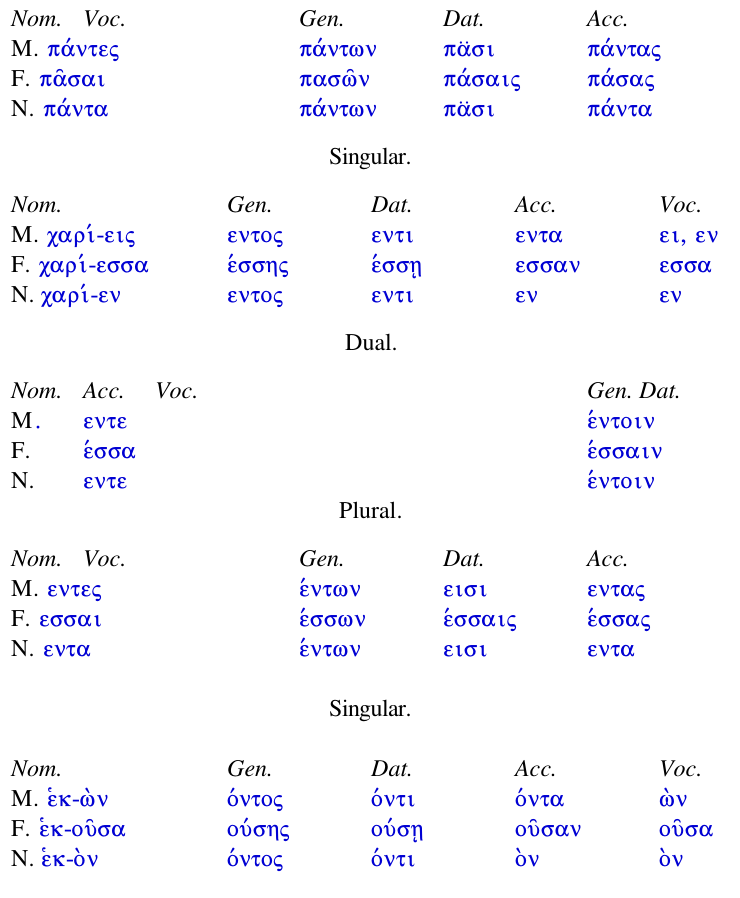
Editorial note: Transcription correction in the passage beginning “M. πάντες πάντων pa`si πάντας”: the independent 1872 printing, vol. XIV, printed p. 90 (physical PDF page 99), establishes these repairs: “pa`si” → “πᾶσι”. The repair follows the historical print; it does not modernize the grammar or certify other forms and table columns in the passage. Independent 1872 printing, vol. XIV, printed p. 90 (PDF page 99).
Editorial note: Transcription correction in the passage beginning “N. πάντα πάντων pa`si πάντα”: the independent 1872 printing, vol. XIV, printed p. 90 (physical PDF page 99), establishes these repairs: “pa`si” → “πᾶσι”. The repair follows the historical print; it does not modernize the grammar or certify other forms and table columns in the passage. Independent 1872 printing, vol. XIV, printed p. 90 (PDF page 99).
Editorial note: Transcription correction in the passage beginning “M. eJk-ὼν όντος όντι όντα ὼν”: the independent 1872 printing, vol. XIV, printed p. 90 (physical PDF page 99), establishes these repairs: “eJk-” → “ἑκ-”. The repair follows the historical print; it does not modernize the grammar or certify other forms and table columns in the passage. Independent 1872 printing, vol. XIV, printed p. 90 (PDF page 99).
Editorial note: Transcription correction in the passage beginning “F. eJk-οῦσα ούσης ούσῃ οῦσαν οῦσα”: the independent 1872 printing, vol. XIV, printed p. 90 (physical PDF page 99), establishes these repairs: “eJk-” → “ἑκ-”. The repair follows the historical print; it does not modernize the grammar or certify other forms and table columns in the passage. Independent 1872 printing, vol. XIV, printed p. 90 (PDF page 99).
Editorial note: Transcription correction in the passage beginning “N. eJk-ὸν όντος όντι ὸν ὸν”: the independent 1872 printing, vol. XIV, printed p. 90 (physical PDF page 99), establishes these repairs: “eJk-” → “ἑκ-”. The repair follows the historical print; it does not modernize the grammar or certify other forms and table columns in the passage. Independent 1872 printing, vol. XIV, printed p. 90 (PDF page 99).
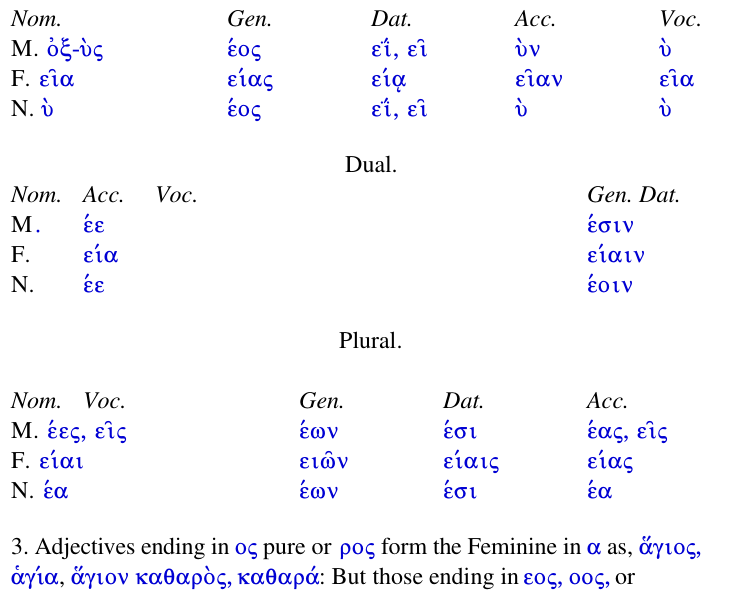
Editorial note: Transcription correction in the passage beginning “M. ojx-ὺς έος ei`>, εῖ ὺν ὺ”: the independent 1872 printing, vol. XIV, printed p. 91 (physical PDF page 100), establishes these repairs: “ojx-” → “ὀξ-”; “ei`>” → “εΐ”. The repair follows the historical print; it does not modernize the grammar or certify other forms and table columns in the passage. Independent 1872 printing, vol. XIV, printed p. 91 (PDF page 100).
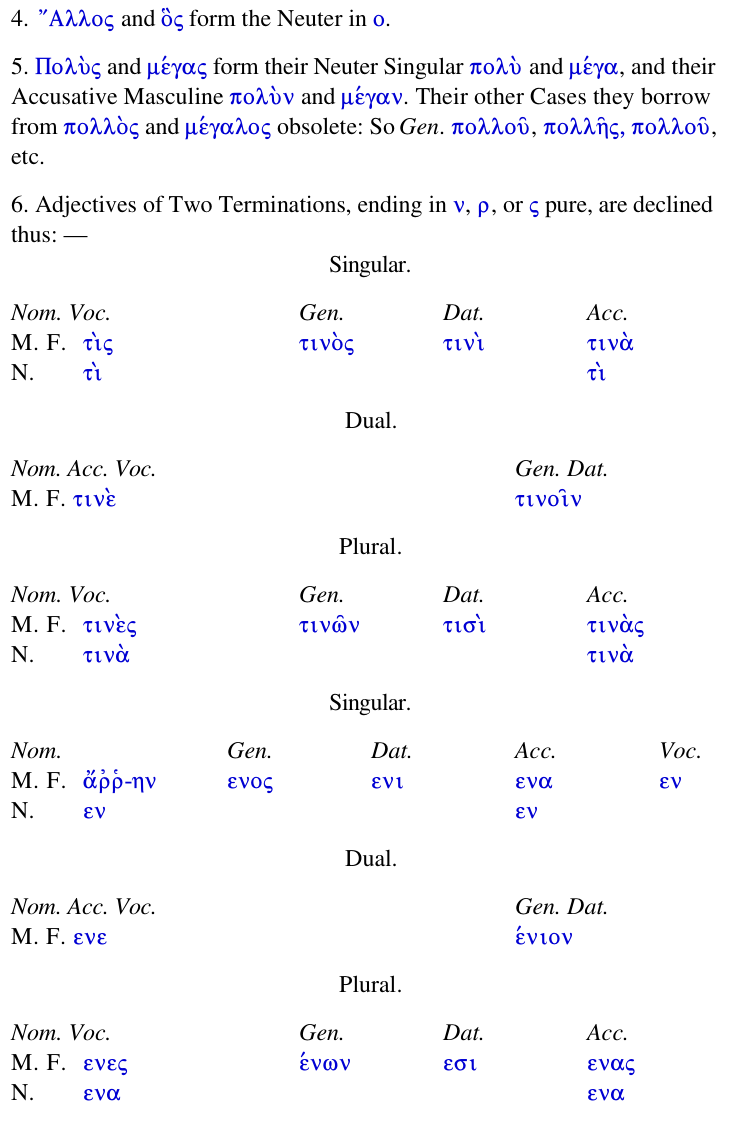
Editorial note: Transcription correction in the passage beginning “M. F. ἀῤῥ-hn ενος ενι ενα εν”: the independent 1872 printing, vol. XIV, printed p. 92 (physical PDF page 101), establishes these repairs: “ἀῤῥ-hn” → “ἄῤῥ-ην”. The repair follows the historical print; it does not modernize the grammar or certify other forms and table columns in the passage. Independent 1872 printing, vol. XIV, printed p. 92 (PDF page 101).
Editorial note: Transcription correction in the passage beginning “M. F. ajlhq-ὴς έος, οῦς έι`, εῖ έα, ῆ ὲς”: the independent 1872 printing, vol. XIV, printed p. 92 (physical PDF page 101), establishes these repairs: “ajlhq-” → “ἀληθ-”; “έι`” → “έϊ”. The repair follows the historical print; it does not modernize the grammar or certify other forms and table columns in the passage. Independent 1872 printing, vol. XIV, printed p. 92 (PDF page 101).
Editorial note: Transcription correction in the passage beginning “M. F. ἐνδοξ-ov ου ῳ ον ε”: the independent 1872 printing, vol. XIV, printed p. 92 (physical PDF page 101), establishes these repairs: “ἐνδοξ-ov” → “ἔνδοξ-ος”. The repair follows the historical print; it does not modernize the grammar or certify other forms and table columns in the passage. Independent 1872 printing, vol. XIV, printed p. 92 (PDF page 101).
Editorial note: Transcription correction in the passage beginning “M. F. ἀδακρ-uv υος υι υν υ”: the independent 1872 printing, vol. XIV, printed p. 92 (physical PDF page 101), establishes these repairs: “ἀδακρ-uv” → “ἄδακρ-υς”. The repair follows the historical print; it does not modernize the grammar or certify other forms and table columns in the passage. Independent 1872 printing, vol. XIV, printed p. 92 (PDF page 101).
Editorial note: Transcription correction in the passage beginning “M. F. ἀδάκρ-ue ύοιν”: the independent 1872 printing, vol. XIV, printed p. 93 (physical PDF page 102), establishes these repairs: “ἀδάκρ-ue” → “ἀδάκρ-υε”. The repair follows the historical print; it does not modernize the grammar or certify other forms and table columns in the passage. Independent 1872 printing, vol. XIV, printed p. 93 (PDF page 102).
Editorial note: Transcription correction in the passage beginning “M. F. εὐδαίμ-wn ονος ονι ονα ον”: the independent 1872 printing, vol. XIV, printed p. 93 (physical PDF page 102), establishes these repairs: “εὐδαίμ-wn” → “εὐδαίμ-ων”. The repair follows the historical print; it does not modernize the grammar or certify other forms and table columns in the passage. Independent 1872 printing, vol. XIV, printed p. 93 (PDF page 102).
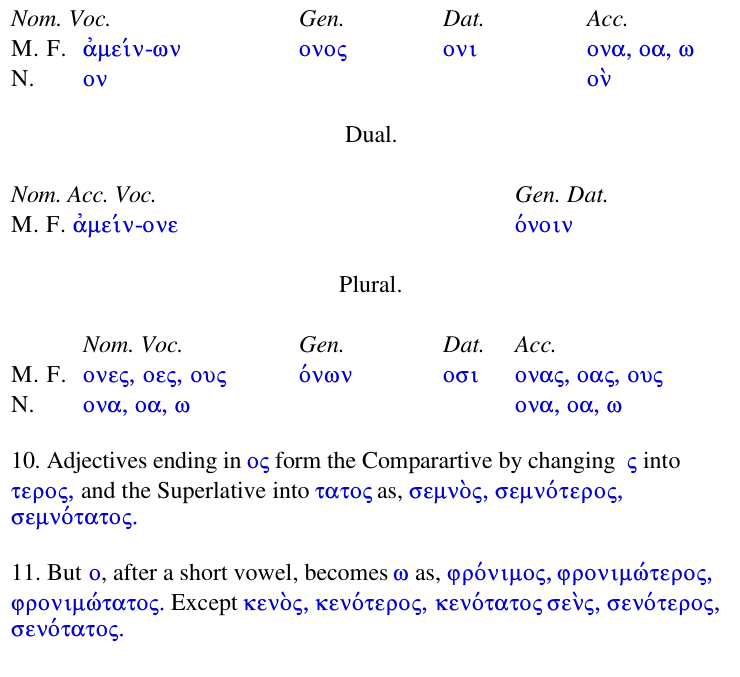
Editorial note: Transcription correction in the passage beginning “M. F. ἀμείν-wn ονος ονι ονα, οα, ω”: the independent 1872 printing, vol. XIV, printed p. 93 (physical PDF page 102), establishes these repairs: “ἀμείν-wn” → “ἀμείν-ων”. The repair follows the historical print; it does not modernize the grammar or certify other forms and table columns in the passage. Independent 1872 printing, vol. XIV, printed p. 93 (PDF page 102).
Editorial note: Transcription correction in the passage beginning “11. But ο, after a short vowel, becomes ω as, φρόνιμος, φρονιμώτερος, φρονιμώτατος. Except κενὸς, κενότερος, κενότατος sen<v, σενότερος, σενότατος.”: the independent 1872 printing, vol. XIV, printed p. 94 (physical PDF page 103), establishes these repairs: “sen<v” → “στενὸς”; “σενότερος” → “στενότερος”; “σενότατος” → “στενότατος”. The sigma–tau ligature in the three forms of στενός is expanded to its two letters. Source type on physical PDF page 139; Independent 1872 printing, vol. XIV, printed p. 94 (PDF page 103).
Editorial note: Transcription correction in the passage beginning “or ’Αγαθὸς βελτίων or βέλτερος, κρείσσων βέλτισος, κράτισος lwi`>wn, φέρτερος λῷσος, φέρτατος”: the independent 1872 printing, vol. XIV, printed p. 95 (physical PDF page 104), establishes these repairs: “lwi`>wn” → “λωΐων”. Only the surviving Latin font code is repaired; the rest of the comparison table remains subject to the layout note. Independent 1872 printing, vol. XIV, printed p. 95 (PDF page 104).
Editorial note: Transcription correction in the passage beginning “M. Δύο or Δύω duo~in (δυεῖν, Fem.) δυσὶ”: the independent 1872 printing, vol. XIV, printed p. 95 (physical PDF page 104), establishes these repairs: “duo~in” → “δυοῖν”. The repair follows the historical print; it does not modernize the grammar or certify other forms and table columns in the passage. Independent 1872 printing, vol. XIV, printed p. 95 (PDF page 104).
Editorial note: Transcription correction in the passage beginning “M. F. Tr-εῖς (ία, Neut.) ιῶν ισὶ”: the independent 1872 printing, vol. XIV, printed p. 95 (physical PDF page 104), establishes these repairs: “Tr-” → “Τρ-”. The repair follows the historical print; it does not modernize the grammar or certify other forms and table columns in the passage. Independent 1872 printing, vol. XIV, printed p. 95 (PDF page 104).
Editorial note: Transcription correction in the passage beginning “M. F. Τέσσαρ-ev (α, Neut.) ων σι ας (α, Neut.)”: the independent 1872 printing, vol. XIV, printed p. 95 (physical PDF page 104), establishes these repairs: “Τέσσαρ-ev” → “Τέσσαρ-ες”. The repair follows the historical print; it does not modernize the grammar or certify other forms and table columns in the passage. Independent 1872 printing, vol. XIV, printed p. 95 (PDF page 104).
Editorial note: Source-reading note (WES_WW14.PDF, physical page 134): the Greek/Hebrew forms and their layout near “pa sa pa sain n pa nte pantoin plural nom voc gen dat acc m pa ntev pa ntwn pa si pa ntav f pa sai pasw n pa saiv pa sav n pa nta pa ntwn pa”; “ssaiv e ssav n enta e ntwn eisi enta singular nom gen dat acc voc m ejkw n o ntov o nti o nta w n f ejkou sa ou shv ou sh ou san ou sa n ejk” are not fully established by the transcription. The linked source image preserves the original type for comparison. The original type remains the reference for unresolved letters, accents, points, and layout. Additional-source investigation: an independently typeset 1872 printing of Wesley's Works, vol. XIV, has been located. Its Greek and Hebrew grammar tables provide a second witness, but the available comparison does not securely establish every flagged letter, accent, vowel point, or column boundary in this passage. Any bounded repairs established in this section are identified in separate transcription-correction notes; consult both scans for the remaining unresolved details. Source type and layout, physical PDF page 134; Independent 1872 printing of Wesley's Works, vol. XIV.
Editorial note: Source-reading note (WES_WW14.PDF, physical page 135): the Greek/Hebrew forms and their layout near “n o nta o ntwn ou si o nta singular nom gen dat acc voc m ojxu v e ov ei ei u n u f ei a ei av ei a ei an ei a n u e ov ei ei u u dual nom a” are not fully established by the transcription. The linked source image preserves the original type for comparison. The original type remains the reference for unresolved letters, accents, points, and layout. Additional-source investigation: an independently typeset 1872 printing of Wesley's Works, vol. XIV, has been located. Its Greek and Hebrew grammar tables provide a second witness, but the available comparison does not securely establish every flagged letter, accent, vowel point, or column boundary in this passage. Any bounded repairs established in this section are identified in separate transcription-correction notes; consult both scans for the remaining unresolved details. Source type and layout, physical PDF page 135; Independent 1872 printing of Wesley's Works, vol. XIV.
Editorial note: Source-reading note (WES_WW14.PDF, physical page 136): the Greek/Hebrew forms and their layout near “4 allov and o v form the neuter in o 5 polu v and me gav form their neuter singular polu and me ga and their accusative masculine polu n and”; “tinw n tisi tina v n tina tina singular nom gen dat acc voc m f a rjrjhn enov eni ena en n en en dual nom acc voc gen dat m f ene e nion plu” are not fully established by the transcription. The linked source image preserves the original type for comparison. The original type remains the reference for unresolved letters, accents, points, and layout. Additional-source investigation: an independently typeset 1872 printing of Wesley's Works, vol. XIV, has been located. Its Greek and Hebrew grammar tables provide a second witness, but the available comparison does not securely establish every flagged letter, accent, vowel point, or column boundary in this passage. Any bounded repairs established in this section are identified in separate transcription-correction notes; consult both scans for the remaining unresolved details. Source type and layout, physical PDF page 136; Independent 1872 printing of Wesley's Works, vol. XIV.
Editorial note: Source-reading note (WES_WW14.PDF, physical page 137): the Greek/Hebrew forms and their layout near “singular nom gen dat acc voc m f ajlhqh v e ov ou v e i ei e a h e v n e v e v e v dual nom acc voc gen dat m f e e h e oin oi n plural”; “v n e a h e a h singular nom gen dat acc voc m f e ndoxov ou w on e n on on on dual nom acc voc gen dat m f w oin plural nom voc gen dat”; “f oi wn oiv ouv n a a singular nom gen dat acc voc m f a dakruv uov ui un u n u u u” are not fully established by the transcription. The linked source image preserves the original type for comparison. The original type remains the reference for unresolved letters, accents, points, and layout. Additional-source investigation: an independently typeset 1872 printing of Wesley's Works, vol. XIV, has been located. Its Greek and Hebrew grammar tables provide a second witness, but the available comparison does not securely establish every flagged letter, accent, vowel point, or column boundary in this passage. Any bounded repairs established in this section are identified in separate transcription-correction notes; consult both scans for the remaining unresolved details. Source type and layout, physical PDF page 137; Independent 1872 printing of Wesley's Works, vol. XIV.
Editorial note: Source-reading note (WES_WW14.PDF, physical page 138): the Greek/Hebrew forms and their layout near “dual nom acc voc gen dat m f ajda krue u oin plural nom voc gen dat acc m f uev uv u wn usi uav uv n”; “u wn usi uav uv n ua ua singular nom gen dat acc voc m f eujdai mwn onov oni ona on n on on on dual nom acc voc gen dat m f one o noin plura” are not fully established by the transcription. The linked source image preserves the original type for comparison. The original type remains the reference for unresolved letters, accents, points, and layout. Additional-source investigation: an independently typeset 1872 printing of Wesley's Works, vol. XIV, has been located. Its Greek and Hebrew grammar tables provide a second witness, but the available comparison does not securely establish every flagged letter, accent, vowel point, or column boundary in this passage. Any bounded repairs established in this section are identified in separate transcription-correction notes; consult both scans for the remaining unresolved details. Source type and layout, physical PDF page 138; Independent 1872 printing of Wesley's Works, vol. XIV.
Editorial note: Source-reading note (WES_WW14.PDF, physical page 139): the Greek/Hebrew forms and their layout near “ka ka 9 the comparitive is declined thus singular nom voc gen dat acc m f ajmei nwn onov oni ona oa w n on on dual nom acc voc gen dat m f a”; “onov oni ona oa w n on on dual nom acc voc gen dat m f ajmei none o noin plural nom voc gen dat acc m f onev oev ouv o nwn osi onav oav”; “tatov as semno v semno terov semno tatov 11 but o after a short vowel becomes w as fro nimov fronimw terov fronimw tatov except keno v keno ” are not fully established by the transcription. The linked source image preserves the original type for comparison. The original type remains the reference for unresolved letters, accents, points, and layout. Additional-source investigation: an independently typeset 1872 printing of Wesley's Works, vol. XIV, has been located. Its Greek and Hebrew grammar tables provide a second witness, but the available comparison does not securely establish every flagged letter, accent, vowel point, or column boundary in this passage. Any bounded repairs established in this section are identified in separate transcription-correction notes; consult both scans for the remaining unresolved details. Source type and layout, physical PDF page 139; Independent 1872 printing of Wesley's Works, vol. XIV.
Editorial note: Source-reading note (WES_WW14.PDF, physical page 140): the Greek/Hebrew forms and their layout near “a vowel as fi lov fi lterov fi ltatov 21 the following adjectives are compared irregularly esqlo v ajmei nwn ajrei wn ajgaqw tatov a risov o” are not fully established by the transcription. The linked source image preserves the original type for comparison. The original type remains the reference for unresolved letters, accents, points, and layout. Additional-source investigation: an independently typeset 1872 printing of Wesley's Works, vol. XIV, has been located. Its Greek and Hebrew grammar tables provide a second witness, but the available comparison does not securely establish every flagged letter, accent, vowel point, or column boundary in this passage. Any bounded repairs established in this section are identified in separate transcription-correction notes; consult both scans for the remaining unresolved details. Source type and layout, physical PDF page 140; Independent 1872 printing of Wesley's Works, vol. XIV.
Editorial note: Source-reading note (WES_WW14.PDF, physical page 141): the Greek/Hebrew forms and their layout near “want the positive and comparitive 23 comparitives and superlatives are generally declined like other adjectives 24 ei v du o a mfw trei v te”; “a mfw trei v te ssarev are thus declined singular nom voc gen dat acc m ei v ejno v ejni e na f mi a mia v mia mi an n e n ejno v ejni e n d”; “an n e n ejno v ejni e n dual nom acc voc gen dat m du o or du w duo in duei n fem dusi plural nom acc voc gen dat m f trei v i a neut iw n ”; “du w duo in duei n fem dusi plural nom acc voc gen dat m f trei v i a neut iw n isi” are not fully established by the transcription. The linked source image preserves the original type for comparison. The original type remains the reference for unresolved letters, accents, points, and layout. Additional-source investigation: an independently typeset 1872 printing of Wesley's Works, vol. XIV, has been located. Its Greek and Hebrew grammar tables provide a second witness, but the available comparison does not securely establish every flagged letter, accent, vowel point, or column boundary in this passage. Any bounded repairs established in this section are identified in separate transcription-correction notes; consult both scans for the remaining unresolved details. Source type and layout, physical PDF page 141; Independent 1872 printing of Wesley's Works, vol. XIV.
Editorial note: Source-reading note (WES_WW14.PDF, physical page 142): the Greek/Hebrew forms and their layout near “nom voc gen dat acc m f te ssarev a neut wn si av a neut 25 other numerals to ejkato n an hundred are indeclinable 26 prw tov and the” are not fully established by the transcription. The linked source image preserves the original type for comparison. The original type remains the reference for unresolved letters, accents, points, and layout. Additional-source investigation: an independently typeset 1872 printing of Wesley's Works, vol. XIV, has been located. Its Greek and Hebrew grammar tables provide a second witness, but the available comparison does not securely establish every flagged letter, accent, vowel point, or column boundary in this passage. Any bounded repairs established in this section are identified in separate transcription-correction notes; consult both scans for the remaining unresolved details. Source type and layout, physical PDF page 142; Independent 1872 printing of Wesley's Works, vol. XIV.
SECTION V.
OF ADJECTIVE NOUNS.
1. ADJECTIVES are of one, two, or three terminations.
2. Adjectives of Three Terminations, ending in ος, ας, εις, ων, υς, are declined thus: —
Singular.
Nom. Gen. Dat. Acc. Voc.
M. καλὸς οῦ ᾳ ὸν ὲ
F. καλὴ ῆς ῃ ὴν ὴ
N. καλὸν οῦ ῷ ὸν ὸν
Dual.
Nom. Acc. Voc. Gen.Dat.
ὼ οῖν
ὰ αῖν
ὼ οῖν
Plural.
Nom. Gen. Dat. Acc. Voc.
M. καλοὶ ῶν οῖς οὺς οὶ
F. καλαὶ αῖς ὰς αὶ
N. καλὰ οῖς ὰ ὰ
Singular.
Nom. Gen. Dat. Acc. Voc.
M. πᾶς παντὸς παντὶ πάντα πᾶς
F. πᾶσα πάσης πάσῃ πᾶσαν πᾶσα
N. πᾶν παντὸς παντὶ πᾶν πᾶν
Dual.
Nom. Acc. Voc. Gen. Dat.
M. πάντε πάντοιν
F. πάσα πάσαιν
N. πάντε παντοιν
Plural.
Nom. Voc. Gen. Dat. Acc.
M. πάντες πάντων πᾶσι πάντας
F. πᾶσαι πασῶν πάσαις πάσας
N. πάντα πάντων πᾶσι πάντα
Singular.
Nom. Gen. Dat. Acc. Voc.
M. χαρί-εις εντος εντι εντα ει, εν
F. χαρί-εσσα έσσης έσσῃ εσσαν εσσα
N. χαρί-εν εντος εντι εν εν
Dual.
Nom. Acc. Voc. Gen. Dat.
M. εντε έντοιν
F. έσσα έσσαιν
N. εντε έντοιν
Plural.
Nom. Voc. Gen. Dat. Acc.
M. εντες έντων εισι εντας
F. εσσαι έσσων έσσαις έσσας
N. εντα έντων εισι εντα
Singular.
Nom. Gen. Dat. Acc. Voc.
M. ἑκ-ὼν όντος όντι όντα ὼν
F. ἑκ-οῦσα ούσης ούσῃ οῦσαν οῦσα
N. ἑκ-ὸν όντος όντι ὸν ὸν
Dual.
Nom. Acc. Voc. Gen. Dat.
M. όντε όντοιν
F. ούσα ούσαιν
N. όντε όντοιν
Plural.
Nom. Voc. Gen. Dat. Acc.
M. όντες όντων οῦσι όντας
F. οῦσαι ούσων ούσαις ούσας
N. όντα όντων οῦσι όντα
Singular.
Nom. Gen. Dat. Acc. Voc.
M. ὀξ-ὺς έος εΐ, εῖ ὺν ὺ
F. εῖα είας είᾳ εῖαν εῖα
N. ὺ έος ei`>, εῖ ὺ ὺ
Dual.
Nom. Acc. Voc. Gen. Dat.
M. έε έσιν
F. εία είαιν
N. έε έοιν
Plural.
Nom. Voc. Gen. Dat. Acc.
M. έες, εῖς έων έσι έας, εῖς
F. είαι ειῶν είαις είας
N. έα έων έσι έα
3. Adjectives ending in ος pure or ρος form the Feminine in α as, ἁγιος, ἁγία, ἁγιον καθαρὸς, καθαρά: But those ending in εος, οος, or compounded of πλόος, in η as, ὀγδοος, ὀγδόη ἁπλόος, ἁπλόη.
4. Ἀλλος and ο{ς form the Neuter in ο.
5. Πολὺς and μέγας form their Neuter Singular πολὺ and μέγα, and their Accusative Masculine πολὺν and μέγαν. Their other Cases they borrow from πολλὸς and μέγαλος obsolete: So Gen. πολλοῦ, πολλῆς, πολλοῦ, etc.
6. Adjectives of Two Terminations, ending in ν, ρ, or ς pure, are declined thus: —
Singular.
Nom. Voc. Gen. Dat. Acc.
M. F. τὶς τινὸς τινὶ τινὰ
N. τὶ τὶ
Dual.
Nom. Acc. Voc. Gen. Dat.
M. F. τινὲ τινοῖν
Plural.
Nom. Voc. Gen. Dat. Acc.
M. F. τινὲς τινῶν τισὶ τινὰς
N. τινὰ τινὰ
Singular.
Nom. Gen. Dat. Acc. Voc.
M. F. ἄῤῥ-ην ενος ενι ενα εν
N. εν εν
Dual.
Nom. Acc. Voc. Gen. Dat.
M. F. ενε ένιον
Plural.
Nom. Voc. Gen. Dat. Acc.
M. F. ενες ένων εσι ενας
N. ενα ενα
Singular.
Nom. Gen. Dat. Acc. Voc.
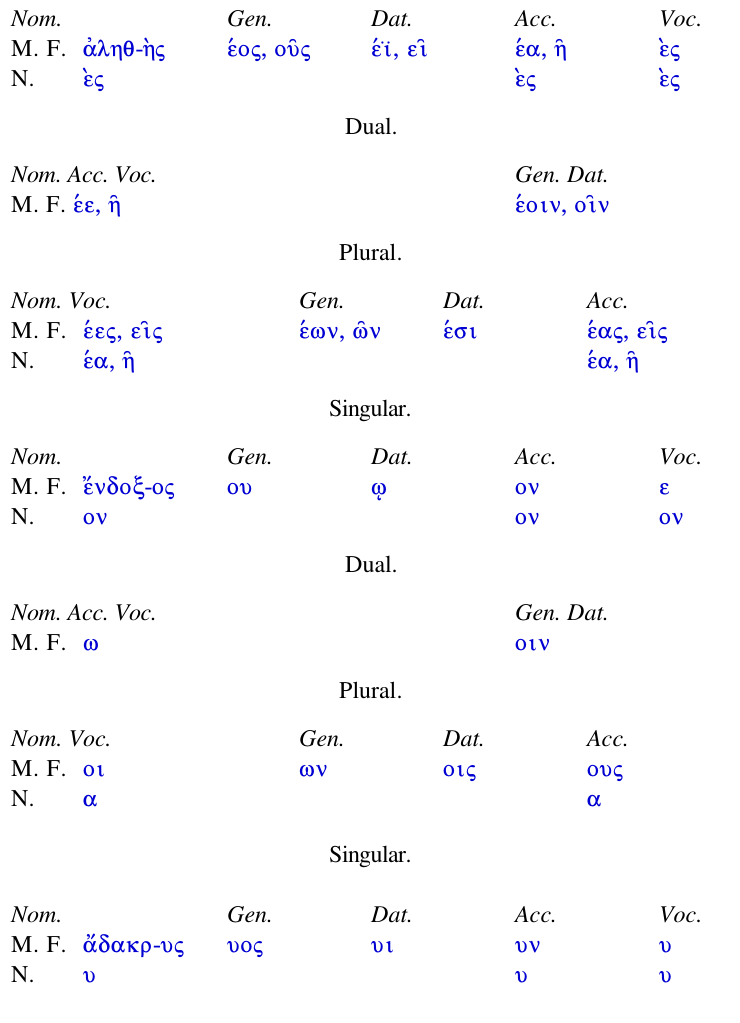
M. F. ἀληθ-ὴς έος, οῦς έϊ, εῖ έα, ῆ ὲς
N. ὲς ὲς ὲς
Dual.
Nom. Acc. Voc. Gen. Dat.
M. F. έε, ῆ έοιν, οῖν
Plural.
Nom. Voc. Gen. Dat. Acc.
M. F. έες, εῖς έων, ῶν έσι έας, εῖς
N. έα, ῆ έα, ῆ
Singular.
Nom. Gen. Dat. Acc. Voc.
M. F. ἔνδοξ-ος ου ῳ ον ε
N. ον ον ον
Dual.
Nom. Acc. Voc. Gen. Dat.
M. F. ω οιν
Plural.
Nom. Voc. Gen. Dat. Acc.
M. F. οι ων οις ους
N. α α
Singular.
Nom. Gen. Dat. Acc. Voc.
M. F. ἄδακρ-υς υος υι υν υ
N. υ υ υ
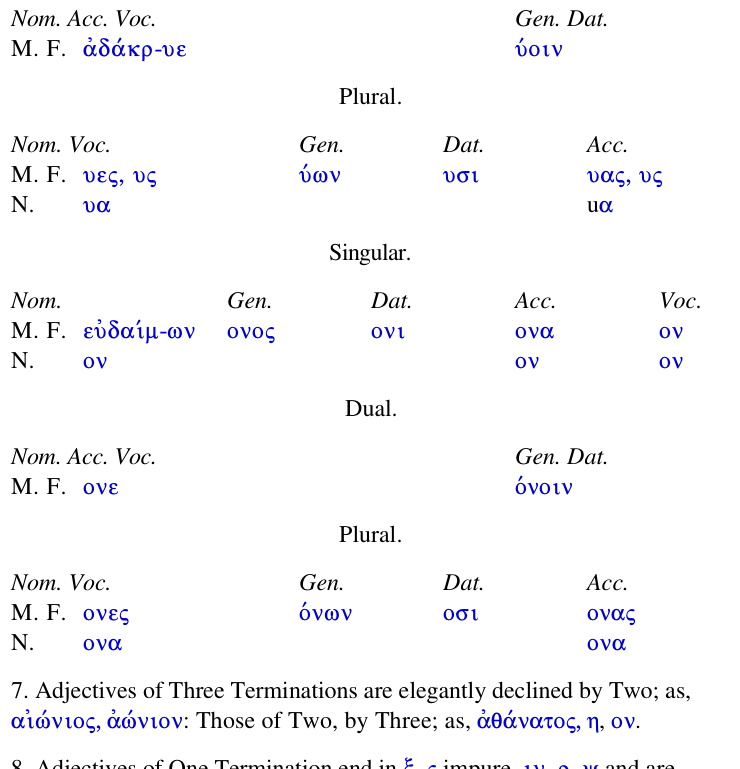
Dual.
Nom. Acc. Voc. Gen. Dat.
M. F. ἀδάκρ-υε ύοιν
Plural.
Nom. Voc. Gen. Dat. Acc.
M. F. υες, υς ύων υσι υας, υς
N. υα υα
Singular.
Nom. Gen. Dat. Acc. Voc.
M. F. εὐδαίμ-ων ονος ονι ονα ον
N. ον ον ον
Dual.
Nom. Acc. Voc. Gen. Dat.
M. F. one όνοιν
Plural.
Nom. Voc. Gen. Dat. Acc.
M. F. ονες όνων οσι ονας
N. ονα ονα
7. Adjectives of Three Terminations are elegantly declined by Two; as, αἰώνιος, ἀώνιον: Those of Two, by Three; as, ἀθάνατος, η, ον.
8. Adjectives of One Termination end in ξ, ς impure, ιν, ρ, ψ and are declined thus: —
Singular.
Nom. Voc. Gen. Dat. Acc.
M. F. N. ἡλι-ξ κος κι κα
Dual.
Nom. Acc. Voc. Gen. Dat.
M. F. κε κοιν
Plural.
Nom. Voc. Gen. Dat. Acc.
M. F. κες κων ξι κας
N. κα κα
9. The Comparitive is declined thus: —
Singular.
Nom. Voc. Gen. Dat. Acc.
M. F. ἀμείν-ων ονος ονι ονα, οα, ω
N. ον on<
Dual.
Nom. Acc. Voc. Gen. Dat.
M. F. ἀμείν-one όνοιν
Plural.
Nom. Voc. Gen. Dat. Acc.
M. F. ονες, οες, ους όνων οσι ονας, οας, ους
N. ονα, οα, ω ονα, οα, ω
10. Adjectives ending in ος form the Comparartive by changing ς into τερος, and the Superlative into τατος as, σεμνὸς, σεμνότερος, σεμνότατος.
11. But ο, after a short vowel, becomes ω as, φρόνιμος, φρονιμώτερος, φρονιμώτατος. Except κενὸς, κενότερος, κενότατος στενὸς, στενότερος, στενότατος.
12. If the preceeding syllable is common, it is either ότερος ότατος, or ώτερος ώτατος as, ἰσος, ἰσότερος or ἰσώτερος, etc. Such are also ἰσχυρὸς, φανός.
13 Adjectives ending in εις are changed into έσερος and έσατος.
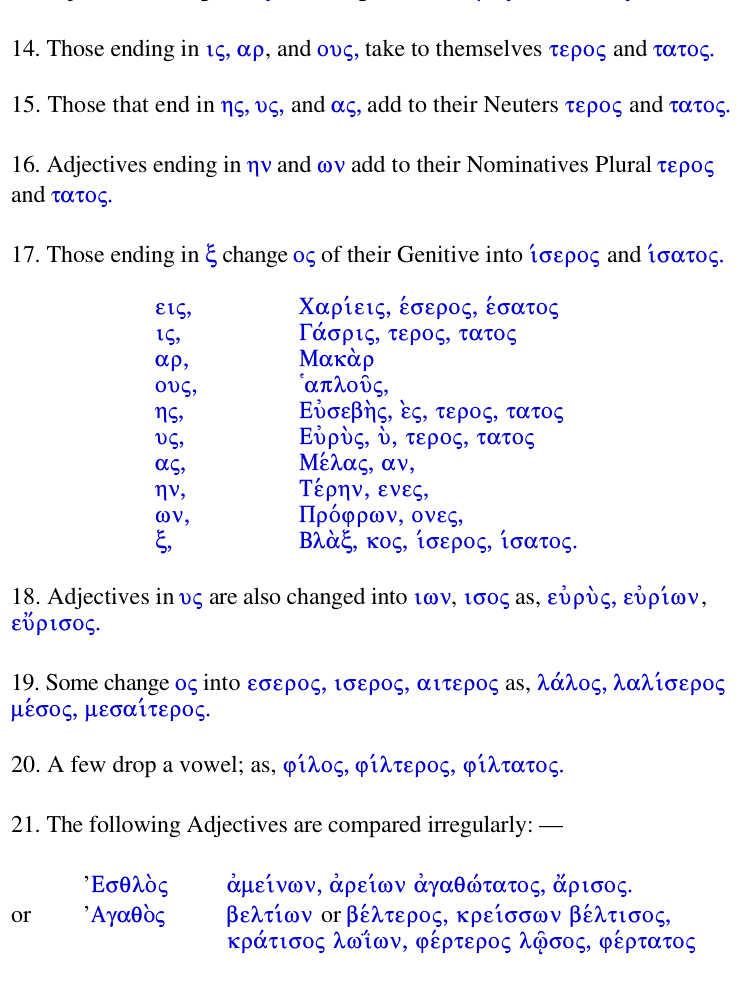
14. Those ending in ις, αρ, and ους, take to themselves τερος and τατος.
15. Those that end in ης, υς, and ας, add to their Neuters τερος and τατος.
16. Adjectives ending in ην and ων add to their Nominatives Plural τερος and τατος.
17. Those ending in ξ change ος of their Genitive into ίσερος and ίσατος. εις, Χαρίεις, έσερος, έσατος
ις, Γάσρις, τερος, τατος
αρ, Μακὰρ
ους, ˚απλοῦς,
ης, Εὐσεβὴς, ὲς, τερος, τατος
υς, Εὐρὺς, ὺ, τερος, τατος
ας, Μέλας, αν,
ην, Τέρην, ενες,
ων, Πρόφρων, ονες,
ξ, Βλὰξ, κος, ίσερος, ίσατος.
18. Adjectives in υς are also changed into ιων, ισος as, εὐρὺς, εὐρίων, εὐρισος.
19. Some change ος into εσερος, ισερος, αιτερος as, λάλος, λαλίσερος μέσος, μεσαίτερος.
20. A few drop a vowel; as, φίλος, φίλτερος, φίλτατος.
21. The following Adjectives are compared irregularly: — ’Εσθλὸς ἀμείνων, ἀρείων ἀγαθώτατος, ἀρισος.
or ’Αγαθὸς βελτίων or βέλτερος, κρείσσων βέλτισος, κράτισος λωΐων, φέρτερος λῷσος, φέρτατος
or φέρτισος.
Κακὸς, κακώτερος or κακίων, χείρων or χερείων
κάκισος, χείρισος.
Μέγας, μείζων, μέγισος.
Μικρός, μικρότερος, μείων μειότερος, μεῖσος.
or ’Ελαχὺς, ἐλάσσων, ἡσσων ἐλάχισος, ἡκισος.
’Ολίγος, ὀλιγίσερος, ὀλίγισος.
Πολὺς πλείων, πλεῖσος.
’Ρᾴδιος, ῥᾴων, ῥᾷσος.
22. The following Adjectives want the Positive, and most of them are derivived from Adverbs; κερδίων, κέρδισος δεύτερος, δεύτατος ἀνώτερος, ἀνώτατος κατώτερος, κατώτατος and others ’Ανθρώπινος, ἀνθρωπινέσατος αὐτὸς, αὐτότατος, want the Comparitive. Ἐσχατος, the last; πύματος, the utmost; κύδισος, most famous; want the Positive and Comparitive.
23. Comparitives and Superlatives are generally declined like other Adjectives.
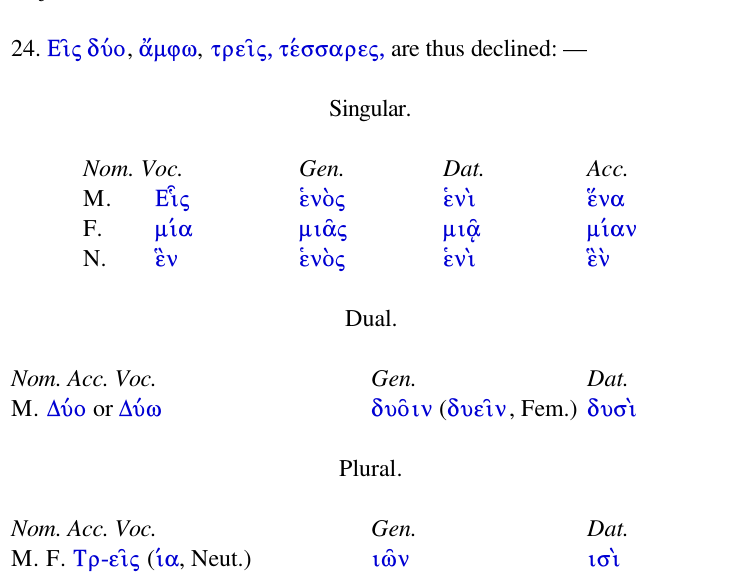
24. Εῖς δύο, ἀμφω, τρεῖς, τέσσαρες, are thus declined: — Singular.
Nom. Voc. Gen. Dat. Acc.
M. Εἶς ἑνὸς ἑνὶ ἑνα
F. μία μιᾶς μιᾷ μίαν
N. ε{ν ἑνὸς ἑνὶ e{n<
Dual.
Nom. Acc. Voc. Gen. Dat.
M. Δύο or Δύω δυοῖν (δυεῖν, Fem.) δυσὶ
Plural.
Nom. Acc. Voc. Gen. Dat.
M. F. Τρ-εῖς (ία, Neut.) ιῶν ισὶ
Nom. Voc. Gen. Dat. Acc.
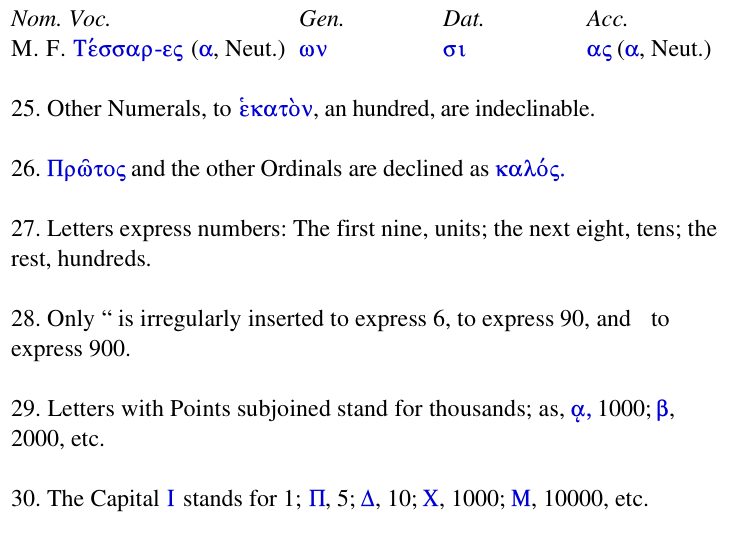
M. F. Τέσσαρ-ες (α, Neut.) ων σι ας (α, Neut.)
25. Other Numerals, to ἑκατὸν, an hundred, are indeclinable.
26. Πρῶτος and the other Ordinals are declined as καλός.
27. Letters express numbers: The first nine, units; the next eight, tens; the rest, hundreds.
28. Only “ is irregularly inserted to express 6, to express 90, and Ù to express 900.
29. Letters with Points subjoined stand for thousands; as, ᾳ, 1000; β, 2000, etc.
30. The Capital Ι stands for 1; Π, 5; Δ, 10; Χ, 1000; Μ, 10000, etc.