Section 15: Prosody
This transcription includes editorial corrections or unresolved source readings. The full record and source references are available below.
Editorial notes and transcription record · 7 notes
Editorial note: Transcription correction in the passage beginning “10. But it is long in Nouns ending in ea, αα, δα, θα in εια, from Verbs ending in ευω in ια, except ἀία, μία, πότνια in words of many syllables in αια in Adject”: the independent 1872 printing, vol. XIV, printed p. 128 (physical PDF page 137), establishes these repairs: “in ea,” → “in εα,”. The repair follows the historical print; it does not modernize the grammar or certify other forms and table columns in the passage. Source type on physical PDF page 197; Independent 1872 printing, vol. XIV, printed p. 128 (PDF page 137).
Editorial note: Transcription correction in the passage beginning “11. Αν final short; as, tr>apezan, ἐτυψαν, μέλαν.”: the independent 1872 printing, vol. XIV, printed p. 128 (physical PDF page 137), establishes these repairs: “tr>apezan” → “τράπεζαν”. The repair follows the historical print; it does not modernize the grammar or certify other forms and table columns in the passage. Source type on physical PDF page 196; Independent 1872 printing, vol. XIV, printed p. 128 (PDF page 137).

Editorial note: Transcription correction in the passage beginning “18. Except Adverbs and Pronouns increased by a Paragoge, as nuni<~ οὐτοσὶ, made out of ε by the Attics; as, ὀδὶ for ὁδὲ, ταυτὶ for ταυτά: Also κρι, barley, and ”: the independent 1872 printing, vol. XIV, printed p. 128 (physical PDF page 137), establishes these repairs: “nuni<~” → “νυνὶ”. The repair follows the historical print; it does not modernize the grammar or certify other forms and table columns in the passage. Source type on physical PDF page 198; Independent 1872 printing, vol. XIV, printed p. 128 (PDF page 137).
Editorial note: Source-reading note (WES_WW14.PDF, physical page 197): the Greek/Hebrew forms and their layout near “as hj tra peza a table 10 but it is long in nouns ending in ea aa da qa in eia from verbs ending in euw in ia except aji a mi a po tnia in w” are not fully established by the transcription. The linked source image preserves the original type for comparison. The original type remains the reference for unresolved letters, accents, points, and layout. Additional-source investigation: an independently typeset 1872 printing of Wesley's Works, vol. XIV, has been located. Its Greek and Hebrew grammar tables provide a second witness, but the available comparison does not securely establish every flagged letter, accent, vowel point, or column boundary in this passage. Any bounded repairs established in this section are identified in separate transcription-correction notes; consult both scans for the remaining unresolved details. Source type and layout, physical PDF page 197; Independent 1872 printing of Wesley's Works, vol. XIV.
Editorial note: Source-reading note (WES_WW14.PDF, physical page 198): the Greek/Hebrew forms and their layout near “and second declension in poetic vocative cases in the doric a in the genitive case as tou aijnei a for aijnei ou of aeneas 11 an final short”; “as tou aijnei a for aijnei ou of aeneas 11 an final short as tr apezan e tuyan me lan 12 these are excepted pa n all unless in its compounds”; “short as me li honey 18 except adverbs and pronouns increased by a paragoge as nuni oujtosi made out of e by the attics as ojdi for ojde tau” are not fully established by the transcription. The linked source image preserves the original type for comparison. The original type remains the reference for unresolved letters, accents, points, and layout. Additional-source investigation: an independently typeset 1872 printing of Wesley's Works, vol. XIV, has been located. Its Greek and Hebrew grammar tables provide a second witness, but the available comparison does not securely establish every flagged letter, accent, vowel point, or column boundary in this passage. Any bounded repairs established in this section are identified in separate transcription-correction notes; consult both scans for the remaining unresolved details. Source type and layout, physical PDF page 198; Independent 1872 printing of Wesley's Works, vol. XIV.
Editorial note: Source-reading note (WES_WW14.PDF, physical page 199): the Greek/Hebrew forms and their layout near “25 u final is short as su da kru gluku 26 but it is long in u gru mu nu and in the third person singular of the imperfect and second indefin”; “ya r yaro v 33 so also in words of the masculine and feminine gender in av in nouns in y as aray arabov and most words ending in x” are not fully established by the transcription. The linked source image preserves the original type for comparison. The original type remains the reference for unresolved letters, accents, points, and layout. Additional-source investigation: an independently typeset 1872 printing of Wesley's Works, vol. XIV, has been located. Its Greek and Hebrew grammar tables provide a second witness, but the available comparison does not securely establish every flagged letter, accent, vowel point, or column boundary in this passage. Any bounded repairs established in this section are identified in separate transcription-correction notes; consult both scans for the remaining unresolved details. Source type and layout, physical PDF page 199; Independent 1872 printing of Wesley's Works, vol. XIV.
Editorial note: Source-reading note (WES_WW14.PDF, physical page 200): the Greek/Hebrew forms and their layout near “34 and in words of the masculine and feminine gender in ar and lv as oj ma kar blessed hj a lv the sea 35 an increases anov long except ta l” are not fully established by the transcription. The linked source image preserves the original type for comparison. The original type remains the reference for unresolved letters, accents, points, and layout. Additional-source investigation: an independently typeset 1872 printing of Wesley's Works, vol. XIV, has been located. Its Greek and Hebrew grammar tables provide a second witness, but the available comparison does not securely establish every flagged letter, accent, vowel point, or column boundary in this passage. Any bounded repairs established in this section are identified in separate transcription-correction notes; consult both scans for the remaining unresolved details. Source type and layout, physical PDF page 200; Independent 1872 printing of Wesley's Works, vol. XIV.

SECTION XV.
OF PROSODY.
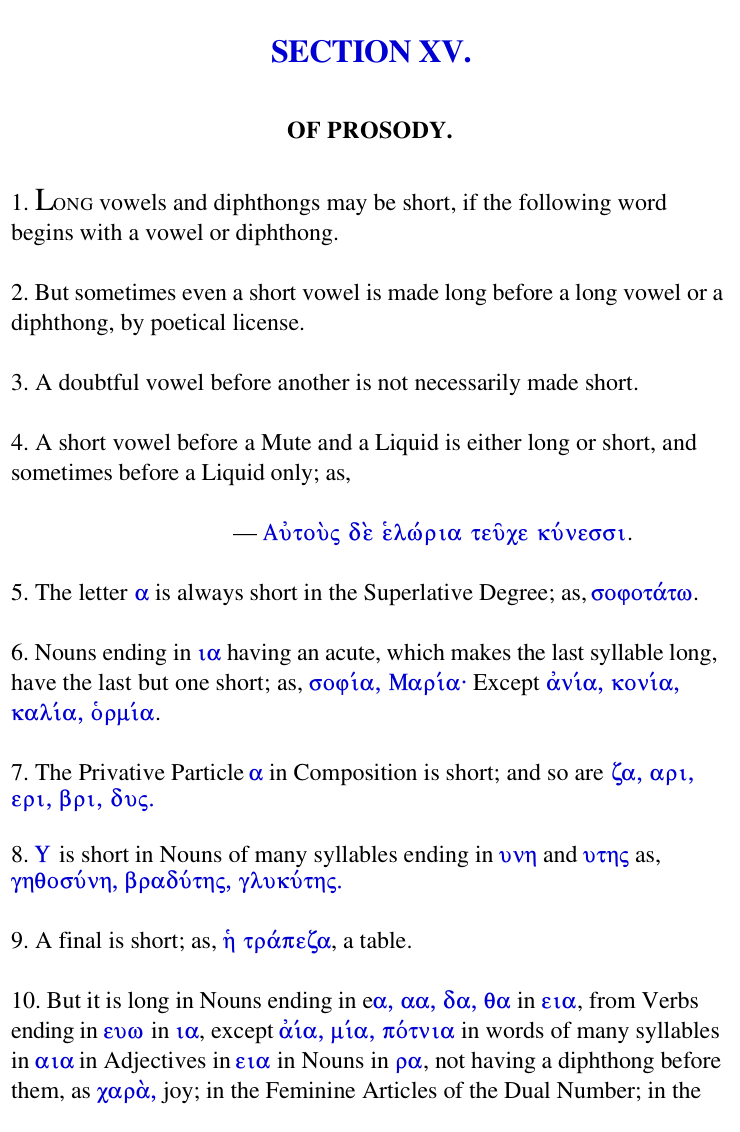
1. LONG vowels and diphthongs may be short, if the following word begins with a vowel or diphthong.
2. But sometimes even a short vowel is made long before a long vowel or a diphthong, by poetical license.
3. A doubtful vowel before another is not necessarily made short.
4. A short vowel before a Mute and a Liquid is either long or short, and sometimes before a Liquid only; as,
— Αὐτοὺς δὲ ἑλώρια τεῦχε κύνεσσι.
5. The letter α is always short in the Superlative Degree; as, σοφοτάτω.
6. Nouns ending in ια having an acute, which makes the last syllable long, have the last but one short; as, σοφία, Μαρία? Except ἀνία, κονία, καλία, ὁρμία.
7. The Privative Particle α in Composition is short; and so are ζα, αρι, ερι, βρι, δυς.
8. Υ is short in Nouns of many syllables ending in υνη and υτης as, γηθοσύνη, βραδύτης, γλυκύτης.
9. A final is short; as, ἡ τράπεζα, a table.
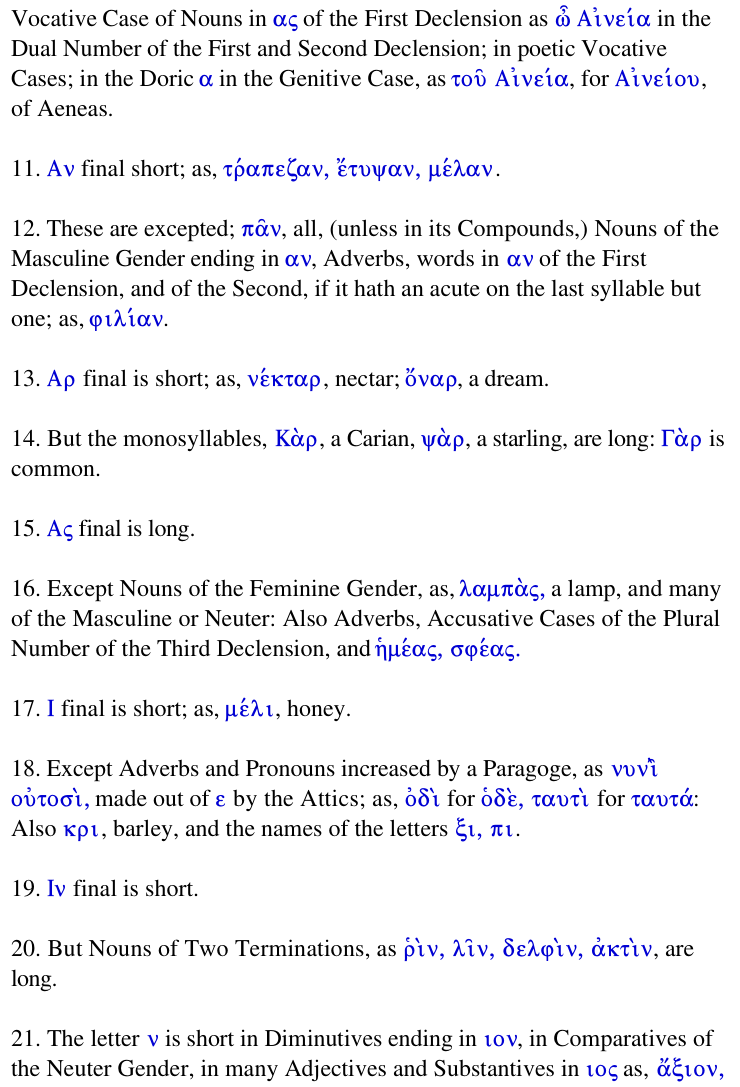
10. But it is long in Nouns ending in εα, αα, δα, θα in εια, from Verbs ending in ευω in ια, except ἀία, μία, πότνια in words of many syllables in αια in Adjectives in εια in Nouns in ρα, not having a diphthong before them, as χαρὰ, joy; in the Feminine Articles of the Dual Number; in the Vocative Case of Nouns in ας of the First Declension as ὠ Αἰνεία in the Dual Number of the First and Second Declension; in poetic Vocative Cases; in the Doric α in the Genitive Case, as τοῦ Αἰνεία, for Αἰνείου, of Aeneas.
11. Αν final short; as, τράπεζαν, ἐτυψαν, μέλαν.
12. These are excepted; πᾶν, all, (unless in its Compounds,) Nouns of the Masculine Gender ending in αν, Adverbs, words in αν of the First Declension, and of the Second, if it hath an acute on the last syllable but one; as, φιλίαν.
13. Αρ final is short; as, νέκταρ, nectar; ὀναρ, a dream.
14. But the monosyllables, Κὰρ, a Carian, ψὰρ, a starling, are long: Γὰρ is common.
15. Ας final is long.
16. Except Nouns of the Feminine Gender, as, λαμπὰς, a lamp, and many of the Masculine or Neuter: Also Adverbs, Accusative Cases of the Plural Number of the Third Declension, and ἡμέας, σφέας.
17. Ι final is short; as, μέλι, honey.
18. Except Adverbs and Pronouns increased by a Paragoge, as νυνὶ οὐτοσὶ, made out of ε by the Attics; as, ὀδὶ for ὁδὲ, ταυτὶ for ταυτά: Also κρι, barley, and the names of the letters ξι, πι.
19. Ιν final is short.
20. But Nouns of Two Terminations, as ῥὶν, λῖν, δελφὶν, ἀκτὶν, are long.
21. The letter ν is short in Diminutives ending in ιον, in Comparatives of the Neuter Gender, in many Adjectives and Substantives in ιος as, ἀξιον, βίον.
22. As also in Nouns Possessive, and Nouns which signify matter, ending in ινος as, ἀνθρώπινος, λίθινος.
23. Ις final is short; as, πόλις.
24. But it is long in words whose increase is long; and in words of one syllable, the Indefinite τὶς excepted.
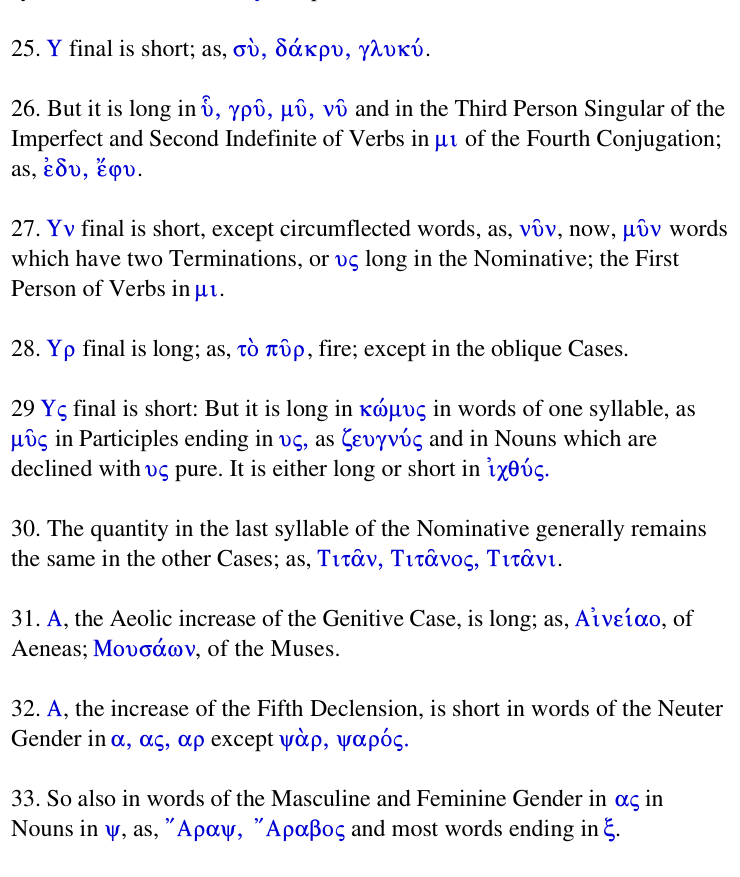
25. Υ final is short; as, σὺ, δάκρυ, γλυκύ.
26. But it is long in ὖ, γρῦ, μῦ, νῦ and in the Third Person Singular of the Imperfect and Second Indefinite of Verbs in μι of the Fourth Conjugation; as, ἐδυ, ἐφυ.
27. Υν final is short, except circumflected words, as, νῦν, now, μῦν words which have two Terminations, or υς long in the Nominative; the First Person of Verbs in μι.
28. Υρ final is long; as, τὸ πῦρ, fire; except in the oblique Cases. 29 Υς final is short: But it is long in κώμυς in words of one syllable, as μῦς in Participles ending in υς, as ζευγνύς and in Nouns which are declined with υς pure. It is either long or short in ἰχθύς.
30. The quantity in the last syllable of the Nominative generally remains the same in the other Cases; as, Τιτᾶν, Τιτᾶνος, Τιτᾶνι.
31. Α, the Aeolic increase of the Genitive Case, is long; as, Αἰνείαο, of Aeneas; Μουσάων, of the Muses.
32. Α, the increase of the Fifth Declension, is short in words of the Neuter Gender in α, ας, αρ except ψὰρ, ψαρός.
33. So also in words of the Masculine and Feminine Gender in ας in Nouns in ψ, as, Αραψ, Αραβος and most words ending in ξ.
34. And in words of the Masculine and Feminine Gender in αρ and λς as, ὁ μάκαρ, blessed; ἡ α{λς, the sea.
35. An increases ανος long; except τάλανος and μέλανος.
36. Αυς increases αος short; as, ναῦς, ναός.
37. The increase ι is long in Nouns of the Masculine and Feminine Gender which have Two Terminations; as, ἀκτὶς and ἀκτὶν ἀκτῖνος and in Monosyllables; except Δὶς, Διός ὀρνις, ὀρνιθος.
38. The increase ι is short in Nouns of the Neuter Gender, in Nouns of the Masculine or Feminine which increase in ιος, ιδος, and ιτος, without an accent.
39. And in Nouns of the Feminine Gender which have an Acute on ίδος as, ἡ πατρὶς, πατρίδος.
40. Also in most Nouns ending in ιξ and ιψ as, ἡ θρὶξ, τριχός.
41. Monosyllables in υς increase short; as, ὁ μῦς, μύος.
42. Also Nouns of the Neuter Gender in υ, Nouns penacuted, Nouns that have an Acute on the last syllable, and circumflected nouns ending in υς and υρ as, ὁ νέκυς, νέκυος ὁ μάρτυρ, μάρτυρος.
43. But υ is long in Nouns which end both in υν and υς as, Φόρκυς and Φόρκυν, Φόρκυνος.
44. Nouns ending in υξ and υψ increase long; except γρὺψ, γρυπὸς, and γὺψ, γυπός.
45. A doubtful vowel has the same quantity in the Preterimperfect Tense, as well of the Active as of the Passive Voice, of all Moods, and in the Participles, as it hath in the Present; as, κρίνω, ἐκρινον, κρίνομαι, ἐκρινόμην, κρινόμενος the syllable κρι being long everywhere.
46. Verbs in άνω have the last syllable but one short, unless they are formed from the future Tense; as, αὐξάνω, from αὐξήσω.
47. Verbs in uvnw have the last syllable but one long in the Present and Preterimperfect Tense; as, μολύνω.
48. Verbs in ύω and ίω have the last syllable but one either long or short.
49. If a doubtful vowel be short in the First Future or First Indefinite, it is also short in the Preterimperfect Tense of the Active and Passive Voice of all Moods; as, γελάω, γελάσω, γεγέλακα.
50. The Third Person Plural of the Preterperfect Tense in ασι is always long.
51. So is the Participle of the Feminine Gender of the First Indefinite in asa.
52. The reduplication of Verbs in μι, unless Position hinders it, is short.
53. The letter υ of the Fourth Conjugation, in the Singular Number of the Active Voice, is long; but it is short in the Dual and Plural Number of the Passive and Middle Voice.
54. The letter υ is short in the Singular Number of the Imperative Mood of Polysyllables; but it is long in words of two syllables; as, κλῦθί μευ, ’Αργυρότοξε.
55. The kinds of Verses are nearly the same among the Greeks as among the Latins.