Section 16: Dialects in the Greek Tongue
This transcription includes editorial corrections or unresolved source readings. The full record and source references are available below.
Editorial notes and transcription record · 43 notes
Editorial note: Transcription correction in the passage beginning “(3.) By uniting syllables, while it retains the letters; as, Νηρῇδες for Nhrhi`>dev.”: the independent 1872 printing, vol. XIV, printed p. 131 (physical PDF page 140), establishes these repairs: “Nhrhi`>dev” → “Νηρηΐδες”. The repair follows the historical print; it does not modernize the grammar or certify other forms and table columns in the passage. Source type on physical PDF page 202; Independent 1872 printing, vol. XIV, printed p. 131 (PDF page 140).

Editorial note: Transcription correction in the passage beginning “3. They change α long into αε as, ἀεθλος for ἀθλος ει into hi`, as, ἀληθήι`a for ἀλήθεια ᾳ into hi`, as, Θρήιξ for Θρᾷξ ῳ into αοι, as, ἀοιδὴ for ᾠδή αυ into wu”: the independent 1872 printing, vol. XIV, printed p. 131 (physical PDF page 140), establishes these repairs: “hi`” → “ηϊ”; “ἀληθήι`a” → “ἀληθήϊα”; “Θρήιξ” → “Θρήϊξ”; “wu`” → “ωϋ”; “ejmωϋτέου” → “ἐμωϋτέου”. Only the broken font codes and the visible diaereses are repaired. The supplied ending -τέου is retained; the 1872 image appears to end -τέο, so this ending remains an edition-reading uncertainty. Source type on physical PDF page 203; Independent 1872 printing, vol. XIV, printed p. 131 (PDF page 140).
Editorial note: Transcription correction in the passage beginning “Com. ὁ τοῦ, τῷ, τὸν τὼ τοῖν τὼ οἱ τῶν τοῖς τοὺς τοῖο I. τοῖι`n I. τοὶ D. τοῖσι I.A.”: the independent 1872 printing, vol. XIV, printed p. 132 (physical PDF page 141), establishes these repairs: “τοῖι`n” → “τοῖϊν”. The repair follows the historical print; it does not modernize the grammar or certify other forms and table columns in the passage. Independent 1872 printing, vol. XIV, printed p. 132 (PDF page 141).
Editorial note: Transcription correction in the passage beginning “Com. τὁ τοῦ τῷ τὸ τὼ τοῖν τὼ τὰ τῶν τοῖς τὰ τοῖο I. τοῖι`n I. τάων AE.”: the independent 1872 printing, vol. XIV, printed p. 133 (physical PDF page 142), establishes these repairs: “τοῖι`n” → “τοῖϊν”. The repair follows the historical print; it does not modernize the grammar or certify other forms and table columns in the passage. Independent 1872 printing, vol. XIV, printed p. 133 (PDF page 142).
Editorial note: Transcription correction in the passage beginning “οιο I. οῖι`n I. οισι I.A.”: the independent 1872 printing, vol. XIV, printed p. 133 (physical PDF page 142), establishes these repairs: “οῖι`n” → “οῖϊν”. The repair follows the historical print; it does not modernize the grammar or certify other forms and table columns in the passage. Independent 1872 printing, vol. XIV, printed p. 133 (PDF page 142).
Editorial note: Transcription correction in the passage beginning “N. G. D. A. V. N.A. G.D. V. N. G. D. A. V. Com.hv εος ei` εα ες εε έοιν εε εες έων εσι εας εες ες η ες εις ῶν εις εις”: the independent 1872 printing, vol. XIV, printed p. 134 (physical PDF page 143), establishes these repairs: “Com.hv” → “Com. ης”; “ei`” → “εϊ”. The repair follows the historical print; it does not modernize the grammar or certify other forms and table columns in the passage. Source type on physical PDF page 207; Independent 1872 printing, vol. XIV, printed p. 134 (PDF page 143).
Editorial note: Transcription correction in the passage beginning “N. G. D. A. V. N.A. G.D. V. N. G. D. A. V. Com. Ις ιος ii` ιν ι ιε ιοιν ιες ιων ισι ιας ιες ι ι ι ια ια ια”: the independent 1872 printing, vol. XIV, printed p. 134 (physical PDF page 143), establishes these repairs: “ii`” → “ιϊ”. The repair follows the historical print; it does not modernize the grammar or certify other forms and table columns in the passage. Source type on physical PDF page 207; Independent 1872 printing, vol. XIV, printed p. 134 (PDF page 143).
Editorial note: Transcription correction in the passage beginning “εος ei` εε εοιν εες εων εσι εας eevI.”: the independent 1872 printing, vol. XIV, printed p. 134 (physical PDF page 143), establishes these repairs: “ei`” → “εϊ”; “eevI.” → “εες I.”. The repair follows the historical print; it does not modernize the grammar or certify other forms and table columns in the passage. Independent 1872 printing, vol. XIV, printed p. 134 (PDF page 143).
Editorial note: Transcription correction in the passage beginning “ηος ηι P. η εις eivA. εις I.”: the independent 1872 printing, vol. XIV, printed p. 134 (physical PDF page 143), establishes these repairs: “eivA.” → “εις A.”. The repair follows the historical print; it does not modernize the grammar or certify other forms and table columns in the passage. Independent 1872 printing, vol. XIV, printed p. 134 (PDF page 143).
Editorial note: Additional-source comparison, 1872 Wesley Works XIV, printed p. 134 (PDF page 143): The flagged row’s Greek forms, including εῦς, ῆι, and the Ionic label I., are legible in the older third-class paradigm. They are retained. This confirms those readings, not the alignment of the flattened row with every printed column. Independent 1872 printing, vol. XIV, printed p. 134 (PDF page 143).
Editorial note: Transcription correction in the passage beginning “N. G. D. A. V. N.A. G.D. V. N. G. D. A. V. Com.av ατος ατι ας ας ατε άτοιν ατε ατα άτωνασι ατα ατα Sync. αος ai` αε άοιν αε αα άων αα αα”: the independent 1872 printing, vol. XIV, printed p. 135 (physical PDF page 144), establishes these repairs: “Com.av” → “Com. ας”; “ai`” → “αϊ”. The repair follows the historical print; it does not modernize the grammar or certify other forms and table columns in the passage. Source type on physical PDF page 207; Independent 1872 printing, vol. XIV, printed p. 135 (PDF page 144).
Editorial note: Transcription correction in the passage beginning “Poet. νῶι` νῶι`n”: the independent 1872 printing, vol. XIV, printed p. 135 (physical PDF page 144), establishes these repairs: “νῶι`n” → “νῶϊν”; “νῶι`” → “νῶϊ”. The repair follows the historical print; it does not modernize the grammar or certify other forms and table columns in the passage. Independent 1872 printing, vol. XIV, printed p. 135 (PDF page 144).
Editorial note: Transcription correction in the passage beginning “Dor. ἁμες ἁμμες ἁμῶν ἁμέων ἁμῖν ὰμας Aeol. ἀμμες ἀμμων ἀμμέων ἀμμιν ἀμμι ἀμμας Ion. ἡμέες ἡμέων (P. ἡμείων ἡμίν) ἡμέας Su>>.”: the independent 1872 printing, vol. XIV, printed p. 135 (physical PDF page 144), establishes these repairs: “Su>>.” → “Σύ.”. Σύ is the heading of the following pronoun paradigm in the print. Its attachment to the preceding flattened row is retained and remains a layout limitation. Independent 1872 printing, vol. XIV, printed p. 135 (PDF page 144).
Editorial note: Transcription correction in the passage beginning “Ion. σοῖο se~o”: the independent 1872 printing, vol. XIV, printed p. 135 (physical PDF page 144), establishes these repairs: “se~o” → “σέο”. The repair follows the historical print; it does not modernize the grammar or certify other forms and table columns in the passage. Independent 1872 printing, vol. XIV, printed p. 135 (PDF page 144).
Editorial note: Transcription correction in the passage beginning “Poet. σεῖο σέοθεν σέθεν τὶν tei<`n”: the independent 1872 printing, vol. XIV, printed p. 135 (physical PDF page 144), establishes these repairs: “tei<`n” → “τεΐν”. The repair follows the historical print; it does not modernize the grammar or certify other forms and table columns in the passage. Independent 1872 printing, vol. XIV, printed p. 135 (PDF page 144).
Editorial note: Transcription correction in the passage beginning “Poet. σφῶι` σφῶι`n”: the independent 1872 printing, vol. XIV, printed p. 136 (physical PDF page 145), establishes these repairs: “σφῶι`n” → “σφῶϊν”; “σφῶι`” → “σφῶϊ”. The repair follows the historical print; it does not modernize the grammar or certify other forms and table columns in the passage. Independent 1872 printing, vol. XIV, printed p. 136 (PDF page 145).
Editorial note: Transcription correction in the passage beginning “Com. οὖ oi=< ε{”: the independent 1872 printing, vol. XIV, printed p. 136 (physical PDF page 145), establishes these repairs: “oi=<” → “οἷ”. The repair follows the historical print; it does not modernize the grammar or certify other forms and table columns in the passage. Independent 1872 printing, vol. XIV, printed p. 136 (PDF page 145).
Editorial note: Transcription correction in the passage beginning “Poet. σφωὲ σφεὲ sfwi`<n”: the independent 1872 printing, vol. XIV, printed p. 136 (physical PDF page 145), establishes these repairs: “sfwi`<n” → “σφωΐν”. The repair follows the historical print; it does not modernize the grammar or certify other forms and table columns in the passage. Independent 1872 printing, vol. XIV, printed p. 136 (PDF page 145).
Editorial note: Transcription correction in the passage beginning “S. h+n< ἠς ἠ or ἠν Att.”: the independent 1872 printing, vol. XIV, printed p. 137 (physical PDF page 146), establishes these repairs: “h+n<” → “ἦν”. The repair follows the historical print; it does not modernize the grammar or certify other forms and table columns in the passage. Independent 1872 printing, vol. XIV, printed p. 137 (PDF page 146).
Editorial note: Transcription correction in the passage beginning “εἰω P. εἰης εἰη P. εἰητονΠ. εἰωμεν εἰητε εἰωσι P. ἐω I. ἐῃς I. ἐῃ I. ἐητον I. εἰομεν”: the independent 1872 printing, vol. XIV, printed p. 138 (physical PDF page 147), establishes these repairs: “εἰητονΠ.” → “εἰητον P.”. The Latin P. is a dialect-table label; the Greek forms and flattened column relationships are otherwise retained. Independent 1872 printing, vol. XIV, printed p. 138 (PDF page 147).
Editorial note: Transcription correction in the passage beginning “a av a aton άτην amen ate an”: the independent 1872 printing, vol. XIV, printed p. 139 (physical PDF page 148), establishes these repairs: “a av a aton άτην amen ate an” → “α ας α ατον άτην αμεν ατε αν”. The repair follows the historical print; it does not modernize the grammar or certify other forms and table columns in the passage. Independent 1872 printing, vol. XIV, printed p. 139 (PDF page 148).
Editorial note: Transcription correction in the passage beginning “ον άτω aton άτων ate άτωσαν”: the independent 1872 printing, vol. XIV, printed p. 139 (physical PDF page 148), establishes these repairs: “aton” → “ατον”; “ate” → “ατε”. The repair follows the historical print; it does not modernize the grammar or certify other forms and table columns in the passage. Independent 1872 printing, vol. XIV, printed p. 139 (PDF page 148).
Editorial note: Transcription correction in the passage beginning “on I. όντων A.”: the independent 1872 printing, vol. XIV, printed p. 139 (physical PDF page 148), establishes these repairs: “on I.” → “ον I.”. The repair follows the historical print; it does not modernize the grammar or certify other forms and table columns in the passage. Independent 1872 printing, vol. XIV, printed p. 139 (PDF page 148).
Editorial note: Transcription correction in the passage beginning “hai P. όμεθεν Aeol.”: the independent 1872 printing, vol. XIV, printed p. 141 (physical PDF page 150), establishes these repairs: “hai” → “ηαι”. The repair follows the historical print; it does not modernize the grammar or certify other forms and table columns in the passage. Independent 1872 printing, vol. XIV, printed p. 141 (PDF page 150).
Editorial note: Transcription correction in the passage beginning “θήσ-omai ῃ εται όμεθον εσθον εσθον όμεθα εσθε ονται εαι Ion. ομεσθα D.”: the independent 1872 printing, vol. XIV, printed p. 141 (physical PDF page 150), establishes these repairs: “omai” → “ομαι”. The repair follows the historical print; it does not modernize the grammar or certify other forms and table columns in the passage. Independent 1872 printing, vol. XIV, printed p. 141 (PDF page 150).
Editorial note: Source-reading note (WES_WW14.PDF, physical page 202): the Greek/Hebrew forms and their layout near “prou rgou for pro e rgou 3 by uniting syllables while it retains the letters as nhrh dev for nhrhi dev 4 by dropping one vowel that the two ” are not fully established by the transcription. The linked source image preserves the original type for comparison. The original type remains the reference for unresolved letters, accents, points, and layout. Additional-source investigation: an independently typeset 1872 printing of Wesley's Works, vol. XIV, has been located. Its Greek and Hebrew grammar tables provide a second witness, but the available comparison does not securely establish every flagged letter, accent, vowel point, or column boundary in this passage. Any bounded repairs established in this section are identified in separate transcription-correction notes; consult both scans for the remaining unresolved details. Source type and layout, physical PDF page 202; Independent 1872 printing of Wesley's Works, vol. XIV.
Editorial note: Source-reading note (WES_WW14.PDF, physical page 203): the Greek/Hebrew forms and their layout near “ojye in compounds as ojyimaqh v 2 the ionic 1 the ionics drop a consonant as kre aov for kre atov 2 they assume an e as muse wn for musw n 3” are not fully established by the transcription. The linked source image preserves the original type for comparison. The original type remains the reference for unresolved letters, accents, points, and layout. Additional-source investigation: an independently typeset 1872 printing of Wesley's Works, vol. XIV, has been located. Its Greek and Hebrew grammar tables provide a second witness, but the available comparison does not securely establish every flagged letter, accent, vowel point, or column boundary in this passage. Any bounded repairs established in this section are identified in separate transcription-correction notes; consult both scans for the remaining unresolved details. Source type and layout, physical PDF page 203; Independent 1872 printing of Wesley's Works, vol. XIV.
Editorial note: Source-reading note (WES_WW14.PDF, physical page 205): the Greek/Hebrew forms and their layout near “masculine singular dual plural n g d a n g v n g d a com oj tou tw to n tw toi n tw oij tw n toi v tou v toi o i toi i n i toi d toi si i a ”; “neuter singular dual plural n g d a n g d n g d a com toj tou tw to tw toi n tw ta tw n toi v ta toi o i toi i n i ta wn ae tw teu d toi si ”; “ae tw teu d toi si i a te w p the subjunctive article masculine com o v ou w o n oi n oi w n oi v ou v o p o tou o tw a ojte wn ojte oisi i ” are not fully established by the transcription. The linked source image preserves the original type for comparison. The original type remains the reference for unresolved letters, accents, points, and layout. Additional-source investigation: an independently typeset 1872 printing of Wesley's Works, vol. XIV, has been located. Its Greek and Hebrew grammar tables provide a second witness, but the available comparison does not securely establish every flagged letter, accent, vowel point, or column boundary in this passage. Any bounded repairs established in this section are identified in separate transcription-correction notes; consult both scans for the remaining unresolved details. Source type and layout, physical PDF page 205; Independent 1872 printing of Wesley's Works, vol. XIV.
Editorial note: Source-reading note (WES_WW14.PDF, physical page 206): the Greek/Hebrew forms and their layout near “feminine com h h v h h n a ai n ai w n ai v a v th v th th n i a ta v ta ta n d the first declension n g d a v n g n g d a v”; “first declension n g d a v n g n g d a v com av ou a an a a ain ai w n aiv av ai hv ou h hn h hv ew h hn ea e wnh v h si ewv i av a a an a n” are not fully established by the transcription. The linked source image preserves the original type for comparison. The original type remains the reference for unresolved letters, accents, points, and layout. Additional-source investigation: an independently typeset 1872 printing of Wesley's Works, vol. XIV, has been located. Its Greek and Hebrew grammar tables provide a second witness, but the available comparison does not securely establish every flagged letter, accent, vowel point, or column boundary in this passage. Any bounded repairs established in this section are identified in separate transcription-correction notes; consult both scans for the remaining unresolved details. Source type and layout, physical PDF page 206; Independent 1872 printing of Wesley's Works, vol. XIV.
Editorial note: Source-reading note (WES_WW14.PDF, physical page 207): the Greek/Hebrew forms and their layout near “g d a v n a g d v n g d a v com hv eov ei ea ev ee e oin ee eev e wn esi eav eev ev h ev eiv w n eiv eiv ouv ei h oi n h ea ea ea ov ov ov h”; “n g d a v n a g d v n g d a v com iv iov ii in i ie ioin iev iwn isi iav iev i i i ia ia ia eov ei ee eoin eev ewn esi eav eevi hov hi p h e” are not fully established by the transcription. The linked source image preserves the original type for comparison. The original type remains the reference for unresolved letters, accents, points, and layout. Additional-source investigation: an independently typeset 1872 printing of Wesley's Works, vol. XIV, has been located. Its Greek and Hebrew grammar tables provide a second witness, but the available comparison does not securely establish every flagged letter, accent, vowel point, or column boundary in this passage. Any bounded repairs established in this section are identified in separate transcription-correction notes; consult both scans for the remaining unresolved details. Source type and layout, physical PDF page 207; Independent 1872 printing of Wesley's Works, vol. XIV.
Editorial note: Source-reading note (WES_WW14.PDF, physical page 208): the Greek/Hebrew forms and their layout near “n g d a v n a g d v n g d a v com eu v e ov e i e a eu e e e oin e ev e wn eu si e ave ev ei ei v ei v ei v eu v ae h i h a i h e i h oin h ”; “n g d a v n a g d v n g d a v com w o ov o i o a oi w oi n w oi w n oi v ou v oi w v ou v oi w w v w n ae ou n i w a fifth class singular du”; “g d a v n a g d v n g d a v com av atov ati av av ate a toin ate ata a twnasi ata ata sync aov ai ae a oin ae aa a wn aa aa cras wv a a w n ” are not fully established by the transcription. The linked source image preserves the original type for comparison. The original type remains the reference for unresolved letters, accents, points, and layout. Additional-source investigation: an independently typeset 1872 printing of Wesley's Works, vol. XIV, has been located. Its Greek and Hebrew grammar tables provide a second witness, but the available comparison does not securely establish every flagged letter, accent, vowel point, or column boundary in this passage. Any bounded repairs established in this section are identified in separate transcription-correction notes; consult both scans for the remaining unresolved details. Source type and layout, physical PDF page 208; Independent 1872 printing of Wesley's Works, vol. XIV.
Editorial note: Source-reading note (WES_WW14.PDF, physical page 209): the Greek/Hebrew forms and their layout near “qen sync poet ejmei o boeot ijw ga ijw nga dual nom acc gen dat com nw nw n dor a mme aeol a mme poet nw i nw i n plural nom gen dat acc com” are not fully established by the transcription. The linked source image preserves the original type for comparison. The original type remains the reference for unresolved letters, accents, points, and layout. Additional-source investigation: an independently typeset 1872 printing of Wesley's Works, vol. XIV, has been located. Its Greek and Hebrew grammar tables provide a second witness, but the available comparison does not securely establish every flagged letter, accent, vowel point, or column boundary in this passage. Any bounded repairs established in this section are identified in separate transcription-correction notes; consult both scans for the remaining unresolved details. Source type and layout, physical PDF page 209; Independent 1872 printing of Wesley's Works, vol. XIV.
Editorial note: Source-reading note (WES_WW14.PDF, physical page 210): the Greek/Hebrew forms and their layout near “su singular com su sou soi se dor tu tu ga tu nh seu teu teoi o toi te tu aeol seu teu ion soi o se o poet sei o se oqen se qen ti n tei n d”; “sei o se oqen se qen ti n tei n dual nom acc gen dat com sfw sfw n dor u mme aeol u mme poet sfw i sfw i n plural nom gen dat acc com ujmei ”; “mme aeol u mme poet sfw i sfw i n plural nom gen dat acc com ujmei v ujmw n ujmi n ujmav dor um mev u mev u mmin u mmi u mmav aeol u mmev uj”; “wn ujme av poet ujmei ev ujmei wn ujmi n ou singular gen dat acc com ou oi e dor eu mi n 7 ni n aeol eu ion e o eje poet ei o e oqen parag e” are not fully established by the transcription. The linked source image preserves the original type for comparison. The original type remains the reference for unresolved letters, accents, points, and layout. Additional-source investigation: an independently typeset 1872 printing of Wesley's Works, vol. XIV, has been located. Its Greek and Hebrew grammar tables provide a second witness, but the available comparison does not securely establish every flagged letter, accent, vowel point, or column boundary in this passage. Any bounded repairs established in this section are identified in separate transcription-correction notes; consult both scans for the remaining unresolved details. Source type and layout, physical PDF page 210; Independent 1872 printing of Wesley's Works, vol. XIV.
Editorial note: Source-reading note (WES_WW14.PDF, physical page 211): the Greek/Hebrew forms and their layout near “dual nom acc gen dat com sfe sfi n poet sfwe sfee sfwi n plural nom gen dat acc com sfei v sfw n sfi si sfa v”; “sfe av poet sfei wn sfi sfi n sfe m f n m f n com so v sh so n com o v h o n dor teo v tea teo n poet ejo v ejh ejo n th nov for ejkei nov d”; “with a grave accent to distinguish it from ei mi eo circumflected indicative mood present s eijmi ei v or ei ejsi ejmmi d e h e ei a ejnti d” are not fully established by the transcription. The linked source image preserves the original type for comparison. The original type remains the reference for unresolved letters, accents, points, and layout. Additional-source investigation: an independently typeset 1872 printing of Wesley's Works, vol. XIV, has been located. Its Greek and Hebrew grammar tables provide a second witness, but the available comparison does not securely establish every flagged letter, accent, vowel point, or column boundary in this passage. Any bounded repairs established in this section are identified in separate transcription-correction notes; consult both scans for the remaining unresolved details. Source type and layout, physical PDF page 211; Independent 1872 printing of Wesley's Works, vol. XIV.
Editorial note: Source-reading note (WES_WW14.PDF, physical page 212): the Greek/Hebrew forms and their layout near “p ejsme n ejse eijsi eijme v d ejte p e asi i ejme n p eu ti ae eijme n ejnti d imperfect s h n h v h or h n att e a p h”; “asi i ejme n p eu ti ae eijme n ejnti d imperfect s h n h v h or h n att e a p h sqa ae h v att h a e hsqa p e h p h a p h ev h e e skon e s” are not fully established by the transcription. The linked source image preserves the original type for comparison. The original type remains the reference for unresolved letters, accents, points, and layout. Additional-source investigation: an independently typeset 1872 printing of Wesley's Works, vol. XIV, has been located. Its Greek and Hebrew grammar tables provide a second witness, but the available comparison does not securely establish every flagged letter, accent, vowel point, or column boundary in this passage. Any bounded repairs established in this section are identified in separate transcription-correction notes; consult both scans for the remaining unresolved details. Source type and layout, physical PDF page 212; Independent 1872 printing of Wesley's Works, vol. XIV.
Editorial note: Source-reading note (WES_WW14.PDF, physical page 213): the Greek/Hebrew forms and their layout near “en sync future ejssi mhn e soio e soito etc subjective mood present singular dual plural w h v h h ton h ton w men h te w si ei w p ei hv ei” are not fully established by the transcription. The linked source image preserves the original type for comparison. The original type remains the reference for unresolved letters, accents, points, and layout. Additional-source investigation: an independently typeset 1872 printing of Wesley's Works, vol. XIV, has been located. Its Greek and Hebrew grammar tables provide a second witness, but the available comparison does not securely establish every flagged letter, accent, vowel point, or column boundary in this passage. Any bounded repairs established in this section are identified in separate transcription-correction notes; consult both scans for the remaining unresolved details. Source type and layout, physical PDF page 213; Independent 1872 printing of Wesley's Works, vol. XIV.
Editorial note: Source-reading note (WES_WW14.PDF, physical page 214): the Greek/Hebrew forms and their layout near “future e sesqai participles pres w n ou sa o n etc ejw n ejou sa ejo n i ei v ei sa e n ae fut ejso menov h on etc ejsso menov p the dialect” are not fully established by the transcription. The linked source image preserves the original type for comparison. The original type remains the reference for unresolved letters, accents, points, and layout. Additional-source investigation: an independently typeset 1872 printing of Wesley's Works, vol. XIV, has been located. Its Greek and Hebrew grammar tables provide a second witness, but the available comparison does not securely establish every flagged letter, accent, vowel point, or column boundary in this passage. Any bounded repairs established in this section are identified in separate transcription-correction notes; consult both scans for the remaining unresolved details. Source type and layout, physical PDF page 214; Independent 1872 printing of Wesley's Works, vol. XIV.
Editorial note: Source-reading note (WES_WW14.PDF, physical page 217): the Greek/Hebrew forms and their layout near “ousa on oi sa d oi sa d eu sa ae indicative present singular dual plural o mai h etai o meqon esqon esqon o meqa esqe ontai eai i o mesqa a ” are not fully established by the transcription. The linked source image preserves the original type for comparison. The original type remains the reference for unresolved letters, accents, points, and layout. Additional-source investigation: an independently typeset 1872 printing of Wesley's Works, vol. XIV, has been located. Its Greek and Hebrew grammar tables provide a second witness, but the available comparison does not securely establish every flagged letter, accent, vowel point, or column boundary in this passage. Any bounded repairs established in this section are identified in separate transcription-correction notes; consult both scans for the remaining unresolved details. Source type and layout, physical PDF page 217; Independent 1872 printing of Wesley's Works, vol. XIV.
Editorial note: Source-reading note (WES_WW14.PDF, physical page 218): the Greek/Hebrew forms and their layout near “2 hn hv h hton h thn hmen hte hsan en b future 2 paulopost future omai h etai o meqon esqon esqon o meqa esqe ontai eai i o mesqa a hai p pr” are not fully established by the transcription. The linked source image preserves the original type for comparison. The original type remains the reference for unresolved letters, accents, points, and layout. Additional-source investigation: an independently typeset 1872 printing of Wesley's Works, vol. XIV, has been located. Its Greek and Hebrew grammar tables provide a second witness, but the available comparison does not securely establish every flagged letter, accent, vowel point, or column boundary in this passage. Any bounded repairs established in this section are identified in separate transcription-correction notes; consult both scans for the remaining unresolved details. Source type and layout, physical PDF page 218; Independent 1872 printing of Wesley's Works, vol. XIV.
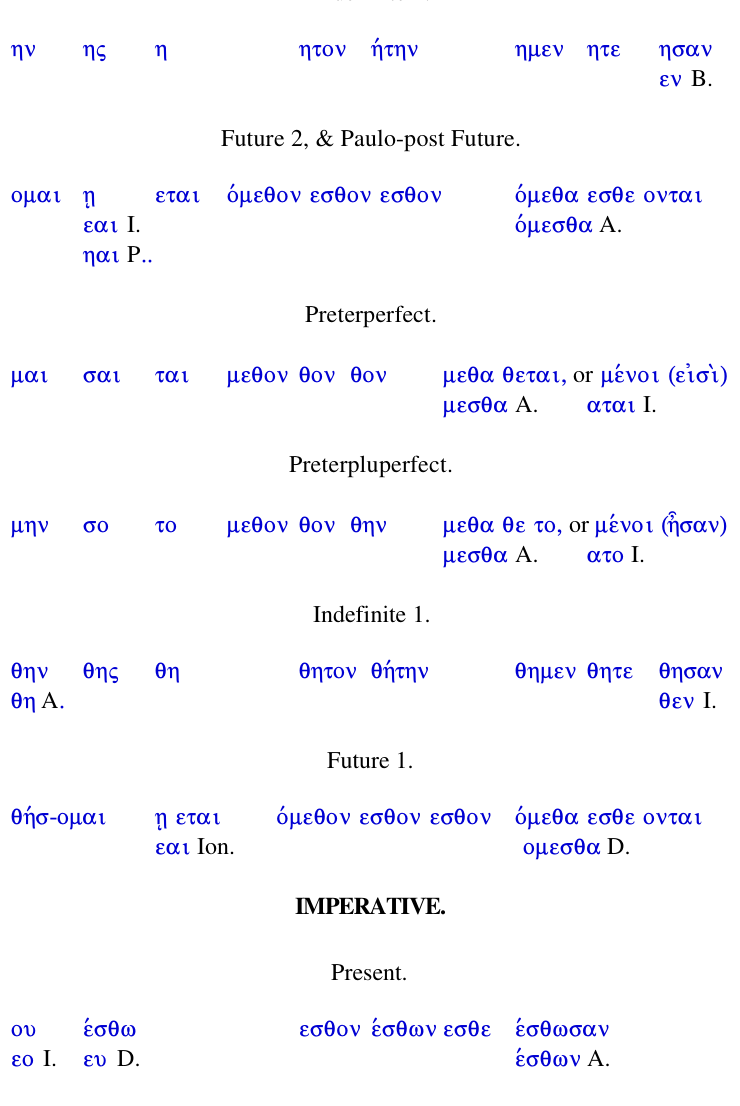
Editorial note: Source-reading note (WES_WW14.PDF, physical page 219): the Greek/Hebrew forms and their layout near “oi sqhn oi meqa oisqe ointo oi mesqa a oi ato i p indefinite 1 2 ei hn ei hv ei h ei hton ei hthn ei hmen ei hte ei hsan ei menei te ei en s” are not fully established by the transcription. The linked source image preserves the original type for comparison. The original type remains the reference for unresolved letters, accents, points, and layout. Additional-source investigation: an independently typeset 1872 printing of Wesley's Works, vol. XIV, has been located. Its Greek and Hebrew grammar tables provide a second witness, but the available comparison does not securely establish every flagged letter, accent, vowel point, or column boundary in this passage. Any bounded repairs established in this section are identified in separate transcription-correction notes; consult both scans for the remaining unresolved details. Source type and layout, physical PDF page 219; Independent 1872 printing of Wesley's Works, vol. XIV.
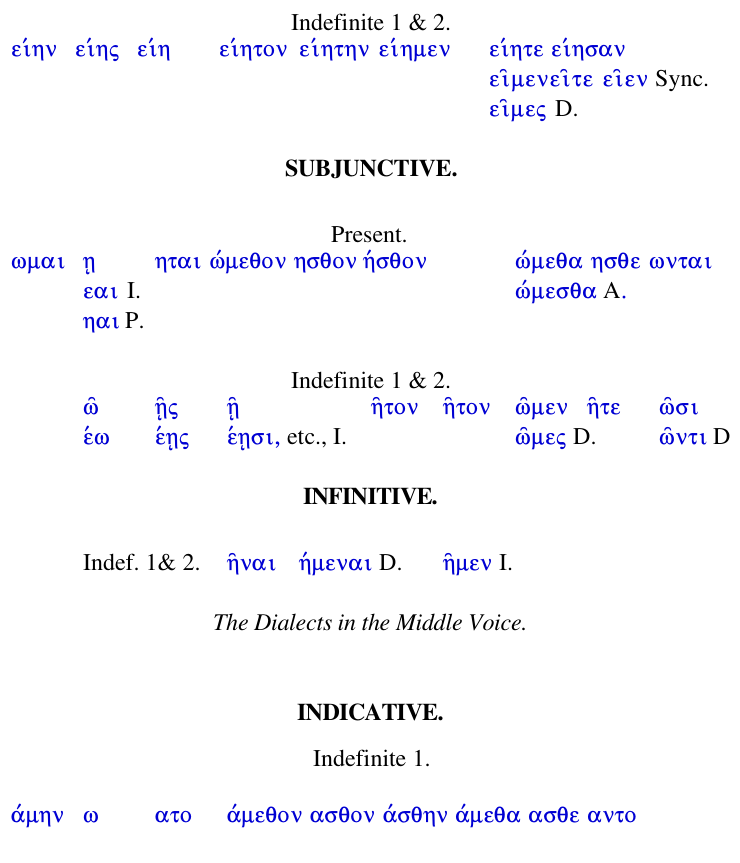
Editorial note: Source-reading note (WES_WW14.PDF, physical page 220): the Greek/Hebrew forms and their layout near “ao i a mesqa a a d indefinite 2 o mhn ou eto o meqon esqon e sqhn o meqa esqe onto eo i o mesqa a future 1 omai h etai o meqon esqon esqon o”; “p participles future 2 tupou menov tupeu menov d ae imperative indefinte 1 singular dual plural ai a sqw asqon q sqwn asqe a sqwsan a sqwn a” are not fully established by the transcription. The linked source image preserves the original type for comparison. The original type remains the reference for unresolved letters, accents, points, and layout. Additional-source investigation: an independently typeset 1872 printing of Wesley's Works, vol. XIV, has been located. Its Greek and Hebrew grammar tables provide a second witness, but the available comparison does not securely establish every flagged letter, accent, vowel point, or column boundary in this passage. Any bounded repairs established in this section are identified in separate transcription-correction notes; consult both scans for the remaining unresolved details. Source type and layout, physical PDF page 220; Independent 1872 printing of Wesley's Works, vol. XIV.
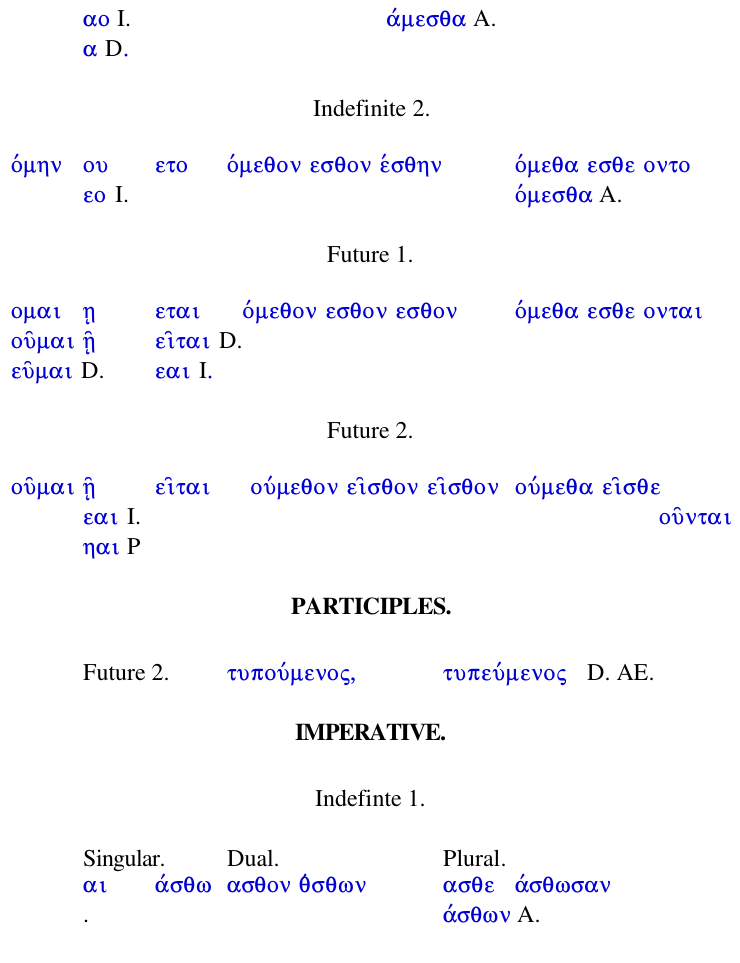
Editorial note: Source-reading note (WES_WW14.PDF, physical page 222): the Greek/Hebrew forms and their layout near “oi hv oi h etc a w hn w hv w etc d singular dual plural w mi w v w w ton w thn w men a te w en w hn w hv w h etc d oi mi oi v oi oi ton oi t” are not fully established by the transcription. The linked source image preserves the original type for comparison. The original type remains the reference for unresolved letters, accents, points, and layout. Additional-source investigation: an independently typeset 1872 printing of Wesley's Works, vol. XIV, has been located. Its Greek and Hebrew grammar tables provide a second witness, but the available comparison does not securely establish every flagged letter, accent, vowel point, or column boundary in this passage. Any bounded repairs established in this section are identified in separate transcription-correction notes; consult both scans for the remaining unresolved details. Source type and layout, physical PDF page 222; Independent 1872 printing of Wesley's Works, vol. XIV.
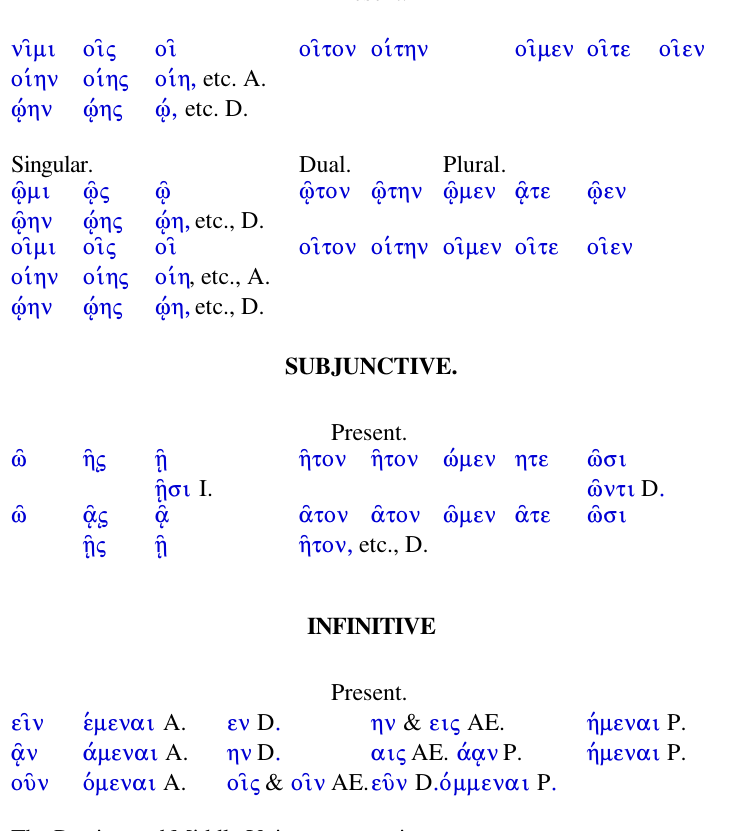
Editorial note: Source-reading note (WES_WW14.PDF, physical page 224): the Greek/Hebrew forms and their layout near “imperative present eti e tw a d h ae p ei ei to a aqi a tw aton a twn ate a twsan h a a d oqi o tw ou a contract wqi p oi d optative present” are not fully established by the transcription. The linked source image preserves the original type for comparison. The original type remains the reference for unresolved letters, accents, points, and layout. Additional-source investigation: an independently typeset 1872 printing of Wesley's Works, vol. XIV, has been located. Its Greek and Hebrew grammar tables provide a second witness, but the available comparison does not securely establish every flagged letter, accent, vowel point, or column boundary in this passage. Any bounded repairs established in this section are identified in separate transcription-correction notes; consult both scans for the remaining unresolved details. Source type and layout, physical PDF page 224; Independent 1872 printing of Wesley's Works, vol. XIV.
SECTION XVI.
OF THE DIALECTS IN THE GREEK TONGUE.
1. A DIALECT is the various forms of Pronunciation peculiar to several sorts of people speaking one and the same language.
2. The Dialects in Greek are four; the Attic, the Ionic. the Doric, and the Aeolic.
1. — THE ATTIC.
1. The Attic Dialect contracts,
(1.) By cutting off a vowel or diphthong between two words; as, ταὐ τὸ for τὸ αὐτὸ, κείς for καὶ εἰς.
(2.) By joining two separate vowels or diphthongs; as, τἀμὰ for τα ἐμὰ, προὐργου for πρὸ ἐργου.
(3.) By uniting syllables, while it retains the letters; as, Νηρῇδες for Νηρηΐδες.
(4.) By dropping one vowel, that the two others might be contracted; as, ἐμουδόκει for ἐμοὶ ἐδόκει.
(5.) By dropping one vowel, and uniting two others; as, ἐμουποδύνει for ἐμοὶ ὑποδύνει.
(6.) By dropping one vowel, and uniting two others in a Contraction; as, ἐν τᾀθιοπίᾳ for ἐν τῇ Αἰθιοπίᾳ.
(7.) Also by contracting syllables in the same word, and omitting letters; as, ποῶν for ποιῶν.
2. This Dialect changes σ into ξ, as, ξὺν into ρ, as, θαῤῥεῖν for θαρσεῖν into τ, as, πράττω for πράσσω.
3. It casts away ι from αι and ει as, κλάω for κλαίω.
4. It changes ο into ω as, νεὼς for ναός.
5. It joins ουν to the end of words, and ι to Adverbs; as, οὐκουν, νυνὶ for νῦν.
6. It puts νυνδὶ for νῦν δὲ, ὀψὶ for ὀψὲ, in Compounds; as, ὀψιμαθής.
2. — THE IONIC.
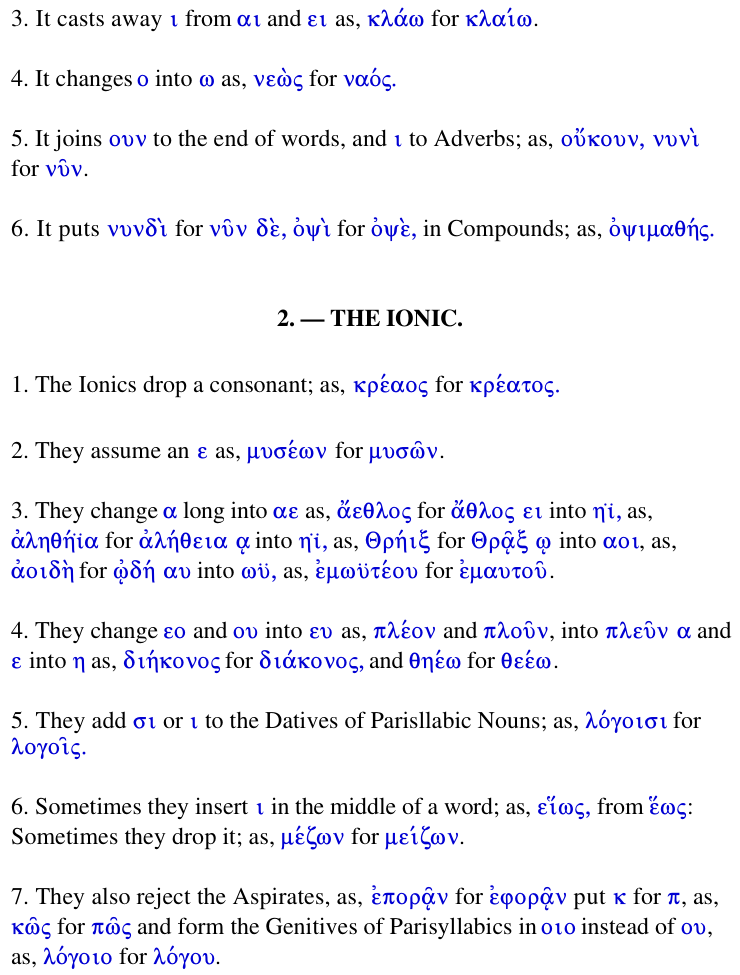
1. The Ionics drop a consonant; as, κρέαος for κρέατος.
2. They assume an ε as, μυσέων for μυσῶν.
3. They change α long into αε as, ἀεθλος for ἀθλος ει into ηϊ, as, ἀληθήϊα for ἀλήθεια ᾳ into ηϊ, as, Θρήϊξ for Θρᾷξ ῳ into αοι, as, ἀοιδὴ for ᾠδή αυ into ωϋ, as, ἐμωϋτέου for ἐμαυτοῦ.
4. They change εο and ου into ευ as, πλέον and πλοῦν, into πλεῦν α and ε into η as, διήκονος for διάκονος, and θηέω for θεέω.
5. They add σι or ι to the Datives of Parisllabic Nouns; as, λόγοισι for λογοῖς.
6. Sometimes they insert ι in the middle of a word; as, εἱως, from ἑως: Sometimes they drop it; as, μέζων for μείζων.
7. They also reject the Aspirates, as, ἐπορᾷν for ἐφορᾷν put κ for π, as, κῶς for πῶς and form the Genitives of Parisyllabics in οιο instead of ου, as, λόγοιο for λόγου.
3. — THE DORIC.
1. The Dorics change η, ω, ε, ο, and ου, into α as, μᾶν for μὴν, a month; τιμᾶν for τιμῶν, of honors; μέγαθος for μέγεθος, as the Ionics; ἁσσα, for ὁσα or ὁσσα and χρύσα for χρυσοῦ.
2. They change ει into αι, as, φθαίρω for φθείρω ει into ῃ, as, λαβῇν for λαβεῖν αυ and ου into ω, as, ὠλαξ for αὐλαξ, μώσας for μούσας.
3. They reject ι from the Infinitive; as, λαβὲν for λαβεῖν.
4. They often put the Plural of the Feminine for the Singular; as, καλὰς for καλήν.
4. — THE AEOLIC.
1. The Aeolics reject the rough Breathing, as, ἠμέρα for ἡμέρα draw back the accent, as, κάλος for καλός.
2. They also put αι for α, as, καλαῖς for καλάς άων for ῶν, as, μουσάων for μουσῶν οισα for ουσα, as, τύπτοισα for τύπτουσα β for ρ, instead of the aspiration, as, βρόδον for ῥόδον. Some put ἐμβροτον for ἡμαρτον, I have sinned; changing the Breathing, transposing the ρ, and changing α into ο.
3. They change μμ into ππ as, ὀππατα for ὀμματα. A Table of the Terminations of the several Dialects. THE PREPOSITIVE ARTICLE.
Masculine.
Singular. Dual. Plural.
N. G. D. A. N. G. V. N. G. D. A
Com. ὁ τοῦ, τῷ, τὸν τὼ τοῖν τὼ οἱ τῶν τοῖς τοὺς τοῖο I. τοῖϊν I. τοὶ D. τοῖσι I.A.
τῶ & τεῦ D. τῶς D.
τέω P.
Feminine.
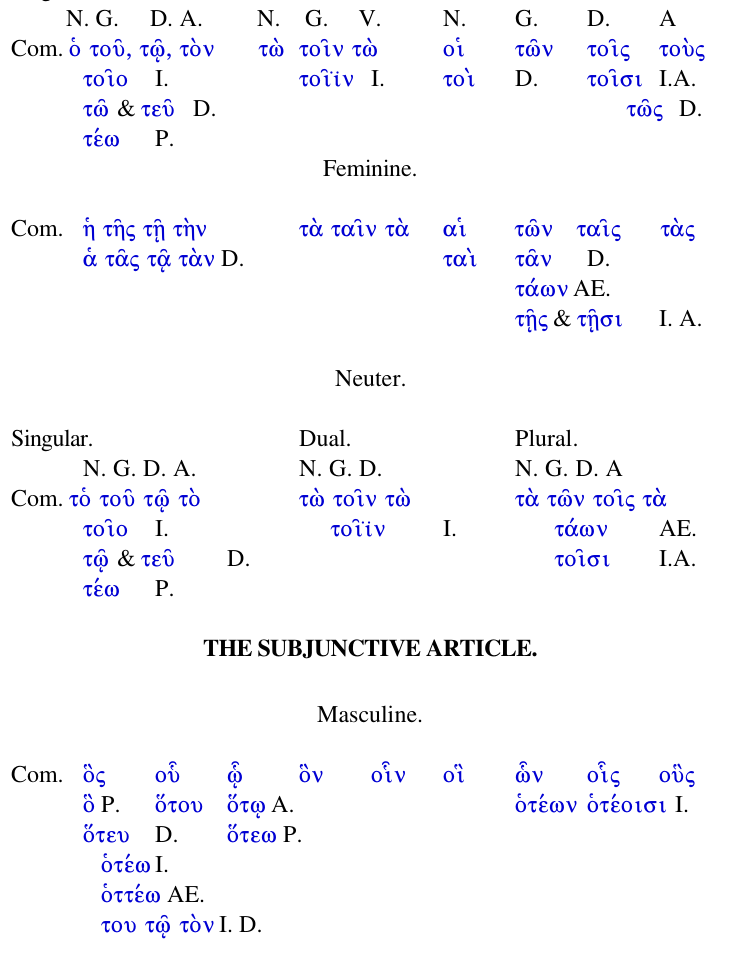
Com. ἡ τῆς τῇ τὴν τὰ ταῖν τὰ αἱ τῶν ταῖς τὰς ἁ τᾶς τᾷ τὰν D. ταὶ τᾶν D.
τάων AE.
τῇς & τῇσι I. A.
Neuter.
Singular. Dual. Plural.
N. G. D. A. N. G. D. N. G. D. A
Com. τὁ τοῦ τῷ τὸ τὼ τοῖν τὼ τὰ τῶν τοῖς τὰ τοῖο I. τοῖϊν I. τάων AE.
τῷ & τεῦ D. τοῖσι I.A.
τέω P.
THE SUBJUNCTIVE ARTICLE.
Masculine.
Com. ο{ς οὖ ᾦ ο{ν οἶν οι{ ὦν οἶς ου{ς ο{ P. ὁτου ὁτῳ A. ὁτέων ὁτέοισι I.
ὁτευ D. ὁτεω P.
ὁτέωΙ.
ὁττέω AE.
του τῷ τὸν I. D.
Feminine.
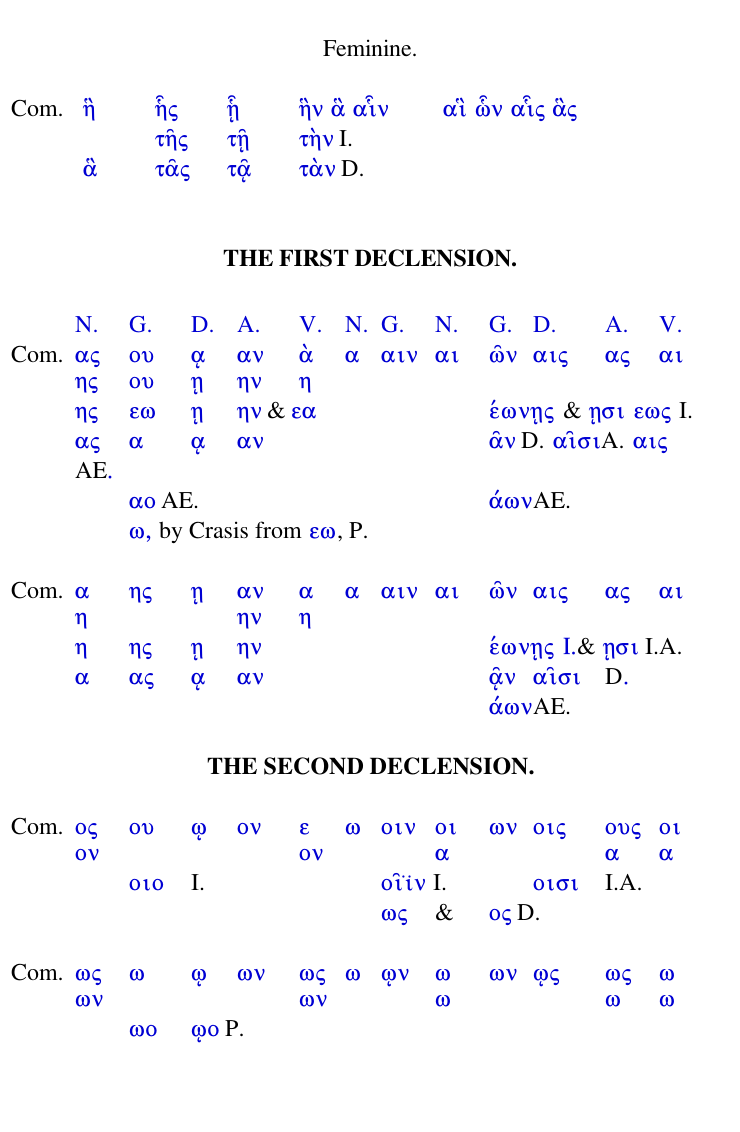
Com. η{ ἦς ᾖ η{ν α{ αἶν αι{ ὦν αἶς α{ς τῆς τῇ τὴν I.
α{ τᾶς τᾷ τὰν D.
THE FIRST DECLENSION.
N. G. D. A. V. N. G. N. G. D. A. V.
Com. ας ου ᾳ αν ὰ α αιν αι ῶν αις ας αι ης ου ῃ ην η
ης εω ῃ ην & εα έωνῃς & ῃσι εως I.
ας α ᾳ αν ᾶν D. αῖσιΑ. αις
AE.
αο AE. άωνΑΕ.
ω, by Crasis from εω, P.
Com. α ης ῃ αν α α αιν αι ῶν αις ας αι
η ην η
η ης ῃ ην έωνῃς I.& ῃσι I.A.
α ας ᾳ αν ᾷν αῖσι D.
άωνΑΕ.
THE SECOND DECLENSION.
Com. ος ου ῳ ον ε ω οιν οι ων οις ους οι
ον ον α α α
οιο I. οῖϊν I. οισι I.A.
ως & ος D.
Com. ως ω ῳ ων ως ω ῳν ω ων ῳς ως ω
ων ων ω ω ω
ωο ῳο P.
THE THIRD DECLENSION.
Singular. Dual. Plural.
N. G. D. A. N.G. N. G. D. A. V.
Com. α ι υ ος ι α ε οῖν ες ων σι ας ες
ω ν ρ
σ ξ ψ ν α ξι α α
ψι
εσσι & εσι P.
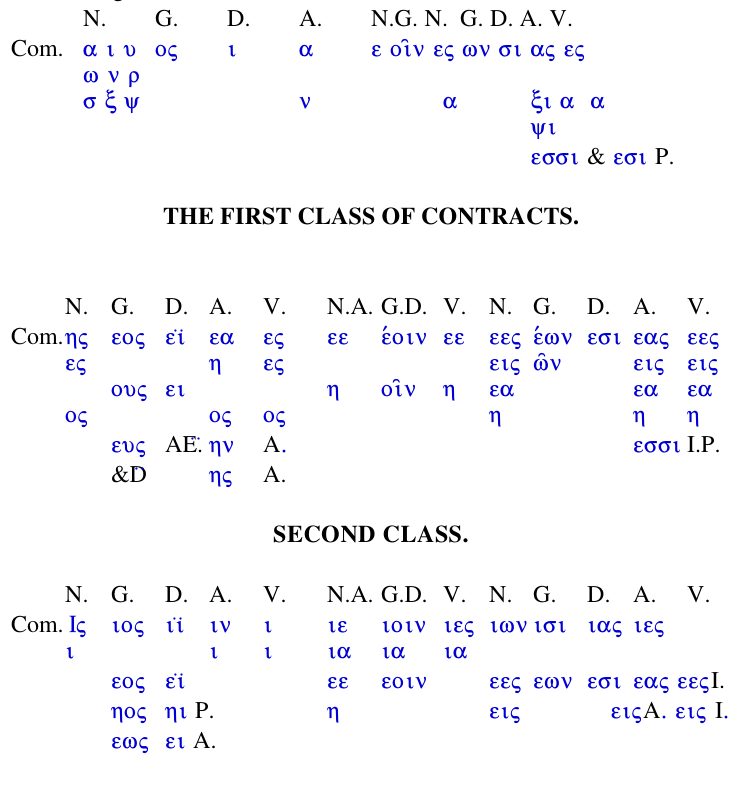
THE FIRST CLASS OF CONTRACTS.
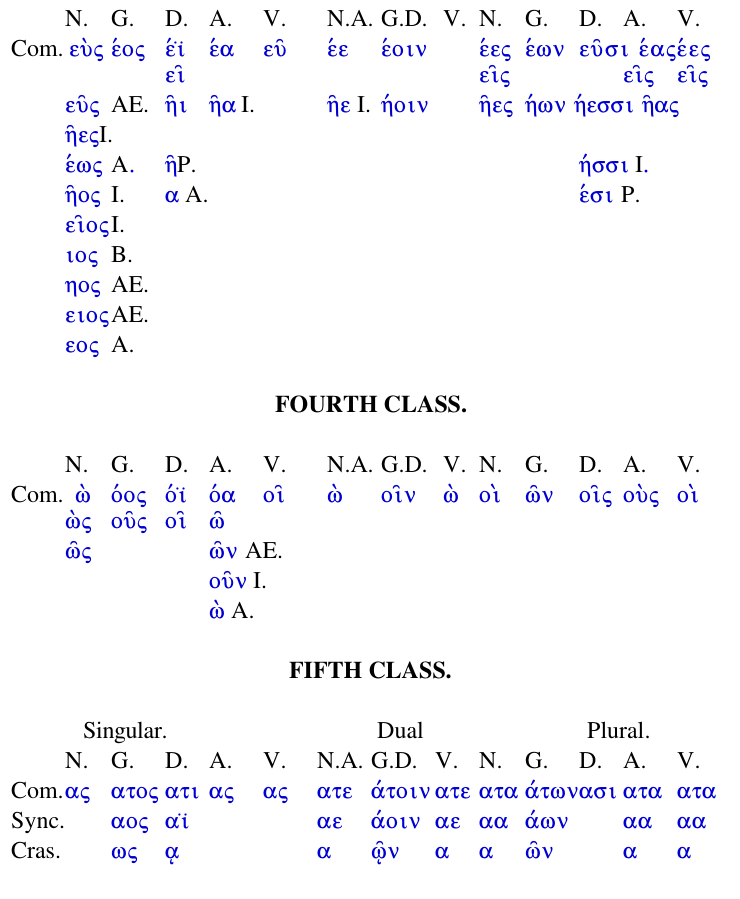
N. G. D. A. V. N.A. G.D. V. N. G. D. A. V. Com. ης εος εϊ εα ες εε έοιν εε εες έων εσι εας εες ες η ες εις ῶν εις εις
ους ει η οῖν η εα εα εα
ος ος ος η η η
ευς AE.` ην A. εσσι I.P.
&D` ης A.
SECOND CLASS.
N. G. D. A. V. N.A. G.D. V. N. G. D. A. V. Com. Ις ιος ιϊ ιν ι ιε ιοιν ιες ιων ισι ιας ιες ι ι ι ια ια ια
εος εϊ εε εοιν εες εων εσι εας εες I.
ηος ηι P. η εις εις A. εις I.
εως ει A.
THIRD CLASS.
N. G. D. A. V. N.A. G.D. V. N. G. D. A. V. Com. εὺς έος έι` έα εῦ έε έοιν έες έων εῦσι έαςέες εῖ εῖς εῖς εῖς
εῦς AE. ῆι ῆα I. ῆε I. ήοιν ῆες ήων ήεσσι ῆας ῆεςΙ.
έως A. ῆΠ. ήσσι I.
ῆος I. α A. έσι P.
εῖοςΙ.
ιος B.
ηος AE.
eiovAE.
εος A.
FOURTH CLASS.
N. G. D. A. V. N.A. G.D. V. N. G. D. A. V. Com. ὼ όος όι` όα οῖ ὼ οῖν ὼ οὶ ῶν οῖς οὺς οὶ ὼς οῦς οῖ ῶ
ῶς ῶν AE.
οῦν I.
ὼ A.
FIFTH CLASS.
Singular. Dual Plural.
N. G. D. A. V. N.A. G.D. V. N. G. D. A. V. Com. ας ατος ατι ας ας ατε άτοιν ατε ατα άτωνασι ατα ατα Sync. αος αϊ αε άοιν αε αα άων αα αα
Cras. ως ᾳ α ῷν α α ῶν α α
THE DIALECTS OF PRONOUNS.
’Εγώ.
Singular.
Nom. Gen. Dat. Acc.
Com. ἐγὼ ἐμοῦ μοῦ ἐμοὶ μοὶ ἐμὲ μὲ Att. ἐγωγε ἐμοιγε
Dor. ἐγώνη ἐγὼν ἐμεῦ ἐμίν
ἐγωγα
Aeol. ἐγὼν ἐμεῦ ἐμοῖο ἐμέο
ἐμέοθεν Parag.
ἐμέθεν Sync.
Poet. ἐμεῖο
Boeot. ἰώγα ἰώνγα
Dual.
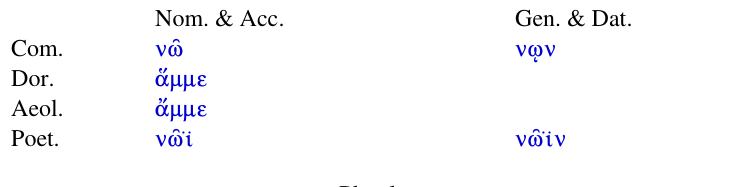
Nom. & Acc. Gen. & Dat.
Com. νῶ νῳν
Dor. ἁμμε
Aeol. ἀμμε
Poet. νῶϊ νῶϊν
Plural.
Nom. Gen. Dat. Acc.
Com. ἡμεῖς ἡμῶν ἡμῖν
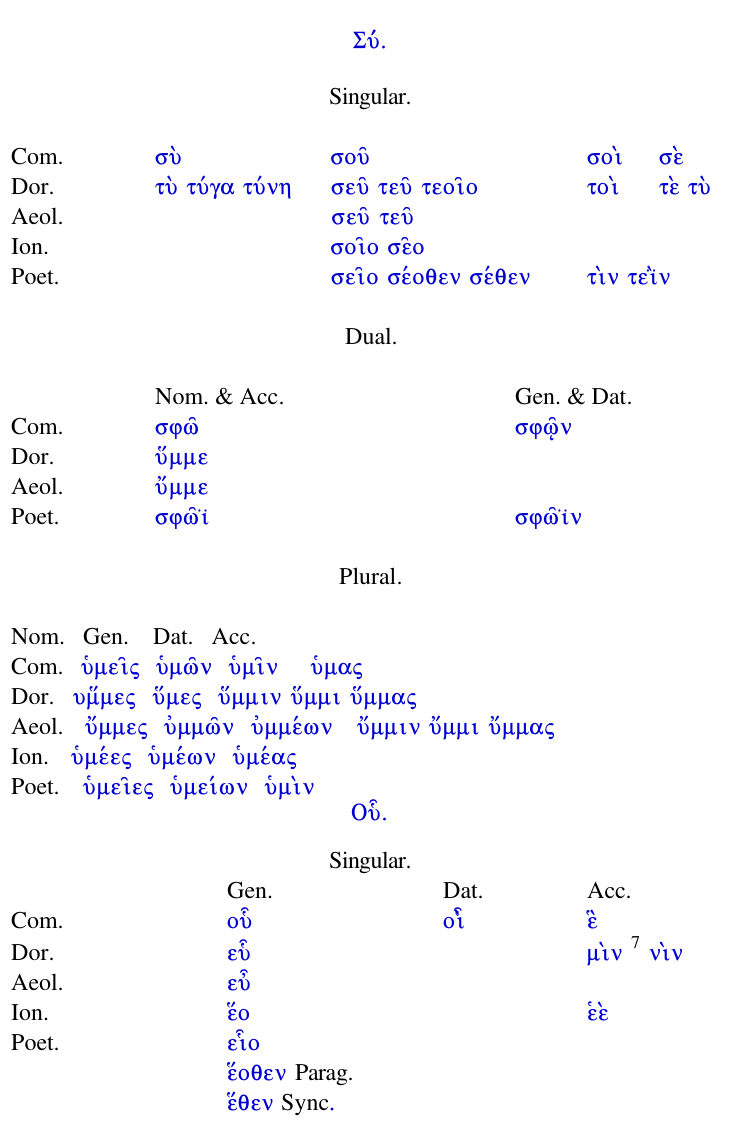
Dor. ἁμες ἁμμες ἁμῶν ἁμέων ἁμῖν ὰμας Aeol. ἀμμες ἀμμων ἀμμέων ἀμμιν ἀμμι ἀμμας Ion. ἡμέες ἡμέων (P. ἡμείων ἡμίν) ἡμέας Σύ.
Singular.
Com. σὺ σοῦ σοὶ σὲ
Dor. τὺ τύγα τύνη σεῦ τεῦ τεοῖο τοὶ τὲ τὺ Aeol. σεῦ τεῦ
Ion. σοῖο σέο
Poet. σεῖο σέοθεν σέθεν τὶν τεΐν
Dual.
Nom. & Acc. Gen. & Dat.
Com. σφῶ σφῷν
Dor. ὑμμε
Aeol. ὐμμε
Poet. σφῶϊ σφῶϊν
Plural.
Nom. Gen. Dat. Acc.
Com. ὑμεῖς ὑμῶν ὑμῖν ὑμας
Dor. um[mev ὑμες ὑμμιν ὑμμι ὑμμας
Aeol. ὐμμες ὐμμῶν ὐμμέων ὐμμιν ὐμμι ὐμμας Ion. ὑμέες ὑμέων ὑμέας
Poet. ὑμεῖες ὑμείων ὑμὶν
Οὖ.
Singular.
Gen. Dat. Acc.
Com. οὖ οἷ ε{
Dor. εὖ μὶν 7 νὶν
Aeol. εὐ
Ion. ἑο ἑὲ
Poet. εἶο
ἑοθεν Parag.
ἑθεν Sync.
Dual.
Nom. & Acc. Gen. & Dat.
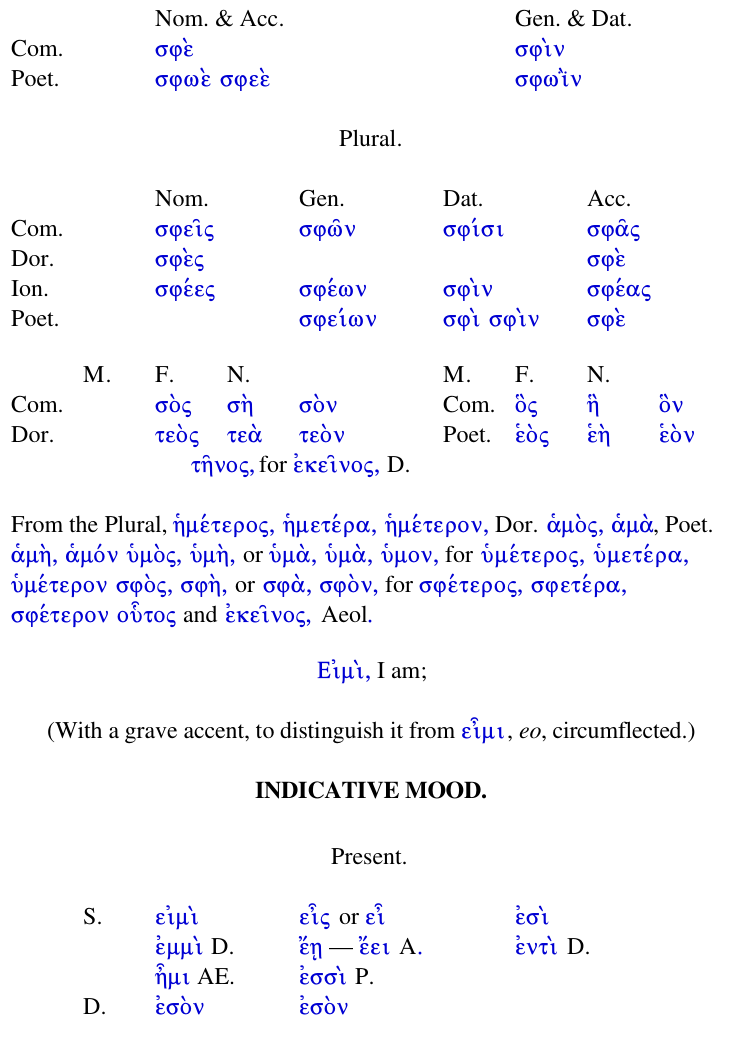
Com. σφὲ σφὶν
Poet. σφωὲ σφεὲ σφωΐν
Plural.
Nom. Gen. Dat. Acc.
Com. σφεῖς σφῶν σφίσι σφᾶς
Dor. σφὲς σφὲ
Ion. σφέες σφέων σφὶν σφέας
Poet. σφείων σφὶ σφὶν σφὲ
M. F. N. M. F. N.
Com. σὸς σὴ σὸν Com. ο{ς η{ ο{ν
Dor. τεὸς τεὰ τεὸν Poet. ἑὸς ἑὴ ἑὸν τῆνος, for ἐκεῖνος, D.
From the Plural, ἡμέτερος, ἡμετέρα, ἡμέτερον, Dor. ἁμὸς, ἁμὰ, Poet. ἁμὴ, ἁμόν ὑμὸς, ὑμὴ, or ὑμὰ, ὑμὰ, ὑμον, for ὑμέτερος, ὑμετέρα, ὑμέτερον σφὸς, σφὴ, or σφὰ, σφὸν, for σφέτερος, σφετέρα, σφέτερον οὖτος and ἐκεῖνος, Aeol.
Εἰμὶ, I am;
(With a grave accent, to distinguish it from εἰμι, eo, circumflected.) INDICATIVE MOOD.
Present.
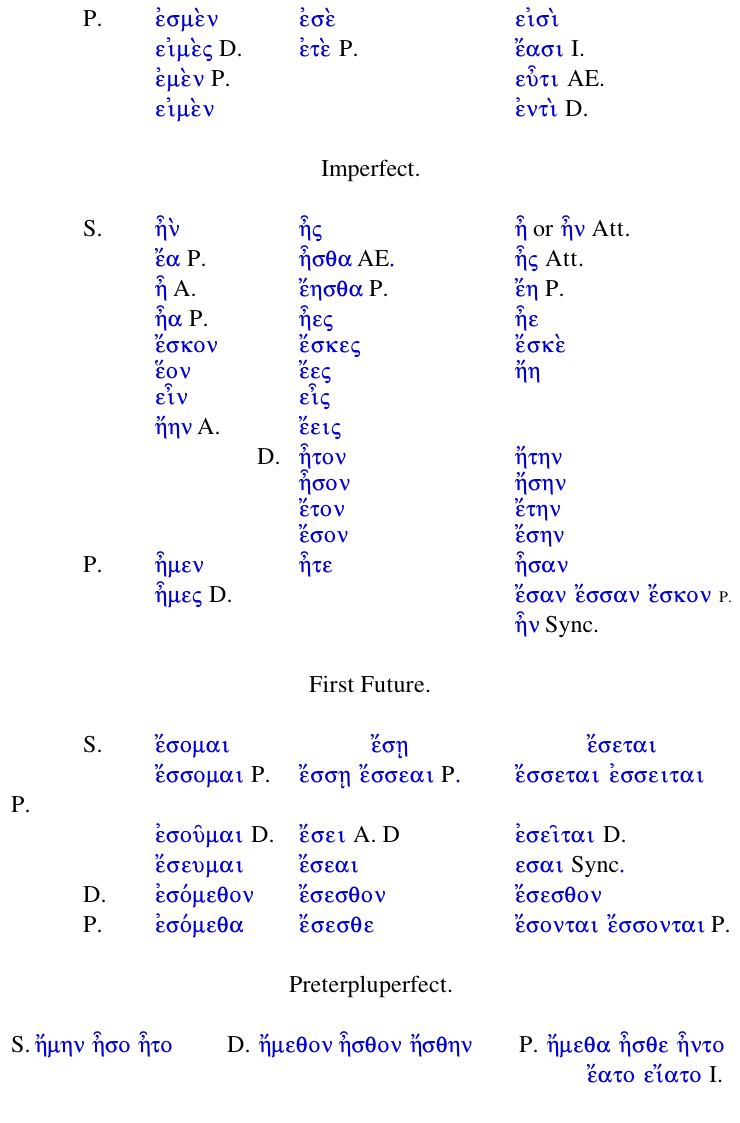
S. εἰμὶ εἰς or εἰ ἐσὶ
ἐμμὶ D. ἐῃ — ἐει A. ἐντὶ D.
ἠμι AE. ἐσσὶ P.
D. ἐσὸν ἐσὸν
P. ἐσμὲν ἐσὲ εἰσὶ
εἰμὲς D. ἐτὲ P. ἐασι I.
ἐμὲν P. εὐτι AE.
εἰμὲν ἐντὶ D.
Imperfect.
S. ἦν ἠς ἠ or ἠν Att.
ἐα P. ἠσθα AE. ἠς Att.
ἠ A. ἐησθα P. ἐη P.
ἠα P. ἠες ἠε
ἐσκον ἐσκες ἐσκὲ
ἑον ἐες ἠη
εἰν εἰς
ἠην A. ἐεις
D. ἠτον ἠτην
ἠσον ἠσην
ἐτον ἐτην
ἐσον ἐσην
P. ἠμεν ἠτε ἠσαν
ἠμες D. ἐσαν ἐσσαν ἐσκον P.
ἠν Sync.
First Future.
S. ἐσομαι ἐσῃ ἐσεται
ἐσσομαι P. ἐσσῃ ἐσσεαι P. ἐσσεται ἐσσειται P.
ἐσοῦμαι D. ἐσει A. D ἐσεῖται D.
ἐσευμαι ἐσεαι εσαι Sync.
D. ἐσόμεθον ἐσεσθον ἐσεσθον
P. ἐσόμεθα ἐσεσθε ἐσονται ἐσσονται P. Preterpluperfect.
S. ἠμην ἠσο ἠτο D. ἠμεθον ἠσθον ἠσθην P. ἠμεθα ἠσθε ἠντο ἐατο εἰατο I.
IMPERATIVE MOOD.
Present.
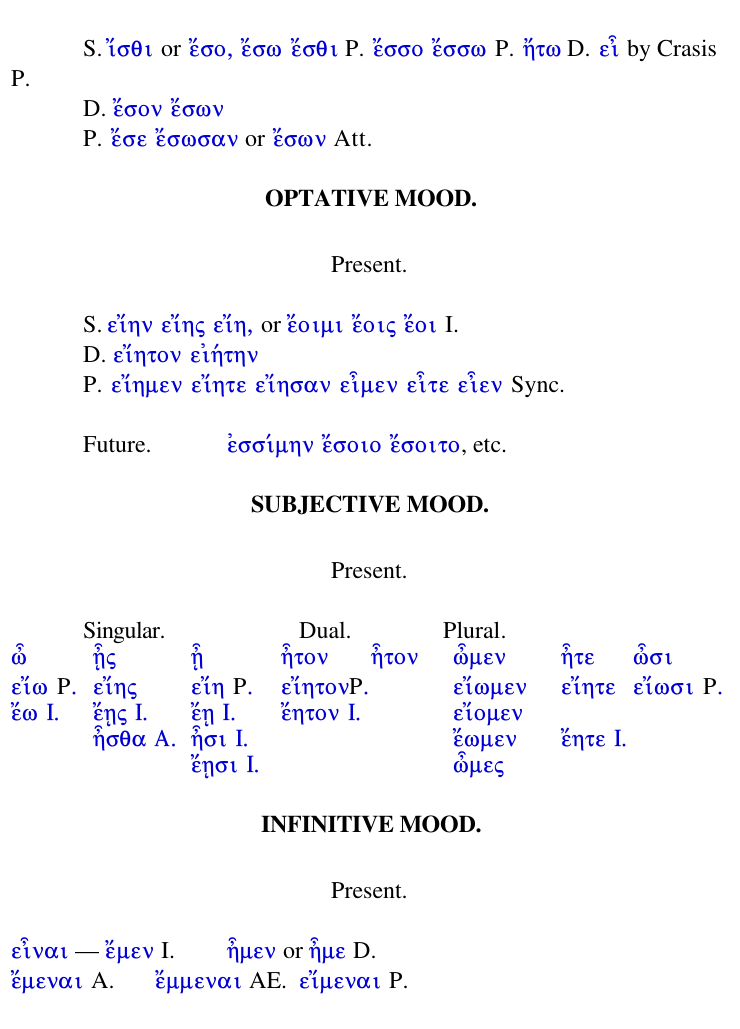
S. ἰσθι or ἐσο, ἐσω ἐσθι P. ἐσσο ἐσσω P. ἠτω D. εἰ by Crasis P.
D. ἐσον ἐσων
P. ἐσε ἐσωσαν or ἐσων Att.
OPTATIVE MOOD.
Present.
S. εἰην εἰης εἰη, or ἐοιμι ἐοις ἐοι I. D. εἰητον εἰήτην
P. εἰημεν εἰητε εἰησαν εἰμεν εἰτε εἰεν Sync. Future. ἐσσίμην ἐσοιο ἐσοιτο, etc.
SUBJECTIVE MOOD.
Present.
Singular. Dual. Plural.
ὠ ᾐς ᾐ ἠτον ἠτον ὠμεν ἠτε ὠσι
εἰω P. εἰης εἰη P. εἰητον P. εἰωμεν εἰητε εἰωσι P. ἐω I. ἐῃς I. ἐῃ I. ἐητον I. εἰομεν
ἠσθα A. ἠσι I. ἐωμεν ἐητε I.
ἐῃσι I. ὠμες
INFINITIVE MOOD.
Present.
εἰναι — ἐμεν I. ἠμεν or ἠμε D.
ἐμεναι A. ἐμμεναι AE. εἰμεναι P.
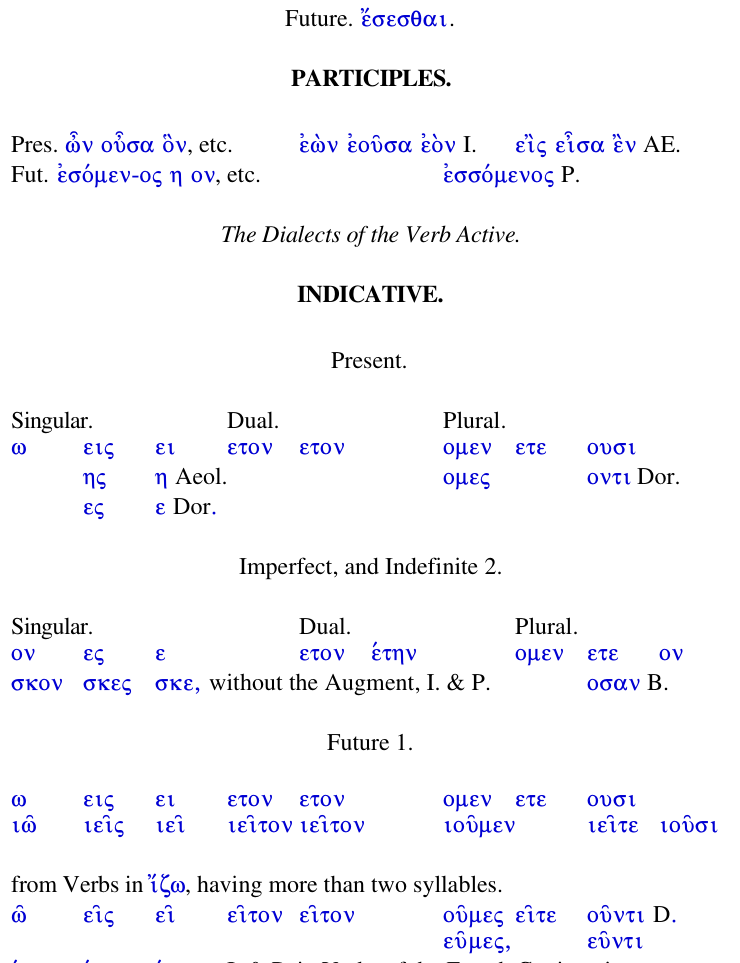
Future. ἐσεσθαι.
PARTICIPLES.
Pres. ὠν οὐσα ο{ν, etc. ἐὼν ἐοῦσα ἐὸν I. ει}ς εἰσα ε}ν AE. Fut. ἐσόμεν-ος η ον, etc. ἐσσόμενος P. The Dialects of the Verb Active.
INDICATIVE.
Present.
Singular. Dual. Plural.
ω εις ει ετον ετον ομεν ετε ουσι
ης η Aeol. ομες οντι Dor.
ες ε Dor.
Imperfect, and Indefinite 2.
Singular. Dual. Plural.
ον ες ε ετον έτην ομεν ετε ον
σκον σκες σκε, without the Augment, I. & P. οσαν B. Future 1.
ω εις ει ετον ετον ομεν ετε ουσι
ιῶ ιεῖς ιεῖ ιεῖτον ιεῖτον ιοῦμεν ιεῖτε ιοῦσι from Verbs in ἰζω, having more than two syllables. ῶ εῖς εῖ εῖτον εῖτον οῦμες εῖτε οῦντι D. εῦμες, εῦντι
έω έεις έει I. & P. in Verbs of the Fourth Conjugation. Indefinite 1.
α ας α ατον άτην αμεν ατε αν
ασκον ασκες ασκε I.P. αμες ασαν
B.
Preterperfect.
α ας ε ατον ατον αμεν ατε ασι
αμες D. αντι
D.
an B.
αα αας αε, etc., I.
Preterpluperfect.
ειν εις ει ειτον είτην ειμεν ειτε εισαν
ην ης η A. &. D. ειμες D.
εσαν A.& I. εα εε I.
Future 2.
ω εῖς εῖ εῖτον εῖτον οῦμεν εῖτε οῦσι οῦμες οῦντι εῦντι D.
έω έεις έει έειτον, etc., Ion.
IMPERATIVE.
Present.
ε έτω ετον έτων ετε έτωσαν
όντων A.
Indefinite 1.
ον άτω ατον άτων ατε άτωσαν
άντων A.
Indefinite 2.
ε έτω ετον έτων ετε έτωσαν
ον I. όντων A.
OPTATIVE.
Present, Preterperfect, Indefinite 2, and Future 1 & 2. Singular. Dual. Plural.
οιμι οις οι οιτον οίτην οιμεν οιτε οιεν
οιμες D.
Indefinite 1.
αιμι αις αι αιτον αίτην αιμεν αιτε αιεν
εια ειας ειε AE. αιμες D.
SUBJUNCTIVE.
In all Tenses.
ω ῃς ῃ ητον ητον ωμεν ητε ωσι
ῃσι I. ωμες ωντι
INFINITIVE.
Pres. & Fut. 1. Perf.
ειν έναι
έμεν I. έμεν I.
έμεναι A. D. έμεναι D. A.
εν D.
έμμεναι P.
Indef. 1. Indef. 2. & Fut. 2.
αι εῖν
έμεναι I. έειν έμεν I.
έμεναι A. D. εν D.
PARTICIPLES.
Present. Perfect.
ων ουσα ον ὼς υῖα ὸς
οῖσα D. ὼν AE`. as, εἰρηκὼν, for
εἰρηκὼς.
εῦσα AE. ῶσα ὼς A.
Indef. 1. Fut. 2.
ας ασα αν ων οῦσα οῦν A.
αις αισα αιν Aeol. έων έουσα έον I.
Indef. 2. Fut. 1.
ὼν οῦσα ὸν ων ουσα ον
οῖσα D. οῖσα D.
εῦσα AE.
INDICATIVE.
Present.
Singular. Dual. Plural.
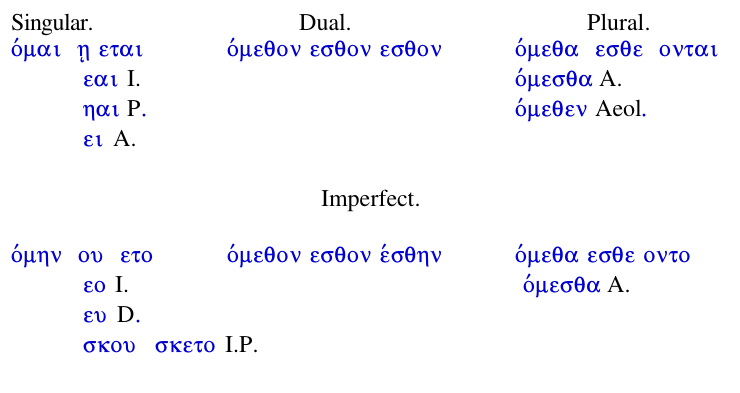
όμαι ῃ εται όμεθον εσθον εσθον όμεθα εσθε ονται εαι I. όμεσθα A.
ηαι P. όμεθεν Aeol.
ει A.
Imperfect.
όμην ου ετο όμεθον εσθον έσθην όμεθα εσθε οντο εο I. όμεσθα A.
ευ D.
σκου σκετο I.P.
Indefinite 2.
ην ης η ητον ήτην ημεν ητε ησαν
εν B.
Future 2, & Paulo-post Future.
ομαι ῃ εται όμεθον εσθον εσθον όμεθα εσθε ονται εαι I. όμεσθα A.
hai P..
Preterperfect.
μαι σαι ται μεθον θον θον μεθα θεται, or μένοι (εἰσὶ) μεσθα A. αται I.
Preterpluperfect.
μην σο το μεθον θον θην μεθα θε το, or μένοι (ἠσαν) μεσθα A. ατο I.
Indefinite 1.
θην θης θη θητον θήτην θημεν θητε θησαν
θη A. θεν I.
Future 1.
θήσ-ομαι ῃ εται όμεθον εσθον εσθον όμεθα εσθε ονται εαι Ion. ομεσθα D.
IMPERATIVE.
Present.
ου έσθω εσθον έσθων εσθε έσθωσαν
εο I. ευ D. έσθων A.
The other Tenses have no Dialect.
OPTATIVE.
Present, Future 1 & 2, Paulo-post Future.
Singular. Dual. Plural.
οίμην οιο οιτο οίμεθον οισθον οίσθην οίμεθα οισθε οιντο οίμεσθα A.οίατο I. P.
Indefinite 1 & 2.
είην είης είη είητον είητην είημεν είητε είησαν εῖμενεῖτε εῖεν Sync.
εῖμες D.
SUBJUNCTIVE.
Present.
ωμαι ῃ ηται ώμεθον ησθον ήσθον ώμεθα ησθε ωνται εαι I. ώμεσθα A.
hai P.
Indefinite 1 & 2.
ῶ ῇς ῇ ῆτον ῆτον ῶμεν ῆτε ῶσι
έω έῃς έῃσι, etc., I. ῶμες D. ῶντι D INFINITIVE.
Indef. 1& 2. ῆναι ήμεναι D. ῆμεν I.
The Dialects in the Middle Voice.
INDICATIVE.
Indefinite 1.
άμην ω ατο άμεθον ασθον άσθην άμεθα ασθε αντο αο I. άμεσθα A.
a D.
Indefinite 2.
όμην ου ετο όμεθον εσθον έσθην όμεθα εσθε οντο εο I. όμεσθα A.
Future 1.
ομαι ῃ εται όμεθον εσθον εσθον όμεθα εσθε ονται οῦμαι ῇ εῖται D.
εῦμαι D. εαι I.
Future 2.
οῦμαι ῇ εῖται ούμεθον εῖσθον εῖσθον ούμεθα εῖσθε εαι I. οῦνται
hai P
PARTICIPLES.
Future 2. τυπούμενος, τυπεύμενος D. AE.
IMPERATIVE.
Indefinte 1.
Singular. Dual. Plural.
αι άσθω ασθον q>sqwn ασθε άσθωσαν
. άσθων A.
In the other moods, the Dialects are the same as in the Active and Passive. The Dialects of Contract Verbs
Present
έω ῶ εῖς εῖ εῖτον εῖτον οῦμεν εῖτε οῦσι εῦμες εῦντι & οῦντι D.
εῦσι AE.
άω ῶ ᾷς ᾷ ᾶτον ᾶτον ῶμεν ᾶτε ῶσι ῷ ῇς ῇ ῆτον, etc., D.
όω άᾳς άᾳ όωμεν etc., P.
έω έεις έει I.
όω ῶ οῖς οῖ οῦτον οῦτον οῦμεν οῦτε οῦσι οῦμες οῦντι D.
Imperfect
οῦν εις ει εῖτον είτην οῦμεν εῖτε ουν εσκον, etc., P.I. ευν D.
ων ας α ᾶτον άτην ῶμεν ᾶτε ων
ης η ῆτον ήτην D.
ασκον, etc., I.
αα P.
ουν ους ου οῦτον ούτην οῦμεν οῦτε ουν
σκον, etc., I.
IMPERATIVE.
Present.
ει είτω εῖτον είτων εῖτε είτωσαν
ούντων A.
a άτω ᾶτον άτων ᾶτε άτωσαν
άντων A.
OPTATIVE.
Present.
νῖμι οῖς οῖ οῖτον οίτην οῖμεν οῖτε οῖεν οίην οίης οίη, etc. A.
ῴην ῴης ῴ, etc. D.
Singular. Dual. Plural.
ῷμι ῷς ῷ ῷτον ῷτην ῷμεν ᾷτε ῷεν ῷην ῴης ῴη, etc., D.
οῖμι οῖς οῖ οῖτον οίτην οῖμεν οῖτε οῖεν οίην οίης οίη, etc., A.
ῴην ῴης ῴη, etc., D.
SUBJUNCTIVE.
Present.
ῶ h~v| ῇ ῆτον ῆτον ώμεν ητε ῶσι
ῇσι I. ῶντι D.
ῶ a~|v| ᾷ ᾶτον ᾶτον ῶμεν ᾶτε ῶσι
ῇς ῇ ῆτον, etc., D.
INFINITIVE
Present.
εῖν έμεναι A. εν D. ην & εις AE. ήμεναι P. ᾷν άμεναι A. ην D. αις AE. άᾳν P. ήμεναι P. οῦν όμεναι A. οῖς & οῖν AE.εῦν D.όμμεναι P. The Passive and Middle Voices are wanting. The Dialects of Verbs in μι.
INDICATIVE.
Present.
ημι ης ησι ετον ετον εμεν ετε εῖσι
ητι D. έαμεν I. εντι D.
έασι I.
ητον ητον ημεν ητε ηντι D.
ημι ης ησι ατον ατον αμεν ατε ᾶσι
ωτι D. άντι D.
έασι I.
ωμι ως ωσι οτον οτον ομεν οτε οῦσι
ωτι D. ωντι D.
όασι I.
υμι υς υσι υτον υτον υμεν υτε ῦσι
υντι D.
ύασι I.
Present.
ην ης η ετον έτην εμεν ετε εσαν
εα Ι. εε I. . εν Β.
ουν εις ει A.
σκον σκες σκε P.I.
Singular. Dual. Plural.
ην ης η ατον άτην αμεν ατε ασαν
σκον σκες σκε P.I. αν Β.
ων ας α A.
ων ως ω οτον ότην ομεν οτε οσαν
σκον σκες σκε P.I. ον Β.
ουν ους ου A.
υν υς υ υτον ύτην υμεν υτε υσαν
υσκον, etc., I.
ἐσ-hn ης η ητον ήτην ημεν ητε ησαν
σασκον I. ἑσαν B.
IMPERATIVE.
Present.
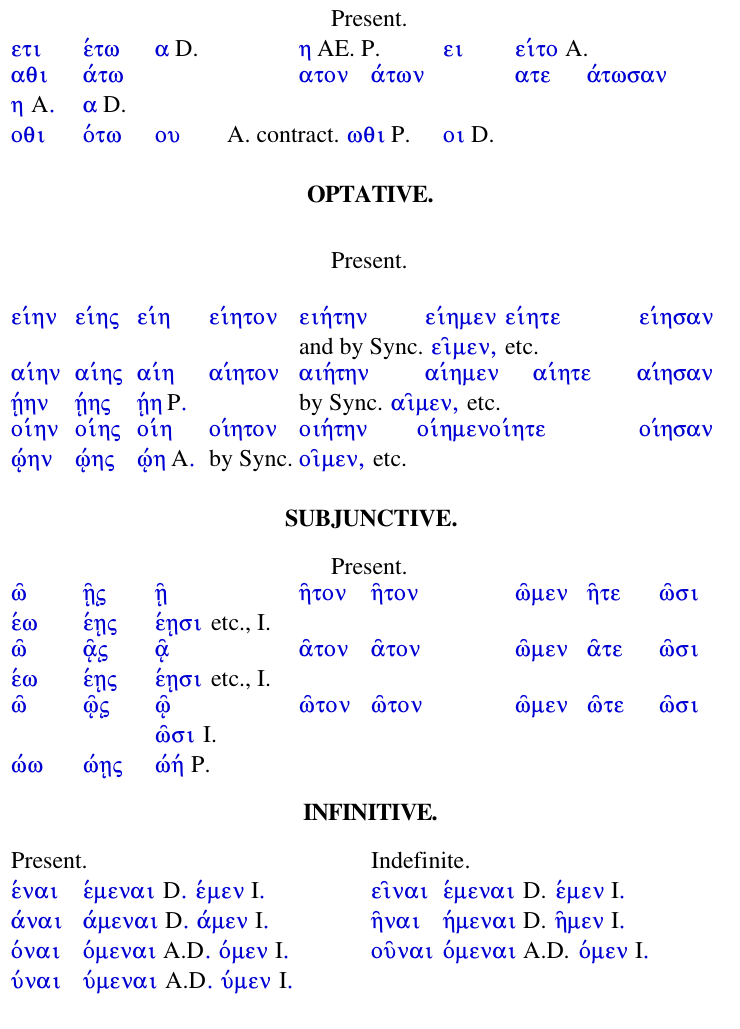
ετι έτω α D. η AE. P. ει είτο A.
αθι άτω ατον άτων ατε άτωσαν
η A. α D.
οθι ότω ου A. contract. ωθι P. οι D.
OPTATIVE.
Present.
είην είης είη είητον ειήτην είημεν είητε είησαν and by Sync. εῖμεν, etc.
αίην αίης αίη αίητον αιήτην αίημεν αίητε αίησαν ῄην ῄης ῄη P. by Sync. αῖμεν, etc.
οίην οίης οίη οίητον οιήτην οίημενοίητε οίησαν ῴην ῴης ῴη A. by Sync. οῖμεν, etc.
SUBJUNCTIVE.
Present.
ῶ h~|v| ῇ ῆτον ῆτον ῶμεν ῆτε ῶσι
έω έῃς έῃσι etc., I.
ῶ a~|v| ᾷ ᾶτον ᾶτον ῶμεν ᾶτε ῶσι
έω έῃς έῃσι etc., I.
ῶ w~|v| ῷ ῶτον ῶτον ῶμεν ῶτε ῶσι
ῶσι I.
ώω ώῃς ώή P.
INFINITIVE.
Present. Indefinite.
έναι έμεναι D. έμεν I. εῖναι έμεναι D. έμεν I. άναι άμεναι D. άμεν I. ῆναι ήμεναι D. ῆμεν I. όναι όμεναι A.D. όμεν I. οῦναι όμεναι A.D. όμεν I. ύναι ύμεναι A.D. ύμεν I.
The Dialects of the Passive Voice of Verbs in μι. Present.
Singular. Dual. Plural.
εμαι εσαι εται
ῃ A. εαι Ι.
αμαι ασαι αται άμεθον ασθον ασθον άμεθα ασθε ανται ῃ Α. εαι Ι. έαται Ι.
Imperfect.
έμην εσο ετο
ήμην etc., AE. εο I. ευ D. ου A.
άμην ασο ατο ἱσέατο Ι.
αο I. ω A.
όμην οσο ου A. οτο
IMPERATIVE.
Present.
εσο έσθω I. ασο άσθω οσο or ου A. όσθω
εο Ι. ω A. οι D.
ου A. ευ D. αο I.
The Dialects of the Middle Voice of Verbs in μι. Indefinite 2.
έμην εσο ετο όμην οσο οτο
εο I. ου A. ευ D. ου A.
IMPERATIVE.
Indefinite 2.
έσο έσθω όσο όσθω
εο Ι. ου A. εῦ D. ου A.
In Adverbs are found ανε, σθεν, and σθε, for θεν and θε and on the other hand, in local Adverbs, ὀπιθεν, for ὀπισθεν βαβαιὰξ, for βαβαὶ μόγις, for μόλις, scarcely; δὴ, for δέ ἐνθαῦτα, for ἐνταῦθα ἀληθέως, truly for ἀληθῶς πόκα, for πότε, when; ὁκα and ὁκκα, for ὁτε, when; μὲς, for μὲν, truly; αἰὲς, for αἰεὶ, always; ἐνδε, for ἐνδον, within; εἰκα, for εἰκεν, if; ἀλλοτα, for ἀλλοτε, otherwise. In Prepositions are found ειν, for εν ἀπαὶ, for ἀπό παραὶ, for παρά καταὶ, for κατά ὑπαὶ, for ὑπό πὰρ, for παρά ἀμπὶ, for ἀμφί and ζὰ, in composition, for διά.